Cartodb: Implement high resolution basemaps in Builder
Hello!
I am wondering if there are any plans to support, in Builder, detecting viewer resolution to serve retina basemap tiles?
There is a big difference in the quality of the map...and with vector rendering, having a crisp looking overlay and a fuzzy basemap, the difference between the two is even more apparent and in some cases the maps look like they don't belong together -- see this example.
Even without overlay, the differences are pretty big:
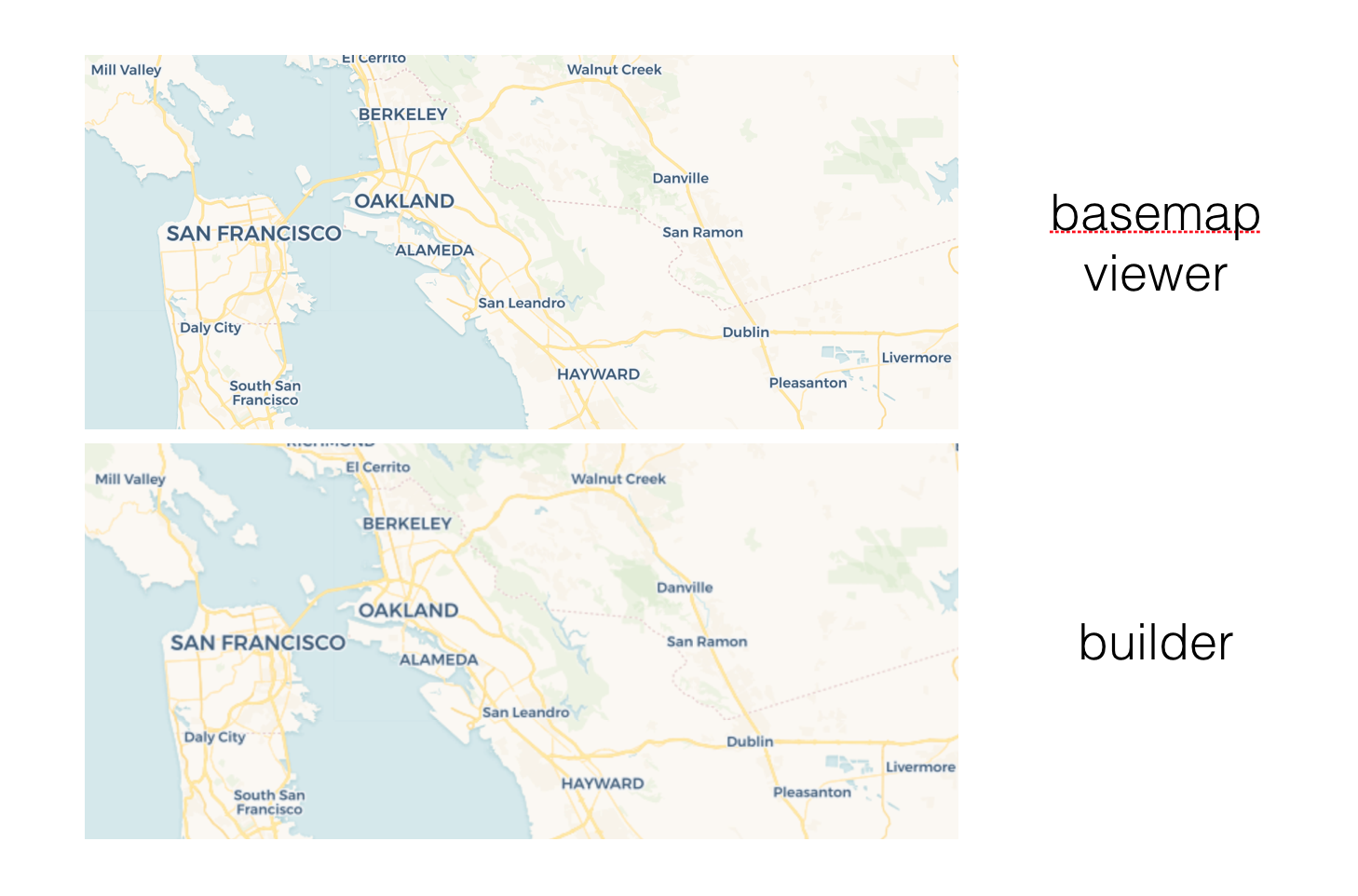
cc @jaakla @noguerol
 makella
All 33 comments
Some tech details:
- all basemap styles support "@2x.png" for retina
- in the preview page it is set with minimal code as following:
      layer = L.tileLayer('/'+style+'/{z}/{x}/{y}' + (L.Browser.retina ? '@2x.png' : '.png'), {
     ...
 jaakla
on 21 Sep 2017
jaakla
on 21 Sep 2017
Prioritizing it.
 noguerol
on 22 Sep 2017
noguerol
on 22 Sep 2017
thank you!
makella
on 22 Sep 2017
Hi :) I opened a PR with a fix for this issue. However, @matallo and I have been talking about this solution and there are several things to take it into account:
Now, retina basemaps and labels are only active for retina viewports. It could be that a user wants to force retina to any viewport, so maybe we've to consider to add this option as a feature (i.e: activate retina checkbox) This is also discused here https://github.com/CartoDB/cartodb.js/pull/364
This fix only affects basemaps and labels, not the layers in between.
I've added the do_not_merge_yet_ label to the PR so we can discuss first if this is rather a good solution or not and think about the points above.
Thanks!! :)
cc @noguerol @makella
 elenatorro
on 18 Oct 2017
elenatorro
on 18 Oct 2017
I think that both proposed points are valid and should be done also, but I would not hold having quick win and big improvement of retina basemaps.
Looking to PR it is not clear to me how retina/noretina is selected, I do not know what is app_config.yml - is it in general config or set somehow in browser, in client side? I expect it to be set in browser, as in the Leaflet code I use as I gave above:
layer = L.tileLayer('//cartodb-basemaps-{s}.global.ssl.fastly.net/rastertiles/voyager_labels_under/{z}/{x}/{y}' + (L.Browser.retina ? '@2x.png' : '.png'), {
...
Here L.Browser.retina is dynamically set property in Leaflet.js. There other ways to do same, but in any case basically browser should know both retina and no-retina URLs and uses suitable based on browser window state.
For example I usually have normal, no-retina screen connected to my macbook retina screen. With the client-side approach I can open browser window in external screen, then it is detected as no-retina, and tiles will be without @2x, now when I move same window to internal retina screen, and do page reload, then it is reconfigured in client side to retina, and otherwise blurry basemap becomes sharp.
jaakla
on 18 Oct 2017
@elenatorro I'd agree with @jaakla that it would be a big win for us to have crisper basemaps on retina devices... especially with vector rendering. in the case where a user is able to have their data layer render vector (if it passes all the checks) it is looking really bad (on retina) with the vector layer and super rasterized basemap...
if the data layer renders vector and the basemap detects retina, at a minimum, we will provide good experiences for that combination of map.
i don't understand enough about why we can't have the data layer detect retina, but do you think graphically, it will look really bad for layers that aren't rendering vector?
makella
on 18 Oct 2017
there are several situations here:
- indeed there's a
L.Browser.retinamethod to append the retina suffix to the baselayer url template that in any case should have to be done atcartodb.jslevel, the thing is: at the moment of making that check cartodb.js knows nothing about the url template, in your example you know because you hardcoded it, but for any other map setup with cartodb.js the beasemap could or could NOT have the corresponding retina versions, thus returning a 404 image if the "@2x" doesn't exist - what we can do, however, is at builder time, setup that urlTemplate with the "@2x" suffix. The PRs is not ideal though, just to spark the discussion, as it would do so in the case the screen you are seeing that UI is retina, you wouldn't be able to do so with a normal screen
that regarding the basemaps (and labels layers) ^^^
- another story is the data layers, which have their own idiosyncrasy
this is an old friend (3 years old, actually), there has already been some attempt for this, but I don't see a straight forward way to do so but forcing the retina version with a setting at builder time
https://github.com/CartoDB/cartodb.js/pull/364 (closed PR)
https://github.com/CartoDB/Windshaft/issues/243 (open PR, not merged)
hope this helps clarify 🙏
 matallo
on 18 Oct 2017
matallo
on 18 Oct 2017
Yep, I imagine it is more complex than with simple manual JS. Still with the server-level configuration I cannot imagine case that there are some cartodb servers only with retina tiles, and others with normal ones. Also I don't see cases where end-user (if so, then which one - builder or consumer of map) wants to manually set it, it is even hard to know without knowing your device hardware specifics which map is good. I would put it completely automatic, at least for all the built-in basemaps. It should work in end-user browser window level, so it cannot be done in server side only.
What about this approach: basemap URLs have additional dynamic parameter, e.g. {r} (AFAIK there is no common standard here), which can get empty or "@2x" value in client side. Server configures it as normal value (if specific basemap supports it), and carto.js understands and replaces it based on L.Browser.retina. It probably does not require any server-side changes (unless there is some validation check), and it automatically also enables retina for customer-defined custom basemap URLs. So server config value would be //cartodb-basemaps-{s}.global.ssl.fastly.net/rastertiles/voyager_labels_under/{z}/{x}/{y}{r}.png' .
Limitation is that the @2x is not really official standard and some basemaps, e.g. HERE satellite has different value, they use /512/ as tile size URL parameter value for higher resolution tiles. For this case two URL config approach would be needed - client (JS side) will know both and dynamically choose suitable - would be more universal. But this requires server-side config changes and UI changes for custom basemaps (if we want to support it there too) - 2 URL fields instead of one. But if we ignore HERE map specifics now, then {r} looks optimal solution for me
jaakla
on 19 Oct 2017
I cannot imagine case that there are some cartodb servers only with retina tiles, and others with normal ones.
I must have explained myself wrong, it is at cartodb.js point where L.Browser.retina is used and retina suffix appended (or not). The thing is cartodb.js knows nothing about the origin of the url template, and this will work for our basemaps, and for the basemaps with the @2x version, but not for other basemap
take this as an example: you set https://stamen-tiles-{S}.a.ssl.fastly.net/watercolor/{z}/{x}/{y}.jpg urltemplate in the example html (or via custom basemap in Builder!) and cartodb.js will try L.Browser.retina and append the @2x suffix if there is a retina screen, but as the retina version of the tile won't exist no tile will load then
I like the approach you describe next, and we already foresaw the issue with HERE basemaps, thus the retina url in the config. I think this is the way to go. Moving towards this direction besides adding the new retina urltemplate to the params passed to cartodb.js we need to support detection of this new param at cartodb.js so when it exists (and the viewport is retina) it makes the replacement.
@elenatorro create (or reopen) the corresponding CartoDB/cartodb.js issue, and leave this for Builder tracking.
ps: this regarding the basemaps and labels layers, data layers are another story that should be discussed separately (probably the former linked issue is a better place)
matallo
on 19 Oct 2017
Yep, we cannot just add automatically @2x everywhere, this has to be defined explicitly, via URL pattern (which would cool as it enables custom urls and even data overlays quite easily, but has also limits) or double URL definition (which has own limits).
jaakla
on 19 Oct 2017
In order to explain a little bit better what the PRs is doing and how we detect if the device supports retina or not:
app_config.yml
| basemap_example |
| - url           | => we have this info
| - retina_url    |    in the client side
+-----------------+
- If the basemap supports retina, then it has a retina_url, that can follow any format:
http://basemap_example/{z}/{x}/{y}@2x.png
or
http://basemap_example/{z}/{x}/{y}/512/png8...
As @jaakla mentioned, @2x is not a standard, and by doing this we are able to set the retina url for every basemap, depending on its configuration.
Our current solution works as follows:
- We have the information of the basemap.
- We detect the device supports retina.
- If it does, then we check if the basemap has a retina url.
- If the basemap has a
retina_url, then we use this url to paint it. Otherwise, it makes use ofurl.
In this solution, we cover the case when you load the map in a retina screen. However, as @jaakla mentioned above, when a user is using two screens, one of them no-retina, if the user moves from the no-retina screen to the retina screen, we should detect that the viewport resolution has changed and then reload the map. Am I right?
I've been talking with cartodb.js team, and they told me that we support high resolution using the @2x notation. It means that we've to tell cartodb.js that the client supports retina, so they can add @2x to the tiles url. Just opened an issue about this https://github.com/CartoDB/cartodb.js/issues/1831
The next steps will be able to paint the tiles between the basemap and the labels also in high resolution if the viewport supports it.
elenatorro
on 19 Oct 2017
when a user is using two screens, one of them no-retina, if the user moves from the no-retina screen to the retina screen, we should detect that the viewport resolution has changed and then reload the map. Am I right?
This would be nice, but probably it is quite marginal case, only happens if user moves window from one screen to another; so I would not spend time for this detection; unless there is already some readymade mechanism for this, which does this already.
jaakla
on 19 Oct 2017
Hey mates, let's move this on :)
Going back to the original issue, the point was having our basemaps looking nice on retina screens.
So let's tackle this with the PR sent by @elenatorro, worse than having a perfect solution for retina screens, but much better than have nothing.
 alrocar
on 30 Jan 2018
alrocar
on 30 Jan 2018
agree! who is the owner of this (which team will it be assigned)?
matallo
on 31 Jan 2018
It's on Charlie's kanban.
@elenatorro are you available for taking a look? otherwise I can take it this week
Thanks! :)
alrocar
on 31 Jan 2018
I can take a look to this again this afternoon, but I would like to discuss it first with someone to see if there is something else we can change / add to the current PR.
elenatorro
on 31 Jan 2018
Some question/comments I would like to see answered before going forward with this:
- Are we also considering changing the tiler to support retina tiles in static images? Or are we doing only the cartodb.js part?
- Regarding backend: we have to do a rake to update all existing layers (and mapcaps). Something similar to
update_nokia_layersinlayers.rake. It will take a long while to run. - We should review the way we write the config in order to be extensible (and avoid trademarked words as "retina")
 javitonino
on 31 Jan 2018
javitonino
on 31 Jan 2018
Are we also considering changing the tiler to support retina tiles in static images? Or are we doing only the cartodb.js part?
Where are static images used by us? In maps listing in Builder? Or you mean static maps API? In any case I would keep this out of scope from here, it would be nice but it looks small win and a lot of extra effort. ps. it reminds me another feature idea #11943.
Regarding backend: we have to do a rake to update all existing layers (and mapcaps). Something similar to update_nokia_layers in layers.rake. It will take a long while to run.
You can update URLs of existing maps? I would see it to be very useful for the url base fix, even more than for retina. There is enough time for that, not that many users would see the difference really.
We should review the way we write the config in order to be extensible (and avoid trademarked words as "retina")
Right, I think "dpi" or "resolution multiplier" could be correct generic tech terms for this. There are screens where @3x and @4x also make sense nowadays, but lets not go into that.
jaakla
on 31 Jan 2018
You can update URLs of existing maps?
Yes, somewhat painful but we have done it before (HERE changed their URL format).
javitonino
on 31 Jan 2018
Are we also considering changing the tiler to support retina tiles in static images? Or are we doing only the cartodb.js part?
Just re-read the whole thread, the quick win is only support retina basemaps. Retina data layers is another big issue (that probably would better be addressed via vector maps)
Regarding backend: we have to do a rake to update all existing layers (and mapcaps). Something similar to update_nokia_layers in layers.rake. It will take a long while to run.
As I envision it, this would need to be done in three different phases:
- support for retina basemaps in cartodb.js which when not existing, i.e. current and new maps case, it just defaults to the current situation
- add config to Builder with new retina basemaps taking into account your point "We should review the way we write the config in order to be extensible"
- run rake to existing maps when there is a basemap with the corresponding retina version just add the new field that will be supported by cartodb.js
about the "retina" nomenclature, I'm afraid it is quite an standard, I wouldn't focus much on this topic http://leafletjs.com/reference-1.3.0.html#tilelayer-detectretina
how does that sound? we can tackle the cartodb.js part at frontend level, and have at least a POC
matallo
on 31 Jan 2018
Sounds like a plan. We can take the opportunity with 2 and 3 to solve #13458 as well, to avoid having to do multiple passes updating all layers.
javitonino
on 31 Jan 2018
How it would work in Builder UI level? For built-in basemaps there is no UI - just internally instead of 1 URL there is definition of 2 patterns. But for custom basemaps I see 3 options:
a) ignore it, just do not support automatic DPI. User can hardcode @2x to the URL if needed, then the map is "always retina"
b) Support additional placeholder, e.g. {r} which will be replaced by '' or '@2x' depending on DPI in browser JS level (carto.js?). Works for 90% of cases (e.g. our and mapbox maps). In fact Leaflet 1.0 already supports this placeholder: https://github.com/Leaflet/Leaflet/issues/4103 , maybe just Builder UI blocks this?
c) Allow to define two separate URLs. This gives more flexibility, can support both size parameter (some URLs have 256 and 512) and apple-style retina code '@2x' etc. But from UI there should be 2 custom URL fields then, even if second one is hidden under 'advanced' button) then it is significant change there.
jaakla
on 1 Feb 2018
Yesterday, @matallo and I worked on the solution you describe in option c).
Allow to define two separate URLs.
We did a PoC to test how it would work with custom basemaps and it works great. We will open a PR so we can discuss the soltuion, but this is basically what we've added:
cartodb backend
- add retina url and retina label url to
app_config.yml(this was already changed )
labels:
  url: 'http://{s}.basemaps.cartocdn.com/dark_only_labels/{z}/{x}/{y}.png'
retina:
  url: 'http://{s}.basemaps.cartocdn.com/dark_nolabels/{z}/{x}/{y}@2x.png'
retina_labels:
  url: 'http://{s}.basemaps.cartocdn.com/dark_only_labels/{z}/{x}/{y}@2x.png'
- add retina url and retina label url in LayerFactory classes (
app/model_factories/carto/layer_factory.rbandapp/model_factories/layer_factory.rb) in order to return aurlTemplateRetinafield along withurlTemplate.
cartodb.js
- check the screen resolution with
window.devicePixelRatioand useurlTemplateRetinainstead ofurlTemplateif the resolution is > 1. (src/vis/layers-factory.js)
elenatorro
on 1 Feb 2018
support for retina basemaps in cartodb.js
NEXT!
matallo
on 1 Feb 2018
I've been working on this and https://github.com/CartoDB/cartodb/issues/13458 as a unit.
Overview
- cartodb.js like in the PoC. I just renamed the attributes.
- I changed the config structure. See it https://github.com/CartoDB/cartodb/blob/e6103578f355fd29d78d9890bda930039a8a07a5/config/app_config.yml.sample#L390-L402. The idea is that the keys under
labelsare merged to the main hash on labels layers, so you can overwrite what is needed (usually just the urls, but maybe some day the min/max zoom for example) - I deprecated
urlin basemap config.urlTemplateis used almost everywhere, and I changed the old code that usedurl(very few instances)
Acceptance note
Test editor and builder, with maps created before and after this patch.
Deployment plan
- Merge https://github.com/CartoDB/cartodb.js/pull/2065 (this renames retina to 2x)
- Merge https://github.com/CartoDB/cartodb-platform/pull/4094 (configuration changes)
- Merge https://github.com/CartoDB/cartodb/pull/13644 (builder changes to use the new configuration)
- Change the configuration again to remove deprecated
urlparameter - Write and run rake to fix existing layers
Please, @elenatorro can you review the general idea as well as the JS bits (PRs 1 and 3)?
javitonino
on 2 Mar 2018
I have seen several issues that we need to solve:
- When you create a new map, it shows voyager with retina but without labels.
- When you go to basemap options and change to a different basemap and then select voyager again, labels appear but neither basemap label nor labels layer have retina enabled.
- Then, if you refresh the page, voyager basemap layer has retina enabled, but labels do not. (I think this is the expected behaviour since there is no "label" field for voyager basemap in
app_config.yml, but I do not really know if there should be). - Then, if you select voyager labels-below basemap, again, it seems retina is not applied.
- However, if you refresh the page, then both basemap and labels layers have retina enabled.
In conclusion, I have some doubts:
- We are not applying retina when selecting a different basemap, and I guess this is something we have to check in Builder.
- Do we need to add
labelsinapp_configfor voyager basemap?
I have to go deeper to understand why this could be happening, but I wanted to discuss it here because maybe I missed something or someone has a better idea about these issues :)
And also, just to remember point 3 from this comment: we will have to enable retina in existing maps.
elenatorro
on 5 Mar 2018
- Did you use the correct cartodb.js branch? I did not bother changing it in package.json (lazy, I know)
- Did you copy
app_config.yml.samplebasemap section into yourapp_config.yml? - From what you describe, it's likely that we are missing something in frontend side (backend only controls the initial map creation, the rest is all frontend). I tested and it worked (at least, the saved model had the required attributes), but I have not done complete acceptance (no retina screen here :P, I'd have to trick cartodb.js).
- Yes, for existing basemaps we need to run a rake task (step 5).
javitonino
on 6 Mar 2018
Yes, I did 1 & 2 :) About 3, yes, we are missing something but as I said, I am almost sure it is related with Builder (frontend), cartodb.js is working as expected.
elenatorro
on 6 Mar 2018
My fault, I forgot to test some commits. We tested it after that and it works fine, except for one little issue. When changing the basemap, builder shows the low-res map until you F5. It seems like we only have the hdpi code for the layers factory in cartodb.js, so it only applies to newly created layers, but not to updated layers.
javitonino
on 6 Mar 2018
This is done for new maps. I've created https://github.com/CartoDB/cartodb-management/issues/5144 for existing maps.
javitonino
on 22 Mar 2018
Awesome team work!! 🎉 ❤️
alrocar
on 22 Mar 2018
🚀 VAMOS 🚀
elenatorro
on 22 Mar 2018
amazing!!
makella
on 22 Mar 2018
Related issues
 ramiroaznar
·
5Comments
javitonino
·
5Comments
ramiroaznar
·
5Comments
javitonino
·
5Comments
 santisaez
·
5Comments
santisaez
·
5Comments
 ivanmalagon
·
3Comments
ivanmalagon
·
3Comments
 xavijam
·
5Comments
xavijam
·
5Comments
Most helpful comment
Sounds like a plan. We can take the opportunity with 2 and 3 to solve #13458 as well, to avoid having to do multiple passes updating all layers.