Brigade: Brigade Build does not fail for sequential Jobs (unless it's the first Job)
Actual Behavior: Brigade Build always succeeds if first Job succeeds. Tested with both promise chains and groups.
Expected Behavior: Brigade Build should fail if any Job fails
    var group = new Group();

    var job1 = create_job(...);

    group.add(job1);
    var job2 = create_job(...);
    group.add(job2);

    group.runEach().then((res) => {
        console.log('RES: ', res);
    }).catch((err) => {
        console.log('ERR: ', err);
    });
Kashti Dashboard:

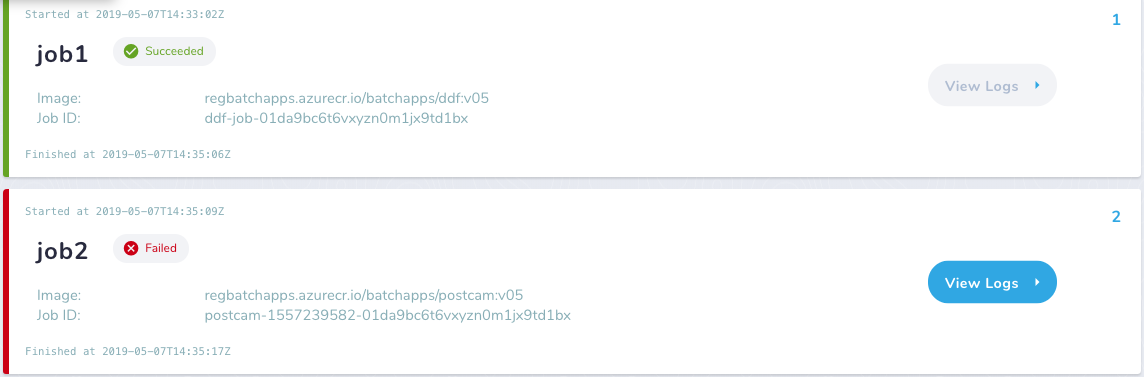
kubectl get pod ...:

Output of brig version:
v1.0.0-23-g1b849be
Output of kubectl version:
Client Version: version.Info{Major:"1", Minor:"14", GitVersion:"v1.14.0", GitCommit:"641856db18352033a0d96dbc99153fa3b27298e5", GitTreeState:"clean", BuildDate:"2019-03-25T15:53:57Z", GoVersion:"go1.12.1", Compiler:"gc", Platform:"darwin/amd64"}
Server Version: version.Info{Major:"1", Minor:"13", GitVersion:"v1.13.5", GitCommit:"2166946f41b36dea2c4626f90a77706f426cdea2", GitTreeState:"clean", BuildDate:"2019-03-25T15:19:22Z", GoVersion:"go1.11.5", Compiler:"gc", Platform:"linux/amd64"}
Cloud Provider/Platform (AKS, GKE, Minikube etc.):
AKS
 gfrankel1997
All 3 comments
@gfrankel1997 This may be a case of inadequate documentation.
In the example provided above, since errors are caught via the catch statement, the pipeline won't fail unless we explicitly tell it to (say, via a throw). This design enables finer control over when and how a pipeline might fail. For instance, we might add retry or other logic in the aforementioned catch section to handle acceptable/expected job errors instead of failing the entire pipeline.
In this case, if we want the pipeline to fail, we can either throw the error we catch or remove the catch stanza entirely, thus enabling it to bubble up all the way to the worker to log and fail the build appropriately.
 vdice
on 8 May 2019
vdice
on 8 May 2019
That being said, this might also open up the discussion for adding a custom field to the Build object passed between the API and various front-ends (brig, brigadeterm, Kashti) that users might be able to set from brigade.js.
 radu-matei
on 9 May 2019
radu-matei
on 9 May 2019
@vdice @radu-matei Imagine that.. catching the error actually catches it. That design is perfect, lets me catch the error, log it wherever, retry logic, etc. and then have it also bubble up to the Build level. Thanks for the clarification guys. Closing.
gfrankel1997
on 9 May 2019
Related issues
 danmx
·
7Comments
danmx
·
7Comments
 mattfarina
·
4Comments
radu-matei
·
6Comments
mattfarina
·
4Comments
radu-matei
·
6Comments
 LittleColin
·
7Comments
LittleColin
·
7Comments
 krancour
·
5Comments
krancour
·
5Comments
Most helpful comment
@gfrankel1997 This may be a case of inadequate documentation.
In the example provided above, since errors are caught via the
catchstatement, the pipeline won't fail unless we explicitly tell it to (say, via athrow). This design enables finer control over when and how a pipeline might fail. For instance, we might add retry or other logic in the aforementionedcatchsection to handle acceptable/expected job errors instead of failing the entire pipeline.In this case, if we want the pipeline to fail, we can either
throwthe error we catch or remove the catch stanza entirely, thus enabling it to bubble up all the way to the worker to log and fail the build appropriately.