Benchmarkdotnet: Synthesizing labels for jump targets
From private conversation with @JosephTremoulet
synthesizing labels for jump targets, emitting them in the instr stream and annotating which one each jump references; it makes the structure of the method apparent in a way that the flat list obscures, it’s always the first transform I do by hand when looking at disasm that hasn’t done it automatically
This should be easy ;)
 adamsitnik
All 6 comments
I implemented new exporter, which prints a pretty output.
Sample input:
public static bool LoopGoto_(String strA, String strB)
{
    int length = strA.Length;

    fixed (char* ap = strA) fixed (char* bp = strB)
    {
        char* a = ap;
        char* b = bp;

        while (length != 0)
        {
            int charA = *a;
            int charB = *b;

            if (charA != charB)
                goto ReturnFalse;

            a++;
            b++;
            length--;
        }

        return true;

        ReturnFalse:
        return false;
    }
}
Before (raw output exporter kept to show the source asm code in case my implementation breaks something):

After:
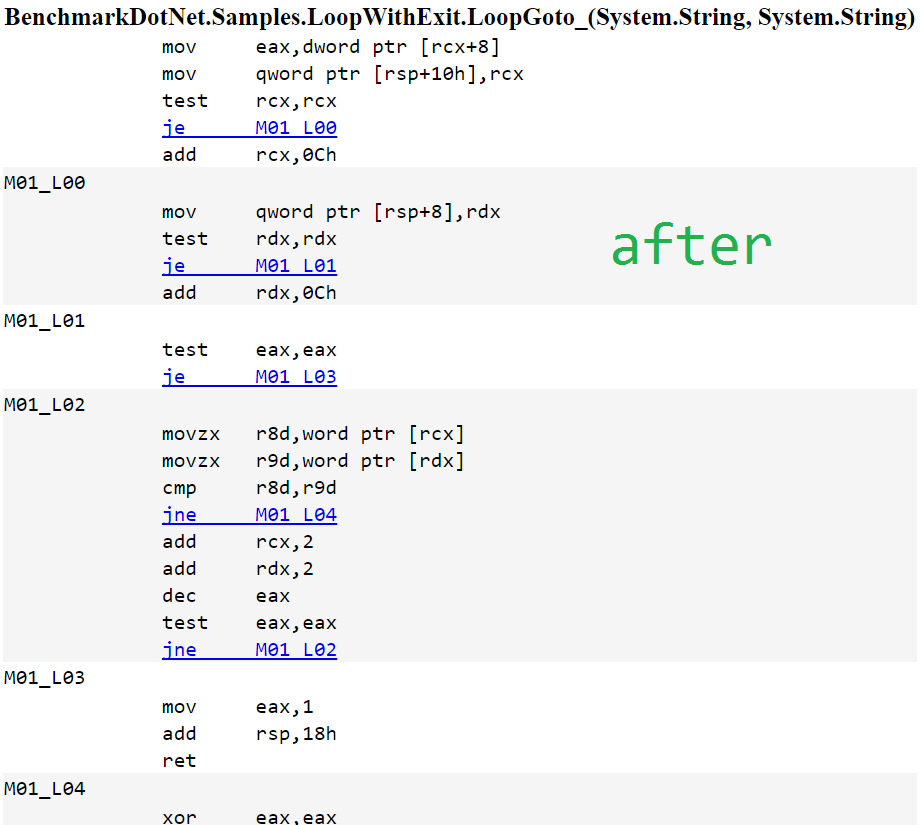
@JosephTremoulet would you like to give it a try and provide some feedback? The package should be available after 0.10.11.362 build finishes.
adamsitnik
on 7 Dec 2017
Big improvement, thanks!
A couple stray thoughts:
It would be cool if there were some easier way to find references to a given label other than scanning the listing for them visually. I don't really have ideas for how to do that, though. I've seen dumps that include reference counts next to labels, but not convinced that would be an improvement. An explicit predecessor list might be nice, but to make that clear you'd probably want the labels to identify basic blocks, which would mean inject labels after conditional branches so blocks are single-exit, which in turn would mean you'd have zero-ref labels that are confusing without the ref counts...
I guess you could do something like label the branches, e.g.jne M01_L04 ; jcc#3 ... M01_L04 ; refs: jcc#3, jcc#7(the idea being that the jcc#s would be sorted by where the branch is, making them easier to find)
but I'm probably over-thinking this...You've suppressed the encoded bytes as well as the addresses. That's probably for the best, though it's not uncommon to make changes whose primary benefit is to use shorter encodings for things. So it would maybe (?) be nice to bring back some indication of the size of each instruction, perhaps in a trailing comment, but I'd guess that would probably just clutter things more than would be worth it...
 JosephTremoulet
on 7 Dec 2017
JosephTremoulet
on 7 Dec 2017
Agree on 2. At least being able to turn them on somehow.
 redknightlois
on 7 Dec 2017
redknightlois
on 7 Dec 2017
@JosephTremoulet @redknightlois thanks for feedback!
speaking of 2. Would a tooltip with raw value would be enough? So anytime user mouse over the pretty text, the tool tip appears?

I have no good idea for the search, except of pressing Ctrl+F in browser and going with F3 to next occurence
adamsitnik
on 7 Dec 2017
I have no good idea for the search, except of pressing Ctrl+F in browser and going with F3 to next occurence
@adamsitnik You produce HTML, so what about including a small bit of JS into it which will handle mouse hovering the label and highlight all places where it is used?
I can offer some help if needed.
This will not solve the case when label is used outside of visible area, though. But we may think of handling clicks instead of hover. So that when you click on the label all usages are highlighted "permanently" until you click another label.
 ilabutin
on 7 Dec 2017
ilabutin
on 7 Dec 2017
@ilabutin thanks for a good hint!
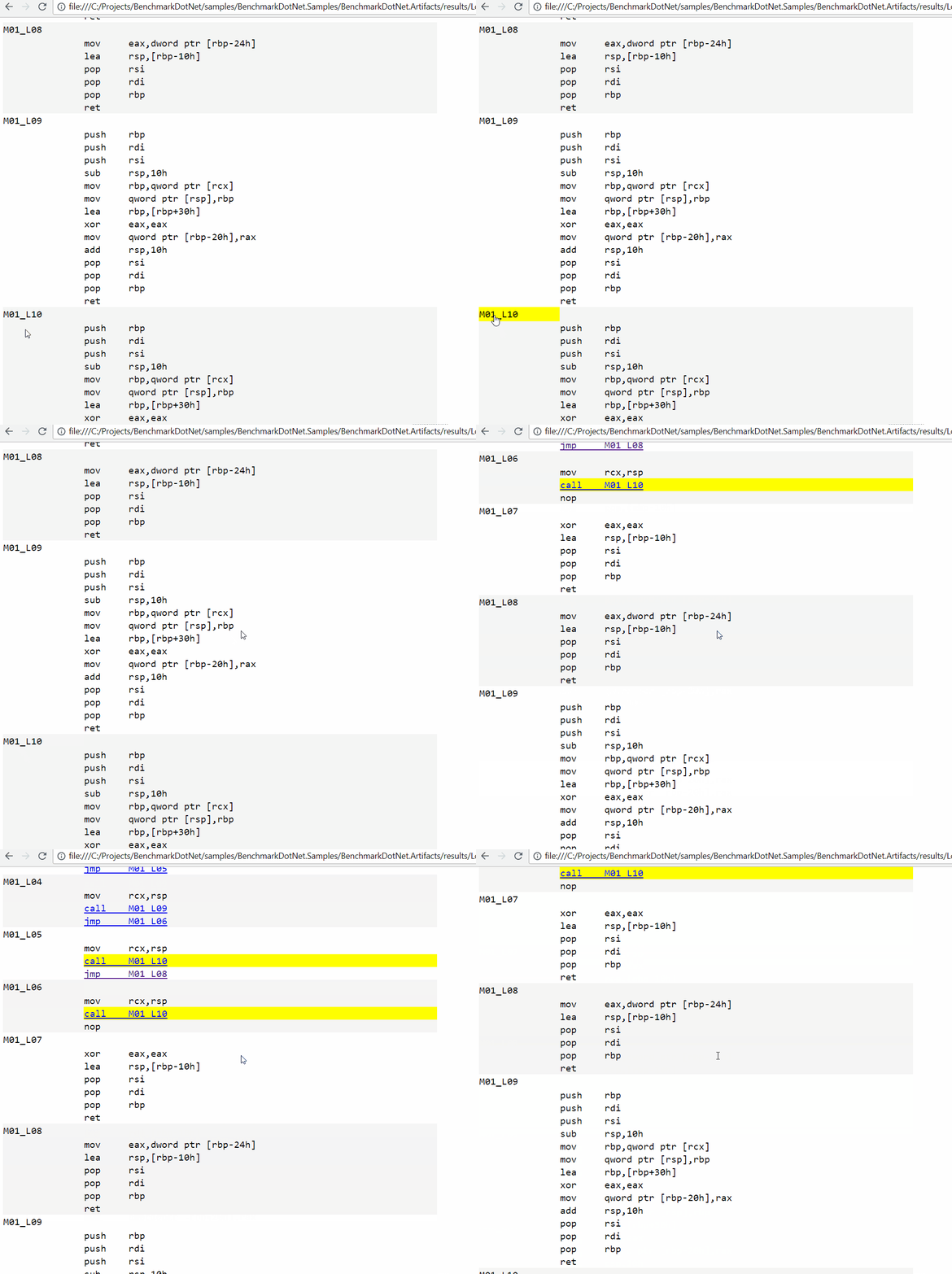
What I implemented:
- When user hovers over a label, the mouse cursor changes to pointer and label get's highlighted
- When user clicks a label, all usages gets highlighted
- When user presses F3, we jump to next usage of given label
Small demo:
adamsitnik
on 9 Dec 2017
Related issues
 kirsan31
·
4Comments
kirsan31
·
4Comments
 BlueRaja
·
4Comments
BlueRaja
·
4Comments
 OlegKarasik
·
3Comments
OlegKarasik
·
3Comments
 steveoh
·
4Comments
steveoh
·
4Comments
 dotMorten
·
3Comments
dotMorten
·
3Comments
Most helpful comment
@ilabutin thanks for a good hint!
What I implemented:
Small demo: