Bedrock: [Experiment] "How To Install" content on /thanks page
Mana Page
https://mana.mozilla.org/wiki/pages/viewpage.action?pageId=90734715
| Estimates | |
| ------------- | ------------- |
| TL | 3 days |
| PM | 1 hour |
| ENG | 5 days |
| SEO | |
| ANA | |
| DES | 1/2 day |
| COPY | 5 days |
We should add instructional content explaining to Chrome/Windows downloaders what to do next, in order to _install_ their new copy of Firefox.
We should measure whether the download:install ratio changes for people who see this messaging.
We should compare the install rate to two other segments: Chrome/Windows downloaders who get the current experience (a newsletter signup form) and Chrome/Windows downloaders who get a generic "thanks" message (which was the treatment prior to the newsletter signup form).
:yellow_heart: Success Criteria :yellow_heart:
- [ ] A percentage of Chrome/Windows downloaders see some clear instructions for how to install Firefox; a percentage of Chrome/Windows downloaders see the current newsletter signup form; a percentage of Chrome/Windows downloaders see a generic "thanks" message
- [ ] We can measure the install rate of these segments of downloaders and can see installs happening from each segment
:heavy_exclamation_mark: Risks :heavy_exclamation_mark:
- [ ] We may see that the FxA signup rate goes down
Tasks
- [ ]
 hoosteeno
All 34 comments
The copy deck can be found here: https://docs.google.com/document/d/1TYsgHFCMgj7xQiveNRAf-m73KH-c9DBYCt6jMPdC-aM/edit?usp=sharing
 claychaffin
on 18 Jan 2019
claychaffin
on 18 Jan 2019
From an experiment & copy perspective, this seems very nearly complete enough to start work on.
One remaining question: do we need any design input here on how the copy should be presented? Are we showing any images to accompany the information, or do we think copy alone is enough for this experiment?
 alexgibson
on 28 Jan 2019
alexgibson
on 28 Jan 2019
I'm going to make a start on this, whilst we iron out the last details.
alexgibson
on 28 Jan 2019
A WIP of this is now up on demo:
URL: https://bedrock-demo-agibson.oregon-b.moz.works/en-US/firefox/download/thanks/
The experiment targets en-US and Chrome only, with each variation set to 33% of traffic.
- https://bedrock-demo-agibson.oregon-b.moz.works/en-US/firefox/download/thanks/?v=a (control)
- https://bedrock-demo-agibson.oregon-b.moz.works/en-US/firefox/download/thanks/?v=b (install copy)
- https://bedrock-demo-agibson.oregon-b.moz.works/en-US/firefox/download/thanks/?v=c (app store buttons, aka no-newsletter)
Each variation fires a unique dataLayer.push() on page load:
    dataLayer.push({
        'data-ex-variant': 'control',
        'data-ex-name': 'new-fx-download-thanks-install'
    });
    dataLayer.push({
        'data-ex-variant': 'install',
        'data-ex-name': 'new-fx-download-thanks-install'
    });
    dataLayer.push({
        'data-ex-variant': 'app-store-buttons',
        'data-ex-name': 'new-fx-download-thanks-install'
    });
@sghoseWI @hoosteeno let me know if this looks ok, or if you would like any adjustments. Thanks
alexgibson
on 28 Jan 2019
@alexgibson this looks great to me! Just made some edits to the Mana page to reflect the changes that were made.
 sghoseWI
on 28 Jan 2019
sghoseWI
on 28 Jan 2019
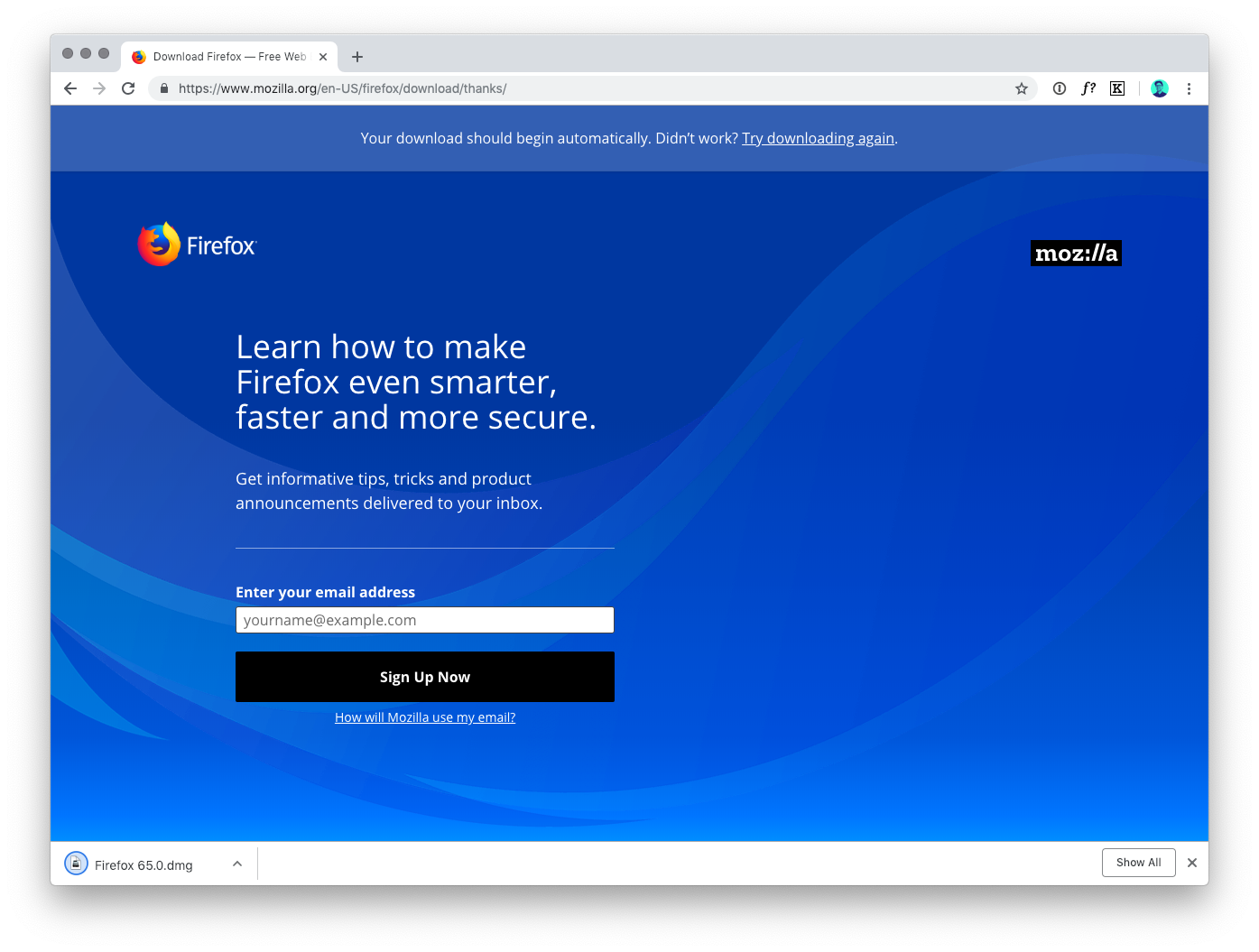
@claychaffin a note on the copy as it stands in the demo: The phrase "Firefox installer" doesn't actually in the Chrome download bar. In my version of Chrome it says "Firefox 65.0.dmg".
Possibly just removing the quotes would be a workable solution, where the final text could be: "Finish setting up Firefox by clicking the Firefox installer in Chrome’s download bar."
See the screenshot for reference.
 vincejoyiv
on 29 Jan 2019
vincejoyiv
on 29 Jan 2019
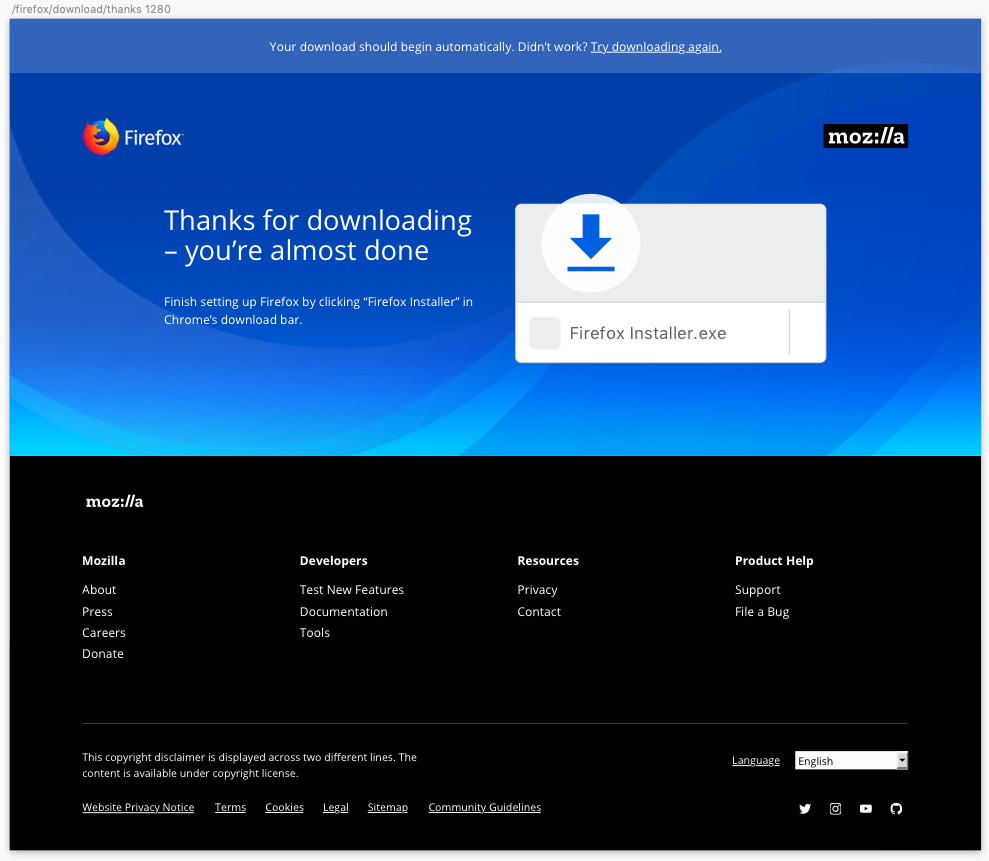
@alexgibson @claychaffin as far as a graphic treatment goes: the obvious thing to do is something like the screenshot below. However, I'd want us to be very careful, because including a screenshot of UI that is _not_ the actual UI can lead to some pretty bad results. If folks click the image expecting something to happen, it could be frustrating when nothing does.
I could spend more time on this, but I'm not sure if it's best to block the experiment to create a new image from scratch.
vincejoyiv
on 29 Jan 2019
@hoosteeno @vincejoyiv @alexgibson If possible, I'd like to do an A/B test on the supporting copy as part of this experiment-
Proposed copy test:
Copy A: Finish setting up Firefox by clicking the Firefox installer in Chrome’s download bar.
_vs_
Copy B: Click on the Firefox installer in Chrome’s download bar to finish setting up Firefox.
We use imperative sentences like these a lot; I'd love to know which imperative sentence structure performs better- - result>action vs action>result--- in hopes of improving results on the "Thanks" page, and to learn and ideally apply it to other pages.
claychaffin
on 30 Jan 2019
Ok, so:
- We have a proposed image (thanks @vincejoyiv! Can you please provide a link so i can download it?).
- We also have a new copy variation proposed by @claychaffin, which would bump this experiment up to a total of 4 variations (control, install-copy-a, install-copy-b, no-newsletter).
@hoosteeno thoughts on the above 2 items? Do you think the image is suitable enough for this experiment, and is the extra copy variation ok to add?
Edit: I do share some of @vincejoyiv's concern here in that people might try and click the image, as opposed to the actual download bar in Chrome. If we did include the image, perhaps our copy could be a little more descriptive e.g. "Finish setting up Firefox by clicking the Firefox installer in Chrome’s download bar at the bottom of the screen"?
alexgibson
on 30 Jan 2019
Re: the image, we agreed to modify to make it a simplified picture of a (Chrome/Windows) browser with an arrow pointing to the location the downloaded file will show up in the footer
Re: the copy, an additional variation seems good
@alexgibson we also talked about the need to implement stub attribution on this, since that's the only way we'll be able to measure install rates. Is it possible to trigger stub attribution without actually setting utm parameters in the URL?
hoosteeno
on 30 Jan 2019
Or perhaps if they click the image add a big down pointing arrow at the bottom left of the screen :)
 pmac
on 30 Jan 2019
pmac
on 30 Jan 2019
Is it possible to trigger stub attribution without actually setting utm parameters in the URL?
Yes. We'd have to decide whether a user would be selected for this experiment in the attribution collection code, and the add some attribution value indicating their involvement and get it signed and ready for inclusion on the bouncer link when/if they get there. But I believe that's quite doable, right @alexgibson ?
pmac
on 30 Jan 2019
The phrase "Firefox installer" doesn't actually in the Chrome download bar. In my version of Chrome it says "Firefox 65.0.dmg".
@vincejoyiv that's because you're on a Mac and the people in this experiment will all be on Windows and will therefore get the Stub Installer and not the full download on this page.
pmac
on 30 Jan 2019
Yes. We'd have to decide whether a user would be selected for this experiment in the attribution collection code, and the add some attribution value indicating their involvement and get it signed and ready for inclusion on the bouncer link when/if they get there. But I believe that's quite doable, right @alexgibson ?
I had not envisaged doing any custom stub attribution code for the basis of this experiment. That's decidedly more work than just letting the attribution code "do it's thing", but if we really wanted to avoid using UTM params on the URL, then anything is possible yeah.
alexgibson
on 30 Jan 2019
Ok, based on our team time discussion yesterday I've re-architected this experiment to the following:
Target audience: Chrome visitors on Windows only.
Target locale: en-US only.
Base URL: https://bedrock-demo-agibson.oregon-b.moz.works/en-US/firefox/new/
There are now a total of 4 variants, set to 25% of traffic each:
- https://bedrock-demo-agibson.oregon-b.moz.works/en-US/firefox/new/?v=a
- https://bedrock-demo-agibson.oregon-b.moz.works/en-US/firefox/new/?v=b
- https://bedrock-demo-agibson.oregon-b.moz.works/en-US/firefox/new/?v=c
- https://bedrock-demo-agibson.oregon-b.moz.works/en-US/firefox/new/?v=d
Landing on any of the variants above, I've routed around our usual stub attribution code to make a custom auth request with the following values (this avoids using same site UTM params):
{
    utm_source: 'www.mozilla.org',
    utm_medium: 'download_button',
    utm_campaign: 'download_thanks_page',
    utm_content: 'download_thanks_install_experiment-v-{a|b|c|d}',
    referrer: document.referrer
}
I guessed these values for now, but we can set them to anything we like.
Each of the above variant URLs will also link directly to our 4 /thanks/ page variations:
- https://bedrock-demo-agibson.oregon-b.moz.works/en-US/firefox/download/thanks/?v=a
- https://bedrock-demo-agibson.oregon-b.moz.works/en-US/firefox/download/thanks/?v=b
- https://bedrock-demo-agibson.oregon-b.moz.works/en-US/firefox/download/thanks/?v=c
- https://bedrock-demo-agibson.oregon-b.moz.works/en-US/firefox/download/thanks/?v=d
I still need to thoroughly test all this logic, but I'm floating it early here to get feedback on how this shapes up in order to meet our needs.
alexgibson
on 31 Jan 2019
@hoosteeno @sghoseWI ^
alexgibson
on 31 Jan 2019
Thanks @alexgibson, great work. So someone who lands in /new with en-US Windows Chrome gets split to one of 4 variants of the page, and their variant determines the message they'll see and the attribution parameters we'll set.
Do those variants also have different GA event instrumentation? I can imagine someone wanting to be sure that the variations each drove appx. the same number of clicks, since we'll be wanting to assert something about any difference in the number of installs.
I have a bit of additional logic to suggest:
if utm_content is missing or empty {
  add our experiment utm_content parameter // this is the only one we *really need* in order to identify these sessions, and it's often empty
  if any other utm parameters are missing or empty {
    add our other experiment parameters // all 4 have to be present to get into stub attribution
  }
}
else {
  don't clobber any utm parameters if we can't modify utm_content
}
Something like this would ensure that we can measure the maximum number of sessions, without clobbering any of them. Let me know if you want to talk it out.
@sghoseWI, Alex's work above is a good, expedient way to distribute this experiment, but it will reduce the overall experiment population slightly since some part of our target audience does not download on the /new page. You may wish to update the experiment plan to anticipate only that part of our target audience that downloads after landing on /new.
hoosteeno
on 31 Jan 2019
@hoosteeno make sense to me, I'll work on incorporating these changes 👍
alexgibson
on 1 Feb 2019
Ok, I've updated the logic based on @hoosteeno's suggestions above:
The experiment will only run if all of the following conditions are met:
- User is on Windows
- User is on Chrome
utm_contentparam is not already present when landing on the /new URL.
If the above three conditions are met OK, the user is redirected to one of the 4 variants. Each of those variants will:
- Make a stub attribution auth request, explicitly setting only the
utm_contentvalue required by our experiment. All other existingutm_*values will be honored, only falling back to our experiment parameters if not present in the URL. - Once that is done, a GA
dataLayer.push()event is then also made:
window.dataLayer.push({
    'data-ex-name': 'download_thanks_install_experiment',
    'data-ex-variant': 'v-' + variant
});
@hoosteeno does this match what you propose?
Note: re clobbering existing stub attribution data. This will only be avoided for people landing directly on /new with UTM params in the URL. If someone landed on a different page (e.g. the homepage) and then navigated to /new before downloading, they would have already made a stub attribution request, and we would still overwrite their data. In theory though this should be ok (i think), since the check for utm_content should filter those people out.
Perhaps this is acceptable, but another option could be to check for the existence of a stub attribution cookie, and only make a custom request if that cookie does not exist. Let me know what you think.
alexgibson
on 4 Feb 2019
Marking this is blocked until we have final imagery.
alexgibson
on 5 Feb 2019
Also noting, if we want to run this experiment on /new/ for en-US, this experiment is likely blocked by the Win10 taskbar funnelcake finishing (https://github.com/mozilla/bedrock/issues/6586)
alexgibson
on 5 Feb 2019
@alexgibson - according to Su Hong in the bug for the funnelcake, the experiment has more than enough (about 157,534) enrollees. It looks like the test was flipped OFF about 5 days ago. We can now remove that and TC).
 ejregithub
on 5 Feb 2019
ejregithub
on 5 Feb 2019
PR to remove the funnelcake test: https://github.com/mozilla/bedrock/pull/6796
alexgibson
on 6 Feb 2019
@alexgibson sketch file with new illustration
Firefox Hub (How-To-Install variation on -thanks @ a97ed0a).sketch.zip
 mrkwvr
on 6 Feb 2019
mrkwvr
on 6 Feb 2019
@hoosteeno Hey Justin, Vince and I refined and added "Need help... ?" copy to the copy doc, so please be sure to take a look. @mrkwvr @alexgibson @vincejoyiv
claychaffin
on 6 Feb 2019
We've had some new guidance about how experimentation relates to FxA signups, and I want to bring those into this experiment. I'm sorry for the late change -- things are moving fast.
Let's go with 3 variations: The control, the install copy (copy variation A only), and the app-store buttons aka no-newsletter.
control: 50%
install copy A: 25%
app-store: 25%
Why?
- @sghoseWI says a 25% split will give us enough data in appx. a week to be confident in the results, which is fast enough.
- Re-allocating copy variation B's traffic to the newsletter signup minimize the FxA impact of this experiment. We can test the hypothesis of copy variation B another time.
I've updated the experiment plan with these changes. Thanks.
hoosteeno
on 6 Feb 2019
Ok, I've reworked the experiment like so:
There are now three variants:
- https://bedrock-demo-agibson.oregon-b.moz.works/en-US/firefox/download/thanks/?v=a (control 50%)
- https://bedrock-demo-agibson.oregon-b.moz.works/en-US/firefox/download/thanks/?v=b (install copy 25%)
- https://bedrock-demo-agibson.oregon-b.moz.works/en-US/firefox/download/thanks/?v=c (app-store 25%)
For the install copy variant I have:
- [x] Updated to the latest copy.
- [x] Added the browser illustration that Mark provided
- [x] Added the help link as suggested by Clay and Vince.
With all of that, I think we're good to move forward here and get this into code review.
Does that sound good to you, @hoosteeno?
alexgibson
on 7 Feb 2019
Yes, this sounds great. :shipit:
hoosteeno
on 8 Feb 2019
Ok in testing on demo, I'm happy with the current code. Flagging this for code review.
alexgibson
on 11 Feb 2019
@amychurchwell - please pick up this review when ready.
ejregithub
on 11 Feb 2019
@stephaniehobson is reviewing this issue! (removing my assignment.) 👍
 amychurchwell
on 14 Feb 2019
amychurchwell
on 14 Feb 2019
Hi Team -- The screenshot below is from a report I made in GA. I think I may have found an instrumentation problem. The downloads #s for the v=c arm are way higher than either of the other two arms. Does anyone have thoughts on whether there might be an issue on the backend?
sghoseWI
on 20 Feb 2019
@sghoseWI I've taken a look at the experiment and as far as I can see everything seems to be functioning as expected. The sessions in your screenshot look correct too (variant a has roughly double the number of sessions compared to b and c).
I'm not sure what the "Firefox Download Counter" field is associated with here. When people land on /download/thanks/, the download is initiated automatically on page load. I suspect this some GA configuration issue. Perhaps @hoosteeno can help here?
alexgibson
on 20 Feb 2019
@alexgibson Thanks for checking - I did some more digging and after chatting with @hoosteeno, we agree with your assessment!
sghoseWI
on 21 Feb 2019
Related issues
hoosteeno
·
9Comments
 ValentinaPC
·
4Comments
ValentinaPC
·
4Comments
 dholbert
·
7Comments
hoosteeno
·
11Comments
hoosteeno
·
9Comments
dholbert
·
7Comments
hoosteeno
·
11Comments
hoosteeno
·
9Comments
Most helpful comment
We've had some new guidance about how experimentation relates to FxA signups, and I want to bring those into this experiment. I'm sorry for the late change -- things are moving fast.
Let's go with 3 variations: The control, the install copy (copy variation A only), and the app-store buttons aka no-newsletter.
control: 50%
install copy A: 25%
app-store: 25%
Why?
I've updated the experiment plan with these changes. Thanks.