Azure-webjobs-sdk: Complete Invocation Filters Feature
For WebJobs v2, bulk of the work for Invocation Filters was checked in via https://github.com/Azure/azure-webjobs-sdk/issues/980. However, there are some remaining work items we're tracking before the feature can be considered complete:
- [ ] Integrate Filters fully with DI
- [ ] Allow filters to provide a response (tracked by https://github.com/Azure/azure-webjobs-sdk/issues/1314)
- [ ] Make filter Timeout behavior consistent. Currently only invocation filters run under timeout, not exception filters
- [ ] Consider adding IBinder to the execution context to facilitate binding operations in filters
- [ ] Add Verbose trace statements when executing filters?
In v3 the Filters feature is currently marked Obsolete due to the above issues: https://github.com/Azure/azure-webjobs-sdk/pull/1912. The feature is not going away - we applied Obsolete because we had to GA v3 before the feature was complete, so we wanted to convey that there may be breaking changes in this area as we complete the work above.
 mathewc
All 35 comments
We should split "Finalize design for FunctionResultException" into a separate work item.
 MikeStall
on 14 Aug 2017
MikeStall
on 14 Aug 2017
@MikeStall - Moved the Result work out into its own issue here: https://github.com/Azure/azure-webjobs-sdk/issues/1314
mathewc
on 22 Aug 2017
Has there been any progress on this? I noticed FunctionInvocationFilterAttribute is still marked Obsolete ("..in preview..."). Any idea when it will be finished up?
 chris-rogala
on 5 Jun 2019
chris-rogala
on 5 Jun 2019
Yeah! Very strange that it is taking this long. Is it because of the latest changes on DI forAzure functions?
https://docs.microsoft.com/en-us/azure/azure-functions/functions-dotnet-dependency-injection
I just love the part that it says:
Microsoft.NET.Sdk.Functions package version 1.0.28 or later
And version 1.0.28 is the latest version and is only 25 days old :)
I hope it means that we get this feature soon as well
 ashkansirous
on 7 Jun 2019
ashkansirous
on 7 Jun 2019
Yes, we want to finish the feature up properly, integrating it with the new DI work naturally. The feature was marked Obsolete because we anticipated there might be some breaking changes as we finished it up. I'd like to complete this in the next major release. @fabiocav
mathewc
on 7 Jun 2019
Any update on this? When is the next Major release?
 kspoojary
on 25 Jul 2019
kspoojary
on 25 Jul 2019
Will it be implemented in 3.0 version?
 vitalybibikov
on 26 Oct 2019
vitalybibikov
on 26 Oct 2019
Any update on this feature? Will this be part of V3?
 AvinashRamalingam
on 4 Nov 2019
AvinashRamalingam
on 4 Nov 2019
Any updates on this feature?
 iamalexmang
on 27 Nov 2019
iamalexmang
on 27 Nov 2019
This feature has not been prioritized as part of the 3.0 work. This is not currently part of the immediate roadmap, so we don't have an ETA we can share.
/cc @mathewc @mattchenderson
 fabiocav
on 27 Nov 2019
fabiocav
on 27 Nov 2019
Thanks for the update @fabiocav.
Reason for why I'm looking for a filter right now is in fact to have a custom authorization done before the function code gets called. Specifically, I want to implement a role authorization provider and validate that an authenticated user is indeed allowed to call a particular function in a function app.
Since filters are, due to their lack of tread-safe nature, a no-go, is there another way in which this can be achieved?
iamalexmang
on 27 Nov 2019
That's too bad because this is something useful that I would like to see in the platform.
 KenBonny
on 13 Dec 2019
KenBonny
on 13 Dec 2019
any update on this?
 BKB503
on 14 May 2020
BKB503
on 14 May 2020
Seems like the lack of update indicates that this feature is dead.
 IanKemp
on 1 Jun 2020
IanKemp
on 1 Jun 2020
I'm eagerly excited for this feature to make it to the day-light and be thread-safe. :-)
Any update on the roadmap would be much appreciated, @anthonychu @fabiocav
iamalexmang
on 1 Jun 2020
Thanks for the update @fabiocav.
Reason for why I'm looking for a filter right now is in fact to have a custom authorization done before the function code gets called. Specifically, I want to implement a role authorization provider and validate that an authenticated user is indeed allowed to call a particular function in a function app.
Since filters are, due to their lack of tread-safe nature, a no-go, is there another way in which this can be achieved?
Since filters are not going to be available anytime soon and we are activiely looking for a way to authorize the Azure functions using JWT tokens, I propose that Microsoft issue sample code(C#) demonstrating how to validate and authorize HTTP functions using JWT tokens.
Thank you.
 sdg002
on 28 Jul 2020
sdg002
on 28 Jul 2020
This is a bit frustrating as now we have to write boilerplate and duplicated error handling/authorization logic. Come on Microsoft! You obviously know this is an important part of any web framework as it was created for MVC AND WebApi. Why is this suddenly not a priority? By the way, I love how the error handling section of Azure HTTP Trigger functions states
https://docs.microsoft.com/en-us/azure/azure-functions/functions-bindings-error-pages
"Use structured error handling
Capturing and publishing errors is critical to monitoring the health of your application. The top-most level of any function code should include a try/catch block. In the catch block, you can capture and publish error" ....no kidding Microsoft!
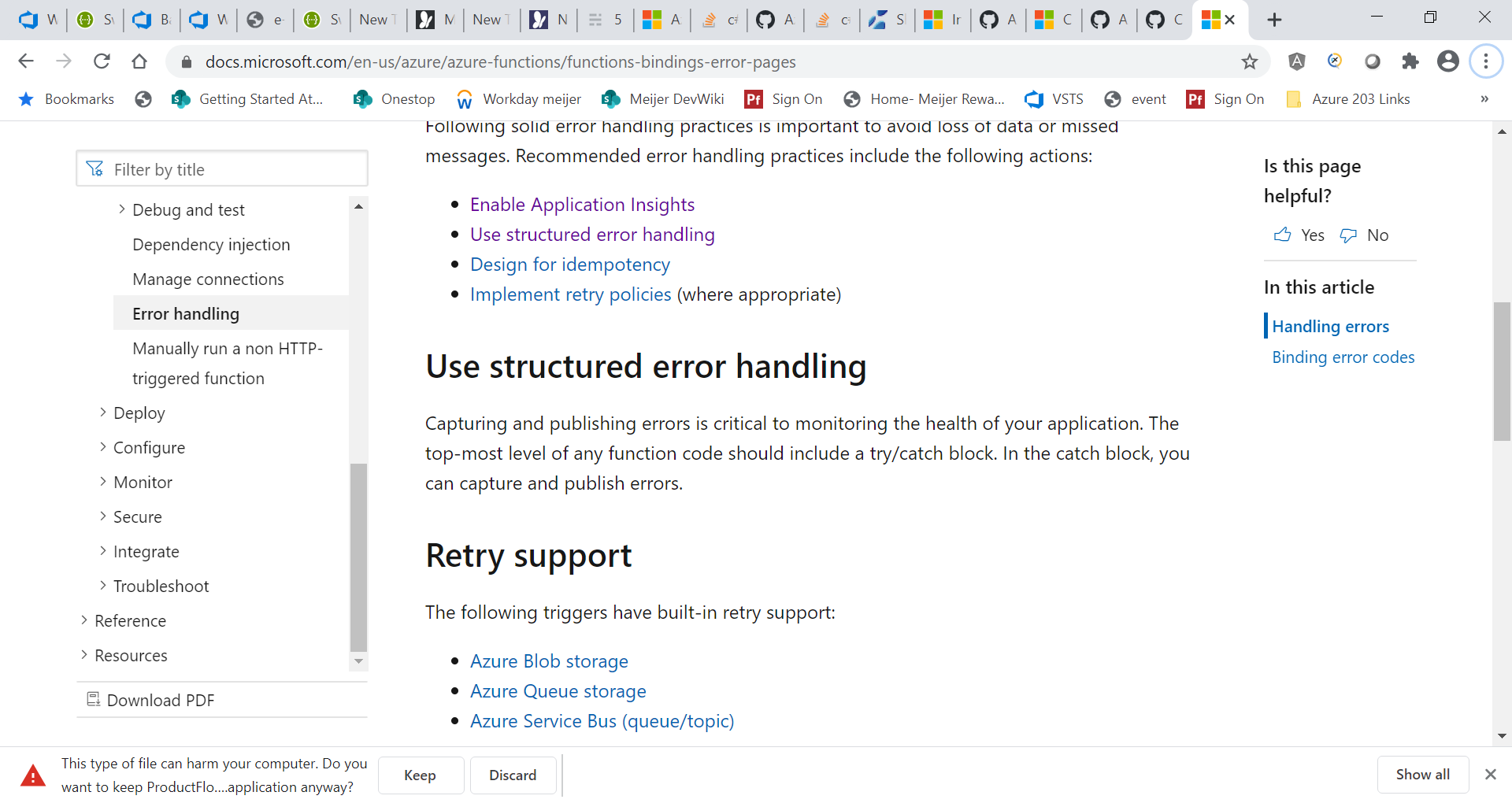
@fabiocav will this functionality get re-prioritized?
 moorechr4484
on 10 Aug 2020
moorechr4484
on 10 Aug 2020
Adding @jeffhollan for awareness/priority discussions, but this has not yet changed.
@moorechr4484 did you have specific feedback/something you'd like to see changed on the doc, or are you pointing out something that seems obvious to you?
fabiocav
on 11 Aug 2020
Can anyone elaborate on what "Integrate Filters fully with DI" means? What integration is missing? Thanks.
 NSouth
on 23 Aug 2020
NSouth
on 23 Aug 2020
Can anyone elaborate on what "Integrate Filters fully with DI" means? What integration is missing? Thanks.
Filters are not constructed using DI. I.e., you must use service location to "inject" dependencies into them.
 davidpeden3
on 23 Aug 2020
davidpeden3
on 23 Aug 2020
@davidpeden3 , thank you. I'll note here a few observations about _global_ filters for others who are interested.
- It seems
IFunctionFilter_must_ be registered as a Singleton. You get a runtime error otherwise. - Other _Singleton_ services can be injected.
- If you want access to non-Singleton services, you need to inject
IServiceScopeFactoryand create a scope to resolve such services.
Here is an example of what works from my testing:
InStartup:
services.AddSingleton<IFunctionFilter, MyFunctionFilter>();
services.AddSingleton<IOtherService, OtherService>();
services.AddTransient<ITransientHelper, TransientHelper>();
In MyFunctionFilter:
public class MyFunctionFilter : IFunctionInvocationFilter
{
    private readonly IServiceScopeFactory _serviceScopeFactory;
    private readonly IOtherService _otherService;

    public MyFunctionFilter(IServiceScopeFactory serviceScopeFactory, IOtherService otherService)
    {
        _serviceScopeFactory = serviceScopeFactory;
        _otherService = otherService
    }

    public async Task OnExecutingAsync(FunctionExecutingContext executingContext, CancellationToken cancellationToken)
    {
        await _otherService.DoSomething();
        using (var scope = _serviceScopeFactory.CreateScope())
        {
            var helper = scope.ServiceProvider.GetRequiredService<ITransientHelper>();
            // use helper
        }
    }

    public Task OnExecutedAsync(FunctionExecutedContext executedContext, CancellationToken cancellationToken)
    {
        throw new NotImplementedException();
    }
}
Following this.
After reading all of them. Even the Microsoft is made IFunctionInvocationFilter, IFunctionExceptionFilter obsoleted I feel, Its safe to use for the basic support of global exception handling and authorizing the requests for my HTTP trigger function.
@mathewc @paulbatum Any suggestions?
 vijaymarada
on 24 Aug 2020
vijaymarada
on 24 Aug 2020
Why this is not based on attribute?
 MrMaheshwari
on 26 Aug 2020
MrMaheshwari
on 26 Aug 2020
@MrMaheshwari, I haven't tried it myself, but I believe you can implement invocation filters as attributes. See the example here:
https://www.c-sharpcorner.com/article/do-you-know-azure-function-have-function-filters/
NSouth
on 26 Aug 2020
@MrMaheshwari, I haven't tried it myself, but I believe you can implement invocation filters as attributes. See the example here:
https://www.c-sharpcorner.com/article/do-you-know-azure-function-have-function-filters/
Thanks for sharing such a nice article
MrMaheshwari
on 26 Aug 2020
Any ETA to release this feature?
MrMaheshwari
on 27 Aug 2020
@MrMaheshwari, I haven't tried it myself, but I believe you can implement invocation filters as attributes. See the example here:
https://www.c-sharpcorner.com/article/do-you-know-azure-function-have-function-filters/
@NSouth Here is a limitation, we can not return back the HttpResponseMessage object
MrMaheshwari
on 27 Aug 2020
Microsoft Azure dev team: issues "preview" of highly-requested feature
Also Microsoft Azure dev team: doesn't bother finishing said feature more than 3 years later
Have you guys, you know, considered hiring more devs so work actually gets done in a reasonable timeframe? It's not as if you work for a small mom-and-pop shop...
IanKemp
on 31 Aug 2020
I can see some interest in this and so going to give the answer that may help folks plan the best, but things can always change. We don't have any plans to bring functions filters as currently implemented as this preview feature forward. That said, the scenario that many people are interested in using function filters for, namely to add some logic and middleware before an execution triggers, is something we do want to solve for. We have recently prototyped some features as part of the upcoming out of process .NET work that allows users to add some middleware to execute before a function triggers for something like token validation or whatnot. If you were to ask me today that's what I would say is the future of this scenario, and not function filters as implemented.
I'm happy to keep this issue open to continue discussion around it, but don't want folks to hold out thinking we are holding out and waiting to move this from preview to GA. There were always some tradeoffs with the approach we took with filters and we feel we may be able to provide the benefits in a more flexible way with something like middleware.
// @anthonychu as FYI who is helping PM these features.
 jeffhollan
on 10 Sep 2020
jeffhollan
on 10 Sep 2020
We have recently prototyped some features as part of the upcoming out of process .NET work that allows users to add some middleware to execute before a function triggers for something like token validation or whatnot. If you were to ask me today that's what I would say is the future of this scenario, and not function filters as implemented.
Honestly, that's exactly how I'd want it to work.
Not to be a downer or fail to give credit where it's due to you guys for your efforts, but for better or worse the ASP.NET Core "way" of doing dependency injection, middleware, etc. is effectively the standard in the .NET world, and Azure Functions' differences (seemingly at times just for the sake of being different) and limitations compared to ASP.NET Core have always frustrated me.
Converging Azure Functions towards the way that ASP.NET Core works is probably the best decision that could be made in terms of helping adoption and maintainability. In an ideal world, I'd love to be able to write an ASP.NET Core web API application - then simply add an Azure Functions NuGet package(s), annotate the endpoints with attributes from that package, and when I press F5 in Visual Studio, func.exe launches instead of Kestrel. If I remove the package and attributes, the app goes back to being a standard web API.
IanKemp
on 10 Sep 2020
Yes. Yes. A million times Yes. At its core, Azure Functions should just be an ASP.NET Core app with an extra service (plus configuration), i.e.:
services.AddAzureFunctions(options => { ... });
 MisinformedDNA
on 22 Sep 2020
MisinformedDNA
on 22 Sep 2020
@jeffhollan @anthonychu is there somewhere where work on middleware is being planned or tracked?
 lambdakris
on 21 Oct 2020
lambdakris
on 21 Oct 2020
@jeffhollan where is our middleware?
 niksanla2
on 3 Feb 2021
niksanla2
on 3 Feb 2021
It might be worth noticing that Azure Function in .NET 5 will have support for middleware directly. My guess would be that supporting both approaches might not be in the pipeline for the future, though I don't know of course
 MartinWickman
on 29 Mar 2021
MartinWickman
on 29 Mar 2021
@MartinWickman Middlewares definitely help out with cross-cutting concerns, although they currently lack any real substance right now to make them useful. E.g., no access to the request/response and no ability to terminate the pipeline.
Also, they don't really make sense as a replacement for filters that are intended to be applied to a specific function (e.g., an authorization-type filter).
 david-peden-q2
on 30 Apr 2021
david-peden-q2
on 30 Apr 2021
Related issues
 nibras85
·
3Comments
nibras85
·
3Comments
 drchilds
·
4Comments
drchilds
·
4Comments
 sergey-netdev
·
5Comments
sergey-netdev
·
5Comments
 fwd079
·
5Comments
fwd079
·
5Comments
 TheeJamesLee
·
3Comments
TheeJamesLee
·
3Comments
Most helpful comment
Thanks for the update @fabiocav.
Reason for why I'm looking for a filter right now is in fact to have a custom authorization done before the function code gets called. Specifically, I want to implement a role authorization provider and validate that an authenticated user is indeed allowed to call a particular function in a function app.
Since filters are, due to their lack of tread-safe nature, a no-go, is there another way in which this can be achieved?