Amphtml: Clarify processes or guidelines around introducing devDependencies
While we have a pretty thorough process around security and license vetting for shipped dependencies, we don't currently hold our dev dependencies to the same standards and also assign Renovate PRs to the build cop (who might not have a whole lot of context on our dependencies) to auto-upgrade all of our dev dependencies.
One idea is that given the history of security incidents related to npm dev dependencies (e.g. event-stream), we should introduce guidelines and processes to either limit dev dependencies where possible, version-lock vetted dev dependencies, or have a re-vetting process for upgrading Renovate PRs. Publishing a custom version of our dependencies under our own amphtml npm namespace is also an idea to guard against left-pad-like issues.
Context:
https://www.theregister.co.uk/2016/03/23/npm_left_pad_chaos/
https://blog.npmjs.org/post/180565383195/details-about-the-event-stream-incident
/cc @ampproject/wg-infra
 cathyxz
All 5 comments
We've been having a parallel discussion about dependency ownership in the context of owners. Notably, if a package version needs to change, who should be required to give approval? Some thoughts here revolved around looking at what files depend on the package and who owned those files. It mostly addresses the general ownership, not the need for a real security review, but linking here for relevance.
 rcebulko
on 17 Sep 2019
rcebulko
on 17 Sep 2019
Does @ampproject/wg-security-privacy have any opinions/thoughts on this? Renovate PRs frequently update our dev dependencies and are generally approved without intense scrutiny.
rcebulko
on 27 Jan 2020
Unfortunately we wouldn't have the capacity to security review each new version of all dependencies. Do we have examples of what other organizations do with this issue?
 molnarg
on 6 Mar 2020
molnarg
on 6 Mar 2020
What we have in place today is an alerting mechanism at the top of amphtml for any security vulnerabilities in one of our dependencies:
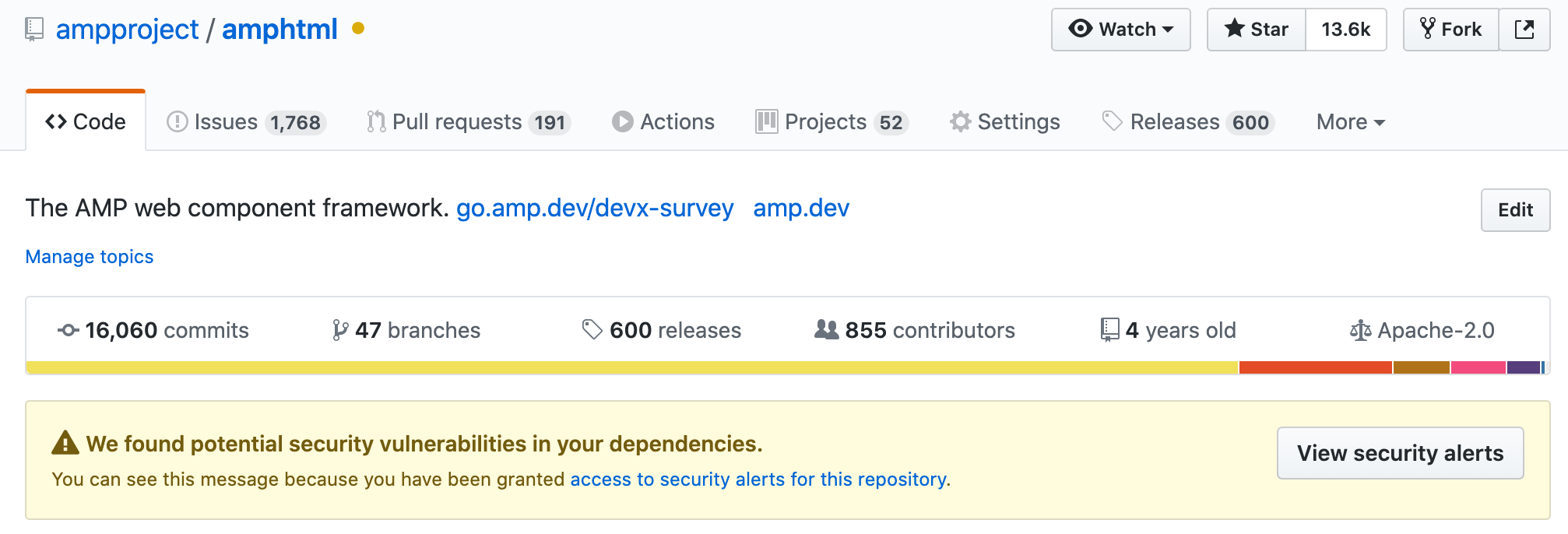
These alerts are typically dealt with via renovate upgrades, or via manual resolutions until an upgrade is available (#25445, #28121).
This isn't a perfect mechanism, but it's likely the best we can do right now. In the absence of any new ideas, I think we should close out this issue.
 rsimha
on 30 Apr 2020
rsimha
on 30 Apr 2020
Yeah, that's probably the best we can do for now. There are some initiatives that might improve OSS supply chains in the future, worth revisiting later.
molnarg
on 30 Apr 2020
Related issues
 radiovisual
·
3Comments
radiovisual
·
3Comments
 samanthamorco
·
3Comments
samanthamorco
·
3Comments
 choumx
·
3Comments
choumx
·
3Comments
 mkhatib
·
3Comments
choumx
·
3Comments
mkhatib
·
3Comments
choumx
·
3Comments