Adapt_framework: adapt-contrib-trickle: "_isAvailable": false on an article causes error
If an article is set to "_isAvailable": false, trickle breaks and you cannot trickle through a page.
Environment
Framework v4.3.0
Latest Chrome
Windows 10
Steps to reproduce
Set up a page with 3 articles, each with trickle configured on the article with "_scrollTo": "@article +1"
Set the second article to "_isAvailable": false
Run course and view the page.
Expected behaviour
Trickle should move through the 2 'available' articles.
Actual behaviour
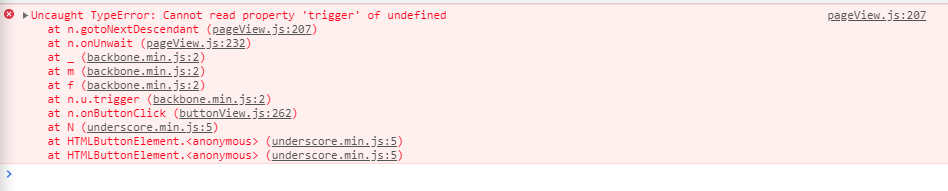
Clicking Trickle on the 1st article does nothing and the console error is shown
 RobertPeek
All 15 comments
The quick fix for this one is to make sure the child blocks are also set to _isAvailable: false.
Would it be worth having a feature that, upon finding an _isAvailable: false flag, automatically sets all applicable child elements as well? Is there a scenario where you would want an available block contained in an unavailable article?
 jamesrea83
on 13 Jan 2020
jamesrea83
on 13 Jan 2020
Is there a scenario where you would want an available block contained in an unavailable article?
@jamesrea83 we have found previously that cascading changes from parent to children can be problematic in unexpected ways. I think @oliverfoster has an alternative technique for addressing this particular issue from within trickle.
 moloko
on 20 Jan 2020
moloko
on 20 Jan 2020
Add something like this to adaptModel.js:
  /**
   * Derives isAvailable from parent stack
   */
  getIsAvailable: function() {
    var isAvailable = this.get('_isAvailable');
    if (!isAvailable) {
      return false;
    }
    var parent = this;
    while (parent = parent.getParent()) {
      isAvailable = parent.get('_isAvailable');
      if (!isAvailable) {
        return false;
      }
    }
    return true;
  }
Then use in trickle.
 oliverfoster
on 20 Jan 2020
oliverfoster
on 20 Jan 2020
Please ignore above comment and refer PR: #2665 for this issue
 akshay-bhavsar
on 28 Feb 2020
akshay-bhavsar
on 28 Feb 2020
this will need fixing in Adapt v5.x/Trickle v4.x as well I think?
moloko
on 18 May 2020
Add something like this to
adaptModel.js:/** * Derives isAvailable from parent stack */ getIsAvailable: function() { var isAvailable = this.get('_isAvailable'); if (!isAvailable) { return false; } var parent = this; while (parent = parent.getParent()) { isAvailable = parent.get('_isAvailable'); if (!isAvailable) { return false; } } return true; }Then use in trickle.
I think this can be done in one line (at least when using ES6):
this.getAncestorModels(true).every(model => model.get('_isAvailable'));
Which makes me wonder if it's worth adding to the core code?
moloko
on 2 Sep 2020
isAvailableInPage is already in isn't it?
You don't want it to descend beyond the first content object because a menu might be _isAvailable:false intentionally
oliverfoster
on 2 Sep 2020
isAvailableInPage is already in isn't it?
I think it's only here? https://github.com/adaptlearning/adapt_framework/tree/v4-patches
moloko
on 2 Sep 2020
I don't mind particularly, it just seemed to me that if it can be done with one line of code then there's no need to do two separate FW releases as well as two trickle releases
moloko
on 2 Sep 2020
this.getAncestorModels(true).every(model => !['page', 'menu'].includes(model.get('_type')) && model.get('_isAvailable'));
or in v5:
this.getAncestorModels(true).every(model => !model.isTypeGroup('contentobject') && model.get('_isAvailable'));
There's no point checking the availability beyond the contentObject as availability is a contentObject relative property.
oliverfoster
on 2 Sep 2020
this.getAncestorModels(true).every(model => !['page', 'menu'].includes(model.get('_type')) && model.get('_isAvailable'));or in v5:
this.getAncestorModels(true).every(model => !model.isTypeGroup('contentobject') && model.get('_isAvailable'));I think these will both return
falsefor anything that's a child of a content object?

There's no point checking the availability beyond the contentObject as availability is a contentObject relative property.
That's true - but it's generally only going to mean checking one more thing (the course) so doesn't seem like too much of an overhead
moloko
on 2 Sep 2020
That's true - but it's generally only going to mean checking one more thing (the course) so doesn't seem like too much of an overhead
It's not because it's expensive that you should not check them, it's because any of the ancestor contentObjects could be _isAvailable: false to hide them from a menu or for use only as a container of notify components or a multitude of other reasons.
I think these will both return false for anything that's a child of a content object?
That's true, they should be a filter / similar.
this.getAncestorModels(true).filter(model => !['page', 'menu'].includes(model.get('_type')).every(model => model.get('_isAvailable'));
or in v5:
this.getAncestorModels(true).filter(model => !model.isTypeGroup('contentobject')).every(model => model.get('_isAvailable'));
It's not because it's expensive that you should not check them, it's because any of the ancestor contentObjects could be
_isAvailable: falseto hide them from a menu or for use only as a container of notify components or a multitude of other reasons.
Ahhh OK I think we're coming at this from two different directions, hence slight confusion. My use-case is to ensure that adapt-search doesn't show results that are included in any 'unavailable' contentObject (or article or block) so it's vital that it does check to see if the parent contentObject _isAvailable or not.
So if you have a different requirement for trickle I think it's an even stronger argument for not including something like isAvailableInPage in Adapt itself and instead having trickle/search do their own check. I'll close the v5 PR.
moloko
on 2 Sep 2020
Or the alternative, that both are useful in the core?
oliverfoster
on 2 Sep 2020
Or the alternative, that both are useful in the core?
From my perspective, it's such a small bit of code that unless it's going to get used by lots of different plugins, it's probably not worth including in core
moloko
on 2 Sep 2020
Related issues
 ryanlynch717
·
4Comments
ryanlynch717
·
4Comments
 chucklorenz
·
5Comments
chucklorenz
·
5Comments
 guywillis
·
6Comments
guywillis
·
6Comments
 ryan-lynch
·
6Comments
ryan-lynch
·
6Comments
 sarveshwar-gavhane
·
5Comments
sarveshwar-gavhane
·
5Comments