Zig: @ptrToInt error: unable to evaluate constant expression
With 0.6.0, @ptrToInt() surprisingly cannot be used as a constant expression:
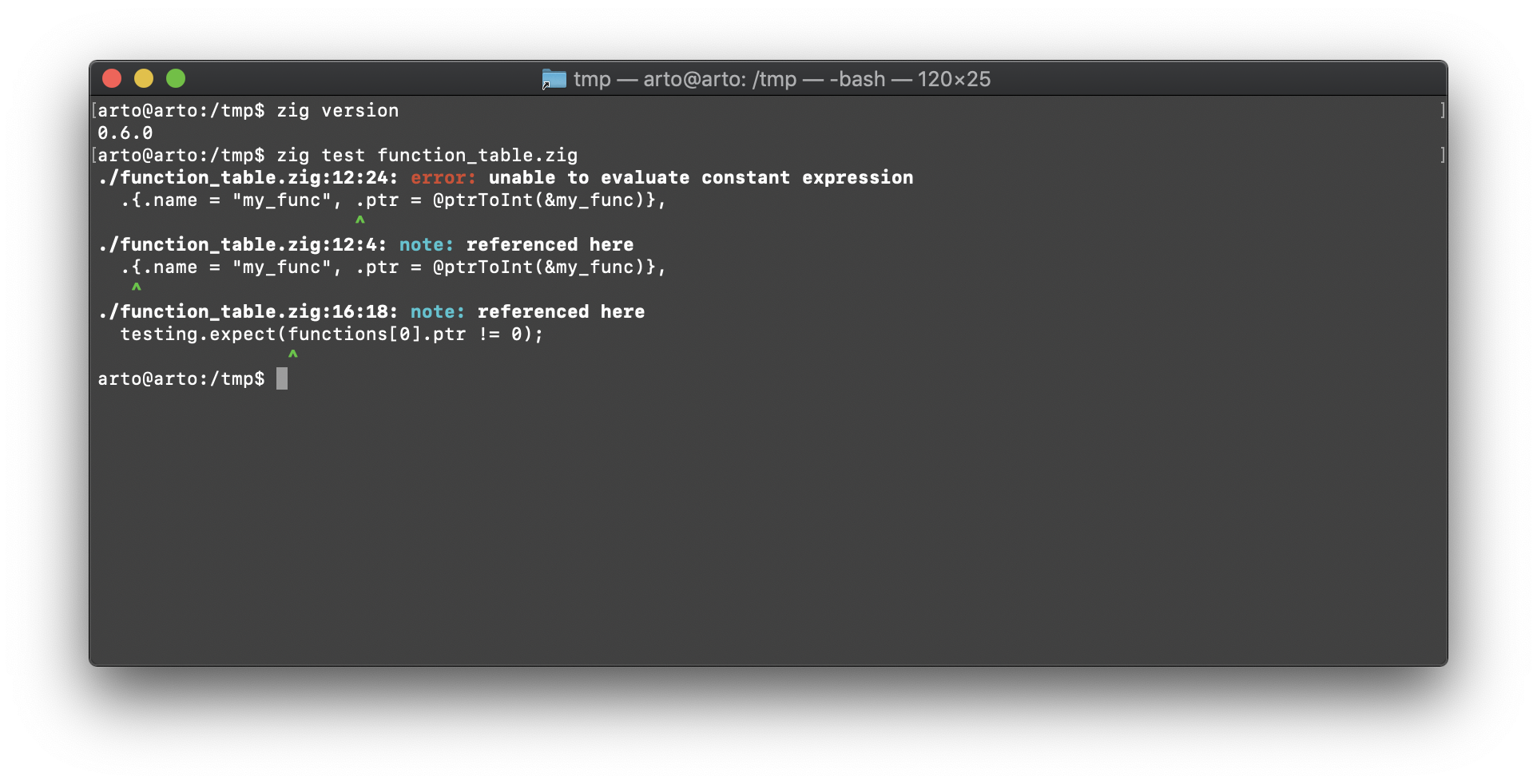
The contents of the aforementioned function_table.zig minimal reproduction case:
const std = @import("std");
const testing = std.testing;

export fn my_func() void {}

const ExportedFunction = struct {
  name: []const u8,
  ptr: usize, // function types vary
};

const functions = [_]ExportedFunction {
  .{.name = "my_func", .ptr = @ptrToInt(&my_func)},
};

test "reproduce error: unable to evaluate constant expression" {
  testing.expect(functions[0].ptr != 0);
}
By the way, in case there's any better way to create a function lookup table storing function pointers (with varying function type signatures) to exported functions, I'm all ears...
 artob
artob
👀1
All 2 comments
The error is correct since the address of the function is not compile time known. If you want to make a function lookup table you have a few different choises:
- use
@ptrCast(fn()void, my_func)and then@ptrCastagain when you want to call it. - put the look up table in a runtime scope like inside a function and use
@ptrToInt. - use tuples:
const std = @import("std");
const testing = std.testing;

export fn my_func() void {}
export fn my_other_func() u32 {return 0;}

const functions = .{
    .my_func = my_func,
    .my_other_func = my_other_func,
};

test "reproduce error: unable to evaluate constant expression" {
    testing.expect(@ptrToInt(functions.my_func) != 0);
    testing.expect(@ptrToInt(functions.my_other_func) != 0);
}
 Vexu
on 8 May 2020
Vexu
on 8 May 2020
👍2
❤1
Kind thanks, @Vexu, that is most helpful. TIL. Closing the issue since it's not a bug.
artob
on 8 May 2020
👍1
Was this page helpful?
0 / 5 - 0 ratings
Related issues
 andrewrk
·
3Comments
andrewrk
·
3Comments
 jorangreef
·
3Comments
jorangreef
·
3Comments
 S0urc3C0de
·
3Comments
jorangreef
·
3Comments
S0urc3C0de
·
3Comments
jorangreef
·
3Comments
 DavidYKay
·
3Comments
DavidYKay
·
3Comments
Most helpful comment
The error is correct since the address of the function is not compile time known. If you want to make a function lookup table you have a few different choises:
@ptrCast(fn()void, my_func)and then@ptrCastagain when you want to call it.@ptrToInt.