Zero-to-jupyterhub-k8s: Extract files from Dockerfile to ConfigMaps?
In #1266 I suggest the use of configmap's to customize jupyterhub jinja templates for its looks. Perhaps this is something we want to do for our jupyterhub_config.py file etc. as well that is currently residing in our Dockerfile.
 consideRatio
All 4 comments
We've been experimenting with mounting etc/jupyter as a volume in mybinder.org-deploy and it's been really nice. I think we should try to explore a similar approach to allowing arbitrary config and files in e.g. /etc/jupyterhub from values.yaml, and others using the helm files api.
 minrk
on 10 May 2019
minrk
on 10 May 2019
Ah! mounting /etc/jupyter as a volume from a ConfigMap! Nice!
consideRatio
on 10 May 2019
Min your comment inspired me to inject templates and images into the hub pod, as well as configuration files into the singleuser pods.
These are the files I inject, through four ConfigMaps.
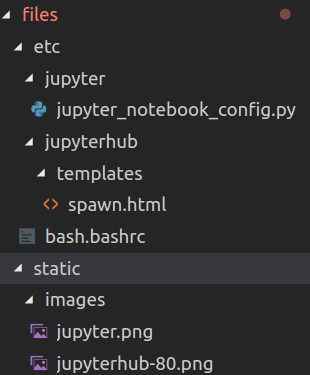
WARNING: I decided to override the images folder of the hub, residing in
/usr/local/share/jupyterhub/static/with the one I provide. So while doing that I also decided to copy the files I found in this folder to the folder I inject.
My ConfigMap
NOTE: This configmap was provided in a meta-chart that has a
requirements.yamlfile with a dependency on the Z2JH Helm chart. This is why I'm able to use Helm templating.
apiVersion: v1
kind: ConfigMap
metadata:
  name: hub-templates
data:
  {{- (.Files.Glob "files/etc/jupyterhub/templates/*").AsConfig | nindent 2 }}
---
apiVersion: v1
kind: ConfigMap
metadata:
  name: hub-images
# NOTE: Because '.AsConfig' and '.AsSecret' only work on string files, we rely on 'binaryData'
# to perform a base64 decoding before mount, and we base64 our image files first.
binaryData:
  {{- $root := . }}
  {{- range $path, $bytes := .Files.Glob "files/static/images/*" }}
  {{ base $path }}: '{{ $root.Files.Get $path | b64enc }}'
  {{- end }}
---
apiVersion: v1
kind: ConfigMap
metadata:
  name: user-bash-bashrc
data:
  {{- (.Files.Glob "files/etc/bash.bashrc").AsConfig | nindent 2 }}
---
apiVersion: v1
kind: ConfigMap
metadata:
  name: user-jupyter-notebook-config
data:
  {{- (.Files.Glob "files/etc/jupyter/*").AsConfig | nindent 2 }}
My provided Helm template values
NOTE: These was provided to a meta-chart that has a
requirements.yamlfile with a dependency on the Z2JH Helm chart. This is why I'm nesting my configuration underjupyterhub.
# extract from my provided helm template values in config.yaml
jupyterhub:
  hub:
    extraConfig:
      templates: |
        c.JupyterHub.template_paths.insert(0, "/etc/jupyterhub/templates")
    extraVolumes:
      - name: hub-templates
        configMap:
          name: hub-templates
      - name: hub-images
        configMap:
          name: hub-images
    extraVolumeMounts:
      - mountPath: /etc/jupyterhub/templates
        name: hub-templates
      - mountPath: /usr/local/share/jupyterhub/static/images
        name: hub-images

  singleuser:
    storage:
      extraVolumes:
        - name: user-bash-bashrc
          configMap:
            name: user-bash-bashrc
        - name: user-jupyter-notebook-config
          configMap:
            name: user-jupyter-notebook-config
      extraVolumeMounts:
        # NOTE: using 'subPath' we can mount a single file, and by specifying a filename in the mountPath
        # we will mount this single file into a file instead of a directory.
        # See: https://stackoverflow.com/questions/44325048/kubernetes-configmap-only-one-file
        - mountPath: /etc/bash.bashrc
          subPath: bash.bashrc
          name: user-bash-bashrc
        - mountPath: /etc/jupyter/jupyter_notebook_config.py
          subPath: jupyter_notebook_config.py
          name: user-jupyter-notebook-config
We have extracted jupyterhub_config.py from being built into our Dockerfile in https://github.com/jupyterhub/zero-to-jupyterhub-k8s/pull/1407.
consideRatio
on 7 Oct 2020
Related issues
consideRatio
·
3Comments
 gsemet
·
3Comments
gsemet
·
3Comments
 Boes-man
·
3Comments
consideRatio
·
3Comments
Boes-man
·
3Comments
consideRatio
·
3Comments
 UsDAnDreS
·
4Comments
UsDAnDreS
·
4Comments
Most helpful comment
We've been experimenting with mounting etc/jupyter as a volume in mybinder.org-deploy and it's been really nice. I think we should try to explore a similar approach to allowing arbitrary config and files in e.g. /etc/jupyterhub from values.yaml, and others using the helm files api.