🚀 This guide explains how to use model ensembling during testing and inference for improved mAP and Recall. From https://www.sciencedirect.com/topics/computer-science/ensemble-modeling:
Ensemble modeling is a process where multiple diverse models are created to predict an outcome, either by using many different modeling algorithms or using different training data sets. The ensemble model then aggregates the prediction of each base model and results in once final prediction for the unseen data. The motivation for using ensemble models is to reduce the generalization error of the prediction. As long as the base models are diverse and independent, the prediction error of the model decreases when the ensemble approach is used. The approach seeks the wisdom of crowds in making a prediction. Even though the ensemble model has multiple base models within the model, it acts and performs as a single model.
Before You Start
Clone this repo and install requirements.txt dependencies, including Python>=3.8 and PyTorch>=1.6.
git clone https://github.com/ultralytics/yolov5 # clone repo
cd yolov5
pip install -r requirements.txt # install requirements.txt
Test Normally
Before ensembling we want to establish the baseline performance of a single model. This command tests YOLOv5x on COCO val2017 at image size 640 pixels. yolov5x.pt is the largest and most accurate model available. Other options are yolov5s.pt, yolov5m.pt and yolov5l.pt, or you own checkpoint from training a custom dataset ./weights/best.pt. For details on all available models please see our README table.
$ python test.py --weights yolov5x.pt --data coco.yaml --img 640
Output:
Namespace(augment=False, batch_size=32, conf_thres=0.001, data='./data/coco.yaml', device='', img_size=640, iou_thres=0.65, save_json=True, save_txt=False, single_cls=False, task='val', verbose=False, weights=['yolov5x.pt'])
Using CUDA device0 _CudaDeviceProperties(name='Tesla P100-PCIE-16GB', total_memory=16280MB)

Fusing layers... Model Summary: 284 layers, 8.89222e+07 parameters, 0 gradients
Scanning labels ../coco/labels/val2017.cache (4952 found, 0 missing, 48 empty, 0 duplicate, for 5000 images): 5000it [00:00, 17761.74it/s]
               Class      Images     Targets           P           R      [email protected]  [email protected]:.95: 100% 157/157 [02:34<00:00,  1.02it/s]
                 all       5e+03    3.63e+04       0.409       0.754       0.669       0.476
Speed: 23.6/1.6/25.2 ms inference/NMS/total per 640x640 image at batch-size 32

COCO mAP with pycocotools... saving detections_val2017__results.json...
 Average Precision  (AP) @[ IoU=0.50:0.95 | area=   all | maxDets=100 ] = 0.492 < ---------- baseline mAP
 Average Precision  (AP) @[ IoU=0.50      | area=   all | maxDets=100 ] = 0.676
 Average Precision  (AP) @[ IoU=0.75      | area=   all | maxDets=100 ] = 0.534
 Average Precision  (AP) @[ IoU=0.50:0.95 | area= small | maxDets=100 ] = 0.318
 Average Precision  (AP) @[ IoU=0.50:0.95 | area=medium | maxDets=100 ] = 0.541
 Average Precision  (AP) @[ IoU=0.50:0.95 | area= large | maxDets=100 ] = 0.633
 Average Recall     (AR) @[ IoU=0.50:0.95 | area=   all | maxDets=  1 ] = 0.376
 Average Recall     (AR) @[ IoU=0.50:0.95 | area=   all | maxDets= 10 ] = 0.616
 Average Recall     (AR) @[ IoU=0.50:0.95 | area=   all | maxDets=100 ] = 0.670
 Average Recall     (AR) @[ IoU=0.50:0.95 | area= small | maxDets=100 ] = 0.493
 Average Recall     (AR) @[ IoU=0.50:0.95 | area=medium | maxDets=100 ] = 0.723
 Average Recall     (AR) @[ IoU=0.50:0.95 | area= large | maxDets=100 ] = 0.812
Ensemble Test
Multiple pretraind models may be ensembled togethor at test and inference time by simply appending extra models to the --weights argument in any existing test.py or detect.py command. This example tests an ensemble of 2 models togethor:
- YOLOv5x
- YOLOv5l
$ python test.py --weights yolov5x.pt yolov5l.pt --data coco.yaml --img 640
Output:
Namespace(augment=False, batch_size=32, conf_thres=0.001, data='./data/coco.yaml', device='', img_size=640, iou_thres=0.65, save_json=True, save_txt=False, single_cls=False, task='val', verbose=False, weights=['yolov5x.pt', 'yolov5l.pt'])
Using CUDA device0 _CudaDeviceProperties(name='Tesla P100-PCIE-16GB', total_memory=16280MB)

Fusing layers... Model Summary: 284 layers, 8.89222e+07 parameters, 0 gradients  # Model 1
Fusing layers... Model Summary: 236 layers, 4.77901e+07 parameters, 0 gradients  # Model 2
Ensemble created with ['yolov5x.pt', 'yolov5l.pt']  # Ensemble Notice

Scanning labels ../coco/labels/val2017.cache (4952 found, 0 missing, 48 empty, 0 duplicate, for 5000 images): 5000it [00:00, 17883.26it/s]
               Class      Images     Targets           P           R      [email protected]  [email protected]:.95: 100% 157/157 [03:42<00:00,  1.42s/it]
                 all       5e+03    3.63e+04       0.402       0.764       0.677        0.48
Speed: 37.5/1.4/38.9 ms inference/NMS/total per 640x640 image at batch-size 32

COCO mAP with pycocotools... saving detections_val2017__results.json...
 Average Precision  (AP) @[ IoU=0.50:0.95 | area=   all | maxDets=100 ] = 0.496 < ---------- improved mAP
 Average Precision  (AP) @[ IoU=0.50      | area=   all | maxDets=100 ] = 0.684
 Average Precision  (AP) @[ IoU=0.75      | area=   all | maxDets=100 ] = 0.538
 Average Precision  (AP) @[ IoU=0.50:0.95 | area= small | maxDets=100 ] = 0.323
 Average Precision  (AP) @[ IoU=0.50:0.95 | area=medium | maxDets=100 ] = 0.548
 Average Precision  (AP) @[ IoU=0.50:0.95 | area= large | maxDets=100 ] = 0.633
 Average Recall     (AR) @[ IoU=0.50:0.95 | area=   all | maxDets=  1 ] = 0.377
 Average Recall     (AR) @[ IoU=0.50:0.95 | area=   all | maxDets= 10 ] = 0.615
 Average Recall     (AR) @[ IoU=0.50:0.95 | area=   all | maxDets=100 ] = 0.670
 Average Recall     (AR) @[ IoU=0.50:0.95 | area= small | maxDets=100 ] = 0.495
 Average Recall     (AR) @[ IoU=0.50:0.95 | area=medium | maxDets=100 ] = 0.723
 Average Recall     (AR) @[ IoU=0.50:0.95 | area= large | maxDets=100 ] = 0.815
Ensemble Inference
Append extra models to the --weights argument to run ensemble inference:
$ python detect.py --weights yolov5x.pt yolov5l.pt --img 640 --source ./inference/images/
Output:
Namespace(agnostic_nms=False, augment=False, classes=None, conf_thres=0.25, device='', img_size=640, iou_thres=0.45, output='inference/output', save_txt=False, source='./inference/images/', update=False, view_img=False, weights=['yolov5x.pt', 'yolov5l.pt'])
Using CUDA device0 _CudaDeviceProperties(name='Tesla P100-PCIE-16GB', total_memory=16280MB)

Fusing layers... Model Summary: 284 layers, 8.89222e+07 parameters, 0 gradients  # Model 1
Fusing layers... Model Summary: 236 layers, 4.77901e+07 parameters, 0 gradients  # Model 2
Ensemble created with ['yolov5x.pt', 'yolov5l.pt']  # Ensemble Notice

image 1/2 inference/images/bus.jpg: 640x512 4 persons, 1 bicycles, 1 buss, Done. (0.073s)
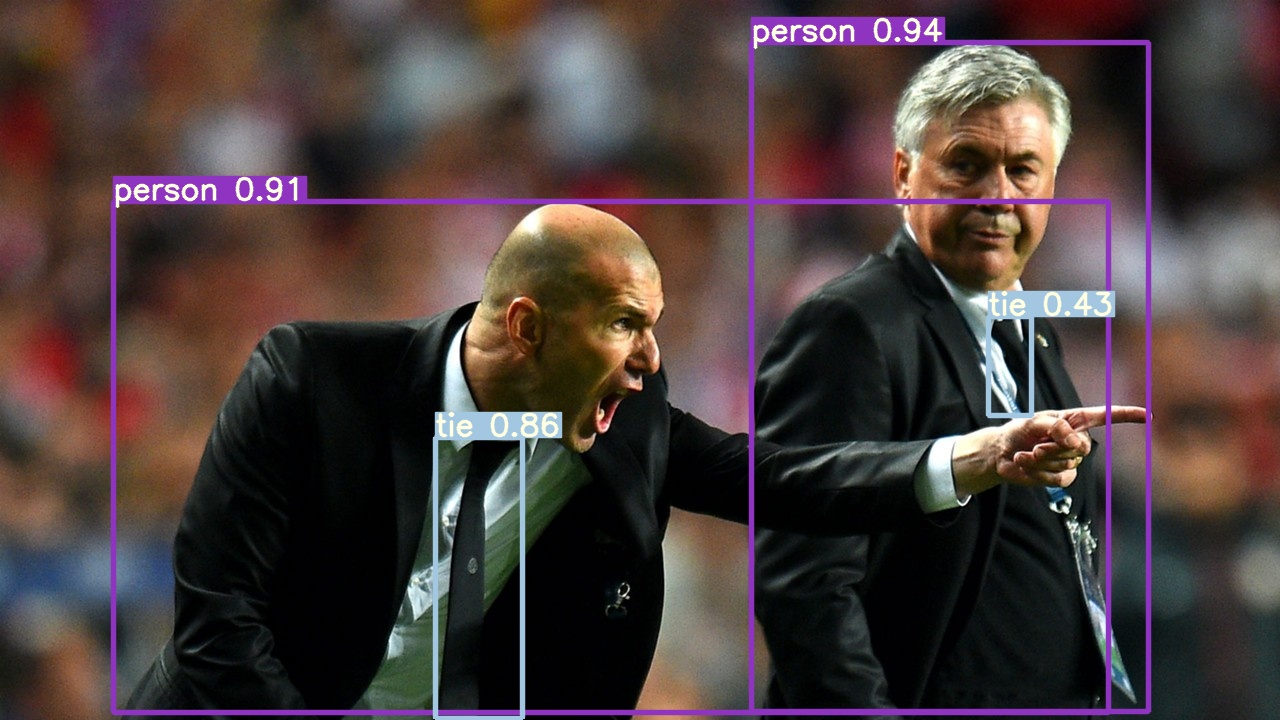
image 2/2 inference/images/zidane.jpg: 384x640 3 persons, 3 ties, Done. (0.063s)
Results saved to inference/output
Done. (0.319s)
Environments
YOLOv5 may be run in any of the following up-to-date verified environments (with all dependencies including CUDA/CUDNN, Python and PyTorch preinstalled):
- Google Colab Notebook with free GPU:

- Kaggle Notebook with free GPU: https://www.kaggle.com/ultralytics/yolov5
- Google Cloud Deep Learning VM. See GCP Quickstart Guide
- Docker Image https://hub.docker.com/r/ultralytics/yolov5. See Docker Quickstart Guide

 glenn-jocher
All 22 comments
Can I use it in version 1?
 ZeKunZhang1998
on 16 Aug 2020
ZeKunZhang1998
on 16 Aug 2020
Can I use it in version 1?
ZeKunZhang1998
on 16 Aug 2020
Can I use it in version 1?
ZeKunZhang1998
on 16 Aug 2020
Can I use it in version 1?
ZeKunZhang1998
on 16 Aug 2020
Can I use it in version 1?
ZeKunZhang1998
on 16 Aug 2020
Can I use it in version 1?
ZeKunZhang1998
on 16 Aug 2020
Can I use it in version 1?
ZeKunZhang1998
on 16 Aug 2020
what's influence of model ensemble
 SISTMrL
on 22 Aug 2020
SISTMrL
on 22 Aug 2020
compare to test-time augmentation? which one will be better?
 Zzh-tju
on 25 Aug 2020
Zzh-tju
on 25 Aug 2020
Well, I see, the model ensembling method is actually more like using a poor model to find missed detections for a good model. In contrast, TTA can also find missed detections by changing the input, while maintaining using the best model.
Zzh-tju
on 25 Aug 2020
@Zzh-tju ensembling and TTA are not mutually exclusive. You can TTA a single model, and you can ensemble a group of models with or without TTA:
python detect.py --weights model1.pt model2.pt --augment
glenn-jocher
on 25 Aug 2020
@Zzh-tju ensembling runs multiple models, while TTA tests a single model at with different augmentations. Typically I've seen the best result when merging output grids directly, (i.e. ensembling YOLOv5l and YOLOv5x), rather than simply appending boxes from multiple models for NMS to sort out. This is not always possible however, for example Ensembling an EfficientDet model with YOLOv5x, you can not merge grids, you must use NMS or WBF (or Merge NMS) to get a final result.
glenn-jocher
on 26 Aug 2020
This issue has been automatically marked as stale because it has not had recent activity. It will be closed if no further activity occurs. Thank you for your contributions.
![github-actions[bot] picture](https://avatars2.githubusercontent.com/in/15368?v=4&s=40) github-actions[bot]
on 25 Sep 2020
github-actions[bot]
on 25 Sep 2020
How can I ensemble EfficientDet D7 with YOLO V5x?
 Blaze-raf97
on 16 Oct 2020
Blaze-raf97
on 16 Oct 2020
@Blaze-raf97 with the right amount of coffee anything is possible.
glenn-jocher
on 16 Oct 2020
How to solve this problem?
COCO mAP with pycocotools... saving detections_val2017__results.json...
ERROR: pycocotools unable to run: invalid literal for int() with base 10: 'Image_20200930140952222'
 LokedSher
on 23 Oct 2020
LokedSher
on 23 Oct 2020
@LokedSher pycocotools is only intended for mAP on COCO data using coco.yaml. https://pypi.org/project/pycocotools/
glenn-jocher
on 23 Oct 2020
@LokedSher pycocotools is only intended for mAP on COCO data using coco.yaml. https://pypi.org/project/pycocotools/
Thanks for your reply!
LokedSher
on 23 Oct 2020
@LokedSher I also encountered the same problem as you, but after I read your Q&A, I still don't know how to improve to get the picture given by the author.

 ZwNSW
on 3 Nov 2020
ZwNSW
on 3 Nov 2020
I want to ensemble yolov3-spp and yolov5x which are trained by using your excellent work yolov3 and yolov5. Few months ago i got the ensemble result ,but i try it again now, error encountered, can you help me? ths!
python detect.py --weights runs/train/exp13/weights/best.pt /home/work/pretrained_weights/best.pt --source /home/work/data
Fusing layers...
Model Summary: 484 layers, 88390614 parameters, 0 gradients
Traceback (most recent call last):
File "detect.py", line 172, in
detect()
File "detect.py", line 33, in detect
model = attempt_load(weights, map_location=device) # load FP32 model
File "/home/work/xunuo/yolov5/yolov5/models/experimental.py", line 137, in attempt_load
model.append(torch.load(w, map_location=map_location)['model'].float().fuse().eval()) # load FP32 model
AttributeError: 'collections.OrderedDict' object has no attribute 'float'
 PromiseXu1
on 23 Nov 2020
PromiseXu1
on 23 Nov 2020
@PromiseXu1 we are currently updating YOLOv3 models and should have them available for autodownload within this repo at the end of the week. In the meantime if you have an existing YOLOv3 model that runs inference correctly with this repo, you can modify the ensemble type to NMS ensemble to allow it to ensemble with the YOLOv5 models. v3 and v5 models have different heads (FPN and PANet), meaning the current ensemnble method will not work as it expects every output to have the same size and shape. You can modify ensemble type in the Ensemble() class:
https://github.com/ultralytics/yolov5/blob/201bafc7cf9545362552ad5b0fc5033d64d7ae77/models/experimental.py#L117-L130
glenn-jocher
on 23 Nov 2020
@PromiseXu1 we are currently updating YOLOv3 models and should have them available for autodownload within this repo at the end of the week. In the meantime if you have an existing YOLOv3 model that runs inference correctly with this repo, you can modify the ensemble type to NMS ensemble to allow it to ensemble with the YOLOv5 models. v3 and v5 models have different heads (FPN and PANet), meaning the current ensemnble method will not work as it expects every output to have the same size and shape. You can modify ensemble type in the Ensemble() class:
https://github.com/ultralytics/yolov5/blob/201bafc7cf9545362552ad5b0fc5033d64d7ae77/models/experimental.py#L117-L130
WOw ! thanks for your prompt response, i will try and wish you all the best in your work ~
PromiseXu1
on 23 Nov 2020
Related issues
 lisa676
·
3Comments
lisa676
·
3Comments
 KangHoyong
·
3Comments
KangHoyong
·
3Comments
 nanometer34688
·
3Comments
nanometer34688
·
3Comments
 dereyly
·
4Comments
dereyly
·
4Comments
 maykulkarni
·
3Comments
maykulkarni
·
3Comments
Most helpful comment
@Blaze-raf97 with the right amount of coffee anything is possible.