Wenyan: English Language "Getting Started" Tutorial
Would you create a getting started tutorial on how to use this programming language? I find it to be an interesting way to learn Traditional Chinese!
 davidpgil
All 9 comments
Learn Traditional Chinese by programming?
IT'S **ING CRAZY
 tinyvan
on 16 Feb 2020
tinyvan
on 16 Feb 2020
I started creating a beginner/learning cheatsheet with pinyin and literal English translation.
I will publish the .pdf when it is finished. Here is the preview, let me know if you have any comment :)
https://twitter.com/alainsaas/status/1232144540590579712
https://twitter.com/alainsaas/status/1232512798934151168
 alainsaas
on 26 Feb 2020
alainsaas
on 26 Feb 2020
@alainsaas Wow! That's pretty awesome! 👍 Looking forward to it.
 antfu
on 26 Feb 2020
antfu
on 26 Feb 2020
Here is the full document, it should be enough to learn the language starting with only basic knowledge of Chinese characters :)
alainsaas
on 28 Feb 2020
👍 Very nice! I like the format. May I propose two small suggestions:
- the green and cyan texts are a bit too bright and hard on the eyes
- some of the English translations seem slightly inaccurate. The same character in modern and Classical Chinese can mean different things. I'll take a closer look when I have time and suggest some edits if you don't mind :)
Just for reference, I did a literal translation of quicksort from wenyan to English at the request of a journalist a while ago:
I have a technique. Name it "quicksort".                                                    | 吾有一術。名之曰「快排」。
    To utilize it, one must obtain an array, called "A". And thus describes the technique:  | 欲行是術。必先得一列。曰「甲」。乃行是術曰。
    If the length of "A" is not greater than one:                                           | 若「甲」之長不大於一者。
        Thus we get "A".                                                                    | 乃得「甲」也。
    I have three arrays. Name them "head", "body", and "tail".                              | 吾有三列。名之曰「首」。曰「頷」。曰「尾」。
    Take the first of "A". Name it "A1". Put "A1" into "body".                              | 夫「甲」之一。名之曰「甲一」。充「頷」以「甲一」。
    Take the rest of "A". Name it "AA".                                                     | 夫「甲」之其餘。名之曰「甲餘」。
    For each "C" in "AA":                                                                   | 凡「甲餘」中之「丁」。
        If "C" is smaller than "A1":                                                        | 若「丁」小於「甲一」者。
            Put "C" into "head"                                                             | 充「首」以「丁」。
        If not:                                                                             | 若非。
            Put "C" into "tail"                                                             | 充「尾」以「丁」也。
    et cetera.                                                                              | 云云。
    Use "quicksort" on "head". That which was called "head" before, now this is what it is. | 施「快排」於「首」。昔之「首」者。今其是矣。
    Use "quicksort" on "tail". That which was called "tail" before, now this is what it is. | 施「快排」於「尾」。昔之「尾」者。今其是矣。
    Connect "head" and "body" and "tail". Name it "B".                                      | 銜「首」以「頷」以「尾」。名之曰「乙」。
    Thus we get "B".                                                                        | 乃得「乙」。
Such is called the technique of "quicksort".                                                | 是謂「快排」之術也。
                                                                                            |
But overall awesome work, thanks for making this!
 LingDong-
on 28 Feb 2020
LingDong-
on 28 Feb 2020
Great job! I have some small suggestions as well
- For the color/theming, maybe we can utilize the colors used in Online IDE and rendering to better match the "wenyan style", you can see the hex value in this file
- I think an English explanation about 天干地支 would help non-Chinese speakers to understanding the context.
Let me know when you think it's ready, we would love to promote it in our wiki. Thanks! 👍
antfu
on 28 Feb 2020
I improved some translations, inspired by yours, LingDong, thanks!
And fixed the colors/theming - I admit it looks much better in "wenyan style" :)
I don't know enough about "天干地支" to provide an explanation (except that is has to do with that 甲, 乙, 丙, .. = A, B, C, ..).
=>
https://github.com/alainsaas/wenyan/blob/master/wenyan-lang%20beginner%20cheatsheet.pdf
Let me know if you have other feedback. And yes feel free to publish it in the wiki. I initially made it because there was no documentation easy to read with pinyin ;)
alainsaas
on 1 Mar 2020
Looks great! Sorry but some more small improvements:
- The font weights are not matched, maybe the code font is a little too thin.
- The line spacings with/without the pinyin do not consist, looks a little misaligned. Adding spacing for lines without pinyin might fix this (or maybe there is better way to handle that in your layout engine)
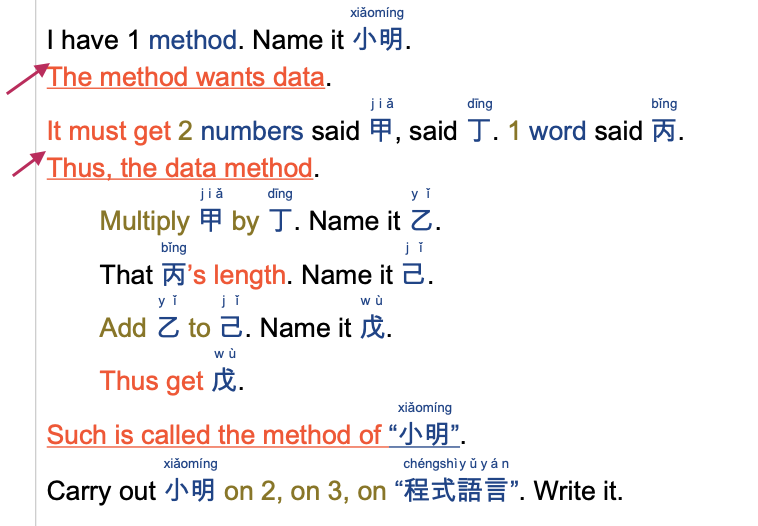
- A green right bracket, maybe you missed that 😄
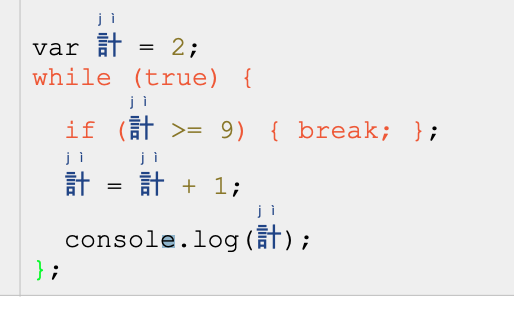
- For the 天干地支 part, I think it's enough to say it's roughly A, B, C in Classical Chinese
I have linked your documentation in this wiki page. Thanks for the great work!
antfu
on 1 Mar 2020
- I fixed the line spacing (had to add some hidden "回車"..), you are right, it looks better!
- About the font weights, let me know if you know a better font for wenyan.
Thanks for the feedback and for adding it to the wiki!
I will keep improving it :)
alainsaas
on 1 Mar 2020
Related issues
 DonkeXu
·
5Comments
LingDong-
·
5Comments
DonkeXu
·
5Comments
LingDong-
·
5Comments
 nobodxbodon
·
3Comments
nobodxbodon
·
3Comments
 y0n21i
·
5Comments
y0n21i
·
5Comments
 GalAster
·
3Comments
GalAster
·
3Comments
Most helpful comment
Here is the full document, it should be enough to learn the language starting with only basic knowledge of Chinese characters :)
https://github.com/alainsaas/wenyan