Wcag: Adding disclaimer at the top of techniques?
Following on from https://github.com/w3c/wcag/issues/1150#issuecomment-640531468 I would propose adding a disclaimer/note at the top of all individual techniques documents (e.g. https://www.w3.org/WAI/WCAG21/Techniques/failures/F3.html). Something along the lines of (open to further wordsmithing here of course)
Techniques are informative—that means they are not required. Content can satisfy the normative requirements of WCAG success criteria even if it does not use any of the documented techniques. Similarly, common failure examples do fail particular WCAG success criteria in isolation, but content can still pass those criteria if it includes additional content or functionality that do satisfy the normative requirements.
Maybe making it a small boxout that's prominently visible at the top (as part of the xslt that generates the final techniques files https://github.com/w3c/wcag/blob/master/xslt/generate-techniques.xslt )
This may also help mitigate/satisfy the core problem noted in https://github.com/w3c/wcag/issues/1150 itself (the confusion around the use of "must" in some of the wordings).
 patrickhlauke
All 8 comments
Hi @patrickhlauke I agree this could be helpful — there is definitely some question as to what is mandated _(shall or must)_, recommended _(should)_ and informative _(may)_.
If it is to be included in every page, then I'd suggest a headline/twisty approach, such as:
Closed
▶︎ Techniques are informative and not required for compliance
Open
▼ Techniques are informative and not required for compliance
_The use of the documented techniques on this page are not required to comply with the related WCAG success criteria. Further, some examples of failures are separate from overall content, and content may still pass these criteria if it contains additional elements that effectively satisfy the criteria._
Whether or not the initial state is open or closed could be assisted with a cookie, as in open until pages were viewed three times, etc, if that backend functionality is available.
 Myndex
on 7 Jan 2021
Myndex
on 7 Jan 2021
CCing @hidde on this one (regarding a standard disclaimer at the top of the techniques.
 alastc
on 8 Jan 2021
alastc
on 8 Jan 2021
The first section that's currently in Techniques pages (“Important Information about Techniques”) serves a similar function, but I don't suspect many will read it or necessarily deduct from it that Techniques are informative.
To be super effective, I feel we should keep it short and extremely clear. @Myndex's idea meets that criterion I think, but I wonder if the details that are being expanded may fit better on a different page that we can link to from each Technique. The About Techniques (part of the redesign project) might be a candidate?
One idea I played with in the redesign project, is to explicitly have “required for conformance”-ness listed as a bit of metadata (with “Required for conformance? No”):
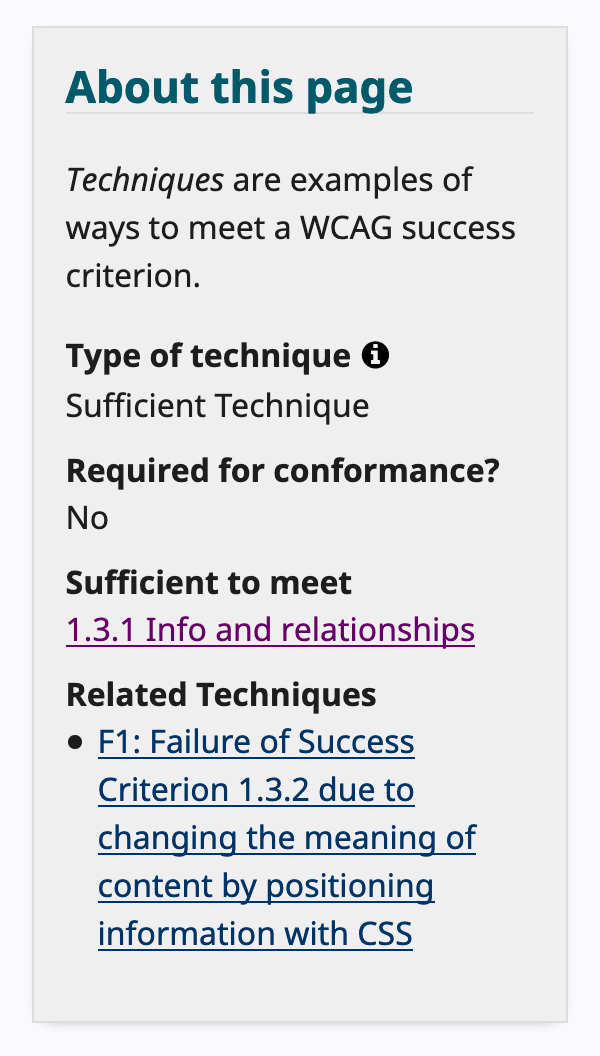
This bit of metadata would _always_ be set to “No”, you might wonder? Yes. It would. Those who are aware of that, might say that's pointless then. But I think not everyone _is_ aware, and the “No” provides a clear and easily skimmable method for indicating requiredness.
 hidde
on 13 Jan 2021
hidde
on 13 Jan 2021
@patrickhlauke - it's a different approach, but could do the trick?
alastc
on 18 Jan 2021
not sure the metadata approach is clear enough to somebody who's not already quite versed in terminology, what "required for conformance", etc means. somebody who's done a naive google search and landed on a technique...that sort of thing.
a clearer, human-readable explanation would be better in my opinion.
patrickhlauke
on 18 Jan 2021
Personally I feel ‘somebody who's done a naive google search and landed on a technique’ (group A) is very much one of the audiences we want to reach.
What's tricky is that there's also ‘somebody who is a WCAG expert’ (group B).
Previous attempts to try and use plainer language for group A made it less clear for group B (for whom ‘conformance’ means something specific that another phrase may not).
Suggestion/explorations super welcome, what would be a good, short, accurate and clear description that makes sense to both?
hidde
on 18 Jan 2021
[insert "why don't we have both" gif]
patrickhlauke
on 18 Jan 2021
Just grabbing my initial rough suggestion, we could crowbar in the word conformance
Techniques are informative—that means they are not required for conformance. Content can satisfy the normative requirements of WCAG success criteria even if it does not use any of the documented techniques. Similarly, common failure examples do fail particular WCAG success criteria in isolation, but content can still pass those criteria if it includes additional content or functionality that do satisfy the normative requirements.
patrickhlauke
on 18 Jan 2021
Related issues
alastc
·
7Comments
 tigt
·
5Comments
tigt
·
5Comments
 36degrees
·
10Comments
patrickhlauke
·
8Comments
36degrees
·
10Comments
patrickhlauke
·
8Comments
 jake-abma
·
8Comments
jake-abma
·
8Comments
Most helpful comment
Just grabbing my initial rough suggestion, we could crowbar in the word conformance