Visidata: A small announcment: a VisiData introductory guide in Italian
Hi @saulpw and @anjakefala I have written the first release of a VisiData introductory guide in Italian :)
I discovered this instrument and I loved it: I think it's important to make it known in my country (and everywhere).
I have put it in a github repo and this is the first release of the text.
Tomorrow I will announce it in a Medium blog post. I think I can activate good "word of mouth" in italian open data community (VisiData could be a good tool for open data tasks).
The text of my guide is very inspired by the great work of @jsvine.
I would like to be able to do better and more, but I hope it can still be useful.
Please do not anticipate it. Tomorrow I will announce it on twitter (and I will write also a note here).
Best regards
 aborruso
All 12 comments
This is the right URL of the guide https://github.com/ondata/guidaVisiData/blob/master/testo/README.md
aborruso
on 28 Dec 2018
Neat! And thank you for the very kind words!
 jsvine
on 28 Dec 2018
jsvine
on 28 Dec 2018
This is awesome, @aborruso! Thank you so much for using your enthusiasm to spread the word about VisiData. I think your tutorial turned out really well, too (from what I can read in google translate).
 saulpw
on 29 Dec 2018
saulpw
on 29 Dec 2018
@aborruso, I read through the translated guide, and I thought of a couple of (very minor) points:
- under Pivot Table, maybe it would be good to note that all aggregators on the pivoted column will be created too.
- under Python modules, maybe note that setting the type with
@and then=data_immatricolazione.monthwould work as well? So people don't think they have to strftime for such a common task :)
Also we recorded another video last weekend, using your recent issue #227 for inspiration. I hope you don't mind if I mention your name again :)
Happy new year!
saulpw
on 29 Dec 2018
Hi Saul,
On Sat, 29 Dec 2018 at 09:06, Saul Pwanson notifications@github.com wrote:
I read through the translated
guide, and I thought of a couple of (very minor) points:
- under Pivot Table, maybe it would be good to note that all
aggregators on the pivoted column will be created too.
I had no idea, I'm sorry. How to show them?
- under Python modules, maybe note that setting the type with @ and
then =data_immatricolazione.month would work as well? So people don't
think they have to strftime for such a common task :)
It is already written in the text: "NOTA BENE: le funzioni del modulo
datetime sono disponibili in modo nativo per le colonne già impostate (come
tipo) a data. Quanto scritto sopra vale soprattutto come guida al come
precaricare e utilizzare un modulo Python in VisiData."
That in english is something like "NOTE: the functions of the datetime
module are available natively for the columns already set (as type) to
date. What is written above is primarily a guide to how to preload and use
a Python module in VisiData."
Also we recorded another video last weekend, using your recent issue #227
https://github.com/saulpw/visidata/issues/227 for inspiration. I hope
you don't mind if I mention your name again :)
I'm very proud to be mentioned. Where can I find this new video?
Happy new year!
Thank you very much, best wishes to you too
aborruso
on 29 Dec 2018
Oh, I missed that NOTE. And the video is not yet out, probably in another week or two.
As for the Pivot aggregators, I don't know how to show them. I just thought mentioning them was a good idea so people knew (I guess you didn't even know!).
saulpw
on 29 Dec 2018
As for the Pivot aggregators, I don't know how to show them. I just thought mentioning them was a good idea so people knew (I guess you didn't even know!).
I did not understand you, I'm sorry.
I know that I can add, but I understood that they were somehow calculated by default.
Instead you are telling me to point out that it is possible to add them. Now Do I understand you?
aborruso
on 29 Dec 2018
Yes, exactly! I believe you mention it with the Frequency Table, and it works similarly with Pivot, so it seems like maybe a good idea to mention.
saulpw
on 29 Dec 2018
On Sat, 29 Dec 2018 at 19:16, Saul Pwanson notifications@github.com wrote:
Yes, exactly! I believe you mention it with the Frequency Table, and it
works similarly with Pivot, so it seems like maybe a good idea to mention.
I'll do it
--
Andrea Borruso
website: https://medium.com/tantotanto
38° 7' 48" N, 13° 21' 9" E, EPSG:4326
"cercare e saper riconoscere chi e cosa,
in mezzo all’inferno, non è inferno,
e farlo durare, e dargli spazio"
Italo Calvino
aborruso
on 29 Dec 2018
Yes, exactly! I believe you mention it with the Frequency Table, and it works similarly with Pivot, so it seems like maybe a good idea to mention.
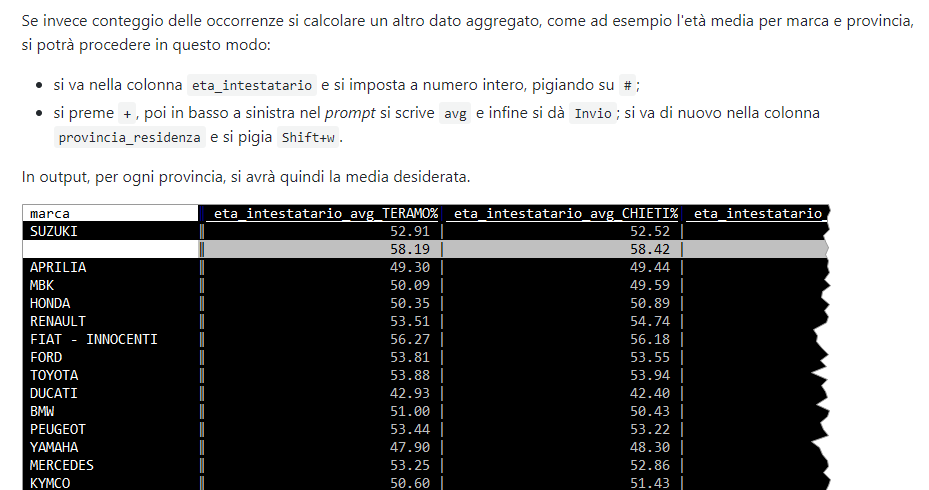
@saulpw I have added an example with avg aggregator
aborruso
on 29 Dec 2018
I have published also a Medium blog post https://medium.com/tantotanto/visidata-il-coltellino-svizzero-per-i-dati-che-probabilmente-non-conosci-2209ffd4fa39
aborruso
on 29 Dec 2018
This is wonderful! ^^ Happiest of New Years. 😊
 anjakefala
on 29 Dec 2018
anjakefala
on 29 Dec 2018
Related issues
 cbrueffer
·
12Comments
cbrueffer
·
12Comments
 kovasap
·
13Comments
kovasap
·
13Comments
 paulklemm
·
11Comments
paulklemm
·
11Comments
 khughitt
·
12Comments
khughitt
·
12Comments
 geekscrapy
·
12Comments
geekscrapy
·
12Comments
Most helpful comment
I have published also a Medium blog post https://medium.com/tantotanto/visidata-il-coltellino-svizzero-per-i-dati-che-probabilmente-non-conosci-2209ffd4fa39