Velero: Option to choose another GVK besides the preferred-version
Describe the problem/challenge you have
A use case is when exporting a resource from a version of K8s being older than the version of the cluster restoring that resource into.
Let's say the backup cluster has api-server supporting:
- "some-api-group/v1" <- preferred-version
- "some-api-group/v2beta1"
And the restore side has:
- "some-api-group/v2"
- "some-api-group/v2beta1"
At the moment this is not possible because the preferred version would export the resource represented in v1 and the api-server on the restore side doesn't support it.
Describe the solution you'd like
Instead of having the version automatically selected from the preferred-version,
being able to choose another API-Group/version (of course only if that GVK is supported by the api-server), would allow to export the involved resource using "some-api-group/v2beta1" and make the import possible into the destination.
Anything else you would like to add:
Overall the idea is to help creating GKVs export/import paths when 2 clusters are apart version-wise.
And the more 2 clusters are away from each others the higher the GVK gap, and this is where such option could really help. And even if a destination doesn't support the exported version, being able to bring it closer to a supported version would help too.
Environment:
- Velero version (use
velero version): 1.2.0+ - Kubernetes version (use
kubectl version): 1.7+ - Kubernetes installer & version: any
- Cloud provider or hardware configuration: any
- OS (e.g. from
/etc/os-release): any
 gildub
All 13 comments
@gildub what if Velero backed up all versions of a resource, and then intelligently restored the appropriate version based on which versions it found in the target cluster? Would that meet your need without requiring you to provide the mapping?
 skriss
on 28 Feb 2020
skriss
on 28 Feb 2020
@skriss, that would be ideal!
Now I'm not sure how you're going to do that magic unless using a similar approach as oc convert.
gildub
on 13 Mar 2020
Now I'm not sure how you're going to do that magic unless using a similar approach as oc convert.
Well, I think for starters we wouldn't do anything too magical. In the example you gave, we'd back up both v1 and v2beta1 representations of the resources. Then, on restore, we'd see that the target cluster supported v2beta1 and v2. Since the only overlap is v2beta1, we'd restore that version of the resource. So, no conversion required by Velero.
The next step would be to support conversion when there is no overlapping version between the backup and the target cluster. That would be pretty magical..
skriss
on 13 Mar 2020
xref #2310
skriss
on 13 Mar 2020
Hi @gildub, if I code a prototype of this request, would you be able to help me with the testing... like running a backup on your environment?
 brito-rafa
on 20 Mar 2020
brito-rafa
on 20 Mar 2020
@brito-rafa, I could definitely help you test.
gildub
on 24 Mar 2020
Thanks! I give you the testing image once I have the code running with 100% backward compatible with the standard format. I am particularly interested to see APIGroups that are not native to K8s.
brito-rafa
on 24 Mar 2020
Hi @gildub
So I have a prototype of the velero backup server with the option to backup all versions. To test, please follow these steps:
Install Velero as usual on your cluster.
Create a file "velero-migration-patch.yaml" with the following content:
spec:
  template:
    spec:
      containers:
      - args:
        - server
        - --log-level
        - debug
        - --features=Migration
        name: velero
        image: quay.io/brito_rafa/velero:dev-2251-0326-D
- Run the kubectl patch command:
kubectl patch deployment velero --patch "$(cat velero-migration-patch.yaml)" -n velero
- Take a normal backup and verify the content of it. You will see additional directories for each version of the resource lists (along with the default preferred group version).
At this point, this version only takes the backup of all API group versions.
The Restore would be coded on the next phase, probably after we confirm this version is fully backward compatible, and the logic makes sense.
Here what I would like to confirm:
- It is indeed 100% backward compatible (my canned tests say yes). I would benefit you to run some restores from the "Migration" backup.
- What the expected outcome of your CRDs with this prototyped version? Is it getting all API group versions?
Any help is appreciated!
Cheers,
Rafa
brito-rafa
on 27 Mar 2020
Just an update, please see script how to test the latest release.
brito-rafa
on 6 Apr 2020
@brito-rafa, that's really great, thank you!
gildub
on 8 Apr 2020
Hey @brito-rafa, I'm taking over for @gildub on testing this out. Will try this out today and report back.
 djwhatle
on 9 Apr 2020
djwhatle
on 9 Apr 2020
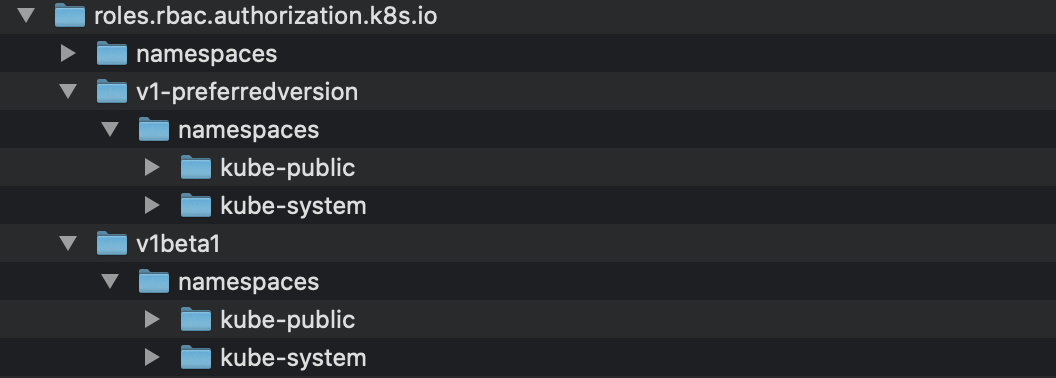
@brito-rafa I used your test script to check out the changes you've made. Looks like it works as described 👍
- [x] Existing "legacy" directory structure has been preserved (top level namespaces dir)
- [x] Conversions of each resource to all apiVersions known to apiserver are included in archive
- [x] Export of resource using preferredVersion is marked accordingly
_New Format of Backup Content Archive_ (includes legacy dir, plus labeled version dirs)
djwhatle
on 9 Apr 2020
Looks like it was finished!
 eleanor-millman
on 11 May 2021
eleanor-millman
on 11 May 2021
Related issues
 ncdc
·
27Comments
ncdc
·
27Comments
 gkdba87
·
28Comments
ncdc
·
133Comments
ncdc
·
34Comments
gkdba87
·
28Comments
ncdc
·
133Comments
ncdc
·
34Comments
 burkhat
·
29Comments
burkhat
·
29Comments