Vega-lite: Allow spec without data source
{
  "$schema": "https://vega.github.io/schema/vega-lite/v4.json",
  "layer": [
    {
      "data": {
        "values": [
          {"a": "A", "b": 28},
          {"a": "B", "b": 55},
          {"a": "C", "b": 43},
          {"a": "D", "b": 91},
          {"a": "E", "b": -81},
          {"a": "F", "b": 53},
          {"a": "G", "b": -19},
          {"a": "H", "b": 87},
          {"a": "I", "b": 52}
        ]
      },
      "mark": "line",
      "encoding": {
        "x": {"field": "a", "type": "ordinal"},
        "y": {"field": "b", "type": "quantitative"}
      }
    },
    {"mark": "rule", "encoding": {"y": {"value": 50}}}
  ]
}
should render the rule layer and the rule layer should have no data source bound in Vega.
 kanitw
All 15 comments
- [ ] For this reason,
layer_bar_annotations.vlneeds to adddata: {values: [{}]}.
kanitw
on 25 Mar 2020
- [ ] Same with
layer_line_datum_rule.vl
 domoritz
on 25 Mar 2020
domoritz
on 25 Mar 2020
- [ ] As we fix this issue, we should also make the following work:
{
  "$schema": "https://vega.github.io/schema/vega-lite/v4.json",
  "data": {
        "values": [
          {"a": "A", "b": 28},
          {"a": "B", "b": 55},
          {"a": "C", "b": 43},
          {"a": "D", "b": 91},
          {"a": "E", "b": -81},
          {"a": "F", "b": 53},
          {"a": "G", "b": -19},
          {"a": "H", "b": 87},
          {"a": "I", "b": 52}
        ]
      },
  "layer": [
    {
      "mark": "line",
      "encoding": {
        "x": {"field": "a", "type": "ordinal"},
        "y": {"field": "b", "type": "quantitative"}
      }
    },
    {
      data: null,  //overriding the derived data
      "mark": "rule", "encoding": {"y": {"value": 50}}
   }
  ]
}
While we are thinking about this, might we also consider having a spec without any data defined at all default to "values": [1]? That would make this very minimal spec work:
{ "mark": "circle" }
As it stands now, a novice user exploring vega-lite's grammar needs to have a fair amount of insight into the workings of the data flow.
{
  "data": { "values": [1] },
  "mark": "circle"
}
 marcprux
on 6 Apr 2020
marcprux
on 6 Apr 2020
What behavior do you propose for multi-view specifications?
domoritz
on 6 Apr 2020
It would be the same as it is now: child layers inherit the parent data source (unless it is null'd out or redefined). So this spec would just use the root layer's (implicit) "data": { "values": [1] }:
{
  "vconcat": [
    {
        "hconcat": [
          { "mark": "circle" },
          { "mark": "tick" }
        ]
    },
    {
        "hconcat": [
          { "mark": "point" },
          { "mark": "square" }
        ]
    }
  ]
}
Okay, so the implicit data is only at the root. I could see that working.
domoritz
on 7 Apr 2020
I think the empty default data is a good idea, though I'd mildly advocate for "data": { "values": [{}] } rather than "data": { "values": [1] }.
 jakevdp
on 7 Apr 2020
jakevdp
on 7 Apr 2020
[{}] works for me too. Perhaps a deserves a name, like "the unit datum" or "the identity datum"?
marcprux
on 7 Apr 2020
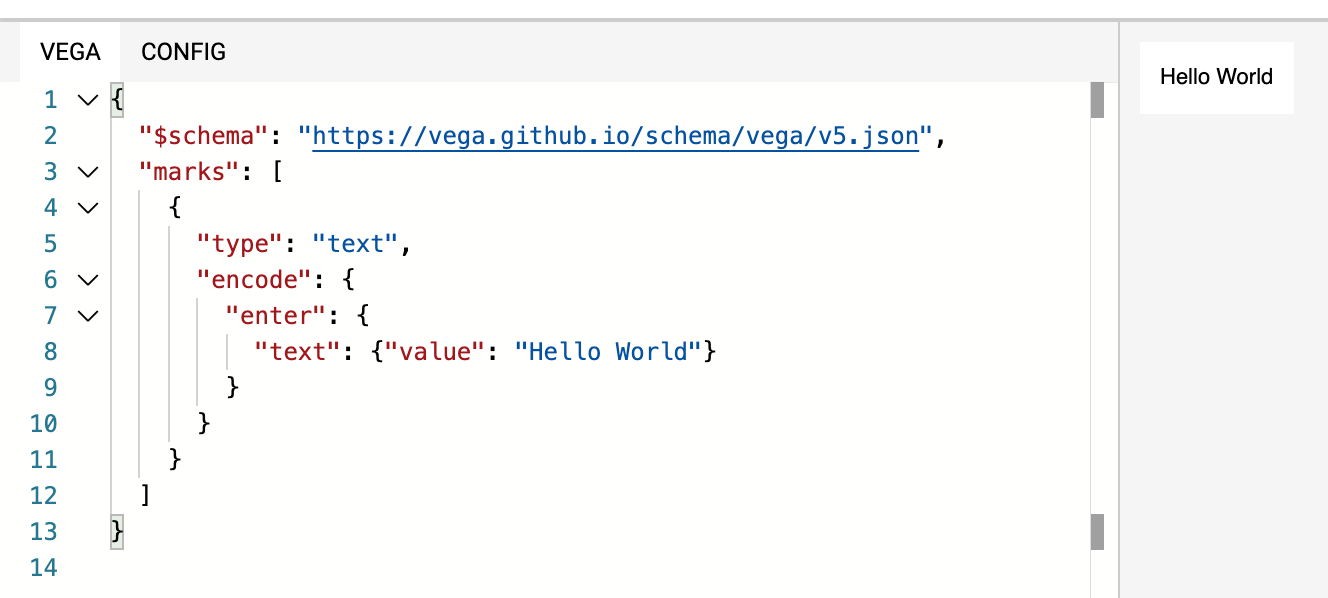
By the way, we may not even need to fill in any data since Vega renders marks without data bindings as a single mark.
{
  "$schema": "https://vega.github.io/schema/vega/v5.json",
  "marks": [
    {
      "type": "text",
      "encode": {
        "enter": {
          "text": {"value": "Hello World"}
        }
      }
    }
  ]
}
domoritz
on 7 Apr 2020
we may not even need to fill in any data
We should not fill any data. That's the original intention. Sorry for not being clear.
kanitw
on 8 Apr 2020
may i also propose that a mark without an encoding to a datasource also be treated in this manner (as if there is no datasource), as a way to address #7011 without having to specify a dummy datasource?
 eflister
on 28 Oct 2020
eflister
on 28 Oct 2020
I like that idea as an extension of this issue! Thanks for the suggestion @eflister.
domoritz
on 28 Oct 2020
may i also propose that a mark without an encoding to a datasource also be treated in this manner (as if there is no datasource), as a way to address #7011 without having to specify a dummy datasource?
I disagree. If you specify a driving data collection for marks, there should be one mark per driving data whether you specify encoding or not.
kanitw
on 3 Jan 2021
data: [{}] already works today. This issue is more like suggesting that unit spec can work without data at all.
We should perhaps allow data: null for child specs that wouldn't adopt data from its parent.
kanitw
on 3 Jan 2021
Related issues
kanitw
·
3Comments
 mcnuttandrew
·
3Comments
mcnuttandrew
·
3Comments
 ijlyttle
·
3Comments
kanitw
·
3Comments
ijlyttle
·
4Comments
ijlyttle
·
3Comments
kanitw
·
3Comments
ijlyttle
·
4Comments
Most helpful comment
I think the empty default data is a good idea, though I'd mildly advocate for
"data": { "values": [{}] }rather than"data": { "values": [1] }.