Vega-lite: legend and axis format property has no effect for ordinal encodings
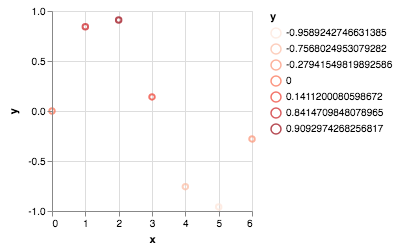
Illustrated by the following spec:
When you specify format in a vega legend, the generated vega spec does not have any format property present:
{
  "data": {
    "values": [
      {"x": 0}, {"x": 1}, {"x": 2}, {"x": 3}, {"x": 4}, {"x": 5}, {"x": 6}
    ]
  },
  "transform": [{"calculate": "sin(datum.x)", "as": "y"}],
  "mark": "point",
  "encoding": {
    "color": {
      "type": "ordinal",
      "field": "y",
      "legend": {"format": ".2f"},
      "scale": {"scheme": "reds"}
    },
    "x": {"type": "quantitative", "field": "x"},
    "y": {"type": "quantitative", "field": "y"}
  }
}
 jakevdp
All 7 comments
Format works for quantitative encodings. I'm not sure whether this is really a bug since it's not obvious whether the format should be a number or a date format. The same problem occurs with axes, btw. This is not unique to legends.
 domoritz
on 20 Aug 2018
domoritz
on 20 Aug 2018
Having said this, I think we could apply format as a numberFormat and add as new property timeFormat.
domoritz
on 20 Aug 2018
That makes sense... I've noticed though that if I manually add the format argument to the compiled vega spec, it produces the result that I would have expected from the vega-lite:
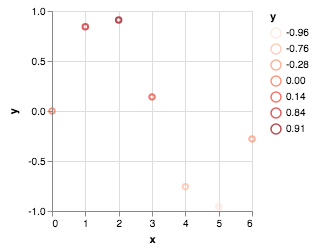
Is there a reason not to assume the user knows what they want to do, and propagate this argument to the compiled spec?
Vega spec for the above chart:
{
  "$schema": "https://vega.github.io/schema/vega/v4.json",
  "autosize": "pad",
  "padding": 5,
  "width": 200,
  "height": 200,
  "style": "cell",
  "data": [
    {
      "name": "source_0",
      "values": [
        {"x": 0},
        {"x": 1},
        {"x": 2},
        {"x": 3},
        {"x": 4},
        {"x": 5},
        {"x": 6}
      ]
    },
    {
      "name": "data_0",
      "source": "source_0",
      "transform": [
        {"type": "formula", "expr": "toNumber(datum[\"x\"])", "as": "x"},
        {"type": "formula", "expr": "sin(datum.x)", "as": "y"}
      ]
    }
  ],
  "marks": [
    {
      "name": "marks",
      "type": "symbol",
      "style": ["point"],
      "from": {"data": "data_0"},
      "encode": {
        "update": {
          "opacity": {"value": 0.7},
          "fill": [
            {
              "test": "datum[\"x\"] === null || isNaN(datum[\"x\"]) || datum[\"y\"] === null || isNaN(datum[\"y\"])",
              "value": null
            },
            {"value": "transparent"}
          ],
          "stroke": [
            {
              "test": "datum[\"x\"] === null || isNaN(datum[\"x\"]) || datum[\"y\"] === null || isNaN(datum[\"y\"])",
              "value": null
            },
            {"scale": "color", "field": "y"}
          ],
          "tooltip": {
            "signal": "{\"x\": format(datum[\"x\"], \"\"), \"y\": format(datum[\"y\"], \"\")}"
          },
          "x": {"scale": "x", "field": "x"},
          "y": {"scale": "y", "field": "y"}
        }
      }
    }
  ],
  "scales": [
    {
      "name": "x",
      "type": "linear",
      "domain": {"data": "data_0", "field": "x"},
      "range": [0, {"signal": "width"}],
      "nice": true,
      "zero": true
    },
    {
      "name": "y",
      "type": "linear",
      "domain": {"data": "data_0", "field": "y"},
      "range": [{"signal": "height"}, 0],
      "nice": true,
      "zero": true
    },
    {
      "name": "color",
      "type": "ordinal",
      "domain": {"data": "data_0", "field": "y", "sort": true},
      "range": {"scheme": "reds"}
    }
  ],
  "axes": [
    {
      "scale": "x",
      "orient": "bottom",
      "grid": false,
      "title": "x",
      "labelFlush": true,
      "labelOverlap": true,
      "tickCount": {"signal": "ceil(width/40)"},
      "zindex": 1
    },
    {
      "scale": "x",
      "orient": "bottom",
      "gridScale": "y",
      "grid": true,
      "tickCount": {"signal": "ceil(width/40)"},
      "domain": false,
      "labels": false,
      "maxExtent": 0,
      "minExtent": 0,
      "ticks": false,
      "zindex": 0
    },
    {
      "scale": "y",
      "orient": "left",
      "grid": false,
      "title": "y",
      "labelOverlap": true,
      "tickCount": {"signal": "ceil(height/40)"},
      "zindex": 1
    },
    {
      "scale": "y",
      "orient": "left",
      "gridScale": "x",
      "grid": true,
      "tickCount": {"signal": "ceil(height/40)"},
      "domain": false,
      "labels": false,
      "maxExtent": 0,
      "minExtent": 0,
      "ticks": false,
      "zindex": 0
    }
  ],
  "legends": [
    {
      "stroke": "color",
      "title": "y",
      "format": ".2f",
      "encode": {
        "symbols": {
          "update": {
            "fill": {"value": "transparent"},
            "opacity": {"value": 0.7}
          }
        }
      }
    }
  ],
  "config": {"axisY": {"minExtent": 30}}
}
Yeah, I think we should propagate format to be the number format automatically.
domoritz
on 20 Aug 2018
I agree that we should fix this bug, though I disagree about the following part:
Having said this, I think we could apply format as a numberFormat and add as new property timeFormat.
We should not introduce a new property here. Raw time data without time unit generally do not make sense to be ordinal, so in most cases, we could apply format to timeFormat when there is timeUnit for the ordinal field.
To support the rare case, we could add formatType: 'number' | 'time' to allow explicit specification. This is better than adding timeFormat as format would normally work for ordinal time field with timeUnit.
 kanitw
on 21 Aug 2018
kanitw
on 21 Aug 2018
Okay, let's do the following
- Use format as number format for ordinal and nominal
- Later we can add
formatTypebut it wouldn't be a breaking change.
domoritz
on 21 Aug 2018
Use format as number format for ordinal and nominal
without timeUnit (and use as timeFormat, with timeUnit)
kanitw
on 21 Aug 2018
Related issues
 rmales
·
3Comments
domoritz
·
4Comments
rmales
·
3Comments
domoritz
·
4Comments
 mcadams92
·
3Comments
mcadams92
·
3Comments
 ijlyttle
·
3Comments
ijlyttle
·
3Comments
 fuglede
·
4Comments
fuglede
·
4Comments
Most helpful comment
I agree that we should fix this bug, though I disagree about the following part:
We should not introduce a new property here. Raw time data without time unit generally do not make sense to be ordinal, so in most cases, we could apply
formatto timeFormat when there istimeUnitfor the ordinal field.To support the rare case, we could add
formatType: 'number' | 'time'to allow explicit specification. This is better than addingtimeFormatasformatwould normally work for ordinal time field withtimeUnit.