Urql: Typescript bindings are missing cache.clear() on offlineExchange.
urql version & exchanges: 1.9.8
dedupExchange, offlineExchange, fetchExchange
Steps to reproduce
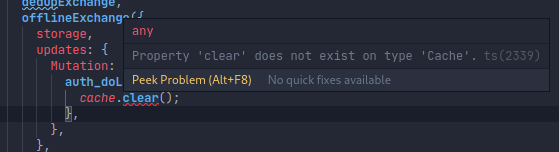
- Adding a cache.clear() update to a mutation ends with a typescript error.
Expected behavior
See this Pull Request for expected behaviour:
https://github.com/FormidableLabs/urql-exchange-graphcache/pull/119/files
Actual behavior
You can reproduce this error by using typescript and the offlineExchange.
This cache-type returned when using "updates" on the offlineCache has the following methods:

As you can see its missing the .clear() method.
I'd also like to add that the StorageAdapter type that each storage extends has the following methods in the typescript-interface:

But in the source code it also has the clear method as seen here:
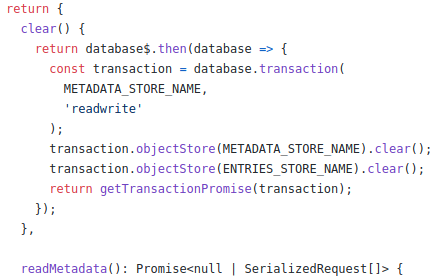
Code snippet taken from this file: https://github.com/FormidableLabs/urql/blob/master/exchanges/graphcache/src/default-storage/index.ts
 ljukas
All 5 comments
It seems I missed in the discussion that the better approach is to recreate the cache using a wrapper where the cache is stored as state. I still think it should be possible to maybe invalidate the entire cache instead, or maybe take a new look at the .clear() method as it seems a far better solution then everyone having to write a wrapper to be able to clear the cache.
ljukas
on 23 Jun 2020
The Cache type isn’t the same as a StorageAdapter.
The cache in each function of the configuration represents the Store which implements the Cache Interface using which you can query and alter the local normalised data.
The StorageAdapter is concerned about persisting that state and restoring it on rehydration.
The default-storage has a clear() method would that persisted state can be cleared in case it becomes super stale (on a complete upgrade of the API for instance, or a log out, or a language change)
The in-memory store can’t be cleared because we don’t believe that it’s a good practice for several reasons:
- Likely if something triggers a mutation or other action (like a logout) that switches pages the app can reinstantiate the entire
urqlClient which is safer as it erases more state - On something like a language switch, a reload may make more sense, since otherwise often local state and state outside of GraphQL isn’t erased or forgotten about, which is a rather common bug
- We don’t want to couple the in-memory cache, which is isolated to _all_ data, which would cause all operations (queries) to reload and refetch which often also isn’t desirable
In these use-cases we’ve often recommended people to simply reload or to recreate the client because it’s safer and less error-prone. This doesn’t typically prevent any use-cases, as a normalised cache that’s entirely erased doesn’t often have any other use-case where it’d be valid to erase all data and trigger a refetch, which triggers all queries on the page to refetch, while the same page and UI components to remain active.
 kitten
on 23 Jun 2020
kitten
on 23 Jun 2020
Thanks for the answer!
How would one hook into the default-storage to clear it? Say when a user logs out. The "useClient" hook doesnt seem to give access to the clients storage. I'm thinking especially when using the offlineStorage exported by exchange-graphcache.
I tried with creating a new client, but since the store is saved in an indexeddb it doesn't get cleared. Deleting the database as well works to erase all the data, but doesn't seem to trigger the useQuery:ies to rerun.
ljukas
on 23 Jun 2020
You'd probably want to create a custom provider for that if that's deeply used inside your app, but since the storage is also a global, you could just export it from a new file and use it directly or expose a helper function that calls storage.clear().
I tried with creating a new client, but since the store is saved in an indexeddb it doesn't get cleared.
Yes, when I'm talking about recreating the client, I'm talking about clearing the in-memory data, not the IndexedDB data, so for clearing that you'll have to call the storage.clear() method you found manually.
kitten
on 23 Jun 2020
Sounds like a good plan! Thanks!
ljukas
on 23 Jun 2020
Related issues
 maxzhuk0v
·
3Comments
maxzhuk0v
·
3Comments
 nicollecastrog
·
3Comments
nicollecastrog
·
3Comments
 wodnjs6512
·
3Comments
kitten
·
4Comments
wodnjs6512
·
3Comments
kitten
·
4Comments
 frederikhors
·
3Comments
frederikhors
·
3Comments
Most helpful comment
You'd probably want to create a custom provider for that if that's deeply used inside your app, but since the storage is also a global, you could just export it from a new file and use it directly or expose a helper function that calls
storage.clear().Yes, when I'm talking about recreating the client, I'm talking about clearing the in-memory data, not the IndexedDB data, so for clearing that you'll have to call the
storage.clear()method you found manually.