Uassets: nytimes.com detects private browsing
URL(s) where the issue occurs
https://www.nytimes.com/2019/05/23/science/spacex-launch.html
Describe the issue
A few seconds after the page loads, the site will detect that you're visiting it in private browsing mode and will hide all of the content.
Versions
- Browser/version: Firefox 67.0
- uBlock Origin version: 1.19.6
Settings
- All defaults
Notes
nytimes.com##+js(abort-on-property-read.js, window.indexedDB) fixes it for me, but interestingly, nytimes.com##+js(set-constant.js, window.indexedDB, undefined) does not.
 josephcsible
All 57 comments
I can't reproduce.
 okiehsch
on 27 May 2019
okiehsch
on 27 May 2019
Hmm, I can reproduce it on my Linux box but not my Windows box (both same browser and uBO versions). I'll poke around a bit to try to figure out why.
josephcsible
on 27 May 2019
I created a completely new profile in Windows, installed uBO without doing anything else, then went there in private browsing mode, and then I could reproduce it there.
josephcsible
on 27 May 2019
I can't reproduce with Linux or Windows on my end.
okiehsch
on 27 May 2019
Did you try with a fresh profile?
josephcsible
on 27 May 2019
With Firefox, I only use it to test filters anyway, so it is a default installation + uBO.
I can't reproduce with Chromium either, though I have not tried a fresh profile.
okiehsch
on 27 May 2019
Let's wait and see if other users can reproduce,
okiehsch
on 27 May 2019
I think they might be doing some kind of A/B testing or something, where not every request has the malicious code. I just opened my original Windows Firefox profile again (the one that I didn't repro on before), and now I do repro there.
josephcsible
on 27 May 2019
This is definitely still happening. Can it be reopened?
josephcsible
on 30 May 2019
I could reproduce on Test Firefox profile on Windows 10 with only uBO & stock filters.
 yourduskquibbles
on 30 May 2019
yourduskquibbles
on 30 May 2019
does the OP's filter fix the issue ?
nytimes.com##+js(abort-on-property-read.js, window.indexedDB)
 mapx-
on 30 May 2019
mapx-
on 30 May 2019
I still can't reproduce.
When the private browsing mode of Firefox is enabled, the IndexedDB throws an InvalidStateError because it is not available in private browsing mode, so the mentioned filter probably works.
okiehsch
on 30 May 2019
@josephcsible nytimes.com##+js(abort-on-property-read.js, window.indexedDB) partially works for me and allows the article to load but it also seems to break embedded objects within the page with that filter as well.
I see a broken twitter embed, a missing youtube video and a missing nytimes.com embedded frame in the article page with that filter. Are you getting those page embedding breaking issues as well?
yourduskquibbles
on 31 May 2019
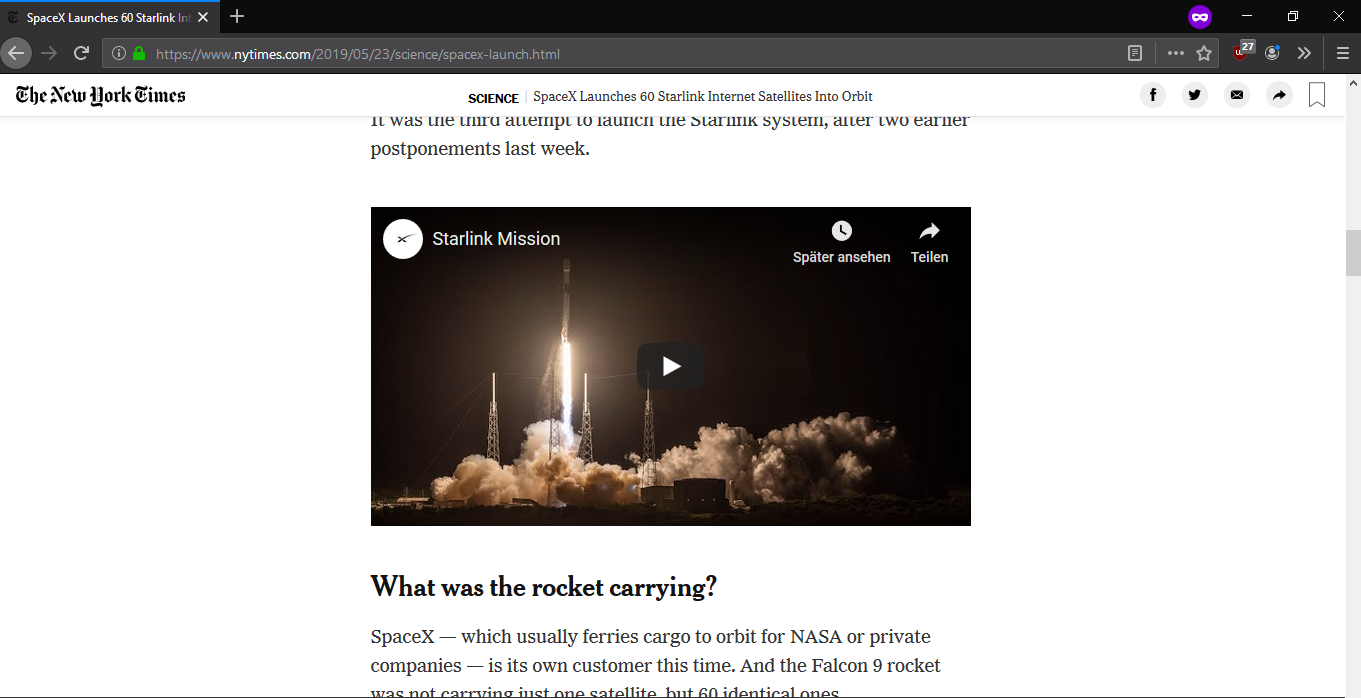
Interestingly nothing is broken on my end with that filter, I see the youtube video, is it always broken on your end - with that filter in place - or only if the private browsing detection kicks in?
okiehsch
on 31 May 2019
Interestingly nothing is broken on my end with that filter, I see the youtube video, is it always broken on your end - with that filter in place - or only if the private browsing detection kicks in?
Yes broken for me on regular or private browsing with nytimes.com##+js(abort-on-property-read.js, window.indexedDB) as my only filter besides stock filters.
Below is a screenshot from a non-private browsing session with logger & example link side by side. The nytimes.com##+js(abort-on-property-read.js, window.indexedDB) filter looks like it is being applied against the nytimes.com embeded frame first on my side which then maybe cripples the twitter and youtube embed as well?
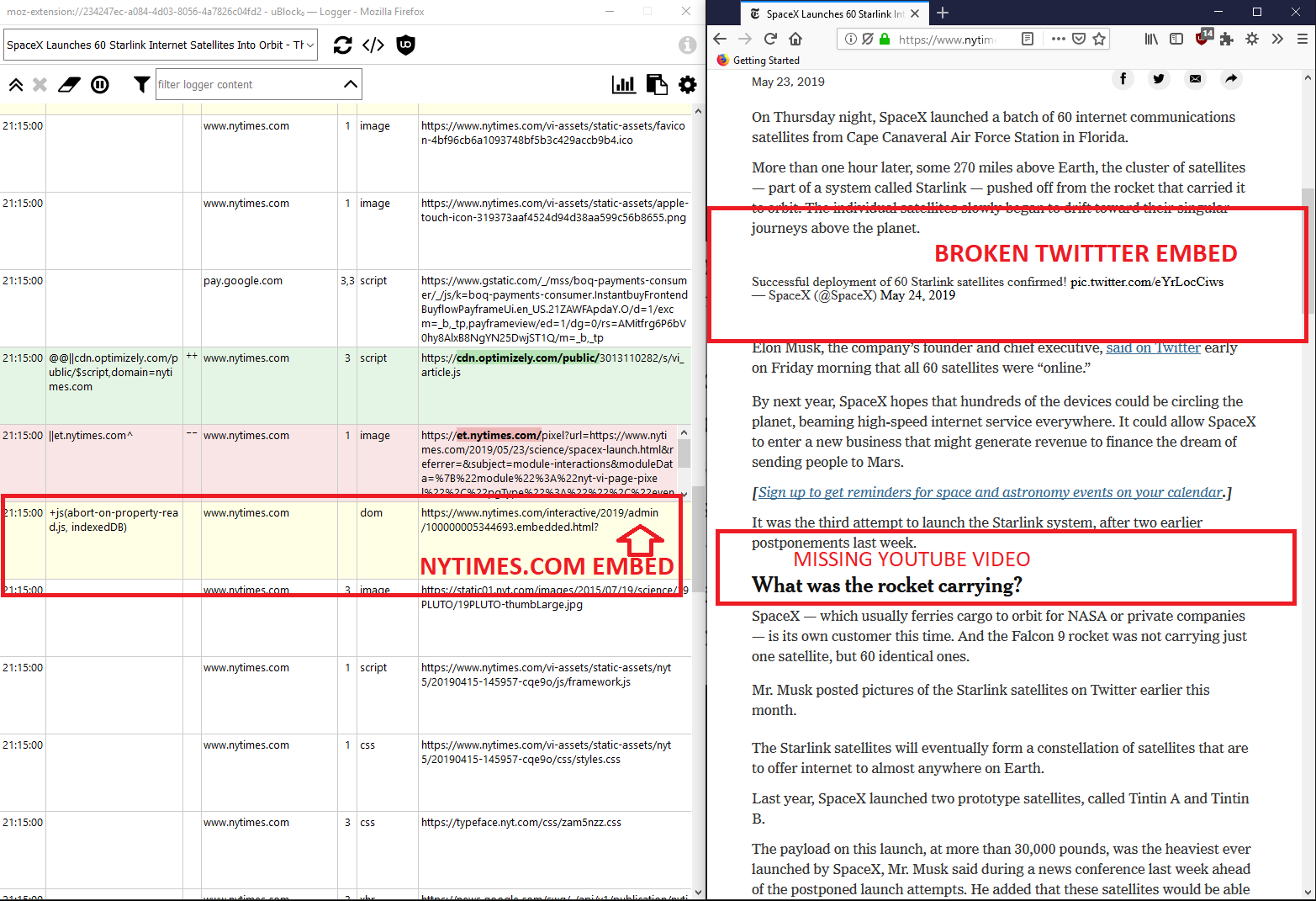
The page looks the same with broken embeds in private browsing mode as well but doesn't break the embeds when I remove nytimes.com##+js(abort-on-property-read.js, window.indexedDB)
yourduskquibbles
on 31 May 2019
Mostly a note....
I was trying to reproduce this issue, but couldn't, however I coulnd't help myself from noting that out of 77 queries the 37 (~50%) of them is tracking / spam .... Shouldn't nytimes.com be a "newspaper" protecting democracy? or is it just me as a European who have misunderstood the concept of "_American_" democracy!!
 spirillen
on 3 Jun 2019
spirillen
on 3 Jun 2019
I can reproduce on both Firefox and chrome on Windows 7. I'm attempting to work on a filter to get around it, but it's going rather slowly.
*note: I'm using more than stock filters
 Jap2-0
on 5 Jun 2019
Jap2-0
on 5 Jun 2019
Happens for me in Brave Browser (Chromium fork)

 irlcatgirl
on 7 Jun 2019
irlcatgirl
on 7 Jun 2019
Same issue using Firefox 67.0.4 on 64-bit Windows 10 as well as Windows 7. Tested both filters shared by @josephcsible.
Tried nytimes.com##+js(set-constant.js, window.indexedDB, undefined) first and it worked just one time and never again.
Tried nytimes.com##+js(abort-on-property-read.js, window.indexedDB) and it's been working so far.
However, the embedded video and twitter feed also gets hidden as a side effect. With the filter enabled, this happens in both normal as well as private browsing mode. Without filter, the embedded items don't get hidden in normal mode.
 in4u
on 23 Jun 2019
in4u
on 23 Jun 2019
Disabling JavaScript works fine if you just want to read an article.
 gorhill
on 7 Jul 2019
gorhill
on 7 Jul 2019
I can reproduce this both with uBO turned off, and while it is on.
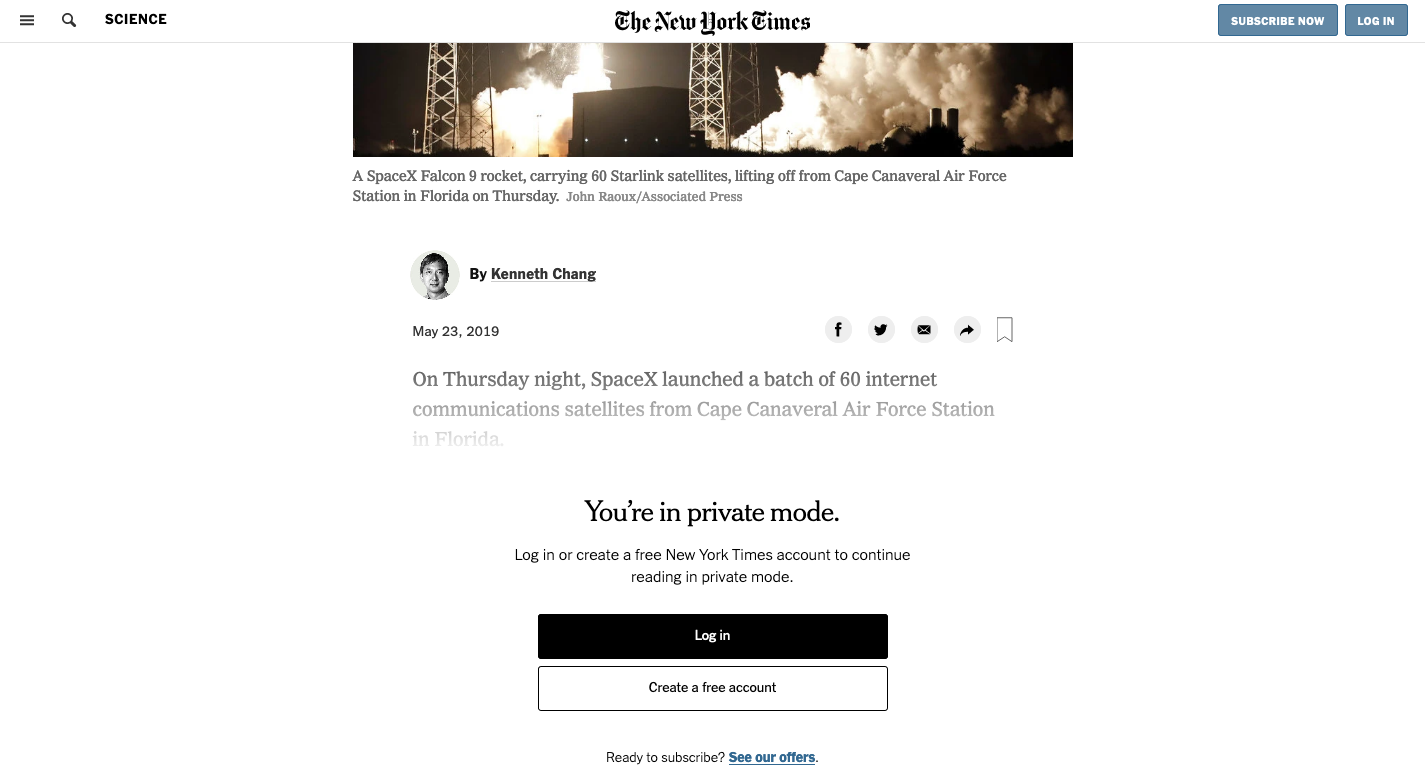
Firefox 67.0.4, uBO 1.20.0, macOS 10.14.4
 numbermaniac
on 10 Jul 2019
numbermaniac
on 10 Jul 2019
Does
nytimes.com##^script:has-text(NYTD.Abra)
work for you?
okiehsch
on 10 Jul 2019
@okiehsch Yes, that fixed it for me.
numbermaniac
on 10 Jul 2019
@numbermaniac just a heads up if you add
nytimes.com##^script:has-text(NYTD.Abra)
to your filter list it will also cause some site breakage, for example it breaks the youtube video at
https://www.nytimes.com/2019/05/23/science/spacex-launch.html
and embedded tweets will not show up.
The filter is only meant to be used if you just want to read an article in incognito mode.
For Chrome/Chromium users
nytimes.com##+js(set-constant.js, NYTD.Abra, noopFunc)
works on my end without causing any noticable breakage.
The filter does not work using Firefox.
okiehsch
on 10 Jul 2019
May be of some relevance: Bypassing anti-incognito detection in Google Chrome
 llacb47
on 21 Jul 2019
llacb47
on 21 Jul 2019
Here's the code the NYT uses to detect private browsing -- from webpack:///./src/shared/utils/privateBrowsingDetect.js. I can reproduce in Chrome and Firefox.
/* eslint-disable consistent-return */

let on;
let off;

const isSafari = () => {
  if (Object.prototype.toString.call(window.HTMLElement).indexOf('Constructor') > 0) {
    return true;
  }

  if (
    // eslint-disable-next-line no-undef
    (!window.safari || safari.pushNotification).toString() === '[object SafariRemoteNotification]'
  ) {
    return true;
  }

  try {
    return window.localStorage && /Safari/.test(window.navigator.userAgent);
  } catch (e) {
    return false;
  }
};

const isMozilla = () => 'MozAppearance' in document.documentElement.style;

const Webkit = () => {
  if (window.webkitRequestFileSystem) {
    window.webkitRequestFileSystem(window.TEMPORARY, 1, off, on);
    return true;
  }
};

const Mozilla = () => {
  if (isMozilla()) {
    const db = indexedDB.open('test');
    db.onerror = on;
    db.onsuccess = off;
    return true;
  }
};

const Safari = () => {
  if (isSafari()) {
    // iOS 11
    // Origin: https://gist.github.com/cou929/7973956#gistcomment-2272103
    try {
      window.openDatabase(null, null, null, null);
    } catch (e) {
      on();
      return true;
    }

    // Older Safari
    try {
      if (localStorage.length) off();
      else {
        localStorage.x = 1;
        localStorage.removeItem('x');
        off();
      }
    } catch (e) {
      // Original gist: https://gist.github.com/jherax/a81c8c132d09cc354a0e2cb911841ff1

      // Safari only enables cookie in private mode
      // if cookie is disabled then all client side storage is disabled
      // if all client side storage is disabled, then there is no point
      // in using private mode
      navigator.cookieEnabled ? on() : off(); // eslint-disable-line no-unused-expressions
    }

    return true;
  }
};

const IE10Edge = () => {
  if (!window.indexedDB && (window.PointerEvent || window.MSPointerEvent)) {
    on();
    return true;
  }
};

export const checkPrivate = (onCb, offCb) => {
  on = onCb || (() => {});
  off = offCb || (() => {});
  Webkit() || Mozilla() || Safari() || IE10Edge() || off(); // eslint-disable-line no-unused-expressions
};

export const checkPrivateWhitelist = (onCb, offCb) => {
  const whitelistOn = onCb || (() => {});
  const whitelistOff = offCb || (() => {});

  const privateButAllowed = [
    'FBAV',
    'FBAN',
    'FBIOS',
    'FBBV',
    'FBDV',
    'FBMD',
    'FBSN',
    'FBSV',
    'FBSS',
    'FBCR',
    'FBID',
    'FBLC',
    'FBOP',
    'Twitter for iPhone',
    'TwitterAndroid',
    'nytios',
    'nytiphone',
    'nytipad',
    'nyt-android',
    'AppleNews',
    'Flipboard',
  ];

  const re = new RegExp(privateButAllowed.join('|'), 'i');
  if (re.test(navigator.userAgent)) {
    whitelistOn();
    return true;
  }

  whitelistOff();
  return false;
};
I can reproduce Washington Post private mode detection https://www.washingtonpost.com/business/2019/07/30/trump-backpedals-china-threats-trade-deal-shows-signs-slipping-away/ in Chrome, but not Firefox in neither browser.
WaPo's private mode detection code is obfuscated... and inside an inline script.
"condition_isPM": function() {
    return new Promise(function(_0x5c8e98) {
        var _0x3054d7 = !![];
        if (navigator[_0x2ec0("0x1a")]["indexOf"](_0x2ec0("0x1b")) >
            -1) return (new Promise(function(_0x5c8e98) {
            var _0x36aeee = window["RequestFileSystem"] || window[_0x2ec0("0x1c")];
            if (_0x36aeee) _0x36aeee(window[_0x2ec0("0x1d")], 100, function() {
                _0x3202b0["pv"] = ![];
                _0x5c8e98({
                    "type": "pv",
                    "result": _0x3202b0["pv"],
                    "overlay": _0x3054d7
                })
            }, function() {
                _0x3202b0["pv"] = !![];
                _0x5c8e98({
                    "type": "pv",
                    "result": _0x3202b0["pv"],
                    "overlay": _0x3054d7
                })
            })
        }))["then"](function(_0x48925e) {
            _0x5c8e98(_0x48925e)
        });
        else if (navigator[_0x2ec0("0x1a")][_0x2ec0("0x1e")]("Safari") > -1) try {
                var _0x50cda8 =
                    _0x2ec0("0x1f");
                window[_0x2ec0("0x20")][_0x2ec0("0x21")](_0x50cda8, _0x2ec0("0x22"));
                window[_0x2ec0("0x20")][_0x2ec0("0x23")](_0x50cda8);
                window[_0x2ec0("0x24")][_0x2ec0("0x21")](_0x50cda8, _0x2ec0("0x22"));
                window["localStorage"][_0x2ec0("0x23")](_0x50cda8);
                window[_0x2ec0("0x25")](null, null, null, null);
                _0x3202b0["pv"] = ![]
            } catch (_0x151b90) {
                _0x3202b0["pv"] = !![]
            } else if (navigator[_0x2ec0("0x1a")][_0x2ec0("0x1e")](_0x2ec0("0x26")) > -1) _0x3202b0["pv"] = !navigator[_0x2ec0("0x27")];
            else if (window[_0x2ec0("0x28")] ||
            window[_0x2ec0("0x29")]) _0x3202b0["pv"] = !window[_0x2ec0("0x2a")];
        else _0x3202b0["pv"] = ![];
        _0x5c8e98({
            "type": "pv",
            "result": _0x3202b0["pv"],
            "overlay": _0x3054d7
        })
    })
}
Since the WaPo anti-adblock and private mode detection are both in the same inline script, the filter washingtonpost.com##+js(abort-current-inline-script, Promise.all, adblocked) from https://github.com/uBlockOrigin/uAssets/commit/f0ade04a56a09472c2715e4525f19598c3490a9f takes care of both.
llacb47
on 30 Jul 2019
These filters work in Chrome (not Firefox) but they mess up fonts:
nytimes.com##+js(abort-current-inline-script.js, NYTD.Abra, indexedDB)
nytimes.com##+js(set-constant.js, NYTD.Abra, noopFunc)
Edit: tested in Chrome and Firefox, these filters don't seem to mess up fonts or anything else. Can you test these @okiehsch?
nytimes.com##+js(set-constant.js, webkitRequestFileSystem, noopFunc)
nytimes.com##+js(abort-current-inline-script.js, NYTD.Abra, indexedDB)
nytimes.com##+js(abort-on-property-read.js, indexedDB.open)
Test link with video: https://www.nytimes.com/2014/01/07/us/burglars-who-took-on-fbi-abandon-shadows.html
Test link with fonts: https://www.nytimes.com/2019/07/30/magazine/deported-mother.html
Test link with third-party embeds: https://www.nytimes.com/2019/05/23/science/spacex-launch.html
llacb47
on 30 Jul 2019
https://chromereleases.googleblog.com/2019/07/stable-channel-update-for-desktop_30.html
Fixes the issue for Chrome users.
nytimes.com##+js(set-constant.js, webkitRequestFileSystem, noopFunc)
works on my end using Firefox.
okiehsch
on 31 Jul 2019
Will filters to fix this still be added? Not everyone who uses uBO has an up-to-date Chrome.
llacb47
on 31 Jul 2019
So this issue will not be fixed in older Chrome versions?
llacb47
on 31 Jul 2019
Is there a reason you're not updating Chrome?
numbermaniac
on 31 Jul 2019
With Chrome 76+ the issue "disappears".
https://www.zdnet.com/article/google-to-clamp-down-on-incognito-mode-detection
okiehsch
on 31 Jul 2019
I have an old version of Chromium to avoid a redesign, but at some point I will probably upgrade due to security concerns. However, not everyone uses the latest version of Chrome, and if a filter can be added for that, that would be appreciated.
llacb47
on 31 Jul 2019
The filter nytimes.com##+js(set-constant.js, webkitRequestFileSystem, noopFunc) works in Firefox and Chrome. This filter doesn't break anything in either browser, as webkitRequestFileSystem is only used for private mode and third party cookie detection by nytimes.com. Please remove the pre-processing directive !#if env_firefox ... !#endif.
llacb47
on 1 Aug 2019
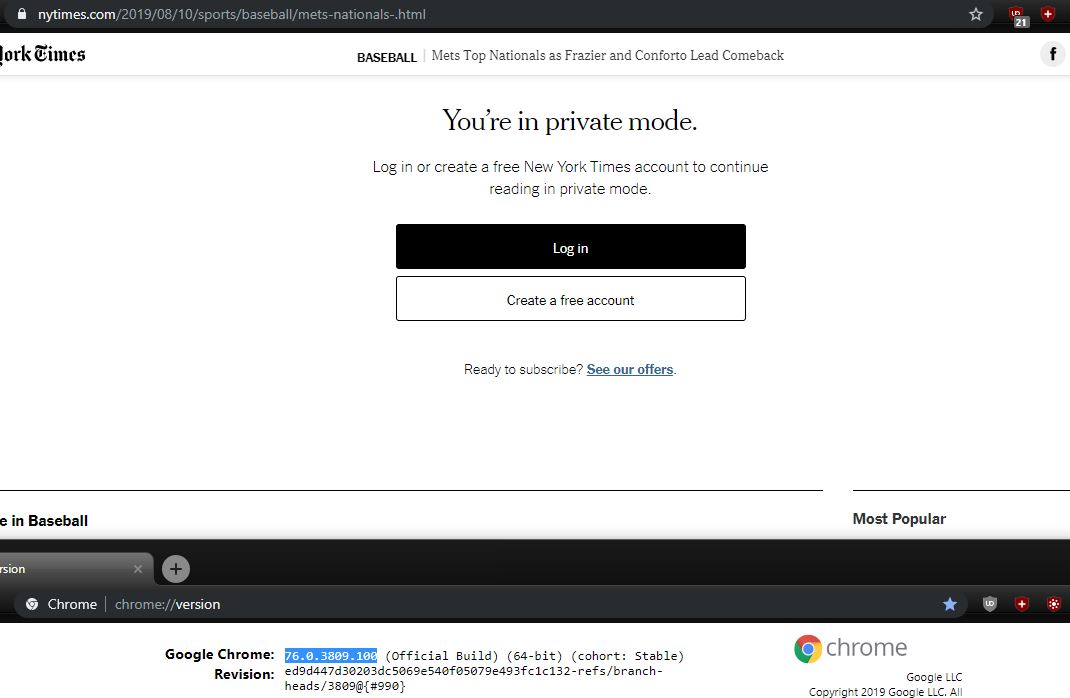
On Chrome 76.0.3809.100 and uBO 1.21.6, I still get caught by this, even with the change made in commit 18955b6.
josephcsible
on 10 Aug 2019
Yes, they changed it again to circumvent
https://www.blog.google/outreach-initiatives/google-news-initiative/protecting-private-browsing-chrome/
and our filter will also not work anymore.
okiehsch
on 10 Aug 2019
nytimes.com##+js(set-constant.js, NYTD.Abra, trueFunc)
works if you just want to read the articles.
It will break the homepage.
okiehsch
on 10 Aug 2019
Install chrome 76 and test again?
 krystian3w
on 10 Aug 2019
krystian3w
on 10 Aug 2019
Install chrome 76 and test again?
okiehsch
on 10 Aug 2019
https://mishravikas.com/articles/2019-07/bypassing-anti-incognito-detection-google-chrome.html
llacb47
on 10 Aug 2019
@llacb47 Yep, that's what they're doing. Here's the new malicious code snippet (they even left a link in the comment pointing to the site you mentioned):
/* eslint-disable consistent-return */

let on;
let off;

/**
 * Quota for an incognito Chrome window is a fraction (10%) of the device memory with an upper limit of 120MB.
 * More info: https://mishravikas.com/articles/2019-07/bypassing-anti-incognito-detection-google-chrome.html
 */
export const INCOG_MAX_QUOTA = 120;
export const MB_IN_BYTES = 2 ** 20;

const isSafari = () => {
  if (Object.prototype.toString.call(window.HTMLElement).indexOf('Constructor') > 0) {
    return true;
  }

  if (
    // eslint-disable-next-line no-undef
    (!window.safari || safari.pushNotification).toString() === '[object SafariRemoteNotification]'
  ) {
    return true;
  }

  try {
    return window.localStorage && /Safari/.test(window.navigator.userAgent);
  } catch (e) {
    return false;
  }
};

const isMozilla = () => 'MozAppearance' in document.documentElement.style;

const Webkit = () => {
  if (window.webkitRequestFileSystem) {
    window.webkitRequestFileSystem(window.TEMPORARY, 1, off, on);
    return true;
  }
};

const Mozilla = () => {
  if (isMozilla()) {
    const db = indexedDB.open('test');
    db.onerror = on;
    db.onsuccess = off;
    return true;
  }
};

const Safari = () => {
  if (isSafari()) {
    // iOS 11
    // Origin: https://gist.github.com/cou929/7973956#gistcomment-2272103
    try {
      window.openDatabase(null, null, null, null);
    } catch (e) {
      on();
      return true;
    }

    // Older Safari
    try {
      if (localStorage.length) off();
      else {
        localStorage.x = 1;
        localStorage.removeItem('x');
        off();
      }
    } catch (e) {
      // Original gist: https://gist.github.com/jherax/a81c8c132d09cc354a0e2cb911841ff1

      // Safari only enables cookie in private mode
      // if cookie is disabled then all client side storage is disabled
      // if all client side storage is disabled, then there is no point
      // in using private mode
      navigator.cookieEnabled ? on() : off(); // eslint-disable-line no-unused-expressions
    }

    return true;
  }
};

const IE10Edge = () => {
  if (!window.indexedDB && (window.PointerEvent || window.MSPointerEvent)) {
    on();
    return true;
  }
};

export const Chrome = () => {
  return Promise.resolve()
    .then(() => {
      if (navigator.storage && navigator.storage.estimate) {
        return navigator.storage.estimate();
      }
      return undefined;
    })
    .then(estimate => {
      if (estimate && estimate.quota) {
        const { quota } = estimate;
        const limit = INCOG_MAX_QUOTA * MB_IN_BYTES;
        if (quota <= limit) {
          return true;
        }
      }
      return false;
    })
    .catch(() => false);
};

export const checkPrivate = (onCb, offCb) => {
  on = onCb || (() => {});
  off = offCb || (() => {});

  Chrome().then(isPrivate => {
    if (isPrivate) {
      return on();
    }
    return Webkit() || Mozilla() || Safari() || IE10Edge() || off();
  });
};

export const checkPrivateWhitelist = (onCb, offCb) => {
  const whitelistOn = onCb || (() => {});
  const whitelistOff = offCb || (() => {});

  const privateButAllowed = [
    'FBAV',
    'FBAN',
    'FBIOS',
    'FBBV',
    'FBDV',
    'FBMD',
    'FBSN',
    'FBSV',
    'FBSS',
    'FBCR',
    'FBID',
    'FBLC',
    'FBOP',
    'Twitter for iPhone',
    'TwitterAndroid',
    'nytios',
    'nytiphone',
    'nytipad',
    'nyt-android',
    'AppleNews',
    'Flipboard',
  ];

  const re = new RegExp(privateButAllowed.join('|'), 'i');
  if (re.test(navigator.userAgent)) {
    whitelistOn();
    return true;
  }

  whitelistOff();
  return false;
};
Adding this rule fixes it for me: nytimes.com##+js(set-constant.js, navigator.storage.estimate, undefined)
josephcsible
on 11 Aug 2019
Thanks, that works on my end.
okiehsch
on 11 Aug 2019
krystian3w
on 17 Sep 2019
It seems only one of the two rules is enough to avoid detection on each platform like https://github.com/uBlockOrigin/uAssets/issues/7058
i.e.
##+js(set-constant.js, navigator.storage.estimate, undefined)
for Chromium and
nytimes.com##+js(set-constant.js, webkitRequestFileSystem, noopFunc)
for Firefox.
 Yuki2718
on 6 Mar 2020
Yuki2718
on 6 Mar 2020
Not sure if it should be addressed in uBlock Annoyances but if you access the site on Android (with or without the Annoyances filter enabled) you'll see leftover of modal popup only for several seconds.
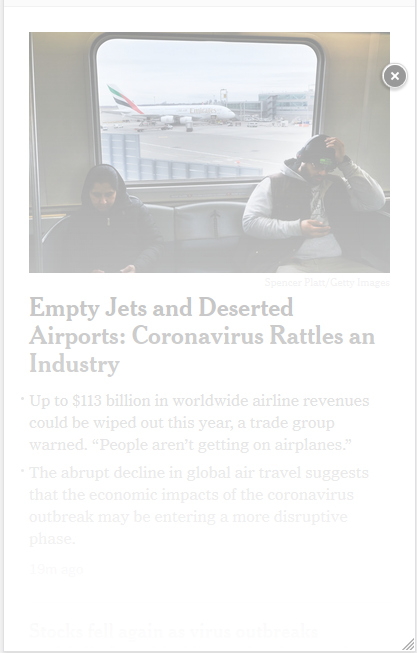
SS was taken on PC for convenience.
nytimes.com##.ReactModalPortal
Yuki2718
on 6 Mar 2020
Locked scroll?
PS. trojmiasto.pl also detect private mode in browser
krystian3w
on 6 Mar 2020
Locked scroll?
PS.
trojmiasto.plalso detect private mode in browser
Yeah, scroll is locked but I'm not sure whether a style rule is necessary as the scroll recovers just 2-3 seconds after page load.
Why don't you create a new issue for that?
Yuki2718
on 7 Mar 2020
Because you haven't separated into a new one with a locked-up pop-up rewind (scroll).
And this thread could be changed to "pages with private mode detection".
krystian3w
on 7 Mar 2020
Ah, I'm still not sure if that leftover should be addressed in uBlock Annoyances as it doesn't require uBO syntax. Given @okiehsch didn't add this I guess it's not.
Personally I agree, but since we don't have such thread as "pages with right-click disabled", maybe we're still required to report them one by one with each URL.
Yuki2718
on 8 Mar 2020
Given @okiehsch didn't add this I guess it's not.
I can't reproduce.
okiehsch
on 8 Mar 2020
Given @okiehsch didn't add this I guess it's not.
I can't reproduce.
Okay, will make a new issue. I'm currently a bit busy so may be late.
Yuki2718
on 8 Mar 2020
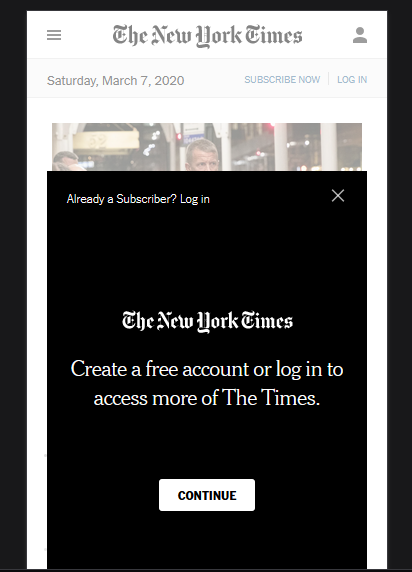
Is this the modal? Reproduced with Firefox emulating Android. Just like you said (only for several seconds) the modal goes away after a few seconds.
llacb47
on 8 Mar 2020
This filter gets rid of that: nytimes.com##.ReactModalPortal:has(.welcomeAd)
I assume this fits the criteria for annoyances.
Here's the full DOM structure of the popup, it's hard to look at since it is removed from the DOM after a few seconds: https://pastebin.com/hFG45Jqt
llacb47
on 8 Mar 2020
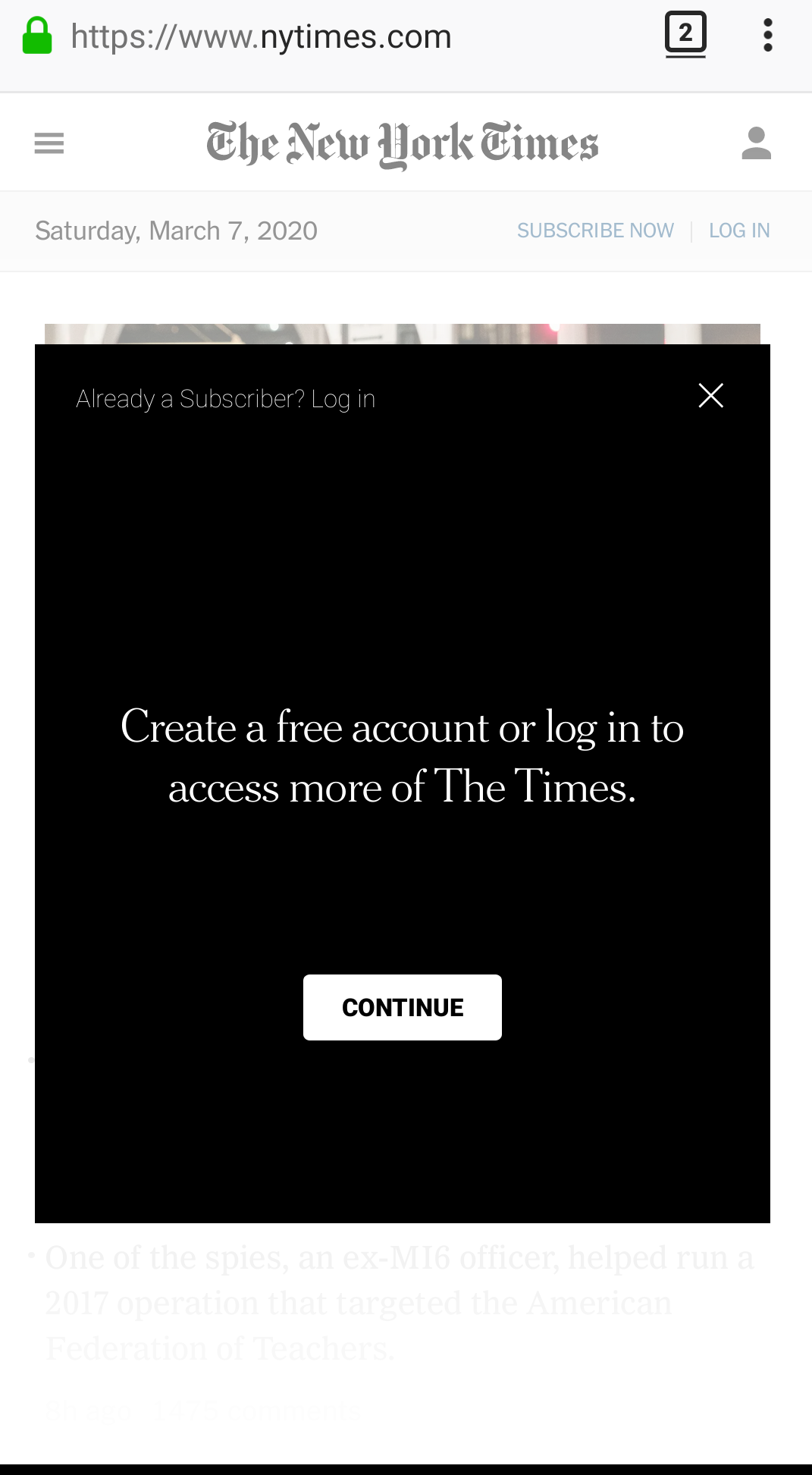
@llacb47 ty for confirmation and more, yeah, that one! I found I see that one on default settings rather than the leftover I posted on medium mode settings.
SS
Yuki2718
on 8 Mar 2020
Related issues
 ghost
·
3Comments
ghost
·
3Comments
 JulianNorton
·
3Comments
JulianNorton
·
3Comments
 macheteBadger
·
3Comments
macheteBadger
·
3Comments
 igitur
·
3Comments
igitur
·
3Comments
 Htin
·
4Comments
Htin
·
4Comments
Most helpful comment
I think they might be doing some kind of A/B testing or something, where not every request has the malicious code. I just opened my original Windows Firefox profile again (the one that I didn't repro on before), and now I do repro there.