Typescript: Poor deprecated messages - types should almost never be displayed.
/** @deprecated - this is bad advice */
declare function crossTheStreams(): void

crossTheStreams()
Expected: 'crossTheStreams' is deprecated.
Actual: '(): void' is deprecated
Notice the type in place of the entity name, notice the lack of a period at the end.

 DanielRosenwasser
All 17 comments
Note: This should normally happen only with overloads. It's not great with overloads either, so probably the overload message should be '{0}' with type '{1}' is deprecated. instead of putting a type into '{0}' is deprecated
 sandersn
on 27 Oct 2020
sandersn
on 27 Oct 2020
I assume this isn't as simple as using signature.declaration.name.escapedText?
Like, signature.declaration could be JSDocSignature.
How would you get the function name from a JSDocSignature?
 AnyhowStep
on 28 Oct 2020
AnyhowStep
on 28 Oct 2020
This should normally happen only with overloads.
Only if not every overload is deprecated. If all overloads are deprecated, showing the type doesn't help.
I assume this isn't as simple as using
signature.declaration.name.escapedText?
It is better to use one of the various helpers for printing out the expression when a name is available. We've done this in a couple of places where we try to special case this when the invoked expression is an identifier/property access.
DanielRosenwasser
on 28 Oct 2020
tryGetPropertyAccessOrIdentifierToString is one
DanielRosenwasser
on 28 Oct 2020
getCalledExpressionName is also similar, but is weird in that it'll give a partial result if the expression gets a bit too complex (e.g. foo().bar.baz will give you bar.baz).
Probably what you want is just to do something even more basic where you try grabbing the name.text off a property access, the text off an Identifier, and stop there. Not sure of any other helper functions that do this, but I'm sure this isn't the only place.
DanielRosenwasser
on 28 Oct 2020
I see getNameOfDeclaration, too
AnyhowStep
on 28 Oct 2020
The declaration name isn't always useful because it might be anonymous (it might just be a call signature, it might come from a default import). The most relevant name for this error message is the one that is being used locally.
Something useful might be to provide a related span linking back to where the deprecation comes from, so that would link users back to the relevant declaration.
The declaration was marked as deprecated here.
I have no clue what I'm doing but I tried something like this (I should remove the "lol"),
        function checkDeprecatedSignature(signature: Signature, node: CallLikeExpression) {
            if (signature.declaration && signature.declaration.flags & NodeFlags.Deprecated) {
                const suggestionNode = getDeprecatedSuggestionNode(node);
                const deprecation = getJSDocDeprecatedTag(signature.declaration);
                if (deprecation == undefined) {
                    errorOrSuggestion(/*isError*/ false, suggestionNode, Diagnostics._0_is_deprecated, signatureToString(signature));
                } else {
                    const diagnostic = createDiagnosticForNode(
                        suggestionNode,
                        Diagnostics._0_is_deprecated,
                        signatureToString(signature) + "lol"
                    );
                    addRelatedInfo(
                        diagnostic,
                        createDiagnosticForNode(deprecation, Diagnostics.The_implementation_signature_is_declared_here)
                    );
                    suggestionDiagnostics.add({ ...diagnostic, category: DiagnosticCategory.Suggestion });
                }
            }
        }
And got something like this,
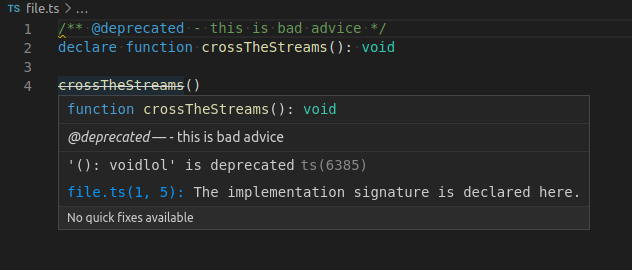
(I know it's the wrong diagnostic lol)
I'm surprised getJSDocDeprecatedTag() works for this,
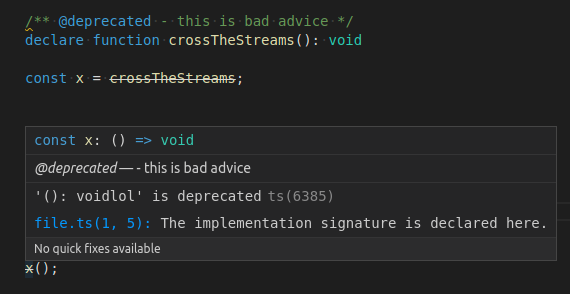
AnyhowStep
on 28 Oct 2020
(I should remove the "lol"),
But it's so fun!
Yeah, I don't know what the code currently looks like, but on the node, you should be able to getInvokedExpression and get the text using any of the methods I described above.
DanielRosenwasser
on 28 Oct 2020
I noticed this doesn't produce the deprecation notice on foo(blah)
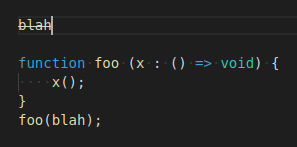
getCalledExpressionName seems to be in src/services/navigationBar.ts and not exported.
Huzzah!

Regarding overloads, this is pretty good. (ignore the eslint red squigglies)

AnyhowStep
on 28 Oct 2020
I think I've got it down,

AnyhowStep
on 28 Oct 2020
@DanielRosenwasser
Is it normal for Symbol.declarations to be a non-empty array but for valueDeclaration to be undefined?
I assumed valueDeclaration was just a shorthand for declarations[0].
This happens in tests/cases/fourslash/jsdocDeprecated_suggestion1.ts
Smaller repro,
//a.ts
/** @deprecated */
export function bar() {

}

/** @deprecated */
export type QW = 3;
//b.ts
import { bar, QW } from './a';
The import of bar is fine. It has valueDeclaration set.
However, QW has declarations.length == 1 but valueDeclaration == undefined.
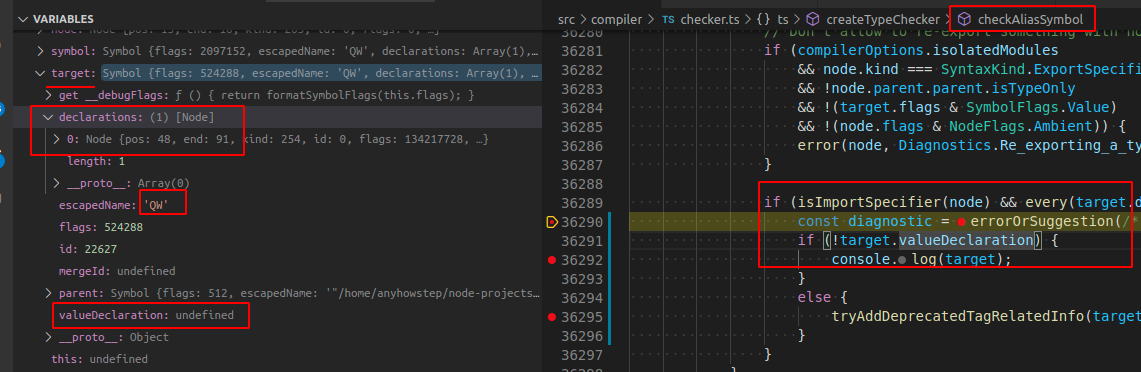
AnyhowStep
on 28 Oct 2020
It also seems like tryGetPropertyAccessOrIdentifierToString() doesn't like namespaces + optional chains.
In tests/cases/fourslash/jsdocDeprecated_suggestion1.ts,
the line containing foo?.[[|"faff"|]]?.() trips up tryGetPropertyAccessOrIdentifierToString().
Minimal repro,
export namespace foo {
    /** @deprecated */
    export function faff() { }
}

foo?.["faff"]?.();

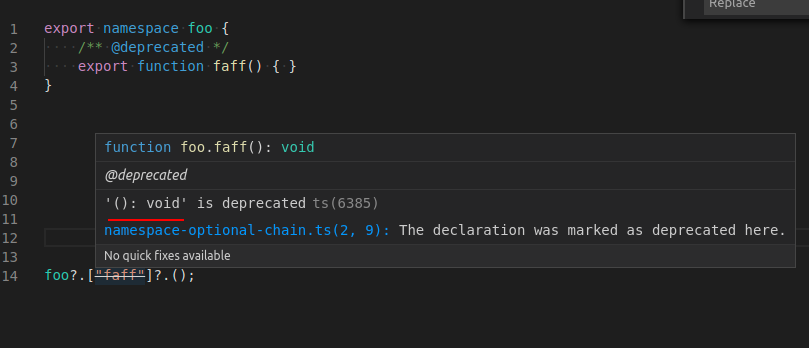
If you replace the namespace with a variable, it works.

Adding this seems to fix it,
        else if (isElementAccessExpression(expr)) {
            const baseStr = tryGetPropertyAccessOrIdentifierToString(expr.expression);
            if (baseStr !== undefined && isPropertyName(expr.argumentExpression)) {
                return baseStr + "." + getPropertyNameForPropertyNameNode(expr.argumentExpression);
            }
        }
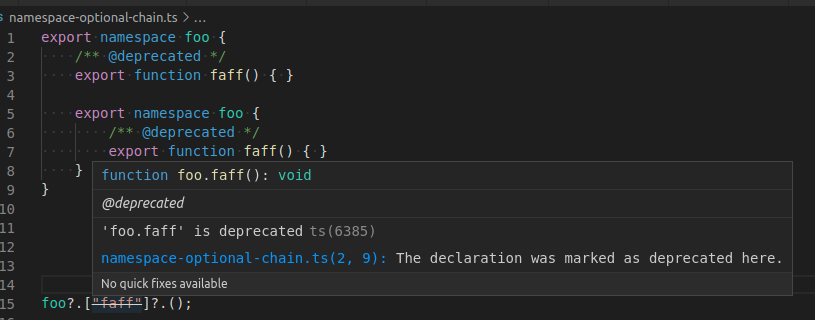
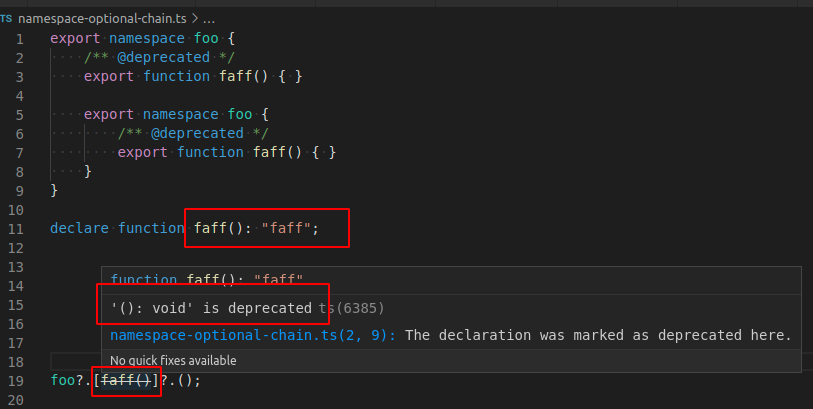
Unfortunately... It fails in this case,
AnyhowStep
on 28 Oct 2020
Is it normal for Symbol.declarations to be a non-empty array but for valueDeclaration to be undefined?
I assumed valueDeclaration was just a shorthand for declarations[0].
Basically, As the name of valueDeclaration, Only existed when some symbol could be an value
 Kingwl
on 28 Oct 2020
Kingwl
on 28 Oct 2020
It trips me up, though, because I see it declared as type Declaration, not Declaration|undefined.

It also doesn't make sense for a symbol to exist without a declaration, in my head.
AnyhowStep
on 28 Oct 2020
First value declaration means first declaration of value
You can also find all declarations(includes valueDeclaration) in the declarations field
Kingwl
on 28 Oct 2020
I see I had the wrong idea of what valueDeclaration was. It's conditionally set.

AnyhowStep
on 28 Oct 2020
Related issues
 manekinekko
·
3Comments
manekinekko
·
3Comments
 kyasbal-1994
·
3Comments
kyasbal-1994
·
3Comments
 MartynasZilinskas
·
3Comments
MartynasZilinskas
·
3Comments
 weswigham
·
3Comments
weswigham
·
3Comments
 fwanicka
·
3Comments
fwanicka
·
3Comments
Most helpful comment
I see I had the wrong idea of what

valueDeclarationwas. It's conditionally set.