Typescript: NoImplicitAny ignores inline functions that are type-constrained
TypeScript Version: 3.8.0-dev.20191025
Search Terms:
unknown noimplicitany
noimplicitany inline function
Code
interface SyncProjector<TSource> {
  (source: TSource): any;
}
function wth<T>(func: SyncProjector<T>) {
  return 0;
}
wth(dat=>dat);
Expected behavior:
The inline dat=>dat function should complain about implicit any
Actual behavior:
It doesn't complain even in strict mode. In fact, I can't figure out any way at all to make it complain about this while constraining func to be some kind of function.
Playground Link:
Already boiled it down to 7 lines above
Related Issues:
None
 captaincaius
All 11 comments
It’s actually not implicit any: dat gets inferred as explicit any due to contextual typing. That in turn causes T to be inferred as any.
 fatcerberus
on 26 Oct 2019
fatcerberus
on 26 Oct 2019
Why any? T's type (and hence, TSource's type) isn't specified - vscode and tsplayground say it's "unknown".
Maybe my example threw you off, since TNext and TSource were in a weird order? I just removed TNext so it's a little simpler and clearer.
Am I just approaching the problem wrong? I just want to say "this generic function should have a parameter that needs to be a function with a parameter". The real thing I'm doing is more complex, but the problem I'm having comes down to this particular behavior.
captaincaius
on 26 Oct 2019
Hmm... in the new rewritten example, dat is inferred as unknown, not any.
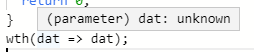
I believe this happens because there is no inference site for T, so it defaults to the constraint. The default constraint for a generic is unknown (used to be {}). You can see this if you give a default type for T, e.g. T = number, then the parameter type defaults to number.
fatcerberus
on 26 Oct 2019
What you'd really need to make this work the way you want, I think, is an "explicit implicit any", then you could go T = impany and dat => dat would then trigger the error.
fatcerberus
on 26 Oct 2019
There's no implicit any here; dat is of type unknown.
 RyanCavanaugh
on 30 Oct 2019
RyanCavanaugh
on 30 Oct 2019
Right, I agree that under current typing rules, dat is unambiguously unknown. However, it is unfortunate that normal inference when applied to dat => dat produces an implicit-any error, while there is no way to get the same error in the presence of a generic because of contextual typing. We're asking to infer T from the parameter of a function that was passed in, but under normal inference rules with --noImplicitAny enabled, that parameter doesn't actually have a type. It's only thanks to the feedback loop between generics and contextual typing that it gains a type: unknown. Which is IMO, confusing.
fatcerberus
on 30 Oct 2019
Thank you both for your help.
@fatcerberus yes, you articulated it way better than I could - I understand now why it's behaving the way it does, but the inconsistency between how it behaves when not generic is confusing.
I first thought the "impany" thing you suggested was some hidden feature I didn't know about :D
FYI I tried jimmying it up with what's already available like this:
type knownornever<TKnown, TThen> = unknown extends TKnown
  ? // must be unknown or any
  TKnown extends TKnown & string
    ? // only any behaves this way, so allow it
      TThen
    : // must be unknown, so disallow it
      never
  : // is neither unknown nor any
  TThen;

interface SyncProjector<TSource> {
  (source: TSource): any;
}

function wth<T>(func: knownornever<T, SyncProjector<T>>) {
  return 0;
}

wth((dat) => dat); // error \o/ yay
wth((dat: number) => dat); // works \o/ yay
wth((dat: any) => dat); // works \o/ yay
It "works" (behaves like a non-generic would), but it's a little hokey and rigid. If the "impany" thing is possible, that would make this a lot simpler.
captaincaius
on 31 Oct 2019
@captaincaius For posterity, and for anyone else who happens upon this issue in the future, here's a rough play-by-play of what happens:
wthis called, passing the lambda expression (arrow function)dat => dat.wth<T>is generic, and we need an inference forT. TS attempts to inferTfrom the parameter type offunc. This fails, asdathas no type annotation. There are no other inference sites.- In the absence of an inference for
T, the compiler defaults it. - No default is declared for
T, so its upper bound is chosen--in this caseunknown. wth<T>is now fully instantiated aswth<unknown>, which is the final call target.dathas no type annotation, so contextual typing kicks in to try to infer it.- The
unknownfrom type parameter inference is fed back into contextual typing and becomes the type ofdat(in more prosaic terms, the final call target is not generic; contextual typing infersfuncbased on a concrete target type of(source: unknown) => any). - As a result, no implicit-any error is produced.
fatcerberus
on 4 Nov 2019
Thanks for the awesome detailed run through!
captaincaius
on 4 Nov 2019
Extremely good summary @fatcerberus 🥇
RyanCavanaugh
on 4 Nov 2019
This issue has been marked as 'Question' and has seen no recent activity. It has been automatically closed for house-keeping purposes. If you're still waiting on a response, questions are usually better suited to stackoverflow.
 typescript-bot
on 9 Nov 2019
typescript-bot
on 9 Nov 2019
Related issues
 uber5001
·
3Comments
uber5001
·
3Comments
 jbondc
·
3Comments
jbondc
·
3Comments
 Roam-Cooper
·
3Comments
Roam-Cooper
·
3Comments
 kyasbal-1994
·
3Comments
kyasbal-1994
·
3Comments
 bgrieder
·
3Comments
bgrieder
·
3Comments
Most helpful comment
@captaincaius For posterity, and for anyone else who happens upon this issue in the future, here's a rough play-by-play of what happens:
wthis called, passing the lambda expression (arrow function)dat => dat.wth<T>is generic, and we need an inference forT. TS attempts to inferTfrom the parameter type offunc. This fails, asdathas no type annotation. There are no other inference sites.T, the compiler defaults it.T, so its upper bound is chosen--in this caseunknown.wth<T>is now fully instantiated aswth<unknown>, which is the final call target.dathas no type annotation, so contextual typing kicks in to try to infer it.unknownfrom type parameter inference is fed back into contextual typing and becomes the type ofdat(in more prosaic terms, the final call target is not generic; contextual typing infersfuncbased on a concrete target type of(source: unknown) => any).