Typescript: OR operator (|) treated like UNION (&) of two types
TypeScript error in /home/thakker/Documents/GitHub/crqcentral/src/Models/helpers.ts(34,64):
Property 'then' does not exist on type 'Promise<GraphQLResult> | Observable<object>'.
  Property 'then' does not exist on type 'Observable<object>'.  TS2339
I've started receiving errors like these too often starting around TypeScript 3.5. They make me feel like pulling my hair out even though I'm already going bald at a young age. Please think about other developers like me in your design decisions before bloating the language even further. I still have fond memories of Typescript 2. Even TypeScript 3.2 was pretty good and then it just kept going downhill from there. It feels like going from Windows XP to Windows Vista.
In the above error, a Promise is clearly listed as a potential return type. Why is TypeScript focusing on the other return type and not inferring that it is a Promise that is being returned based on the syntax of the calling function?
 selipso
All 11 comments
I'm not even sure of the root of the criticism is here - this behavior has been around since TypeScript 1.4 (almost 5 years ago)
The | operator does create a union type, and because the type-checker doesn't know whether you have a Promise or an Observable, it can't be sure whether it's safe to call then.
 DanielRosenwasser
on 25 Oct 2019
DanielRosenwasser
on 25 Oct 2019
Could you post an example of code that worked in earlier versions but not in the latest ? Accessing then on Promise<GraphQLResult> | Observable<object> would never have worked. A union type can be either of the constituents, so you can't access methods that are not common. Consider this simple example:
let o = Math.random() > 0.5 ? 0 : "" // number | string
o.toString() // ok is on both
o.toExponential() // not ok what if o is string this would be a runtime error
o.toUpperCase()// not ok what if o isnumber  this would be a runtime error
 dragomirtitian
on 25 Oct 2019
dragomirtitian
on 25 Oct 2019
But then what's an appropriate or operator that actually allows you to compose mixed-type functions? And also what's the purpose of duplicating this functionality with &?
selipso
on 25 Oct 2019
&, the intersection type operator.
DanielRosenwasser
on 25 Oct 2019
FYI, I am not the only one in this camp because the above library that declared the typings giving the error is by AWS. The naming conventions and functionality of mixed types and union types are just really confusing.
selipso
on 25 Oct 2019
When first encountering intersection and union types it is easy to be confused about why they are named this way (I know I was). You have to think of types in terms of describing sets of instances.
A union type (|) is the set of instances that belong to either constituent in the union (so for string | number an instances is in the set described by the union if it is either in the set described by number or the set described by string).
The question is having such a type what can we SAFELY do with it? The answer is we can safely access only common members (member which we know to be present regardless of the union constituent an instance actually belongs to). This is where the confusion usually comes in, since the safe members are the intersection of members from the constituent types. But the name union type, refers to the set described by the type not what members we can access.
Same reasoning applies to intersection types (&). The set described by an intersection type is the set of instances that belong simultaneously to both constituents of an intersection (So { a: number } & { b: string } represents a type where an instance is at the same type an instance of { a: number } and an instance of { b: string }). SInce the instance is an instance of both of the constituents types at the same type, we can safely access members of either constituents resulting in a union of members, but again the name is not related to members we can access but to the set operation described by the type.
dragomirtitian
on 25 Oct 2019
 RyanCavanaugh
on 25 Oct 2019
RyanCavanaugh
on 25 Oct 2019
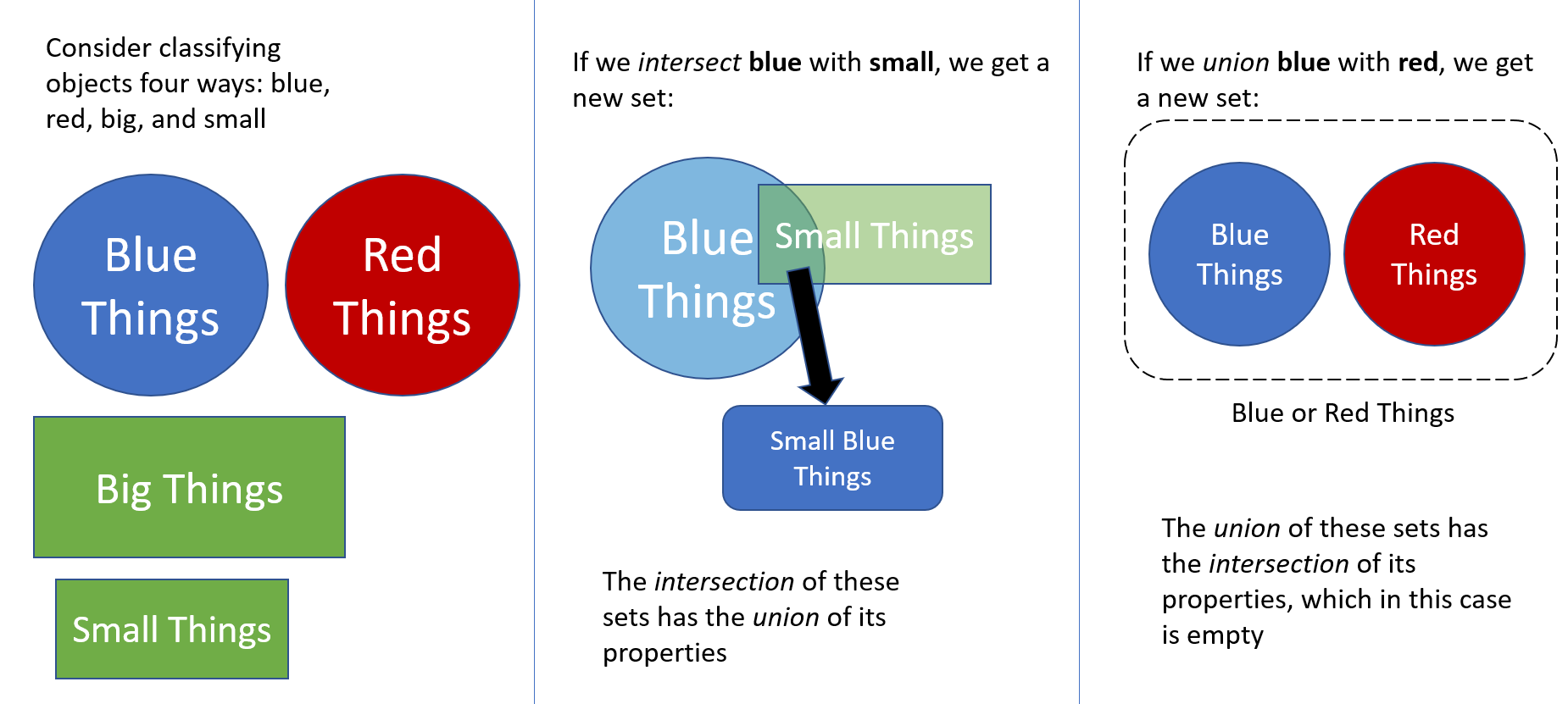
Didn't mean to reopen. Anyway here's a picture
RyanCavanaugh
on 25 Oct 2019
Didn't mean to reopen. Anyway here's a picture
The picture looks confusing because it's not clear what exactly are being operated on and how the operations are defined.
If Pic 2 is true, then it seems like doing set operations, and object properties are being operated on.
If we define four sets in pic 1 in the following way:
Blue_Things = {x in Things | x.color = 'blue'}
Red_Things = {x in Things | x.color = 'red'}
Big_Things = {x in Things | x.size = 'big'}
Small_Things = {x in Things | x.size = 'small'}
Then pic 2 is reasonable if we do set intersection:
intersect(Blue_Things, Small_Things)
= intersect({x in Things | x.color = 'blue'}, {x in Things | x.size = 'small'})
= {x in Things | x.color = 'blue' and x.size = 'small'}
= Small_Blue_Things
But the result of pic 3 is not empty if we do set union:
union(Blue_Things, Red_Things)
= union({x in Things | x.color = 'blue'}, {x in Things | x.color = 'red'})
= {x in Things | x.color = 'blue' or x.color = 'red'}
!= empty
Or maybe the question just cannot be easily explained to people who don't know type theory?
 paseaf
on 18 Aug 2020
paseaf
on 18 Aug 2020
I think Union and Intersection in TS are confusing because their names look like Set operations, but they are actually not. And the result happen to be the opposite if we understand them as set operations.
Union
|in TS === XOR\
Union Operator|in TS is actually doing XOR / Either Or on types, but the result is equivalent to doing Set Intersection on type propertiesIntersection
&in TS === Combining\
Intersection Operator&in TS actually doing Combining on types, but the result is equivalent to doing Set Union on type properties
Example:
Let item a value of arbitrary type.\
Let Type_A = {foo: number, bar: int}, Type_B = {bar: int, baz: string}
the Intersection Type
Type_A & Type_B: \
DefiningitemofType_A & Type_Bmeansitemis the combination ofType_AandType_B, which is actually{foo: number, bar: int, baz: string}. Then it is safe to allowitem.foo,item.bar, anditem.baz.\
Hence, we have
Type_A & Type_B = {foo: number, bar: int, baz: string}the Union Type
Type_A | Type_B:\
DefiningitemofType_A | Type_Bmeansitemis eitherType_AorType_B. Then it is unsafe to allowitem.foo, because that's an error if the actualitemis ofType_B. Similarly, accessingitem.bazis also unsafe. \
Hence, we have
Type_A | Type_B = {bar: int}
paseaf
on 19 Aug 2020
The names are not backwards. Read the StackOverflow link, or a book on type theory.
RyanCavanaugh
on 20 Aug 2020
Related issues
 Antony-Jones
·
3Comments
Antony-Jones
·
3Comments
 weswigham
·
3Comments
weswigham
·
3Comments
 seanzer
·
3Comments
seanzer
·
3Comments
 dlaberge
·
3Comments
dlaberge
·
3Comments
 Zlatkovsky
·
3Comments
Zlatkovsky
·
3Comments
Most helpful comment
Didn't mean to reopen. Anyway here's a picture