Typescript: Leading |/& is not included in the intersection/union node
TypeScript Version: 3.4.1
Search Terms: Union Intersection Leading Character Parse AST
Code
type Foo =
    | A
    | B;
(note this behaviour is exactly the same for IntersectionTypes)
Expected behavior:
The UnionType node should include the leading |.
Actual behavior:
The leading | is not included in the node.
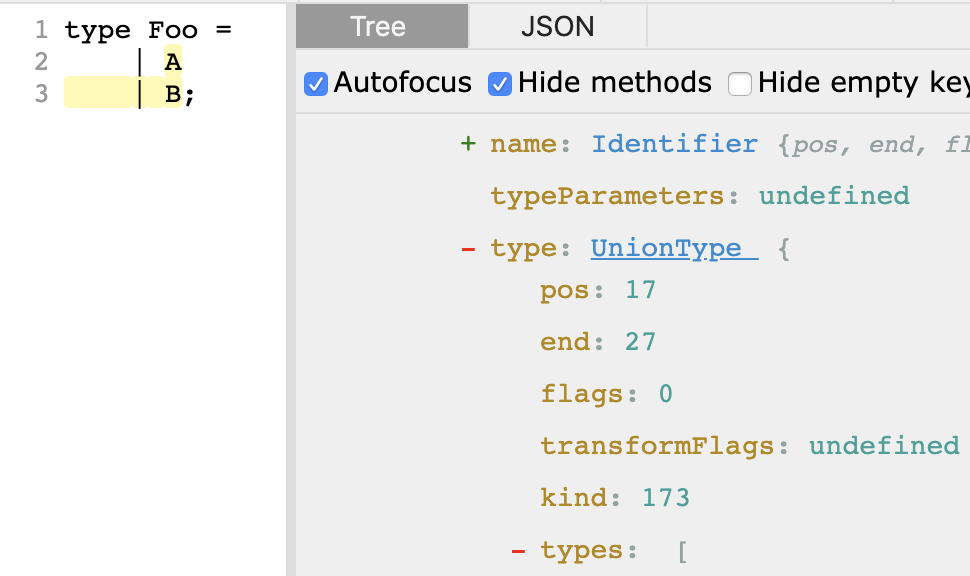
(The underlined node is currently hovered, highlighting it in the editor)
This creates some weirdness because it means the leading character ofc isn't part of the Union/Intersection node, and is instead technically a part of whatever node is its parent.
Related Issues:
https://github.com/typescript-eslint/typescript-eslint/issues/435
 bradzacher
All 12 comments
That definitely seems wrong.
 ahejlsberg
on 17 Apr 2019
ahejlsberg
on 17 Apr 2019
Does this mean the following code is considered as an intersection/union type?
type A = | 1
type B = & 2
 mysticatea
on 19 Apr 2019
mysticatea
on 19 Apr 2019
@mysticatea No. With a single type it'll be a type alias. See here: https://astexplorer.net/#/gist/8c2a38fd42b7326872dfcde0ec74cb5f/fb65f9cee71509112894c26567d5f74ae377ba3e
 MartinJohns
on 19 Apr 2019
MartinJohns
on 19 Apr 2019
In that case, I'm not sure if this is a bug.
I don't think that LiteralType node range should contain the beginning operator. So it's consistent that the intersection/union type node range doesn't contain the beginning operator.
cc: @ahejlsberg
mysticatea
on 19 Apr 2019
IMO it should parse as union/intersection type with one constituent. That's what happens with a trailing | or &
 ajafff
on 19 Apr 2019
ajafff
on 19 Apr 2019
@ajafff A trailing | or & is syntax error: https://www.typescriptlang.org/play/index.html#src=type%20A%20%3D%20%7C%201%0D%0Atype%20B%20%3D%20%26%202%0D%0Atype%20C%20%3D%201%20%7C%3B%0D%0Atype%20D%20%3D%201%20%26%0D%0A
mysticatea
on 19 Apr 2019
The problem with ignoring it is that you now have this free token in the code which doesn't belong to any node at all, which creates an invalid state in the produced AST.
Not that I want to prescribe a solution (I'm not a language designer).
But from the point of someone looking for consistency, I'd probably want type x = | T; to be a semantic error. i.e. prefixing a type with the | or & operator is not semantically valid unless there is more than one type (i.e. it is a union/intersection).
The problem that I see with the current semantics is that this is 100% valid typescript:
type A = | ( | ( | ( | ( | 1) ) ) );
Which of course means that each of the ParenthesizedType nodes "owns" one |, and the TypeAliasDeclaration owns one | as well.
bradzacher
on 19 Apr 2019
type A = | ( | ( | ( | ( | 1) ) ) );
🤣
I think we have three paths to solve this problem.
- The beginning operator is floating token as is because it doesn't have any effects for semantic. This is similar to the fact AST nodes don't contain extra parentheses. For example,
var a = ((((1))));, this1Literal node range doesn't contain the parentheses. It's not surprising. - Intersection/union node contains the beginning operator and the beginning operator makes intersection/union node even if the followed type was not an intersection/union type. My first question came from this way. For example,
type A = | 1makes aUnionTypenode which has aLiteralTypenode. But as considering @bradzacher 's example, this way can make deeply nested intersection/union types. - Intersection/union node contains the beginning operator and the beginning operator is a syntax error if the followed type was not an intersection/union type. This looks like the most reasonable way, but it's a breaking change.
mysticatea
on 19 Apr 2019
Totally new to Typescript, but: What is the semantic value of nesting types in a union or intersection in the first place? Are dynamic expressions allowed here, such that nesting expressions might be a valid use case?
 platinumazure
on 20 Apr 2019
platinumazure
on 20 Apr 2019
@platinumazure - if I understand your question, you're talking about the use of parenthesis?
They let you clarify types when things become ambiguous. For example:
type UnionIntersection = A | B & C;
type UnionIntersectionClear = (A | B) & C;
type UnionIntersectionClear2 = A | (B & C);
type ArrowFn = () => string | number;
type ArrowFnClear = (() => string) | number;
type ArrowFnClear = () => (string | number);
You can get pretty funky with your nesting if you'd like, the syntax is expressive enough that you can add any combination of types in. types can reference other types, you can inspect types by property names if they have them (type T = { prop: string }; type TProp = T['prop'];).
bradzacher
on 21 Apr 2019
Thanks @bradzacher, I appreciate the primer. That answers my question.
platinumazure
on 21 Apr 2019
I wonder if we should add something like prefixToken to UnionTypeNode and IntersectionTypeNode as a place to put this token, and possibly issue a syntax error on a leading | or & if we don't end up parsing a union or intersection:
// ok
type A =
  | X
  | Y;
// not ok
type B =
  | X;
Alternatively, we could always create a UnionTypeNode or IntersectionTypeNode with a single constituent when we encounter a leading & or | token, so that we have a place to put the token.
 rbuckton
on 8 May 2019
rbuckton
on 8 May 2019
Related issues
 kyasbal-1994
·
3Comments
kyasbal-1994
·
3Comments
 fwanicka
·
3Comments
fwanicka
·
3Comments
 manekinekko
·
3Comments
manekinekko
·
3Comments
 CyrusNajmabadi
·
3Comments
CyrusNajmabadi
·
3Comments
 bgrieder
·
3Comments
bgrieder
·
3Comments
Most helpful comment
I wonder if we should add something like
prefixTokentoUnionTypeNodeandIntersectionTypeNodeas a place to put this token, and possibly issue a syntax error on a leading|or&if we don't end up parsing a union or intersection:Alternatively, we could always create a
UnionTypeNodeorIntersectionTypeNodewith a single constituent when we encounter a leading&or|token, so that we have a place to put the token.