Typedoc: @param names are not rendered
Search terms
@param hyphen
Expected Behavior
The name of the param should be visible next to the 'param' field. The @param block is followed by a parameter name and then a hyphen.
Actual Behavior
The generated document omits the actual param names and just lists the description.
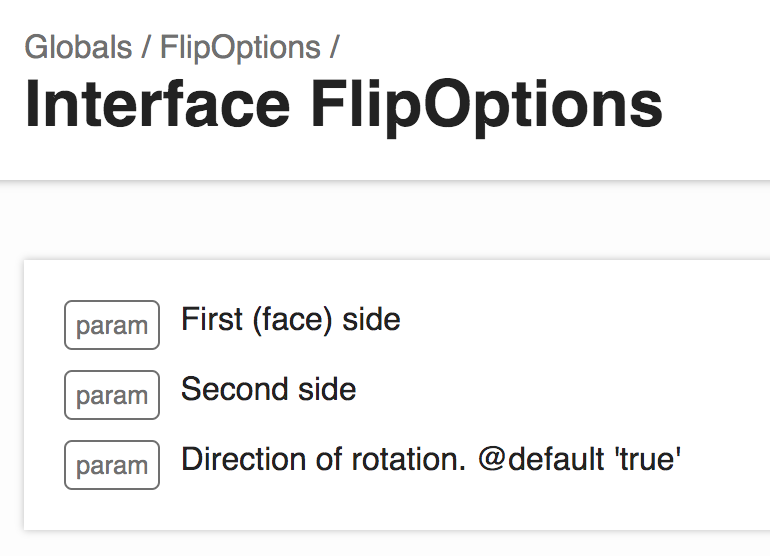
Steps to reproduce the bug
/**
 * @param side1 - First (face) side
 * @param side2 - Second side
 * @param dir - Direction of rotation. @default 'true'
 */
interface FlipOptions  {
    side1: HTMLElement;
    side2: HTMLElement;
    dir?: -1 | 1;
    singleDir?: boolean;
    vertical?: boolean;
    lockPointer?: boolean;
}
Environment
- Typedoc version: 0.20.0-beta.24
- TypeScript version: 4.1.2
- Node.js version: 12.7.0
- OS: OSX
 mk010101
All 5 comments
This is due to the template partial for comment tags - it you to use @param tags for what they are meant to be used for, not for documenting properties. I'd accept a PR that rendered the name if present
 Gerrit0
on 5 Dec 2020
Gerrit0
on 5 Dec 2020
This is the output of the same from https://microsoft.github.io/tsdoc
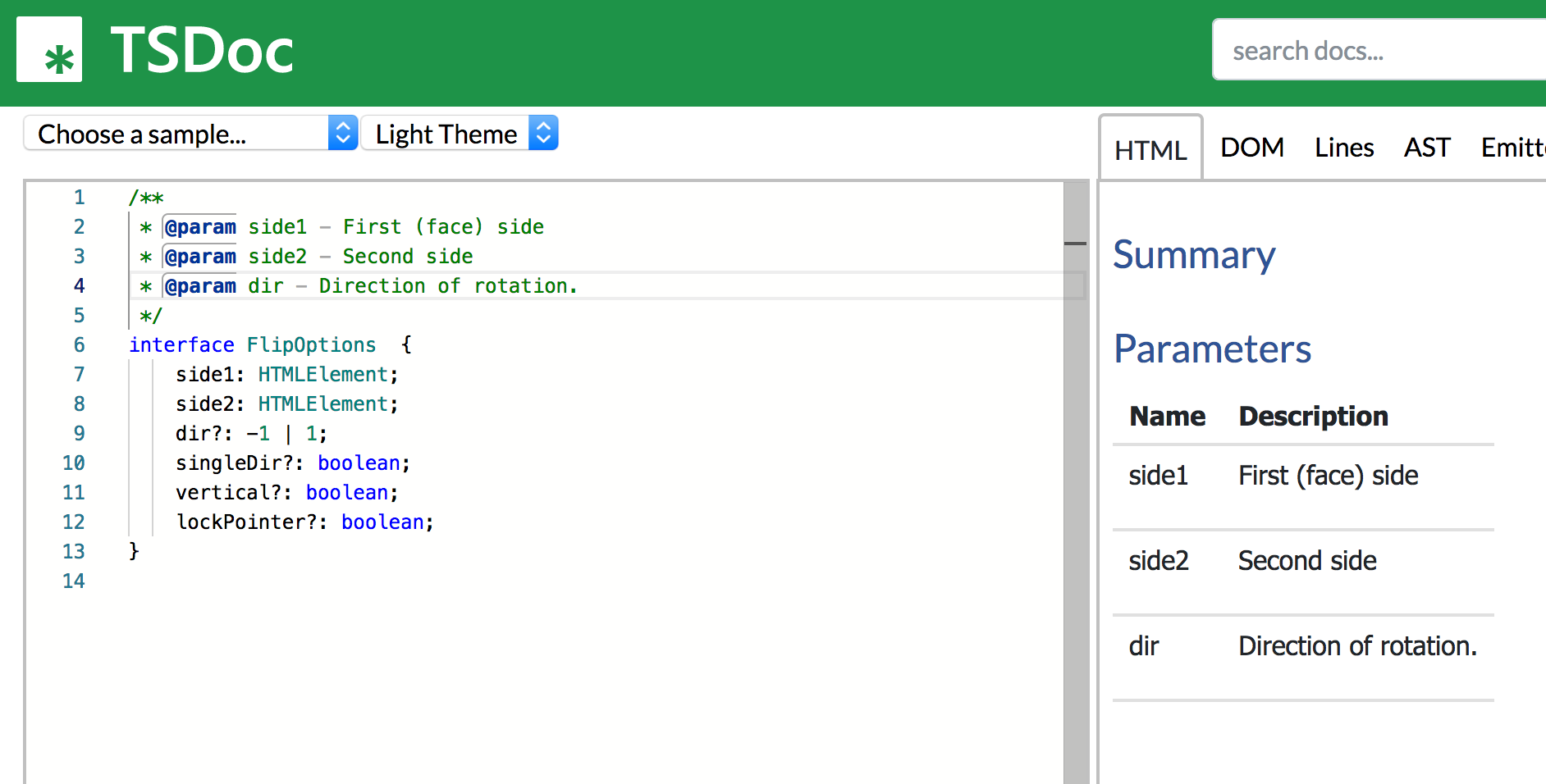
As you can see, it works correctly.
mk010101
on 6 Dec 2020
TSDoc != TypeDoc. TypeDoc doesn't currently conform to the TSDoc standard, though support for it is planned.
That demo is particularly misleading because it doesn't parse the source code - it only grabs a comment and then renders it. I suspect that if you ran that code through api-extractor, it would complain about your use of @param
Gerrit0
on 7 Dec 2020
This defect also applies to the TypeScript binding syntax for member functions:
class MyClass {
/**
* Function that does stuff
*
* @param param1 - The first param
* @param param2 - The second param
*/
protected boundFunction = (param1: string, param2: number): void {}
Is there another way to document this syntax?
 justinwilaby
on 23 Mar 2021
justinwilaby
on 23 Mar 2021
I'm not sure what you mean there. This seems to work as expected.
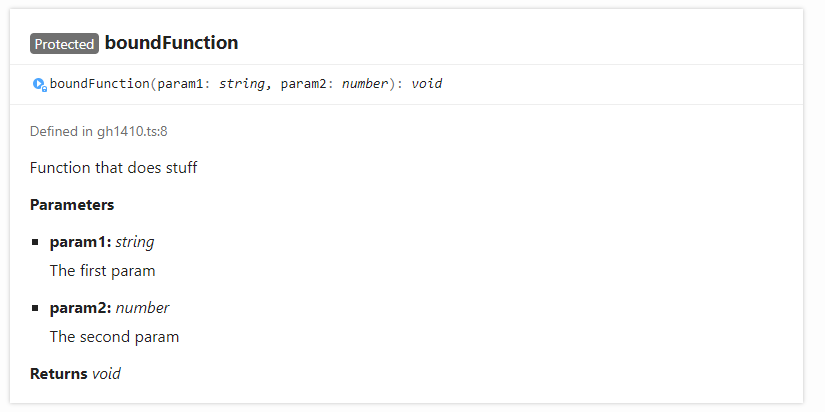
If you aren't seeing this, please open a new issue.
Gerrit0
on 25 Mar 2021
Related issues
 mrbigbunbury
·
26Comments
mrbigbunbury
·
26Comments
 ZheyangSong
·
20Comments
ZheyangSong
·
20Comments
 shlomiassaf
·
29Comments
shlomiassaf
·
29Comments
 maoueh
·
17Comments
maoueh
·
17Comments
 pietro909
·
19Comments
pietro909
·
19Comments
Most helpful comment
TSDoc != TypeDoc. TypeDoc doesn't currently conform to the TSDoc standard, though support for it is planned.
That demo is particularly misleading because it doesn't parse the source code - it only grabs a comment and then renders it. I suspect that if you ran that code through api-extractor, it would complain about your use of
@param