I just recently started using TypeDoc - mostly for documentation - but I am wondering if it just doesn't support currying or if I am implementing it incorrectly.
I have the below file:
/**
 * Helper File
 * @description Contains helper functions needed for multiple entities
 * @exports setParentData
 */

/** ignore this comment */
import React from "react";

/**
 * Takes in an array of props and runs the change function in props.
 * Used in the children where change is passed down from parent for state management.
 * Using currying to pass props, then field, then (e) change event for onchange in child.
 * @param {any} props
 * @param {string} field
 * @param {React.ChangeEvent} e
 */
export const setParentData = (props: any) => (field: string) => (
  e: React.ChangeEvent<any>
) => {
  props.change(field, e.currentTarget.value);
};
and get this output:

Thanks for any help in advance!
 jfreitas-dev
All 4 comments
The "Anonymous function" type certainly isn't ideal, we should support this pattern, and I thought we did... but apparently not. I don't think you did anything wrong.
 Gerrit0
on 21 Sep 2019
Gerrit0
on 21 Sep 2019
I just installed typedoc and experienced the same thing.
For example this function:
export const numberGreaterThan = (otherNum: number) => (num: number) => num > otherNum
got this signature:
numberGreaterThan(otherNum: number): (Anonymous function)
It's not just functions that returns functions though, it is higher order functions in general. Functions in parameters just becomes function
Example:
validateField<T>(...tuples: Array<[function, string]>): (Anonymous function)
 Herlevsen
on 30 Sep 2019
Herlevsen
on 30 Sep 2019
This is still a thing today
 cyrilchapon
on 10 Jun 2020
cyrilchapon
on 10 Jun 2020
In 0.20, the code in the OP renders as:
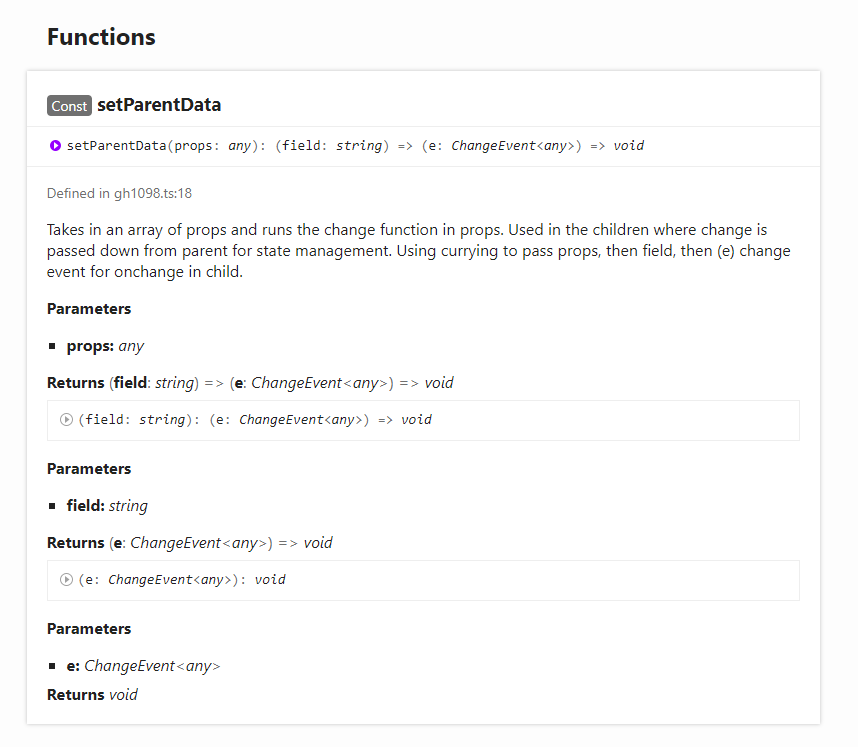
This still isn't exactly ideal, but the confusing non-indented tags is a theme issue, this issue has been resolved
Gerrit0
on 27 Dec 2020
Related issues
 goodmind
·
3Comments
goodmind
·
3Comments
 mcmath
·
3Comments
mcmath
·
3Comments
 woppa684
·
3Comments
woppa684
·
3Comments
 3nsoft
·
3Comments
3nsoft
·
3Comments
 nidsharm
·
3Comments
nidsharm
·
3Comments
Most helpful comment
The "Anonymous function" type certainly isn't ideal, we should support this pattern, and I thought we did... but apparently not. I don't think you did anything wrong.