Twin.macro: Div using only bg-gradient class doesn't get its style applied on prod
- Problem: Hey, so I just came across something strange, more details below.
- Environment: Forked the Next.Js + Emotion example.
- Link: https://codesandbox.io/s/silly-davinci-qbgj4?file=/pages/index.js:129-185
The style of a div using only gradient background class worked fine on dev, but not on prod. And when adding another class (text-white here), then it works:
- Working on dev, working on prod:
<div tw="bg-gradient-to-b from-red-500 to-gray-400"> - Working on dev, not working on prod
<div tw="bg-gradient-to-b from-red-500 to-gray-400 text-white">
If you want to try, go the the sandbox link above. I found a way to test on dev and on prod, by changing the dev command in the package.json. When you first launch, the dev command will be set on next dev. If you want to see the issue, change the dev command to next build && next start:
- Ex 1:
next dev
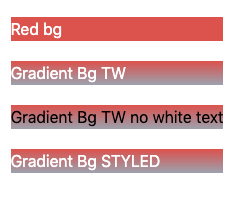
- Ex 2:
next build && next start
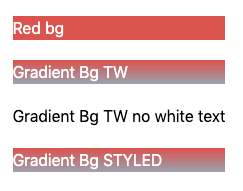
Does anyone have any idea why?
 luknl
luknl
All 7 comments
Hi,
The problem seems to come from the emotion cache / SSR configuration.
I think you can either:
- Skip the
CacheProviderin_app.js(the style will be added by emotion in the body of the page):
import { GlobalStyles } from "twin.macro";

const App = ({ Component, pageProps }) => (
  <>
    <GlobalStyles />
    <Component {...pageProps} />
  </>
);

export default App;
- Add a custom
_document.jsto extract the generated style in the head of the document. Here is an example CodeSandbox with this fix: https://codesandbox.io/s/nifty-http-9puxj
 Dramloc
on 12 Dec 2020
Dramloc
on 12 Dec 2020
Thanks for the quick answer!
Both options did work for me. Which of the 2 would you recommend?
Also, for the first option, what impact does it have on the app to remove CacheProvider?
luknl
on 14 Dec 2020
Hi,
You can find more information on this topic in the emotion docs: https://emotion.sh/docs/ssr.
I would suggest using the default approach if your project does not require the advanced approach. It provides better performance (with response streaming) and is easier to maintain. Also, most of its limitations can be worked around.
In the first approach, @emotion/react will create the CacheProvider under the hood and use it in every Emotion component, so it should have no impact on your application.
Dramloc
on 14 Dec 2020
Ok thank you for the detailed answer!
luknl
on 14 Dec 2020
In the first approach,
@emotion/reactwill create theCacheProviderunder the hood and use it in every Emotion component, so it should have no impact on your application.
Hey @Dramloc thanks for the response here, I've added the advanced method to avoid the flash of unstyled text. I haven't tested the other method yet but does that also fix it? If so, do you think it's worth updating the twin starter to use that method?
 ben-rogerson
on 14 Dec 2020
ben-rogerson
on 14 Dec 2020
Hey @ben-rogerson,
The default emotion approach fixes this issue but after testing it on a larger example, I had some problems with it.
Utilities like space-* and divide-* use the CSS sibling combinator (e.g.: :not([hidden])~:not([hidden])) and can cause layout shifts with this approach.
While testing this, I also found that some issues still remain with the advanced approach. Emotion seems to sometime create invalid CSS when serializing the style with stylis (see https://github.com/thysultan/stylis.js/issues/250). This issue can happen when the last declaration of a style is a CSS variable.
For example, in this snippet:
<span tw="ring-inset" />
<div tw="p-4" />
The ring-inset utility _will_ be applied but the next CSS declaration (p-4) will be skipped by the browser.
In practice, this can cause a FOUC but it's less frequent and less noticeable than the layout shifts of the default approach.
I think you can keep the twin starter as it is and wait for the bug fix on stylis.
Dramloc
on 15 Dec 2020
Thanks for letting us know about that bug, sounds like a doozie. Hope it's fixed up soon, I'll be keeping an eye out for it.
ben-rogerson
on 15 Dec 2020
Related issues
 owaiswiz
·
4Comments
owaiswiz
·
4Comments
 trkaplan
·
7Comments
trkaplan
·
7Comments
 tettoffensive
·
6Comments
tettoffensive
·
6Comments
 bennettrogers
·
5Comments
bennettrogers
·
5Comments
 DaneEveritt
·
6Comments
DaneEveritt
·
6Comments