Twill: Integrating Twill within Laravel Module Without Authentication
Hi guys,
Not an 'issue' per say but I'm very new to Vue.js and front end development in general (I have worked exclusively in server side PHP for the past 8-9 years) and would greatly appreciate a bit of guidance.
I'm trying to integrate Twill within a module within a fairly standard Laravel application. I already have authentication implemented so I want to side-step the Twill user/authentication stuff. Essentially I want to drop the Twill admin UI into an existing view/controller action with the minimum of fuss.
Could you offer some steps of how I can achieve this? For examples sake, my controller lives here:
Modules\Cms\Http\Controllers\PageController (indexAction)
How exactly can I drop in the pre-setup Twill admin view to my own custom action? Do I need to copy the relevant code over from the vendor folder to my module or is it possible to just extend/reference the classes?
Many thanks
Jon
 jkhamler
All 12 comments
Hi @jkhamler,
We'll need to look into this with your use case in mind, as this is something we did not consider but could definitely be achievable. Did you look into extending Twill's ModuleController from your Modules\Cms\Http\Controllers\PageController?
 ifox
on 6 Mar 2019
ifox
on 6 Mar 2019
Hi @ifox thanks for getting back to me. For now I've decided to just work within the 'out of the box' Twill setup as that's proving enough of a challenge for now. May well come back to this in due course.
jkhamler
on 6 Mar 2019
Hi @ifox @yanhao-li - it's time that I looked back at this. Essentially I want to authenticate using our existing functionality (which is based on standard Laravel authentication) so that the Twill/CMS section can just sit within our existing application without having to login twice or maintain a separate users table.
I'm guessing I need to override some functionality in A17\Twill\Http\Controllers\Admin\LoginController
If you could offer some pointers to steer me in the right direction that would be incredibly useful - thanks guys!
jkhamler
on 25 Mar 2019
Just a brief comment to hopefully bump this issue back up. We are urgently looking for a way to use Twill with our existing login/authentication - a question of consolidating the middleware I think.
jkhamler
on 17 Apr 2019
This is exactly what I need too :)
 tchapi
on 17 Apr 2019
tchapi
on 17 Apr 2019
Glad to hear I'm not the only one @tchapi - I would have thought this was a fairly common use case, as the whole point of Twill is that it integrates so nicely with existing Laravel applications. I'm absolutely loving what it can do, I've just got a few things to get production ready (like the login)
Looking forward to some updates from the team :-)
jkhamler
on 17 Apr 2019
I need to test things out but have an idea in mind that you can probably try on your end. What if you rename the twill_users guard everywhere in the twill code base by just users, the default provided Laravel guard that you are probably currently using. If that works we can turn this into a config variable. There's probably issues that are going to be created by this change but would like to see what it does and go from there.
ifox
on 17 Apr 2019
Hi @ifox
I've done as you say, renaming the twill_users guard to users. I've also added the following to twill.php config: 'users_table' => 'users'
So far, I login as usual but when I try and access the Twill admin panel, I still get prompted to log in by Twill.
jkhamler
on 25 Apr 2019
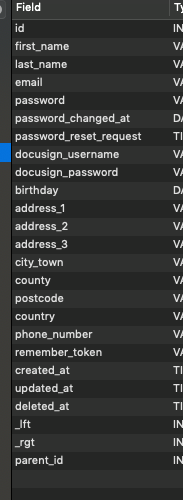
This is my schema for the users table. I've noticed the twill_users table also has a role property (e.g. 'SUPERADMIN') - could this be what's missing?
jkhamler
on 25 Apr 2019
Hi @jkhamler
are you using a subdomain for Twill? If you do you'll need to use .yourdomain.com in SESSION_DOMAIN to share it across subdomains.
ifox
on 26 Apr 2019
You will also definitely need to replicate fields like role and change the A17\Twill\Models\User references in Twill codebase to your own user model. It sounds like extracting the FQCN of the User model is going to happen in Twill to support extending the default user model, so if that solution works for you that will allow you to avoid forking.
ifox
on 26 Apr 2019
Hi @ifox Ok that sounds like a good start - I will try and tackle this today.
When you say this, what exactly do you mean? Is there an update coming shortly?
It sounds like extracting the FQCN of the User model is going to happen in Twill to support extending the default user model, so if that solution works for you that will allow you to avoid forking.
jkhamler
on 26 Apr 2019
Related issues
 gogabidzia
·
4Comments
gogabidzia
·
4Comments
 manuelsofia
·
4Comments
manuelsofia
·
4Comments
 noxify
·
4Comments
noxify
·
4Comments
 jayhaluska
·
4Comments
jayhaluska
·
4Comments
 brammittendorff
·
6Comments
brammittendorff
·
6Comments