Twig: Suggestion: optimize use of getAttribute using additional syntax to use native code
Currently the use of . ends calling to getAttribute(), which is a function that's difficult to optimize.
There's an option when working with arrays to use [] that is more optimized as it ignores all the object calls, but it fails when working with more than one depth of array as a[b][c] calls recursively to getAttribute returning a lot of data, instead of using native php doing $context["a"]["b"]["c"];
I suggest to extend the syntax so it's possible to compile to native php using:
[]to access array variables{}to access object properties (not sure about this one)->to access object methods.
This will result in a[b]{c}->getD compiling into $context["a"]["b"]->c->getD() instead of calling multiple times getAttribute
This should not suppose a problem of backward compatibility, as the use of [] is only for arrays, and you could keep calling with .
 inakivb
All 10 comments
Compiling to native PHP is hard, because it also looses the Twig error handling (and so breaks strict_variables for instance).
Note that the optimized path you describe is still handled by getAttribute even in the non nested case, but the type is set to Twig_Template::ARRAY_CALL.
Btw, for method calls you can also add braces after the name in the template, and it will mark the attribute access as Twig_Template::METHOD_CALL, which will skip the array access and the property checks, allowing only methods.
 stof
on 21 Aug 2017
stof
on 21 Aug 2017
I understand what you mean, but it's a big problem of performance for production environments where you hardly are going to use strict_variables
I've done a performance test using . and [] syntax and there isn't a lot of difference.
Using an average api response array, i've test
Twig . syntax (41.8 ms)
{% for i in 1..10000 %}
    {% set testvar = a.b.c.d.e %}
{% endfor %}

twig [] syntax (34.3 ms)
{% for i in 1..10000 %}
    {% set testvar = a[b][c][d][e] %}
{% endfor %}

twig custom function (1.58 ms + 2.18 ms in getFunction + 1.06 ms in getCallable)
{% for i in 1..10000 %}
    {% set testvar = get_array(a) %}
{% endfor %}
$this->getTwig()->addFunction(new \Twig_SimpleFunction('get_array', function ($array) {
    return $array['b']['c']['d']['e'];
}));

empty twig template + php code in controller (209 µs)
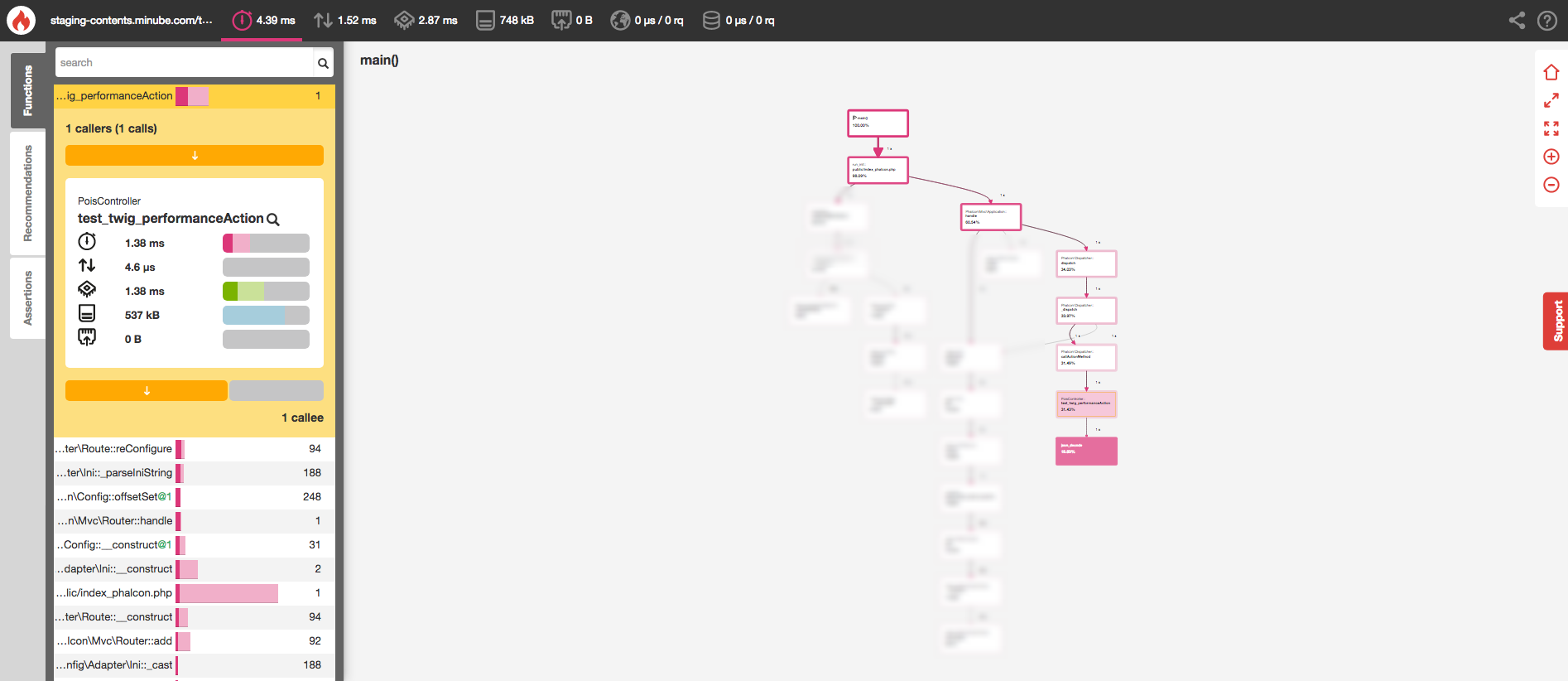
As you can see there is a big performance difference, it make me think that maybe having available strict_variables in production environments is not a good idea.
Anyway, maybe somebody has came with this problem before, is there any workaround to improve calls to getAttribute?
Thank you!
inakivb
on 22 Aug 2017
@inakivb can you share the profiles themselves (using the Blackfire sharing feature) rather than just giving screenshots ? It will allow me to see them more in details.
stof
on 22 Aug 2017
@stof here you can find the profiles
Twig . syntax
https://blackfire.io/profiles/c6eb236f-5a77-45b0-a6df-f1db7a4a7738/graph
Twig [] syntax
https://blackfire.io/profiles/0178abb7-535d-43d4-a703-8d9918fe4135/graph
Custom function
https://blackfire.io/profiles/1d3ba50b-557d-4ca3-9a58-1cc0164228bf/graph
inakivb
on 22 Aug 2017
Hello @stof,
have you had time to take a look at this?
I've been working around with a custom function to solve the problem, focusing on performance. It works (it's about 25x faster than using twig array notation), but with the overhead of calling a user function, and with the readability problems. Anyway it still being much slower than calling the array in php.
Here is the custom function:
        $this->getTwig()->addFunction(new \Twig_SimpleFunction(
            'a',
            function($array,$a1='',$a2='',$a3=''){
                $arg_list = func_get_args();
                $numArgs = count($arg_list);
                switch($numArgs){
                    case 1:
                        return $array;
                        break;
                    case 2:
                        return $array[$a1];
                        break;
                    case 3:
                        return $array[$a1][$a2];
                        break;
                    default:
                        $array = $array[$a1][$a2][$a3];
                        for($i=4;$i<$numArgs;$i++){
                            $array=$array[$arg_list[$i]];
                        }
                        return $array;
                }
            }
        ));
Thank you!
inakivb
on 28 Aug 2017
Hello @stof .
We´ve found the same issue. Do you have any update regarding this? Probably it can improve our performance a lot and the change seems obvious and @inakivb has provided several performance results.
Thanks in advance,
 fjalvarezdd
on 18 Oct 2017
fjalvarezdd
on 18 Oct 2017
Optimizing this part of Twig is quite complex as Twig is very flexible.
I've done one optimization for array calls in #2618 though. I don't see any other obvious ones (but that's a start :)).
 fabpot
on 30 Jan 2018
fabpot
on 30 Jan 2018
Closing for now as there is nothing more to do IMHO.
fabpot
on 2 Mar 2018
And just when I thought nothing could be more optimized, I've found something that optimizes the performance when calling a method by more than 20%. See #2635.
fabpot
on 2 Mar 2018
Of course there is more! #2636
fabpot
on 2 Mar 2018
Related issues
 SDPrio
·
3Comments
SDPrio
·
3Comments
 unique1984
·
4Comments
unique1984
·
4Comments
 yguedidi
·
4Comments
yguedidi
·
4Comments
 xxfaxy
·
6Comments
xxfaxy
·
6Comments
 rungta
·
3Comments
rungta
·
3Comments
Most helpful comment
Optimizing this part of Twig is quite complex as Twig is very flexible.
I've done one optimization for array calls in #2618 though. I don't see any other obvious ones (but that's a start :)).