Tensor Core is a defining feature of the NVIDIA new Volta and Turing GPU Architecture, which gives a massive boost for matrix multiplication and convolution. Tensor Cores enable us to use mixed-precision to achieve higher throughput without sacrificing accuracy.
Tensor Core Overview
Each Tensor Core provides a 4×4×4 matrix processing array that operates D = A * B + C, where A, B, C and D are 4×4 matrices as Figure shows. The matrix multiply inputs A and B are FP16 matrices, while the accumulation matrices C and D may be FP16 or FP32 matrices.
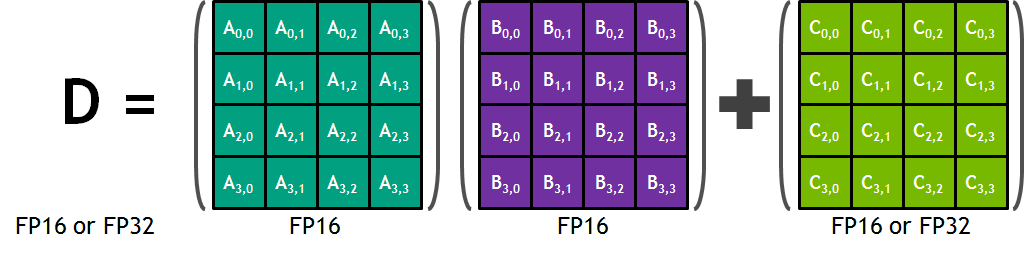
However, CUDA programmers can only use warp-level primitive wmma::mma_sync(acc_frag, a_frag, b_frag, acc_frag) to perform 16×16×16 half-precision matrix multiplication on tensor cores. Before invoking the matrix multiplication, programmers must load data from memory into registers with primitive wmma::load_matrix_sync, explicitly. The NVCC compiler translates that primitive into multiple memory load instructions. At run time, every thread loads 16 elements from matrix A and 16 elements from B.
Proposed Design
It can be regarded as a new hardware instruction just like gemm instruction in vta. So it is easy to use tensorization to replace the code. Note that unlike other accelerators, we need also to consider the shared memory when we use tensor cores. Also, wmma::mma_sync is a wrap-level instruction, which means it will call all threads (32 threads) in a warp. It is a brand new schedule level.
Warp Level Schedule
Although wmma::mma_sync is a warp-level operator, NVIDIA doesn't change the API for kernel launch. It still uses gridDim, blockDim and dynamic shared memory (optional) to launch a kernel. The only thing we should do is ensuring blockDim.x be a multiple of warp size(32).
In tvm schedule, we can just make the extent of threadIdx.x equals 32. It's safe if we want to use threadIdx.y and threadIdx.z, and their extents have no extra constraint. Note that, threadIdx.x can be only used at memory copy or other thread-level operators.
New Memory Scope
As mentioned above, programmers must load data from memory into a new memory scope wmma::fragment before using wmma::mma_sync. There are three types of fragment: matrix_a, matrix_b and accumulator. So I create three new build-in memory scope in tvm: wmma.matrix_a, wmma.matrix_b and wmma.accumulator.
Memory layout
For now, we must relayout before launching the kernel. The input and output matrix shape is [n //16, m //16, 16, 16], which is the same as the vta input and output. The native Cuda API does support the native shape of [n, m], so we can drop this constraint.
Tensor Intrinsic
Here is a tensor intrinsic example for mma_sync
def intrin_wmma_gemm():
    n = 16
    A = tvm.placeholder((n, n), name='A', dtype='float16')
    B = tvm.placeholder((n, n), name='B', dtype='float16')
    k = tvm.reduce_axis((0, n), name="k")
    C = tvm.compute((n, n),
                    lambda ii, jj:
                    tvm.sum(A[ii, k].astype('float') * B[k, jj].astype('float'), axis=k),
                    name='C')
    BA = tvm.decl_buffer(A.shape, A.dtype, name='BA', scope='wmma.matrix_a', data_alignment=32, offset_factor=256)
    BB = tvm.decl_buffer(B.shape, B.dtype, name='BB', scope='wmma.matrix_b', data_alignment=32, offset_factor=256)
    BC = tvm.decl_buffer(C.shape, C.dtype, name='BC', scope='wmma.accumulator', data_alignment=32, offset_factor=256)

    def intrin_func(ins, outs):
        BA, BB = ins
        BC, = outs

        def init():
            ib = tvm.ir_builder.create()
            ib.emit(tvm.call_intrin('handle', 'tvm_fill_fragment', BC.data, BC.elem_offset // 256, 0.0))
            return ib.get()

        def update():
            ib = tvm.ir_builder.create()
            ib.emit(tvm.call_intrin('handle', 'tvm_mma_sync',
                                    BC.data, BC.elem_offset // 256,
                                    BA.data, BA.elem_offset // 256,
                                    BB.data, BB.elem_offset // 256,
                                    BC.data, BC.elem_offset // 256))
            return ib.get()

        return update(), init(), update()

    return tvm.decl_tensor_intrin(C.op, intrin_func, binds={A: BA, B: BB, C: BC})
Performance
The speed test of 4096×4096×4096 mixed-precision matrix multiplication. The test is running on a TITAN V GPU
- tvm w/o tensor core: 11.7415 ms
- cublas w/o tensor core: 11.462592 ms
- tvm w/ tensor core: 2.795257 ms
- cublas w/ tensor core: 1.787328 ms
The speed test of conv2d (batch = 256, in_channel = 256, out_channel = 512, in_size = 14 * 14, kernel = 3 * 3):
- tvm w/o tensor core: 10.943293 ms
- cudnn w/o tensor core: 4.990112 ms
- tvm w/ tensor core: 2.397308 ms
- cudnn w/ tensor core: 1.750688 ms
Roadmap
- [x] schedule for gemm
- [x] schedule for conv2d
- [ ] add support for col-major matrix
- [ ] add support for native layout
Example code and schedule
https://gist.github.com/Hzfengsy/2b13215a926ae439515cc70b4e7027e3
Comments welcome!
cc @tqchen @tmoreau89 @merrymercy
 Hzfengsy
All 9 comments
Very welcome work @Hzfengsy !
we must relayout before launching the kernel
Does this imply that we'll need to alter the layout of the operators in Relay/NNVM if we want to use tensorization in GPUs as we already do for x86 schedules that use AVX512 (NCHWc), an VTA's tensor core (NCHWnc).
 tmoreau89
on 3 Oct 2019
tmoreau89
on 3 Oct 2019
Nice to see other folks working on adding TensorCore support into TVM, we have also been working on enhancing TVM to incorporate TensorCore schedule support.
If my understanding is correct, @Hzfengsy your solution is based on extending TVM's intrinsic while our solution put most of the complexity into TVM IR passes so that at python code level, we don't need to consider too much about TensorCore stuffs, rather the TVM core will take care of most of the TensorCore pattern recognition and schedule customization work, such as col-major/row-major pattern recognition and etc.
@minmin.sun may provide more comments.
Thanks
 yangjunpro
on 3 Oct 2019
yangjunpro
on 3 Oct 2019
cc @Laurawly
 antinucleon
on 3 Oct 2019
antinucleon
on 3 Oct 2019
@tmoreau89 Exactly! For now, we use the NCHWnc layout, the same layout with VTA.
Hzfengsy
on 3 Oct 2019
@yangjunpro Really happy to see another solution for TensorCore.
You are right! I just extend tvm intrinsic to support it. It does cause programmers who write the schedule some trouble. It is not easy to write a high-performance schedule.
I'm really curious about how to use IR passes to recognize the pattern. Does it need to split into several loops of 16 in python code? I appreciate it if you can show me some details and simple examples
Hzfengsy
on 3 Oct 2019
@Hzfengsy Sure, we will show the code as well as a sample schedule very soon. It's being under internal review now. As you will see, the schedule for TensorCore CodeGen looks no different than a normal matmul schedule for GPU. Everything is done in IR passes including matrix_a/matrix_b/accumulator recognition, row/col_major recgnition as @yangjunpro mentioned, thread index unification within a warp for tensorcore operations, loop scaling etc..
 minminsun
on 3 Oct 2019
minminsun
on 3 Oct 2019
Would it be easy to extend your gemm schedule into a schedule for BatchMatMul? That would help round out the TensorCore story for matrix multiplication.
 soiferj
on 7 Oct 2019
soiferj
on 7 Oct 2019
@soiferj Thank you for such a helpful comment. I have just made the extension into the schedule for BatchMatMul. You can check the schedule in my fork repo: https://github.com/Hzfengsy/tvm/blob/master/tests/python/unittest/test_schedule_tensor_core.py#L101
Hzfengsy
on 8 Oct 2019
I have chatted with @minminsun and his team these days. Just as then mentioned https://github.com/dmlc/tvm/issues/4105#issuecomment-542032766. We can have different frontends but only one backend. In my previous implement, users can only use fragments with 16x16x16 shape and row-major layout. To solve this problem, Minmin uses new_expr. Here I proposed a new design here. We use attributes to transmit metadata. Here is an example:
// attr [A.shared.wmma.matrix_a] storage_scope = "wmma.matrix_a"
// attr [A.shared.wmma.matrix_a] fragment_layout = "row_major"
// attr [A.shared.wmma.matrix_a] fragment_shape = "16, 16, 16"
allocate A.shared.wmma.matrix_a[float16 * 1024]
This sulotion has been accepted by Minmin and his team. Thanks for supporting my propsal.
Users can set these configuration in tensor intrinsics
def intrin_wmma_load_matrix(scope):
    n = 16
    A = tvm.placeholder((n, n), name='A', dtype='float16')
    BA = tvm.decl_buffer(A.shape, A.dtype, scope='shared', data_alignment=32, offset_factor=256)
    C = tvm.compute((n, n), lambda i, j: A[i, j], name='C')
    BC = tvm.decl_buffer(C.shape, C.dtype, scope=scope, data_alignment=32, offset_factor=256)

    def intrin_func(ins, outs):
        ib = tvm.ir_builder.create()

        BA = ins[0]
        BC = outs[0]
        # shape (n, n, n) and 'row_major' layout
        ib.emit(tvm.call_intrin('handle', 'tvm_load_matrix_sync',
                                BC.data, n, n, n, BC.elem_offset // 256,
                                BA.access_ptr('r'), n, 'row_major'))
        return ib.get()

    return tvm.decl_tensor_intrin(C.op, intrin_func, binds={A: BA, C: BC})
There is a new IR_pass will transmit these information from intrinsic to attributes.
I am really happy to cooperate with Minmin's team. Thank you again for contributing to TVM.
cc @tqchen
Hzfengsy
on 16 Oct 2019
Related issues
 jroesch
·
5Comments
jroesch
·
5Comments
 tqchen
·
6Comments
jroesch
·
5Comments
jroesch
·
6Comments
tqchen
·
6Comments
jroesch
·
5Comments
jroesch
·
6Comments
 yurivict
·
4Comments
yurivict
·
4Comments
Most helpful comment
@Hzfengsy Sure, we will show the code as well as a sample schedule very soon. It's being under internal review now. As you will see, the schedule for TensorCore CodeGen looks no different than a normal matmul schedule for GPU. Everything is done in IR passes including matrix_a/matrix_b/accumulator recognition, row/col_major recgnition as @yangjunpro mentioned, thread index unification within a warp for tensorcore operations, loop scaling etc..