Hi, I'm using jwt to authenticate users. Everything is working fine and I can retrieve the user in controllers. Now I'd like to get user in services. I know I can pass in the user from controller, but it seems over complicated that I need to have an extra user parameter in each method. Can I inject user into service or store the user in some http context and then retrieve it in services? Is it something supported natively in tsed?
Thanks...
 waterydan
All 20 comments
Might not be possible, if the service is application scoped and the controller is request scoped.
This is my way. What's your way ?
@Middleware()
export class LoginGuard implements IMiddleware {
  public async use(@Req() req: Req, @Context() ctx: Context) {
      const user = ...
      ctx.set('user', user);
  }
}

@Controller()
export class ApiController {
  @Get()
  @UseAuth(LoginGuard)
  self(@Context('user') user: User): User {
    return user;
  }
}
 bchoii
on 24 Dec 2020
bchoii
on 24 Dec 2020
We use express-http-context
// import express-http-context;
this.app
  .use(httpContext.middleware)
  .use((req, _res, next) => {
    if (req.session) {
      httpContext.set('session', req.session);
    }
    next();
In service
// import express-http-context;
httpContext.get('session')
But it would be better to use solution like @bchoii
 silveoj
on 23 Jan 2021
silveoj
on 23 Jan 2021
Hey @Romakita !
Have you looked into https://nodejs.org/api/async_hooks.html#async_hooks_class_asynclocalstorage ?
I guess it would be nice to have smth like ContextService, which we can call in any place of application to retrieve current request related data.
Especially, it will be useful for cases, when you want to isolate your request within DB-transaction in separate DB-connection.
The case looks like this:
- your application get incoming request
- connection to the database is taken from the connections pool and is associated with this incoming request
- All your interactions with DB will be handled only in that connection which is associated with current incoming request. when you start DB-transaction, it will use that connection, which is associated with the current incoming request.
So any new incoming requests will be processed via a new DB-connection from the pool and won't affect any others currently handled incoming requests.
What do you think about this?
 NachtRitter
on 23 Jan 2021
NachtRitter
on 23 Jan 2021
Hello @NachtRitter
The node.js AsyncHook API is interesting but I can't implement this without create a breaking change. Actually, Ts.ED works on Node.js v10 to v15 and this api is available since v12.
Currently, PlatformContext / Context is here for that, his only disadvantage is you have to forward the context by parameters. For me is not a disadvantage but I understand the point that is a pain point for you.
What is the cost of the performance? have you already experienced this API ?
See you
Romain
 Romakita
on 23 Jan 2021
Romakita
on 23 Jan 2021
Hum after a quick reading, it seems to be relatively easily to implement this API without change the current code.
Example:
import {Injectable} from "@tsed/di";
import {OnRequest, OnResponse} from "@tsed/common";

const store: Map<string, any> = new Map();

const asyncHook = asyncHooks.createHook({
    init: (asyncId, _, triggerAsyncId) => {
        if (store.has(triggerAsyncId)) {
            store.set(asyncId, store.get(triggerAsyncId))
        }
    },
    destroy: (asyncId) => {
        if (store.has(asyncId)) {
            store.delete(asyncId);
        }
    }
});

asyncHook.enable();

@Injectable()
export class AsyncHookContext implement OnRequest, OnResponse { // OnRequest need latest version
   private store: Map<string, any> = new Map();

   protected $onRequest($ctx: PlatformRequest): void {
      // PlatformRequest contains all necessary stuff like requestId, DI container, request/response, etc...
      store.set(asyncHooks.executionAsyncId(), $ctx);
   }

  protected $onResponse($ctx: PlatformRequest): void {
     store.delete(asyncHooks.executionAsyncId());
  }

  get(): PlatformContext {
     return store.get(asyncHooks.executionAsyncId());
  }
}
Usage:
@Injectable()
class MyRepository {
   @Inject()
   protected asyncHookContext: AsyncHookContext;

   doSomething() {
       const $ctx = this.asyncHookContext.get()
       $ctx.logger({event: 'hello'});
   }
}
Can you try this code pls :)
Tell me if it's works, I'm interested by the result!
See you
Romain
Romakita
on 23 Jan 2021
@Romakita
Couple years ago I solved such case via domain API: https://nodejs.org/api/domain.html
However it worked totally fine only for callback-based codebase. With using of promises and async/await I faced sometimes with issue of missing domain during incoming request handling.
And now on another project I haven't implemented this yet. However, I made small investigation and found this new async_hooks and AsyncLocalStorage APIs.
Thanks for your spent time.
Maybe it will help someone to save time :)
NachtRitter
on 23 Jan 2021
@Romakita I have this same challenge / need and was lucky to find out this is already an open issue. I'm trying to implement it the way you mention but I'm confused where to put the first file or how to load it. I mean the file with AsyncHookContext
 paschaldev
on 16 Feb 2021
paschaldev
on 16 Feb 2021
Just import the file in the server. Ts.ED will load the service automatically. I’ll try to provide a new package with this code ASAP.
Romakita
on 16 Feb 2021
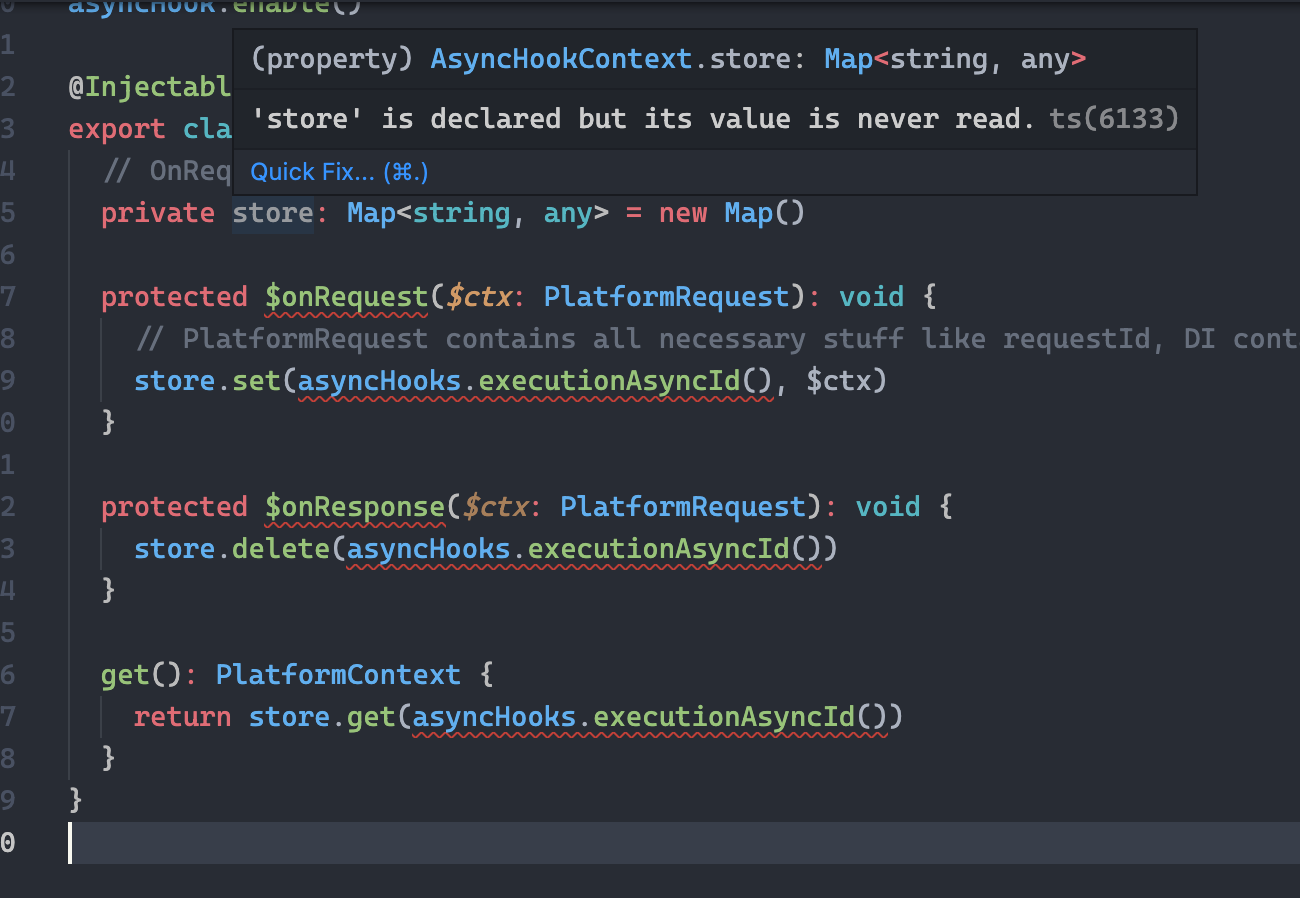
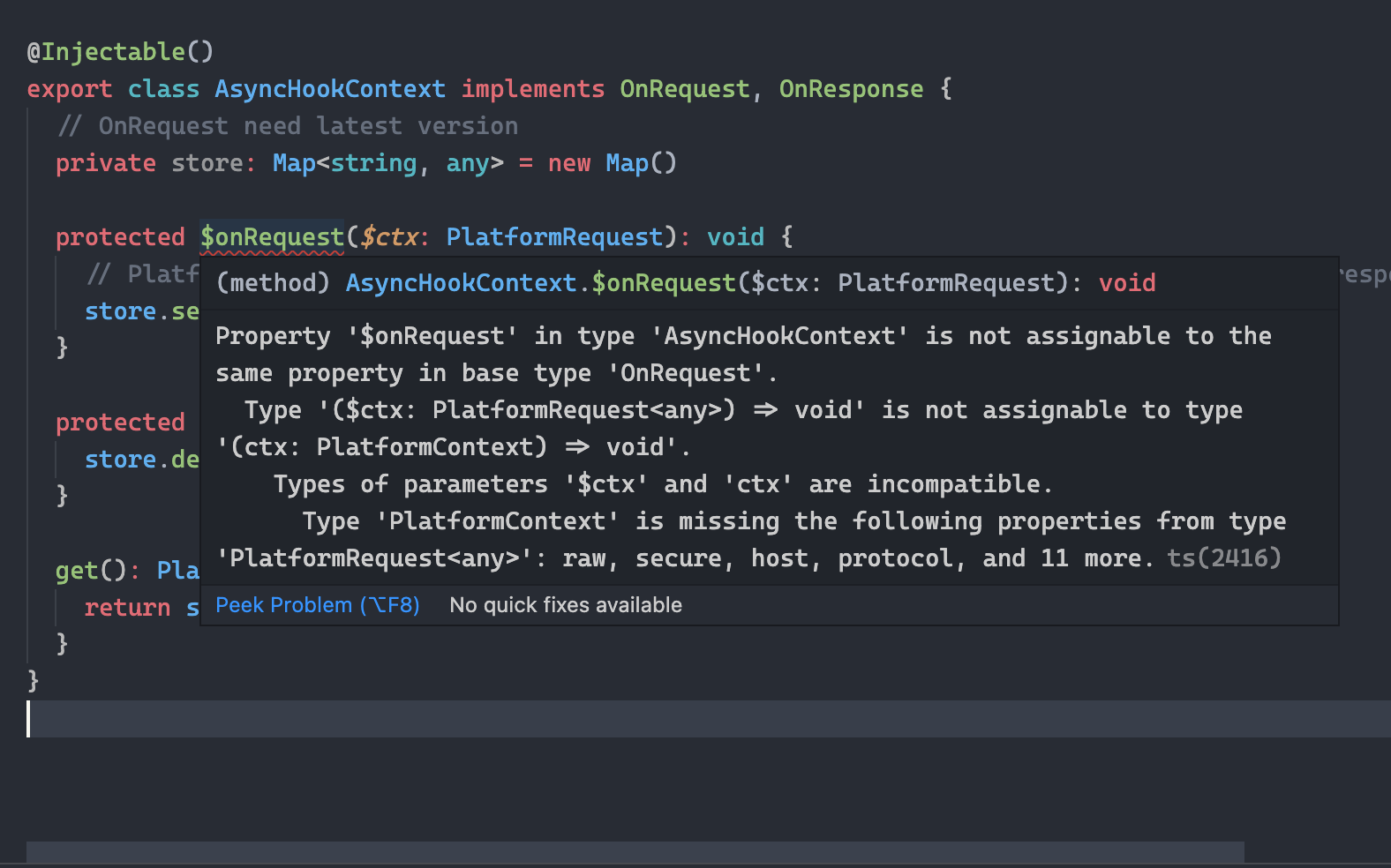
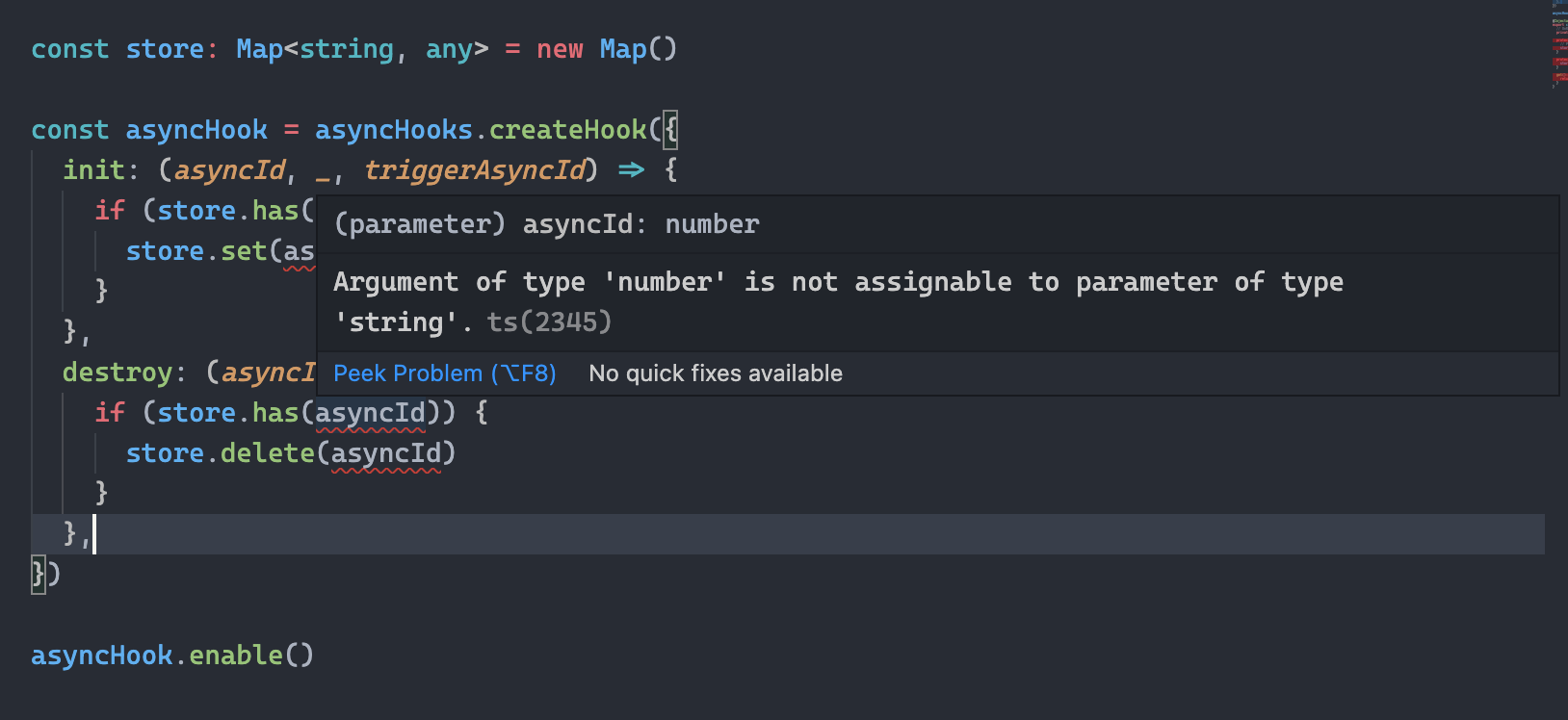
@Romakita some minimal issue with typings and iherited methods
Here, do you mean to use this.store?
paschaldev
on 16 Feb 2021
Ok the only problem is about the OnRequest Interface definition :). Thanks for your feedback.
We can create a new package @tsed/async-hook-context with this code (+ fix). It'll be a plugin in v6 and if the package works fine, we can integrate it into the common package!
Romakita
on 16 Feb 2021
@Romakita I still have a hard time figuring out when / how the $onRequest method of the AsyncHookContext class is fired.
AsyncContextProvider
import { Injectable } from '@tsed/di'
import { OnRequest, OnResponse, PlatformRequest, PlatformContext } from '@tsed/common'
import * as asyncHooks from 'async_hooks'

const store: Map<number, any> = new Map()

const asyncHook = asyncHooks.createHook({
  init: (asyncId, _, triggerAsyncId) => {
    if (store.has(triggerAsyncId)) {
      store.set(asyncId, store.get(triggerAsyncId))
    }
  },
  destroy: (asyncId) => {
    if (store.has(asyncId)) {
      store.delete(asyncId)
    }
  },
})

asyncHook.enable()

@Injectable()
export class AsyncHookContext implements OnRequest, OnResponse {
  /* eslint @typescript-eslint/ban-ts-comment: 0 */
  // @ts-ignore
  protected $onRequest($ctx: PlatformRequest): void {
    // PlatformRequest contains all necessary stuff like requestId, DI container, request/response, etc...
    store.set(asyncHooks.executionAsyncId(), $ctx)
  }

  public $onResponse(): void {
    store.delete(asyncHooks.executionAsyncId())
  }

  get(): PlatformContext {
    return store.get(asyncHooks.executionAsyncId())
  }
}
I imported in Server.ts like this:
import './providers/AsyncContextProvider'
However nothing seems to be happening, where I injected it, $ctx is undefined
paschaldev
on 16 Feb 2021
I finally got it to work,
``` Server.ts
export class Server extends AsyncHookContext {
}
```
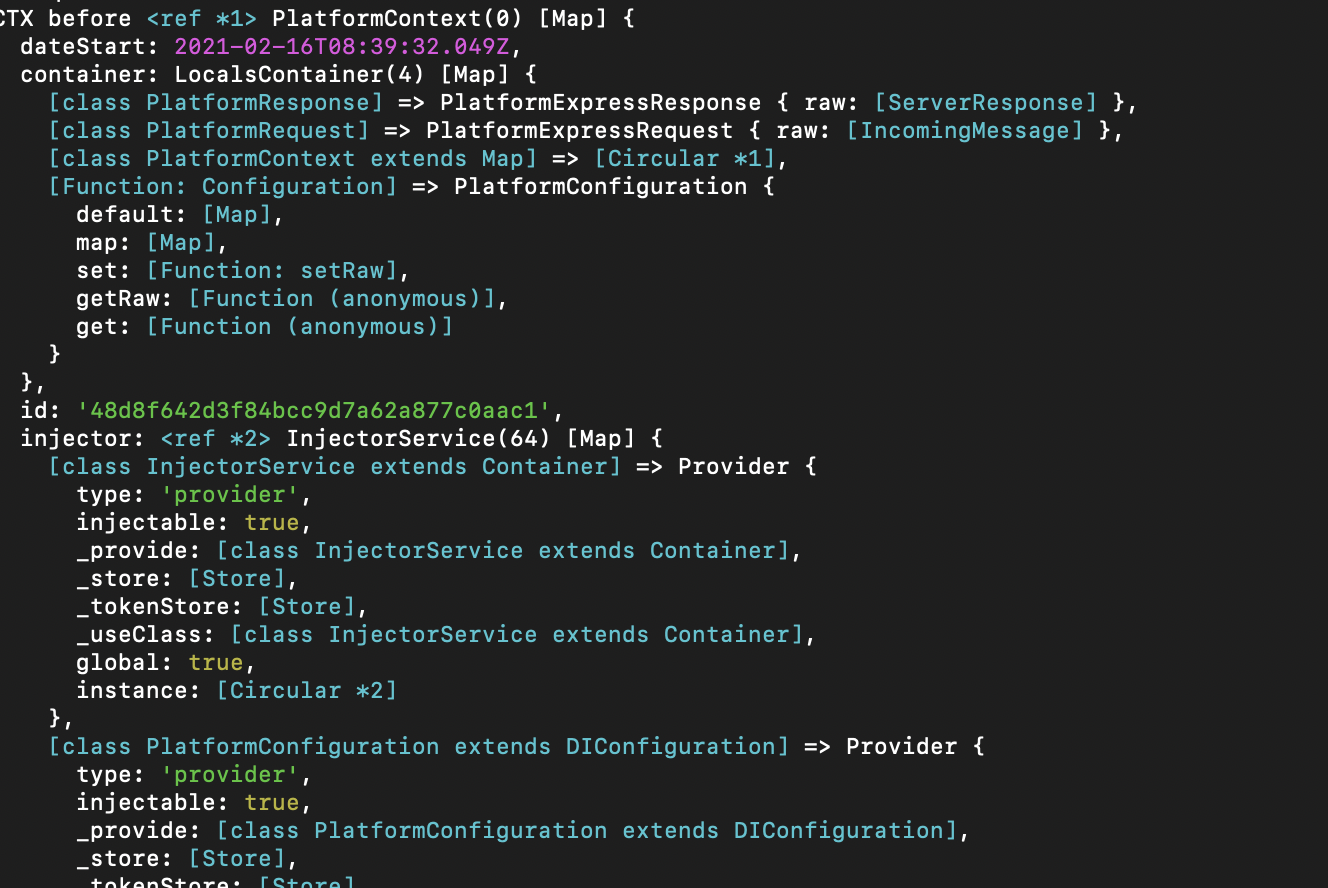
Log output of $ctx in the console after injecting in a custom service. Thank you guys
paschaldev
on 16 Feb 2021
Ok I understand now why it doesn't works XD.
Romakita
on 16 Feb 2021
@Romakita Another weird discovery, only works if Content-Type is set to application/json
paschaldev
on 16 Feb 2021
@paschaldev You can review the PR here: https://github.com/TypedProject/tsed/pull/1246
It add a new package @tsed/async-hook-context :)
See you
Romain
Romakita
on 16 Feb 2021
Thanks @Romakita
paschaldev
on 16 Feb 2021
:tada: This issue has been resolved in version 6.26.0 :tada:
The release is available on:
v6.26.0- GitHub release
Your semantic-release bot :package::rocket:
Romakita
on 16 Feb 2021
@paschaldev you can test the new package ;)
Romakita
on 16 Feb 2021
@Romakita Just tested it, works fine and much better than the manual setup I did earlier. We're good to go
paschaldev
on 16 Feb 2021
Great :D
Romakita
on 16 Feb 2021
Related issues
 teusemanuel
·
4Comments
teusemanuel
·
4Comments
 denisprsa
·
6Comments
Romakita
·
5Comments
denisprsa
·
6Comments
Romakita
·
5Comments
 yangukmo
·
5Comments
yangukmo
·
5Comments
 royibernthal
·
4Comments
royibernthal
·
4Comments