Truffleruby: Repeatedly initializing a new OptCarrot-instance breaks the VM
This is a succession of Issue #919
Using the JAR [of issue #919], a repeated call of
Optcarrot::NES.new(["--benchmark", "examples/Lan_Master.nes"]).run
keeps delivering results, but the VM slows down enormously at ~ 220 calls.

(x-axis: Seconds, y-axis: FPS)
 Ichaelus
All 15 comments
This looks like a memory leak.
Running locally shows increasing RSS and never decreasing.
Probably it goes into swap at you after a few hundred iterations or so.
 eregon
on 11 Jan 2018
eregon
on 11 Jan 2018
Or alternatively, the max heap limit is reached and it starts GC-ing a lot.
eregon
on 11 Jan 2018
Y-Axis: Memory (MB), X-Axis: Seconds
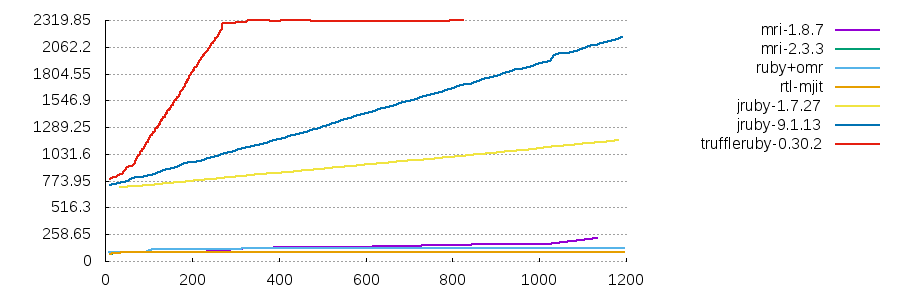
The max heap is definitely reached, since I'm using the flags --jvm.Xmn512m --jvm.Xms1024m --jvm.Xmx2048m -J-Dgraal.TraceTruffleCompilation=false --jvm.server - the process actually exceeds the limit of 2GB.
Ichaelus
on 11 Jan 2018
Interesting, and it seems other implementations also leak in this configuration, but not as fast.
Could you zoom on MRI (exclude jruby/truffleruby) to see how is the curve there?
eregon
on 11 Jan 2018
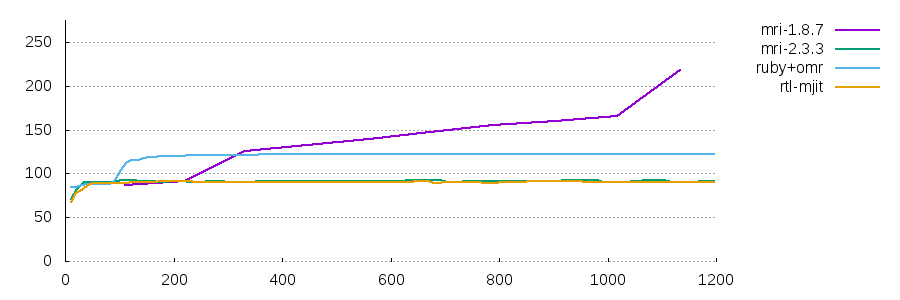
It seems to me that only MRI 1.8.7 is affected, which shows a permanent increase - they changed the GC several times since then, though.
Ichaelus
on 11 Jan 2018
Locally I see MRI 2.5.0 also with a stable memory usage, around 86MB and 704k GC.stat[:heap_live_slots].
eregon
on 11 Jan 2018
This looks like the Fibers created in the benchmark (one per .run) leak.
We currently implement Fibers with Java threads and it seems those threads are never GC'd.
eregon
on 11 Jan 2018
Ah, and these Fibers never terminate (PPU#run has an infinite loop, no break or return).
So we need that fancy trick of killing the Fiber if it is no longer referenced by anything.
That's currently not implemented and very likely the fix for this leak.
eregon
on 11 Jan 2018
A very simple reproducer for this is:
loop { Fiber.new {} }
$ jt ruby -J-Xmx2g -J-verbose:gc -e 'loop { Fiber.new {} }'
[GC (Allocation Failure)  64512K->11119K(245760K), 0.0126776 secs]
[GC (Allocation Failure)  75631K->17020K(245760K), 0.0244291 secs]
[GC (Allocation Failure)  81532K->19169K(245760K), 0.0132140 secs]
[GC (Allocation Failure)  83681K->40904K(310272K), 0.0380130 secs]
[ruby] WARNING OutOfMemoryError
-e:1:in `initialize': failed to allocate memory (NoMemoryError)
These are some great insights, you could be hired as a detective! :wink:
Ichaelus
on 11 Jan 2018
It got fairly obvious once I put the heap dump in the Eclipse Memory Analyzer:
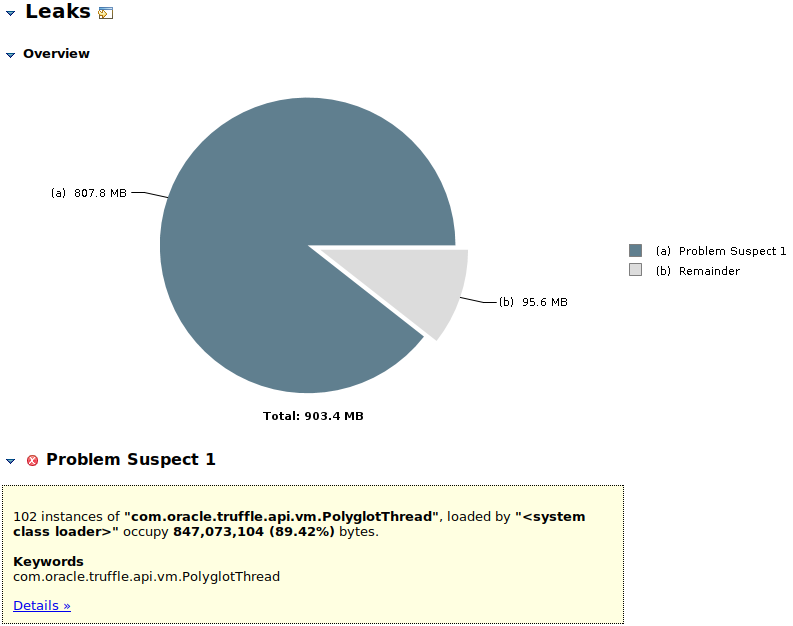
(PolyglotThread is just a subclass of java.lang.Thread)
eregon
on 11 Jan 2018
Running
$ jruby -v
jruby 9.1.13.0 (2.3.3) 2017-09-06 8e1c115 OpenJDK 64-Bit Server VM 25.121-b14 on 1.8.0_121-b14 +jit [linux-x86_64]

# Some Fibers are killed when they become unreachable:
$ jruby -e 'i=0; loop { p i+=1; Fiber.new {begin;Fiber.yield;ensure;$stderr.puts :bye; exit! 2; end}.resume;  }'
1
2
...
50
51
bye
bye
bye
byebye

$ jruby -J-verbose:gc -d -e 'i=0; loop { p i+=1; Fiber.new {}; }'
...
12207
12208
12209
[GC (System.gc())  71262K->56294K(225280K), 0.0434084 secs]
[Full GC (System.gc())  56294K->55475K(225280K), 0.6966010 secs]
Error: Your application demanded too many live threads, perhaps for Fiber or Enumerator.
Ensure your old Fibers and Enumerators are being cleaned up.
    at java.lang.Thread.start0(Native Method)
    at java.lang.Thread.start(Thread.java:714)
    at java.util.concurrent.ThreadPoolExecutor.addWorker(ThreadPoolExecutor.java:950)
    at java.util.concurrent.ThreadPoolExecutor.execute(ThreadPoolExecutor.java:1368)
    at org.jruby.ext.fiber.ThreadFiber.createThread(ThreadFiber.java:253)
So even though JRuby handles killing Fibers when they become unreachable, it doesn't seem to be enough to sustain such a tight loop of creating Fibers. JRuby tries a last GC before giving up, but that doesn't seem to clear Fibers (maybe there is not enough time after the GC finishes to let killed Fibers threads release their Java thread?).
Another problem is since Fibers are implemented with Java Threads, the only way to kill them is by throwing an exception into the Fiber. Throwing an exception executes Ruby code in ensure clauses.
Doing this when the Fiber becomes unreachable will happen concurrently with another Fiber in the same Ruby Thread, which breaks the fundamental assumption that Fibers of the same Ruby Thread do not execute concurrently and only pass control to each other explicitly.
MRI does not have that problem as they can deallocate the native coroutine stack without throwing an exception.
So in summary I'm not too fund of this feature, and it seems portable Ruby programs should properly finish their Fibers and not expect them to be magically GC'd as that only works well with native coroutines.
For Optcarrot, that could be done by quitting the main_loop based on the return value of Fiber.yield.
eregon
on 12 Jan 2018
Another question in this issue is why we consume so much memory per leaked Fiber.
eregon
on 12 Jan 2018
Doing this when the Fiber becomes unreachable will happen concurrently with another Fiber in the same Ruby Thread, which breaks the fundamental assumption that Fibers of the same Ruby Thread do not execute concurrently and only pass control to each other explicitly.
One possible thing might be to pause the current Fiber while throwing the exception in the Fiber to be recycled. But this still breaks the fact a Fiber only yields explicitly.
Or we could throw the exception to finish the fiber to recycle the next time the current Fiber yields, but that could be never.
Although if Fibers never yield then there are likely not many Fibers. Still, one could create a thousand fibers, resume them all once, then no longer reference them and keep running on the main Fiber forever.
I think the proper fix in this case is really to fix OptCarrot, if running the benchmark this way should be supported.
@Ichaelus If you are still interested to run the benchmark this way, could you make a pull request to OptCarrot to quit the emulation loop nicely, allowing prompt disposal of the Fibers and other resources?
eregon
on 26 Jun 2018
I'll close this issue, because I think the real solution is changing OptCarrot to support this mode of running the benchmark better, and there doesn't seem to a satisfying solution not seriously breaking Fiber semantics. Moreover, all solutions proposed so far seem very brittle as they rely on GC and would need non-trivial changes.
One actual solution might be to use native coroutines (for example, from OpenJDK project Loom), but this might take a while.
eregon
on 3 Jul 2018
Related issues
 deepj
·
4Comments
deepj
·
4Comments
 ivoanjo
·
3Comments
deepj
·
6Comments
deepj
·
4Comments
ivoanjo
·
3Comments
deepj
·
6Comments
deepj
·
4Comments
 palkan
·
3Comments
palkan
·
3Comments