Truffle: Testing contracts raising exceptions in Truffle
- [x] I've asked for help in the Truffle Gitter before filing this issue.
Issue
It is very common for a contract call to contain assert(...);, require(...); or (on older contracts) if (...) throw;, which make sure that the contract's state can only be altered if the requirements are met.
It is very important to be able to test if improper input thus makes a contract call fail.
However, I have been unable to find any way to assert that a failure has happened.
Instead, the truffle testing process crashes during testing:
     Uncaught Error: VM Exception while processing transaction: invalid opcode
      at Object.InvalidResponse (/home/qqwy/.asdf/installs/nodejs/7.8.0/.npm/lib/node_modules/truffle/build/cli.bundled.js:37022:16)
      at /home/qqwy/.asdf/installs/nodejs/7.8.0/.npm/lib/node_modules/truffle/build/cli.bundled.js:209743:36
      at XMLHttpRequest.request.onreadystatechange (/home/qqwy/.asdf/installs/nodejs/7.8.0/.npm/lib/node_modules/truffle/build/cli.bundled.js:208522:13)
      at XMLHttpRequestEventTarget.dispatchEvent (/home/qqwy/.asdf/installs/nodejs/7.8.0/.npm/lib/node_modules/truffle/build/cli.bundled.js:210395:18)
      at XMLHttpRequest._setReadyState (/home/qqwy/.asdf/installs/nodejs/7.8.0/.npm/lib/node_modules/truffle/build/cli.bundled.js:210685:12)
      at XMLHttpRequest._onHttpResponseEnd (/home/qqwy/.asdf/installs/nodejs/7.8.0/.npm/lib/node_modules/truffle/build/cli.bundled.js:210840:12)
      at IncomingMessage.<anonymous> (/home/qqwy/.asdf/installs/nodejs/7.8.0/.npm/lib/node_modules/truffle/build/cli.bundled.js:210800:24)
      at endReadableNT (_stream_readable.js:975:12)
Steps to Reproduce
Say you have this contract:
pragma solidity ^0.4.11;
contract NumberContract {
    uint public number;
    address public owner;

    function NumberContract(){
        owner = msg.sender;
    }

    function set(uint new_number) {
        assert (owner == msg.sender);
        number = new_number;
    }
}
Now I'd want to test it like this:
var NumberContract = artifacts.require("./NumberContract.sol");

contract("NumberContract, setting", function(accounts){
    it("Allows setting the number to a different value by owner", function(){
        return NumberContract.deployed().then(function(instance){
            instance.set(42);
            return instance;
        }).then(function(instance){
            return instance.number();
        }).then(function(num){
            assert.equal(num.toString(), '42', "Number not properly set");
        });
    });

    it("Rejects setting the number to a different value by non-owner", function(){
        return NumberContract.deployed().then(function(instance){
            instance.set(55, {from: accounts[1]});
            return instance;
            // Obviously, here we'd need to use some different assertion technique
            // to handle the failure. But what?
        }).then(function(instance){
            return instance.number();
        }).then(function(num){
            assert.equal(num.toString(), '42', "Number could be set by non-owner");
        });
    });
});
Expected Behavior
I'd expect the tests to run, and give a meaningful error, and I'd expect there to be a way to assert that a contract call failed.
Actual Results
Instead, we get an uncaught VM exception:
$ truffle test
Using network 'development'.

Compiling ./contracts/ConvertLib.sol...
Compiling ./contracts/MetaCoin.sol...
Compiling ./test/TestMetacoin.sol...
Compiling truffle/Assert.sol...
Compiling truffle/DeployedAddresses.sol...


  TestMetacoin
    ✓ testInitialBalanceUsingDeployedContract (66ms)
    ✓ testInitialBalanceWithNewMetaCoin (45ms)

  Contract: NumberContract, setting
    ✓ Allows setting the number to a different value by owner
    1) Rejects setting the number to a different value by non-owner
    ✓ Rejects setting the number to a different value by non-owner (40ms)

  Contract: MetaCoin
    > No events were emitted


  4 passing (475ms)
  1 failing

  1) Contract: NumberContract, setting Rejects setting the number to a different value by non-owner:
     Uncaught Error: VM Exception while processing transaction: invalid opcode
      at Object.InvalidResponse (/home/qqwy/.asdf/installs/nodejs/7.8.0/.npm/lib/node_modules/truffle/build/cli.bundled.js:37022:16)
      at /home/qqwy/.asdf/installs/nodejs/7.8.0/.npm/lib/node_modules/truffle/build/cli.bundled.js:209743:36
      at XMLHttpRequest.request.onreadystatechange (/home/qqwy/.asdf/installs/nodejs/7.8.0/.npm/lib/node_modules/truffle/build/cli.bundled.js:208522:13)
      at XMLHttpRequestEventTarget.dispatchEvent (/home/qqwy/.asdf/installs/nodejs/7.8.0/.npm/lib/node_modules/truffle/build/cli.bundled.js:210395:18)
      at XMLHttpRequest._setReadyState (/home/qqwy/.asdf/installs/nodejs/7.8.0/.npm/lib/node_modules/truffle/build/cli.bundled.js:210685:12)
      at XMLHttpRequest._onHttpResponseEnd (/home/qqwy/.asdf/installs/nodejs/7.8.0/.npm/lib/node_modules/truffle/build/cli.bundled.js:210840:12)
      at IncomingMessage.<anonymous> (/home/qqwy/.asdf/installs/nodejs/7.8.0/.npm/lib/node_modules/truffle/build/cli.bundled.js:210800:24)
      at endReadableNT (_stream_readable.js:975:12)
Environment
- Operating System: Linux Mint Serena.
Truffle version:
- Truffle v3.4.3 (core: 3.4.1)
- Solidity v0.4.11 (solc-js)
Ethereum client: testrpc
- node version: 7.8.0
- npm version: 4.2.0 (yarn version 0.24.5)
 Qqwy
Qqwy
All 20 comments
I'm getting the same error for one of the tests in the pet-shop tutorial:
function testUserCanAdoptPet() {
uint returnedId = adoption.adopt(8);
uint expected = 8;
Assert.equal(returnedId, expected, "Adoption of petId should be recorded");
}

The Adoption contract being tested is exactly as instructed by the tutorial:
pragma solidity ^0.4.4;
contract Adoption {
address[16] public adopters;
function adopt(uint petId) public returns (uint) {
require(petId < 0 || petId > 15);
adopters[petId] = msg.sender;
return petId;
}
// [...]
}
 batjko
on 29 Jul 2017
batjko
on 29 Jul 2017
I'm getting the same error as @batjko. I've been able to get around it by comment out the require(petId < 0 || petId > 15); line, but obviously this isn't ideal.
 raid5
on 30 Jul 2017
raid5
on 30 Jul 2017
Actually, that brought me to a solution, @raid5 .
That require statement never made any sense to me. It seems to require that the petId must be less than 0 or more than 15, which is the exact opposite of what the objective was supposed to be.
So I've changed it so that petId is between 0 and 15, and tests now pass:
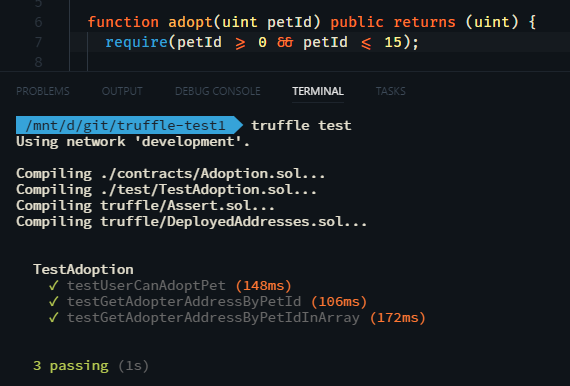
If this was a logical error, a test should not throw a weird, unintuitive exception like that.
batjko
on 30 Jul 2017
@batjko, Thank you! That solved the problem :-) It's obvious if you think to look there :-D
 moritz-botconnect
on 2 Aug 2017
moritz-botconnect
on 2 Aug 2017
Hi there.
I believe we've fixed this issue with the Pet Shop tutorial. I'm going to close for housekeeping reasons, but please open a new ticket if you run into more issues.
Thanks!
 tcoulter
on 18 Sep 2017
tcoulter
on 18 Sep 2017
Hello all. I don't think anyone here solved the original problem. Is there a way to check for require and assert exceptions that we expect from invalid input?
 awgneo
on 2 Oct 2017
awgneo
on 2 Oct 2017
I may have found a decent workaround until Truffle officially supports this. The open-zeppelin project provides an assertJump function for this purpose. Check out this example. https://github.com/OpenZeppelin/zeppelin-solidity/blob/master/test/Ownable.js
awgneo
on 3 Oct 2017
I have the same issue as @batjko with the following require statement
~~~
function adopt(uint petId) public returns (uint) {
require(petId >= 0 && petId <= 15);
~
~~~~
~/C/2/0/pet-shop-tutorial ❯❯❯ truffle test
Using network 'development'.
Compiling ./contracts/Adoption.sol...
Compiling ./test/TestAdoption.sol...
Compiling truffle/Assert.sol...
Compiling truffle/DeployedAddresses.sol...
...
TestAdoption
1) "before all" hook: prepare suite
0 passing (436ms)
1 failing
1) TestAdoption "before all" hook: prepare suite:
Error: VM Exception while processing transaction: invalid opcode
at Object.InvalidResponse (/usr/local/lib/node_modules/truffle/build/cli.bundled.js:37312:16)
at /usr/local/lib/node_modules/truffle/build/cli.bundled.js:220420:36
at /usr/local/lib/node_modules/truffle/build/cli.bundled.js:204149:9
at XMLHttpRequest.request.onreadystatechange (/usr/local/lib/node_modules/truffle/build/cli.bundled.js:205574:13)
at XMLHttpRequestEventTarget.dispatchEvent (/usr/local/lib/node_modules/truffle/build/cli.bundled.js:73069:18)
at XMLHttpRequest._setReadyState (/usr/local/lib/node_modules/truffle/build/cli.bundled.js:73359:12)
at XMLHttpRequest._onHttpResponseEnd (/usr/local/lib/node_modules/truffle/build/cli.bundled.js:73514:12)
at IncomingMessage.
~~~~
Any idea what could go wrong?
 benvoi
on 25 Oct 2017
benvoi
on 25 Oct 2017
Regarding the original problem, I use the error function in the promise, which is triggered by an EVM exception. For example a snippet of a test for a token contract:
it("should reject transfers with insufficient funds", function() {
var account_two = accounts[2];
var account_three = accounts[3];
var amount = 120000;
var tok;
return MyToken.deployed()
.then(function(instance) {
tok = instance;
return tok.transfer(account_two, amount, { from: account_three });
})
.then(function(r) {
assert(false, 'transfer (1) of insufficient funds should have failed');
return true;
},
function(e) {
assert.match(e, /VM Exception[a-zA-Z0-9 ]+: invalid opcode/, "transfer (1) of insufficient funds should have raised VM exception");
});
});
Since I expect the transfer call to fail, I put an assert(false) in the success function, to make the test fail. And in the failure function, I assert that the error looks like it was generated by a EVM exception. The regexp works for tests running against testrpc; it may need to be tweaked for a more general use. It might also be possible to encapsulate the two functions for reuse; currently the tests as written would require a bit of cut and paste.
 escoffon
on 26 Oct 2017
escoffon
on 26 Oct 2017
Is there any way to test this in solidity? Every solution I found is on JS.
I feel that in this context (Ethereum/solidity) testing for edge cases and failure is even more important that testing for working cases.
In the case of the pet shop I'd like to:
- assert that if pet > 15 it fails,
- assert it fails if no pet id
- every edge case I could imagine...
 mritzco
on 14 Dec 2017
mritzco
on 14 Dec 2017
Any updates? Is there any way to test in solidity? Every solution I found is for JS.
I feel that in the context of (Ethereum/solidity) testing for edge cases and failure is as important as testing for working cases.
mritzco
on 18 Dec 2017
@mritzco, +1, i would also like to see progress on this
 lrascao
on 23 Dec 2017
lrascao
on 23 Dec 2017
+1, I would also like to test this in solidity - not javascript. For now, workaround seems to be to test from JS and assert something in the promise error - is that still the only way to accomplish this?
 rickbatka
on 22 Jan 2018
rickbatka
on 22 Jan 2018
+1 for solidity.
 fdouglis
on 24 Jan 2018
fdouglis
on 24 Jan 2018
You all can test for exceptions within Solidity tests using the following tutorial: http://truffleframework.com/tutorials/testing-for-throws-in-solidity-tests
The tutorial is out of date, and is written to test for throw (a predecessor to revert(), assert(), etc.)
However, the important bit is this part:
bool r = throwProxy.execute.gas(200000)();
Assert.isFalse(r, “Should be false, as it should throw”);
Note that instead of throwing, a bool is returned with the status of the execute() function. You can use Solidity tests to test for these error cases in a similar way.
tcoulter
on 24 Jan 2018
Thanks, @tcoulter, for the pointer to the proxy approach. I used that and it works. It's good that if we expect a revert() we can use that to confirm it happens, and fail the test only if it doesn't.
Now if only we could see events emitted during Solidity tests without raising a test failure. My only workaround there has been to do Assert.fail() if I want to see events, but then it counts as a unit test failure.
fdouglis
on 15 Feb 2018
Changing <= to '<' and '>=' to '>' works.
 whoadityanawandar
on 28 Feb 2018
whoadityanawandar
on 28 Feb 2018
I worked around this by catching the error in a try-catch block. However, is there a simpler/cleaner way to do it? Something like expect(tx).to.throw().
Workaround:
it('expect a revert in smart contract', async () => {
let contract = await MyContract.deployed();
try {
let tx = await contract.someFunc(inputParam, {from: accounts[0]});
} catch(err) {
assert(true); // expected the throw
}
})
 jackwzp
on 5 May 2018
jackwzp
on 5 May 2018
Actually I found a solution to this problem to write cleaner tests. In a helper.js file under test/ folder, I created a helper function that wraps all the try-catch stuff. Then in my actualTest.js file under test/, I can just write a simple one line statement.
helper.js
module.exports =  async (promise) => {
    try {
        await promise;
    } catch (err) {
        return;
    }
    assert(false, 'Expected throw not received');
}
actualTest.js
// at the top of the file
var expectThrow = require('./helper.js');

// further down in test file inside a contract()
it('expect a revert in smart contract', async () => {
   let contract = await MyContract.deployed();
   // note there is no await keyword for tx as in my previous comment
   let tx = contract.someFunc(inputParam, {from: accounts[0]});
   await expectThrow(tx);
})
I found @rkalis has done awesome job regarding this topic.
https://ethereum.stackexchange.com/a/60574/41404
https://kalis.me/assert-reverts-solidity-smart-contract-test-truffle/
 OliveIT
on 29 May 2019
OliveIT
on 29 May 2019
Related issues
 oed
·
3Comments
oed
·
3Comments
 Katsu1991
·
3Comments
Katsu1991
·
3Comments
 arunmitteam
·
3Comments
arunmitteam
·
3Comments
 rjl493456442
·
4Comments
rjl493456442
·
4Comments
 jleeh
·
3Comments
jleeh
·
3Comments
Most helpful comment
Actually I found a solution to this problem to write cleaner tests. In a helper.js file under test/ folder, I created a helper function that wraps all the try-catch stuff. Then in my actualTest.js file under test/, I can just write a simple one line statement.
helper.js
actualTest.js