Tribler: Byzantine-resilient, asynchronous, yet decentralized federated learning
Key points:
- Cum Laude ambitions
- thesis _science_ must come above everything else
- possible direction with most science imaginable
- TBM compatible; thus governance of the global financial system (who owns capitalism)
- single universal global market
- liquidity attracts liquidity
- near-zero cost trust
- inherently superior and open
- by design hostile to speculators, hft, and any middleman
- mechanism design against speculation tax
- market makers redundant?
- startup use-case for bootstrapping liquidity
- real euros and real dollar plus Bitcoins?
- real mortgage market?
- avoid utopia thinking
- re-use existing infrastructure from the lab
- thousands of DAO/blockchain competing projects, with fancy white papers and high ambition level
- integrity of the market : fakes, extortion, and fraud
- companies become a front-end for shared critical infrastructure, they keep their helpdesk and customers. However, they can do deals with customers from competitors in a single highly liquid market
- entirely non-custodial, no proxy tricks, autonomous-entities-only principle
- market consolidation and domination mechanism
- design some principle that Booking.com, Expedia and Airbnb see that this is an existential threat and they decide to all join, collaborate, and extend the global market; instead of being cut-off.
- Why did The Internet eat all other proprietary communication protocols? re-use that trick!
- Booking.com, Expedia and Airbnb: they sort of become ISPs for the global market infrastructuur.
- disruptive change: everything becomes transparent and open; pricing, utilisations, market share, etc.
- game theory: fully self-interest driven
- no helping others for free
- willing to do effort for your own interest, safety and fraud prevention
- maintenance?
- Delft University should not be special; always ability to fork away; keep everybody honest
 synctext
All 37 comments
Interesting thesis direction!
We aim to achieve this goal with our own decentralized exchange, which is fundamentally different from existing DEXes. I think the OP identified the main flaws of existing DEXes (e.g., BitShares, Waves, OasisDEX...). Even though the idea of DEXes is interesting, their liquidity is too low to attract traders. Furthermore, even though they offer trust-less asset settlement, their (transaction) costs are still high (of course, this also depends on the specifications of the underlying protocols). Finally, there are many fairness issues attached to blockchain-based exchanges.
I think market fairness as central thesis component could be a viable and novel research direction. This ties directly into mechanism design and behavior of individual agents, whose goal is to optimize their own profits. Can we make a market that provides fairness to traders? Fairness is a multi-dimensional property so you might want to focus on a specific aspect of fairness.
 devos50
on 18 Mar 2020
devos50
on 18 Mar 2020
Some overlap here, however they just want their own coin to become big https://docs.bisq.network/dao/phase-zero.html
Bisq, a peer-to-peer exchange network designed for secure, private and
censorship-resistant trading of bitcoin for national currencies and other cryptocurrencies
[snip]
Appendix A: Roles defines the roles individuals play when participating in the Bisq DAO,
such as trader, contributor and stakeholder, and defines several categories of high-trust
bonded contributor roles such as maintainer, operator, and administrator;
Initial exploratory literature review:
(a) digital marketplaces (https://fetch.ai/wp-content/uploads/2019/10/Fetch.AI-Economics-white-paper.pdf)
(b) distributed ledgers used for financial purposes (http://www.smallake.kr/wp-content/uploads/2018/09/E_JPX_working_paper_No15.pdf / https://papers.ssrn.com/sol3/papers.cfm?abstract_id=3352293)
(c) peer-to-peer lending (https://www.oecd.org/daf/ca/The-Potential-for-Blockchain-in-Public-Equity-Markets-in-Asia.pdf)
 jverbraeken
on 7 Apr 2020
jverbraeken
on 7 Apr 2020
Initial thoughts after reading some literature, before discussing with Johan:
- One universal platform on which every supply/demand-market can be built (from Uber to Airbnb, from Amazon to stock markets, from insurers to lenders)
- Everything peer-to-peer to prevent extra costs from middlemen
- Goal = mainstream adoption ===> integration of payments methods such as Paypal and creditcards is essential + governments should be able to regulate the platform within their regions
- The throughput necessary will easily (!) exceed 9000 transactions/second. For trading in USA alone, system should be able to handle 800 million trades/day => 9000 per second
- Still struggling with who's going to pay the electricity bills
The idea is that anyone can create a market. I identified several considerations that a market creator should consider:
- Checks before the market can be created
- Government regulations (stocks, airbnb, uber)
- A partitioned scheme that keeps certain transactions within certain locations may be required to satisfy local jurisdictional requirements
- Government regulations (stocks, airbnb, uber)
- At creation time
- Send potential buyers/sellers amessage when new marketplace has opened?
- E.g. notify a bank when someone wants to borrow
- Digital or physical product?
- Semantic links with other markets (e.g. ubers in Delft subset of ubers in South-Holland, black ubers subset of ubers)
- Send potential buyers/sellers amessage when new marketplace has opened?
- At run-time
- Buyer
- Anonymous or not?
- Anonymity of both parties is crucial for stock markets, but undesirable for airbnb markets
- Anonymous or not?
- Product
- Scheduling of the good? (airbnb)
- Can change every now and then
- Location of the good? (uber / airbnb)
- Can change every now and then
- Order book
- Type of matching
- Mostly relevant for stock exchanges: first-in-first-out or pro-rata?
- Fixed price level or not?
- Can you see the other asks/bids or not?
- On stock markets this is desirable, on Amazon this is unnecessary
- Additional service
- Reviews for the product or not?
- Does not make sense for the stock market, but very valuable for airbnb
- How to handle fake reviews?
- Recommended items?
- Reviews for the product or not?
- Type of matching
- Scheduling of the good? (airbnb)
- Seller
- Anonymous or not?
- Anonymity of both parties is crucial for stock markets, but undesirable for airbnb markets
- Anonymous or not?
- Buyer
- At purchase time
- KNY/AML/CTM? (know your customer / anti-money laundering / counter-terrorism financing)
- (for physical goods: ) choose third-party escrow to provide protection?
- Payment details
- Automatic / manual approval of purchase
- E.g. does airbnb owner want to have the renter
- Collatoral or not? (house, car)
- Payment obligation (paying right now, in terms, physical or monetary goods, crypto or fiat, …)
- Automatic / manual approval of purchase
- Conditions to enter a marketplace
- E.g. age for adult stuff or creditworthiness for loans
- For loans we still need creditworthiness for external party
- In USA they have a system with bad privacy
- In Netherlands based on financial situation and loan payment history
- Additional details may be obligatory to deploy bailiff (incassobureau/deurwaarder)
- After purchase
- Should some party by notified to keep track of the order?
- E.g. corporate share register managed by a transfer agent for stock markets
- Cancellation possibility after the item has already been purchased
- "The ability for clients to correct/cancel/adjust transactions that were inadvertently charged or credited to the wrong account is a common occurrence and well managed by today’s financial institutions. Additionally, complex financial transactions often include the ability to reverse the transaction based on contractual stipulations as a desirable feature. The ability to cancel or reverse a transaction is not supported in today’s distributed ledger platform, and it is not clear today how the platform could evolve to support that"
- Vendor obligation (sending product right now, in terms, lottery, …)
- Should some party by notified to keep track of the order?
jverbraeken
on 18 Apr 2020
great taxonomy start! Trustchain is consensus-free, thus no electricity for mining.
What are two isolated markets that can be merged into a single infrastructure? Preferably with low competition, high fees, low innovation, and incentives to use your open alternative.
synctext
on 19 Apr 2020
Brainstorm... Inspired by this payout platform it would be possible to build market trackers(). A payout is provided if the stock market is either below or above a certain mark. Use our DAO #5143 with shared ownership of Bitcoins.
- currency trading: Euro/Dollar rate prediction market + actual exchange, clearance and settlement.
- largest: new york stock exchange tracker
- long-term public trackers
- Prediction market for climate change: #2882 (everybody can invest against/on climate change within minutes. This is impossible today. our 2017 idea)
- food pricing ???
synctext
on 19 Apr 2020
I am currently working on a classification/overview of existing electronic market/trade mechanisms based on blockchain technology (for a possible paper). This also includes literature on prediction markets, like Augur. I have collected 130+ (mostly peer-reviewed) articles so far and categorised them. I think there is quite some overlap with topics that you brought up. If you are interested in them, I can share them with you 👍
devos50
on 19 Apr 2020
can you post a list here? + URLs possible even...
synctext
on 19 Apr 2020
@synctext sure! I'm using the Papers application to organize and categorize all the literature that I read, and I'm currently in the process of reading/summarizing each paper. I think the list below is quite complete regarding academic work, but there are still a few open-source (non-peer-reviewed) implementations missing.
Atomic Swaps
Alt chains and atomic transfers
Atomic Cross-Chain Swaps.
Atomic Cross-chain Swaps - Development, Trajectory and Potential of Non-monetary Digital Token Swap Facilities.
Atomic Cross-Chain Swaps with Improved Space and Time Complexity.
Atomic Crosschain Transactions for Ethereum Private Sidechains.
Atomic Swaptions: Cryptocurrency Derivatives
Cross-chain Deals and Adversarial Commerce.
Extending Atomic Cross-Chain Swaps.
On the optionality and fairness of Atomic Swaps.
On the specification and verification of atomic swap smart contracts.
Privacy-Preserving Cross-Chain Atomic Swaps
The state of atomic swaps
(via @papersapp)
http://scholar.google.comjavascript:void(0)
https://dblp.org/rec/conf/podc/Herlihy18
http://aetic.theiaer.org/archive/v3/v3n1/p5.html
https://dblp.org/rec/journals/corr/abs-1905-09985
https://dblp.org/rec/journals/corr/abs-1904-12079
http://arxiv.org/abs/1807.08644v2
https://dblp.org/rec/journals/pvldb/HerlihySL19
http://link.springer.com/10.1007/978-3-030-31500-9_14
http://dl.acm.org/citation.cfm?doid=3318041.3355460
http://arxiv.org/abs/1811.06099v1
http://fc20.ifca.ai/wtsc/WTSC2020/WTSC20_paper_20.pdf
http://diyhpl.us/wiki/transcripts/scalingbitcoin/tokyo-2018/atomic-swaps/
Auctions
PASTRAMI: Privacy-preserving, Auditable, Scalable&Trustworthy Auctions for Multiple Items
Succinctly Verifiable Sealed-Bid Auction Smart Contract.
Verifiable Sealed-Bid Auction on the Ethereum Blockchain.
(via @papersapp)
http://link.springer.com/10.1007/978-3-030-00305-0_1
http://link.springer.com/10.1007/978-3-662-58820-8_18
Custodial Exchanges
Bitcoin: Economics, Technology, and Governance
Bitcoin Transaction Malleability and MtGox
Making Bitcoin Exchanges Transparent
Provisions: Privacy-preserving Proofs of Solvency for Bitcoin Exchanges
ShapeShift
Tesseract - Real-Time Cryptocurrency Exchange Using Trusted Hardware.
The Arwen Trading Protocols (Full Version).
Why Preventing a Cryptocurrency Exchange Heist Isn’t Good Enough
(via @papersapp)
http://pubs.aeaweb.org/doi/10.1257/jep.29.2.213
https://link.springer.com/chapter/10.1007/978-3-319-11212-1_18
https://link.springer.com/chapter/10.1007/978-3-319-24177-7_28
http://dl.acm.org/citation.cfm?doid=2810103.2813674
https://shapeshift.io
http://dl.acm.org/doi/10.1145/3319535.3363221
https://dblp.org/rec/journals/iacr/HeilmanLG20
https://link.springer.com/chapter/10.1007/978-3-030-03251-7_27
Decentralized Exchanges
0x: An open protocol for decentralized exchange on the Ethereum blockchain
A Demonstration of Sterling - A Privacy-Preserving Data Marketplace.
A Distributed Digital Asset-Trading Platform Based on Permissioned Blockchains
Beaver - A Decentralized Anonymous Marketplace with Secure Reputation.
Bisq - The peer-to-peer Bitcoin Exchange
BitShares 2.0: General Overview
Coincer: Decentralised Trustless Platform for Exchanging Decentralised Cryptocurrencies
Decentralized blockchain-based electronic marketplaces
Decentralizing the Stock Exchange using Blockchain An Ethereum-based implementation of the Bucharest Stock Exchange.
Deconstructing Decentralized Exchanges
Enigma Catalyst : A machine-based investing platform and infrastructure for crypto-assets
Etherdelta
Fast and secure global payments with Stellar
Fragmentation of Distributed Exchanges
IDEX: A Real-Time and High-Throughput
Ethereum Smart Contract Exchange
IDMoB - IoT Data Marketplace on Blockchain.
Komodo BarterDEX
Kyber Network whitepaper
Localbitcoins
Loopring: A decentralized token exchange protocol
Mind my value - a decentralized infrastructure for fair and trusted IoT data trading.
Open bazaar protocol
Polkadot: Vision for a heterogeneous multi-chain framework
Republic Protocol: A decentralized dark pool exchange providing atomic swaps for Ethereum-based assets and Bitcoin
Resource Control in P2P Cryptocurrency Networks
SmartExchange: Decentralised Trustless Cryptocurrency Exchange
Swap: A Peer-to-peer Protocol for Trading Ethereum Tokens
Waves.Exchange | Buy crypto with 0% fees
XCLAIM: Trustless, Interoperable, Cryptocurrency-Backed Assets
(via @papersapp)
https://static.xcj.com/uploads/20180518/xumb4xmv3o1516701172833.pdf
http://dl.acm.org/citation.cfm?doid=3229863.3275603
https://link.springer.com/chapter/10.1007/978-3-030-05764-0_6
https://dblp.org/rec/journals/iacr/SoskaKCD16
https://docs.bisq.network/exchange/whitepaper.html
https://cryptorating.eu/whitepapers/BitShares/bitshares-general.pdf
https://link.springer.com/chapter/10.1007/978-3-319-64701-2_53
https://dl.acm.org/doi/10.1145/3158333
https://ieeexplore.ieee.org/document/8516610/
https://assets.pubpub.org/ob89i66u/61573938834913.pdf
https://etherdelta.com
http://dl.acm.org/citation.cfm?doid=3341301.3359636
http://arxiv.org/abs/1910.11216v2
https://ieeexplore.ieee.org/document/8525388/
https://files.kyber.network/Kyber_Protocol_22_April_v0.1.pdf
https://localbitcoins.com
https://raw.githubusercontent.com/Loopring/whitepaper/master/en_whitepaper.pdf
http://dl.acm.org/citation.cfm?doid=3131542.3131564
http://docs.openbazaar.com
http://scholar.google.comjavascript:void(0)
http://arxiv.org/abs/1810.11675v1
https://link.springer.com/chapter/10.1007/978-3-030-04849-5_32
https://swap.tech/whitepaper/
https://waves.exchange
https://ieeexplore.ieee.org/document/8835387/
Blockchain-based Energy Trading
Blockchain-based electricity trading with Digitalgrid router
Consortium Blockchain for Secure Energy Trading in Industrial Internet of Things.
Crypto-trading: Blockchain-oriented energy market
Energy trading for fun and profit buy your neighbor's rooftop solar power or sell your own-it'll all be on a blockchain
Implementation of blockchain-based energy trading system
Privacy-Preserving Energy Trading Using Consortium Blockchain in Smart Grid.
Security and Privacy in Decentralized Energy Trading Through Multi-Signatures, Blockchain and Anonymous Messaging Streams.
Towards resilient networked microgrids: Blockchain-enabled peer-to-peer electricity trading mechanism
(via @papersapp)
https://ieeexplore.ieee.org/abstract/document/7991065/
http://ieeexplore.ieee.org/document/8234700/
https://ieeexplore.ieee.org/abstract/document/8240547/
https://ieeexplore.ieee.org/abstract/document/8048842/
https://www.emerald.com/insight/content/doi/10.1108/APJIE-12-2017-037/full/html
https://ieeexplore.ieee.org/document/8613816/
https://dblp.org/rec/journals/tdsc/AitzhanS18
https://ieeexplore.ieee.org/abstract/document/8245449/
Matchmaking
0x: An open protocol for decentralized exchange on the Ethereum blockchain
Etherdelta
Libra - Fair Order-Matching for Electronic Financial Exchanges.
Loopring: A decentralized token exchange protocol
Swap: A Peer-to-peer Protocol for Trading Ethereum Tokens
The cost of decentralization in 0x and EtherDelta
(via @papersapp)
https://static.xcj.com/uploads/20180518/xumb4xmv3o1516701172833.pdf
https://etherdelta.com
http://dl.acm.org/citation.cfm?doid=3318041.3355468
https://raw.githubusercontent.com/Loopring/whitepaper/master/en_whitepaper.pdf
https://swap.tech/whitepaper/
https://hackingdistributed.com/2017/08/13/cost-of-decent/
Prediction Markets
A permissioned blockchain-based implementation of LMSR prediction markets.
A Smart Contract Oracle for Approximating Real-World, Real Number Values
Augur: a decentralized, open-source platform for prediction markets
Decentralized Prediction Market Without Arbiters.
Gnosis whitepaper
(via @papersapp)
https://linkinghub.elsevier.com/retrieve/pii/S016792361930257X
https://drops.dagstuhl.de/opus/volltexte/2020/11970
http://cryptoverze.com/wp-content/uploads/2019/01/augur.pdf
http://link.springer.com/10.1007/978-3-319-70278-0_13
http://scholar.google.comjavascript:void(0)
Security Aspects of Trading
Flash Boys 2.0 - Frontrunning, Transaction Reordering, and Consensus Instability in Decentralized Exchanges.
Footprints on a Blockchain: Trading and Information Leakage in Distributed Ledgers
On the impossibility of fair exchange without a trusted third party
On the optionality and fairness of Atomic Swaps.
Provisions: Privacy-preserving Proofs of Solvency for Bitcoin Exchanges
The cost of decentralization in 0x and EtherDelta
The Decentralized Financial Crisis: Attacking DeFi
Zexe - Enabling Decentralized Private Computation.
(via @papersapp)
https://dblp.org/rec/journals/corr/abs-1904-05234
http://jot.pm-research.com/lookup/doi/10.3905/jot.2017.12.3.005
https://pdfs.semanticscholar.org/208b/22c7a094ada20736593afcc8c759c7d1b79c.pdf
http://dl.acm.org/citation.cfm?doid=3318041.3355460
http://dl.acm.org/citation.cfm?doid=2810103.2813674
https://hackingdistributed.com/2017/08/13/cost-of-decent/
http://arxiv.org/abs/2002.08099v1
https://dblp.org/rec/journals/iacr/BoweCGMMW18
Settlement Mechanisms
A protocol for interledger payments
Atomically Trading with Roger - Gambling on the Success of a Hardfork.
Blockchain-based secure digital asset exchange scheme with QoS-aware incentive mechanism.
Blockchain-based settlement for asset trading
Blockchain router: A cross-chain communication protocol
Bootstrapping a Blockchain Based Ecosystem for Big Data Exchange.
Centrally Banked Cryptocurrencies.
Cross-asset trading within blockchain networks
Cross-Chain Payment Protocols with Success Guarantees
DeXTT - Deterministic Cross-Blockchain Token Transfers.
Escrow Protocols for Cryptocurrencies - How to Buy Physical Goods Using Bitcoin.
Fair and Decentralized Exchange of Digital Goods.
Fair Two-Party Computations via Bitcoin Deposits.
FairSwap - How To Fairly Exchange Digital Goods.
Hallex: A trust-less exchange system for digital assets
How to Use Bitcoin to Design Fair Protocols.
Hyperledger Fabric: A Distributed Operating System for Permissioned Blockchains
HyperPubSub - Blockchain Based Publish/Subscribe.
Implementing an Asset Trading System Based on Blockchain and Game Theory
Liquid Speed: On-Demand Fast Trading at Distributed Exchanges
Market design for trading with blockchain technology
On the impossibility of fair exchange without a trusted third party
Optimistic Protocols for Fair Exchange.
PEX - Privacy-Preserved, Multi-Tier Exchange Framework for Cross Platform Virtual Assets Trading.
Pisa - Arbitration Outsourcing for State Channels.
Proof of Delivery of Digital Assets Using Blockchain and Smart Contracts.
Real-time Money Routing by Trusting Strangers with your Funds.
Resource trading in blockchain-based industrial Internet of Things
SDTE - A Secure Blockchain-Based Data Trading Ecosystem.
Towards Decentralized Equilibrium Asset Trading Based on Blockchain.
Trading Real-World Assets on Blockchain - An Application of Trust-Free Transaction Systems in the Market for Lemons.
Trading Stocks on Blocks - Engineering Decentralized Markets
Trust Is Risk - A Decentralized Financial Trust Platform.
Usable optimistic fair exchange.
XChange - A Blockchain-based Mechanism for Generic Asset Trading In Resource-constrained Environments.
XCLAIM: Trustless, Interoperable, Cryptocurrency-Backed Assets
(via @papersapp)
http://blockchainlab.com/pdf/interledger.pdf
http://link.springer.com/10.1007/978-3-319-67816-0_19
https://ieeexplore.ieee.org/document/8808111/
https://academic.oup.com/rfs/article-abstract/32/5/1716/5427772
http://ieeexplore.ieee.org/document/8029360/
https://dblp.org/rec/conf/ndss/DanezisM16
https://patents.google.com/patent/US20190311351A1/en
http://arxiv.org/abs/1912.04513v1
http://arxiv.org/abs/1905.06204v1
http://link.springer.com/10.1007/978-3-319-70972-7_18
https://dblp.org/rec/journals/corr/abs-2002-09689
http://link.springer.com/10.1007/978-3-662-44774-1_8
https://dl.acm.org/doi/10.1145/3243734.3243857
https://dblp.org/rec/journals/iacr/BentovK14
http://dl.acm.org/citation.cfm?doid=3190508.3190538
https://ieeexplore.ieee.org/document/9049532/
https://ieeexplore.ieee.org/abstract/document/8945822/
http://arxiv.org/abs/1907.10720v1
http://blockchain.cs.ucl.ac.uk/wp-content/uploads/2016/11/Paper_18.pdf
https://pdfs.semanticscholar.org/208b/22c7a094ada20736593afcc8c759c7d1b79c.pdf
http://portal.acm.org/citation.cfm?doid=266420.266426
https://ieeexplore.ieee.org/document/9045515/
http://dl.acm.org/citation.cfm?doid=3318041.3355461
https://ieeexplore.ieee.org/document/8501910/
https://ieeexplore.ieee.org/document/8696786/
https://ieeexplore.ieee.org/abstract/document/8657779/
https://ieeexplore.ieee.org/document/8759960/
https://ieeexplore.ieee.org/document/8855688/
http://link.springer.com/10.1007/s12599-017-0499-8
https://link.springer.com/chapter/10.1007/978-3-319-59144-5_34
https://dblp.org/rec/journals/iacr/LitosZ17
https://linkinghub.elsevier.com/retrieve/pii/S138912861100301X
http://arxiv.org/abs/2004.05046v1
https://ieeexplore.ieee.org/document/8835387/
Various
Attacking the DeFi Ecosystem with Flash Loans for Fun and Profit.
Beware the Middleman - Empirical Analysis of Bitcoin-Exchange Risk.
Blockchain-enabled Intelligent Asset Exchange for a Circular Economy.
Challenges and Opportunities Associated with a Bitcoin-Based Transaction Rating System.
Dispute Resolution for Smart Contract-based Two-Party Protocols.
Hyperledger Fabric: A Distributed Operating System for Permissioned Blockchains
Measuring the Longitudinal Evolution of the Online Anonymous Marketplace Ecosystem.
Overview of Emerging Blockchain Architectures and Platforms for Electronic Trading Exchanges
Peer Review - Toward a Blockchain-enabled Market-based Ecosystem.
Shared Ledger Accounting - Implementing the Economic Exchange pattern.
The Economics of Cryptocurrency Pump and Dump Schemes
The Emerging Role of Electronic Marketplaces on the Internet.
Tokenization: Open Asset Protocol on Blockchain
Towards atomic cross-chain token transfers: State of the art and open questions within tast
(via @papersapp)
http://arxiv.org/abs/2003.03810v2
http://link.springer.com/10.1007/978-3-642-39884-1_3
https://dblp.org/rec/journals/ercim/AskoxylakisAD17
http://link.springer.com/10.1007/978-3-662-44774-1_3
https://ieeexplore.ieee.org/document/8751312/
http://dl.acm.org/citation.cfm?doid=3190508.3190538
https://dblp.org/rec/conf/uss/SoskaC15
http://www.ssrn.com/abstract=2867344
https://dblp.org/rec/journals/cais/Avital18
https://linkinghub.elsevier.com/retrieve/pii/S0306437919304892
https://papers.ssrn.com/abstract=3310307
http://portal.acm.org/citation.cfm?doid=280324.280330
https://ieeexplore.ieee.org/abstract/document/8711021/
https://dsg.tuwien.ac.at/projects/tast/pub/tast-white-paper-1.pdf
devos50
on 19 Apr 2020
Thanks a lot for the suggestions @synctext @devos50 👍🏻👍🏻
I hadn't heard of Augur yet, very interesting project indeed! Will change my proposed taxonomy a bit to allow for prediction markets.
Would be great if you could share your summaries of those papers @devos50!
My holiday is over unfortunately, from July onwards I'll dedicate all my time to this thesis project
jverbraeken
on 20 Apr 2020
great taxonomy start! Trustchain is consensus-free, thus no electricity for mining.
What are two isolated markets that can be merged into a single infrastructure? Preferably with low competition, high fees, low innovation, and incentives to use your open alternative.
I'd need to look more into that. At first sight, I'd say that Tinder is a great example since they have a near-monopoly, very high fees, and close to no innovation.
jverbraeken
on 20 Apr 2020
I'd need to look more into that. At first sight, I'd say that Tinder is a great example since they have a near-monopoly, very high fees, and close to no innovation.
See Matchpool: dating on a blockchain
You can collect 'arrows' by proposing love interests. You are rewarded with more arrows as the relationship advances and gets more intimate 😄.
devos50
on 20 Apr 2020
Haha nicee, awesome project 😂😂
jverbraeken
on 20 Apr 2020
Coming 6 weeks:
- come up with wow-factor stuff
- Example: an open market for tax evasion for normal people
- now only the elite can do _tax minimisation_. Always use a proxy. At least 200 private jet aircraft have been imported through "the Isle of Man" and cut tax bills by £790m ($1bn).
- digitize the Vermont-EU private tax-free pension buildup or the https://en.wikipedia.org/wiki/Paradise_Papers proxies for zero-taxation
- lega online market for services which minimize your tax through loopholes.
- Moral high-ground: grow political will to plug the holes that the elite exploits.
- ToDo: find an bootstrap thesis prototype and showcase market
- beyond engineering, https://github.com/jverbraeken/UniversalMarket/wiki/Plan
- Freeze the final direction in 3 month
- it has to have scientific grounding for highest grade, novel algorithm or architecture
- make markets safe: escrow, iterative payment versus delivery
- make markets universal, build upon FBase "device drivers" for specific markets
- build upon programmable money of Internet-of-Money IBAN integration
- go beyond target2
- Advise: read complex papers by the IMF and federal reserve
- Fully distributed can be very fast
- Focus on a core problem, like Fairswap mentioned above.
Universal market research questions from kick-off presentation:
- Universal market: search in all these goods, semantics, and relevance ranking
- Universal market: large storage requirement of all these product descriptions, 1 number to rule them all (everybody switch to the Joost Numbering System (JNS))
- Universal market: custodians, open market, transparent, and low-cost
Existing:
- https://github.com/Tribler/trustchain-superapp/blob/master/README.md#ai-trading-bot
- https://play.google.com/store/apps/details?id=nl.tudelft.trustchain
synctext
on 16 Jul 2020

jverbraeken
on 16 Jul 2020
Please read the current status of our global AI marketplace tooling:
https://github.com/Tribler/tribler/files/4929974/Dollynator.-.Final.Report.pdf
After contributions by 31 students in various courses over the years, it is quite sophisticated. Bug-free also obviously :wink:
synctext
on 16 Jul 2020

15 additional screenshots


jverbraeken
on 24 Jul 2020
- https://github.com/jverbraeken/UniversalMarket/wiki/Points-for-consideration
- Follow a structured process;
- no wow-factor! thesis direction found yet.
- read ideas of others to come up with superior smart ideas
- August: document 10+ thesis ideas in few sentences; scientific challenge (axiomatic science: the market primitive! Cheating is guaranteed to be eventually detected; infra: bitshares, waves, etc,; Matching algorithms for trades; ID: no trolls, intermediaries: trustworthy; persistence and finality: core concepts; decentralised finance: P2P lending constructs; Market leaders: Amazon,Target2; custodian: boring stuff)
- September: pick your top-3 ideas, expand them to 1 page of scientific challenge + state-of-the-art, related work.
- September 30: decide on direction.
- October: fully focus on single direction.
- Decentral systems:
- latency is not a problem in (de)central systems, its about engineering excellence
- long-tail is not a problem in (de)central systems, its about engineering excellence
- right to be forgotten is not a problem in (de)central systems, its about engineering excellence
- _new insight_: market primitives for digital markets are easier. Involving the physical world introduces many messy problems. Easier to show novel science in the digital-only markets. Transactions are atomic, fraud is easier to detect, tamper-proof logging solves honesty, incremental payments, and still markets are fragmented!
- Strong disincentive to establish a universal market. No monopoly power. if the single market is created, forces companies to join it.
- monopoly problems:
- Universal market for digital goods:
- Digital services (unique goods which can't be copied)
- Steam alternative, content for gaming market
- Spotify alternative, content for music industry
- Netflix alternative, content for movie industry
- Unify: limited supply, fixed price, bid/ask, lottery, etc.
synctext
on 24 Jul 2020
Some (peer-reviewed) work related to your ideas: Domain Ontology for Digital Marketplaces.
devos50
on 30 Jul 2020

jverbraeken
on 26 Aug 2020
Ideas for thesis focus:
- middleware for distributed machine learning (toward decentralised computation)
- mobile-first zero-cost AI (fully decentralised, zero-server, no upkeep cost)
- resilient against abuse (troll army)
- data never leaves mobile (only training vectors, etc)
- it simply works (its not about the 10% state-of-the-art performance)
- self-scaling (from 1 thousand to 1 billion users)
- scientific progress: select those ideas which will scale it the real world and provide the empirical evidence.
- Second idea
- ToDo: the imperfect scientific paper which everybody jumps upon and improves upon. Seed a community and start a platform.
synctext
on 26 Aug 2020
We choose to focus first on federated learning (instead of distributed learning), because this field is less researched and poses more significant challenges regarding incentives/privacy/security. When this works, extending the functionality to support distributed learning is fairly trivial.
Some literature:

Must-haves
Step 1
Create IPv8 overlay in SuperApp and let it run on a few servers, see:
- https://github.com/Tribler/kotlin-ipv8/blob/8792a95243f84979dfeaaaf37fae78c8d0485df8/doc/OverlayTutorial.md
- https://github.com/Tribler/kotlin-ipv8/tree/8792a95243f84979dfeaaaf37fae78c8d0485df8
- https://github.com/Tribler/trustchain-superapp/blob/master/doc/AppTutorial.md
Step 2
Successfully train a CNN on the MNIST database on a single node
Step 3
Implement most basic gossiping protocol for distributed CNN-training: https://arxiv.org/pdf/1611.04581.pdf
- Create block type I: blk_parameters
Should-haves
Step 4
Prevent attacks (sybil + injection)
- Strong identities by giving people €0,01 when they use the app and hashing their bank account
- Peers select models by (1) taking a sample of models based on the reputation of the peers that created them, and (2) test their performance on their local data, take the 3 best performing models, and take the average of them
- Letting everyone verify if contribution of a random other person improves the accuracy based on his/her own data => put this on the blockchain (RONI)
- Create block type II: blk_reputation
- Establish reputation based on KRUM, median, FoolsGold, ...
- Problem: doesn't work well for non-IID environments, see: https://ieeexplore.ieee.org/stamp/stamp.jsp?arnumber=9066920
- Put most emphasis on most recent interactions in calculating someone's reputation
- Incentive mechanism: limit functionality of app when people don't train the model
- Reputation calculation also based on how well a peer evaluates other peers
Literature:
- https://ieeexplore.ieee.org/stamp/stamp.jsp?arnumber=8832210
- https://arxiv.org/pdf/1811.09904.pdf (reputation denoted as "stake")
- https://ieeexplore.ieee.org/stamp/stamp.jsp?arnumber=8994206
- https://ieeexplore.ieee.org/stamp/stamp.jsp?arnumber=9150433 (want to take similar approach, but with reputations)
Step 5
Use differentially private noise to enhance privacy
- Also consider using Shamir secrets: https://arxiv.org/pdf/1811.09904.pdf
- Or make all peers completely anonymous
- Or apply dimensionality reduction (PCA): https://arxiv.org/pdf/1902.10799.pdf
Could-haves
Step 6
Replace SGD (that everyone uses, why???) with something way better https://ruder.io/optimizing-gradient-descent/index.html#whichoptimizertouse
Step 7
Develop a general supply/demand platform where people can request other people to train their models, people choose which models they want to train
- Financial incentives
- Both federated and distributed learning
Step 8
Take the average of lots of models in the early stages of the network (initially large fluctuations) and phase this averaging out when the model eventually converges
- Use averaging based on weights to put more emphasis on models trained with lots of training data (FedAVG / FedSGD)
jverbraeken
on 9 Sep 2020
Research questions:
- How can we prevent sybil/injection attacks in a decentralized federated learning system?
- Practically all papers use SGD to train decentralized neural networks; would better parameter optimization methods also work well in decentralized settings?
- Can we replace a blockchain to store the model parameters with an eventually consistent system (trustchain) to achieve superior performance?
jverbraeken
on 9 Sep 2020
Now it is _really_ secure :laughing: ; key thesis selling point. Key related work: Biscotti.
Concrete thesis direction proposal:
federated learning on edge devices is a new emerging field with significant promise, but numerous unsolved challenges around privacy, security, and incentives. This thesis will significantly address the state-of-the-art by demonstrating a performance leap beyond classical Gradient Decent, security advancement without reliance on external trusted third parties or services, address the privacy issue without introducing brittle zero-knowledge proofs, and provide incentive alignment.
Our solution relies on _secured gossip_ to address model pollution and Sybil attack by providing easy-to-use trust framework which utilises Internet latency diversity, graph analysis of user activity, and transaction properties for attack-resilience.
Concrete goal: in 6 weeks a "Poisoning attack" (Wednesday 21 Oct).
Possible future sprints past this date:
- broader attacks
- broader attacks and taxonomy of defence mechanisms
- what dataset to use. For instance, high-impact social relevance on edge devices: Anticipating Accidents in Dashcam Videos dataset. video analysis is core of many scientific papers. Possible to release this inside Superapp, re-use code, ask volunteers to mount this in car, live network for scientific publication?
- incentive alignment, wild idea: Who sees the fastest car on the road today? Detect and show how fast cars are going which overtake you on the highway. Fun, improve safety and automatically publish photos with unredacted license plates to Trustchain. Re-use like https://github.com/pddenhar/OpenCV-Dashcam-Car-Detection
synctext
on 9 Sep 2020
Update September 23
- Created new superapp module
- Ping-pong between 2 devices
- Train MNIST dataset on single phone
- Simulate distributed MNIST training on single phone
- Create an faster TFTP-alternative by sending ~50 messages simultaneously (speedup: ~11x faster)
- Implement weighted averaging
- Train MNIST dataset distributed on 2 phones
jverbraeken
on 23 Sep 2020
- Next step is fragmenting the dataset on 2 phones
- TFTP is 40 years old, modern protocol in Java: https://github.com/iiljkic/utp4j
- usage of https://github.com/eclipse/deeplearning4j/
- for comparison of achieved additional performance to related work it is required to use the usual datasets and usual configs.
- Focus on the test, attack emulation, and research infrastructure for 1 month?
- Attacks to test
- "Honest, but curious" attack first
- injection of spam/fake attack from 1 node
- creation of numerous fake identities
- Defense:
- Noise :-)
- use Trustchain, latency diversity, and transaction graph properties
synctext
on 23 Sep 2020
Please use the highly cited more modern HAL dataset, instead of MNIST.
Deep Learning Towards Mobile Applications
synctext
on 1 Oct 2020
Update October 7

- Implement UTP library (speedup ~9x faster)
- Add CIFAR-10 and UCI-HAR dataset + well-performing neural networks
- Redesign UI
- Store relevant training information in custom log files that are easily accessible for the user
- Compress model updates before sending them over the network
- Enable the user to show/hide log entries from specific classes
Issue
Simultaneously receiving/sending packets sometimes crashes => packets not always received by the listener
Links
https://github.com/jverbraeken/trustchain-superapp
https://github.com/jverbraeken/kotlin-ipv8
https://1drv.ms/u/s!AvNMRY4ml2WPgZhA-uL0CvZys_FopA?e=1tEZyo
jverbraeken
on 7 Oct 2020
Great progress again!
- Enhanced Kotlin IPv8 with UTP support, still has 1 pending bug
- Complete packet drop when doing concurrent connections. Thus incoming & outgoing connections are not possible.
- Create single end-to-end test please.
- Create single end-to-end test with concurrent connections for debugging
- ML compression related work
- Communication-efficient learning of deep networks from decentralized data
- Federated Learning: Challenges, Methods, and Future Directions
- Federated Learning: Strategies for Improving Communication Efficiency
- Distributed Mean Estimation with Limited Communication
- Distributed Consensus With Limited Communication Data Rate
- Possible directions (for end March deadline)
- keep the Sybil attack central, security, ease of polluting models. An attack can be expressed in Euros.
- identify cool highly cited papers
- re-produce their algorithm in Superapp
- select the next hot paper (FoolsGold, Mitigating Sybils in Federated Learning Poisoning)
- kill it with fake identities for 100 Euro of cloud hardware
- repeat and show that _all known algorithms are flawed_.
- be mean: https://www.schneier.com/blog/archives/2017/08/confusing_self.html, a great paper: adversarial machine learning
- bootstrap and state convergence.
- core: federated learning speedup
- concept of difficulty applied to federated ML: booststrap time, network partitions, faults, etc.
- use a tamper-proof data structure to record progress
- how to deal with 50MByte of progress data every 10 seconds (5 MByte/sec for every phone)
- Experimental results
- Key to scientific article (REQUIRED)
- Android emulation, cloud usage or DAS6
- Run locally 4 instances on laptop
Red warning signs appear when a field produces a Survey-of-Surveys. Solid paper actually with 205 citations around Mobile Edge Computing (MEC).

synctext
on 8 Oct 2020
Update October 22
- Solved the bug in UTP => sending and receiving simultaneously works and is stable
- Configure and start machine learning task directly from command line
- Thorough literature research
- Started on literature review / thesis document (see https://1drv.ms/w/s!AvNMRY4ml2WPgZhhnJnQjTpIwT-5vw?e=WOJUlo)
- Further delineating of thesis topic: "Byzantine-resilient, asynchronous, yet decentralized federated learning"
Main idea:
Improve current state-of-the-art byzantine defense algorithm Mozi, see https://www.groundai.com/project/towards-byzantine-resilient-learning-in-decentralized-systems/
- Main innovation 1: almost all current methods require a (significant) set of incoming samples to be able to take the average or median or something similar. I want to use a "moving window kind of thing" to let the agent update its model immediately when a new samples arrives
- Main innovation 2: almost all papers use simple averaging; I want to use weighted averaging based on (a) how well a model scores and (b) how frequent a peer has already sent data (frequency filter, see https://arxiv.org/pdf/1802.07928.pdf)
- Main innovation 3: almost all current algorithms require i.i.d. data. I want to loosen this unrealistic assumption (agent A has classes X and Y, agent B has classes Y and Z) and allow for non-i.i.d. data by sending the updated model only to nodes that are quite similar in terms of private data. I will do this by checking the cardinality of the private set intersection between the data labels of both nodes.
- Evaluate the impact of a warm-start
- Usage of ring communication (and compare this approach with random peers, close neighbors, etc.)
- Be the first paper in this field to distinguish between exploration (asking other peers to send you their model) and exploitation (improving your own model), and formalizing the trade-off between these things
- (Comparison with improved BRIDGE (BRIDGE cuts off the top #maxbyzantine and bottom #maxbyzantine incoming values. I reduce this _2b_ constraint to _b_ by searching for the "most coherent" logical sequence of data (bit like Minimum-Diameter Averaging)))
- (Maybe something with PCA to filter out byzantine values (probably doesn't work because there are many (!!!) more dimensions than training samples))
- (Maybe something with RANSAC, particle filters, iterated/iterative filtering, Monte Carlo, ... These methods might also be useful to filter out byzantine values)
Other idea:
(I think this approach yield worse performance than the former, because nodes can abuse their reputation, can make use of the fact that they don't have a reputation yet, can assign excellent reputation to malicious nodes or the other way around. Additionally, it still depends on an algorithm that combines incoming models (which should be, in my opinion, the algorithm described above)
Trustchain-enabled reputation-assisted federated learning
- First, every node receives models from other nodes + half blocks with the hash of the model signed by the sender
- Node checks reliability of peers by checking the trustchain
- Then the node tests every model with his own local data and puts on the trustchain another half block including the accuracy
- The best performing models are combined with the BRIDGE algorithm and then further trained with the node's local data samples
- The node tests if this final model performs better than his old model
- If new model performs worse, throw it away
- If new model performs better, send it to other nodes along with a half block containing the hash of the new model, signed with the node's private key
Question to Martijn/Johan:
- Perhaps we can use X.509 certificates for strong identities (certificate that binds a public key to a name which is signed by a trust anchor). How does this work in the decentralized blockchain-world?
jverbraeken
on 21 Oct 2020
- The solid progress needed for the trip towards Cum Laude by March
- Byzantine defense algorithm Mozi: "cars can collaboratively learn powerful models of traffic sign classification for autonomous driving; in a social network, users can learn better".
- Random failure, large-scale, already difficult enough not large-scale Sybil and collusion
- Random failures; No Data poisoning, no model poisoning attacks
- no targeted model poisoning, specific adversarial pixel pattern, no known defence..
- Thesis needs a "wow factor", include something like storyline below
- Blockchain lab is in need of AI in space
- Defect and Fault Tolerance focus
- Space radiation is known to flip bits, Injecting bit flip faults by means of a purely software approach: a case studied
- Master course with 40+ students need a focus and attractive buzz
- Why not mix&match all the SpaceX, Terminator AI, and Blockchain Gold
- _Space Investment Fund_ is a DAO which aims to be the first to launch byzantine- fault tolerant space swarm satellites.
- This thesis provides the AI tech basis for this work
- Delft has a satellite launch program and is home to several space companies
- Get a good example dataset, sahara+satellite+data
- Actual space-based satellite "train" from NASA
- This thesis is about core technology, generic in nature and broadly applicable. To showcase the new possibilities we unlock beyond MNIST we introduce JoostSpace.
- With Zulu server, 5 x 512 GByte memory in our Tribler cluster; 250 instances may be possible
- _Learn-To-Learn_. Building on Alphazero, adversarial learning, competitive self-play, evolutionary learning. We generated several theories and did a meta-emulation to determine the fitness. What Fitness function?
- 23 Sep 2020 paper: Byzantine-Resilient Decentralized TD Learning with Linear Function Approximation
- Mozi, 70 nodes, 2 week target to reproduce, Byzantine = 50%. "Fig. 5: The worst accuracy of the benign nodes under the bit-flip attack."

synctext
on 22 Oct 2020
I've read the MOZI paper in detail to get a better understanding of the field and techniques used.
I see how their approach is novel (combining distance-based and performances-based vector selection), however, I am slightly confused by the experimental results. Figure 6 shows that MOZI is indeed resilient against common attacks, but not more significantly than DBulyan. In fact, MOZI sometimes exhibits _less_ accuracy than other aggregation rules, e.g., simple average, even under the sophisticated attack (Figure 6c). The "average" strategy actually seems to perform very well in most cases, and shows decent convergence. The authors claim that "the advantage of MOZI over other strategies is obvious" but I strongly disagree with this claim. Figure 7 shows "average" is also very performant compared to MOZI. What are then the main reasons why one should pick MOZI? Am I missing something here?
Some other comments/questions:
- The paper mentions two use-cases for decentralized learning: Internet-of-Vehicle and recommendations in social networks. The latter use-case is close to what we aim to do in our lab, also see #3752. There should be another open issue for music recommendation somewhere. The evaluation of the paper is not tied to a specific use-case, which potentially undermines their results since it is not a realistic experimental setup with respect to an application domain. You should keep this in mind for your own evaluation.
- I noticed that the paper assumes that network messages do not get lost. Their Byzantine behaviour only considers sending carefully-crafted estimates to neighbours.
- As we also discussed last week, a key design decision of your system is synchronous learning vs asynchronous learning. The MOZI authors opt for synchronous learning.
- Why is it not realistic to add an additional validation dataset to a centralised parameter server?
- It was not clear to me how the "connection ratio" is defined. Was this described in the paper?
devos50
on 29 Oct 2020
WIP update November 9
- Fixed several super nasty bugs with UTP (ConcurrentHashMap instead of regular HashMap, Dispatchers.IO context for coroutine instead of default context, incorrect timing between threads, etc.)
- Discovered that restarting my laptop when packages are not being delivered anymore often magically solves the problem and endless hours of debugging
- Sending and receiving UTP from/to many peers simultaneously works correctly
- Created batch script / Visual Basic file to redirect localhost ports to the emulator ports + changed source code of android-ipv8 to send updates to peers with the same IP-address to localhost instead of the network
- Everything running stable on 4 emulators (together with Android Studio consuming 27GB of RAM)
- However, only with the tiny MNIST dataset to prevent out-of-memory exceptions
- More emulators gets really slow
- Create for every peer a random (seed=port) training/test dataset with a user-configurable number of samples per class
- User can select communication pattern
- Communicate updates to everyone (too slow, discommend using this option at the moment)
- Communicate updates to random peer (during my first trial run this resulted in the sequence: 59235, _59243_, _59243_, 59235, 59235, 59235, 59235, 59235, _59243_. This is random, but clearly suboptimal)
- Communicate updates in a round-robin schedule
- Communicates updates in a ring schedule (e.g. peer 1, 2, 4, 8, 16, 32, ..., 1, 2, 4, ...)
- Implemented Coordinate-Wise Median, Trimmed Mean, Krum, BRIDGE, and MOZI
- Implemented 3 behaviors (including 2 data poisoning attacks): benign, noise attack, label-flip attack
- Implemented 3 model poisoning attacks (Fang, 2020): https://www.usenix.org/system/files/sec20summer_fang_prepub.pdf
- Full redesign of the UI

Also discovered some weird quirk in MOZI: when all other peers have a model that results in worse performance than the peer's own model, the peer will still average its own model with the model of the best other peer.
- Advantage: when peer has overfitted on its own data, using the model of the other peer can improve the peer's model
- Disadvantage: the assumption that the algorithm works well, even when all other nodes are malicious, doesn't hold anymore
jverbraeken
on 1 Nov 2020
@devos50
Thanks for your comment!
I see how their approach is novel (combining distance-based and performances-based vector selection), however, I am slightly confused by the experimental results. Figure 6 shows that MOZI is indeed resilient against common attacks, but not more significantly than DBulyan. In fact, MOZI sometimes exhibits _less_ accuracy than other aggregation rules, e.g., simple average, even under the sophisticated attack (Figure 6c). The "average" strategy actually seems to perform very well in most cases, and shows decent convergence. The authors claim that "the advantage of MOZI over other strategies is obvious" but I strongly disagree with this claim. Figure 7 shows "average" is also very performant compared to MOZI. What are then the main reasons why one should pick MOZI? Am I missing something here?
Well, simple average results indeed in better performance than MOZI, but the authors mention that "For baseline, we consider the same decentralized system configuration without Byzantine nodes, and using the Average Aggregation rule (Equation 2). The model trained from this setting can be regarded as the optimal one."
The paper mentions two use-cases for decentralized learning: Internet-of-Vehicle and recommendations in social networks. The latter use-case is close to what we aim to do in our lab, also see #3752. There should be another open issue for music recommendation somewhere. The evaluation of the paper is not tied to a specific use-case, which potentially undermines their results since it is not a realistic experimental setup with respect to an application domain. You should keep this in mind for your own evaluation.
Thanks! I'll keep that in mind 👍🏻. The HAR dataset (that is implemented in the current version) is a pretty realistic use-case I think.
I noticed that the paper assumes that network messages do not get lost. Their Byzantine behaviour only considers sending carefully-crafted estimates to neighbours.
Mmh, yeah that's correct, and currently the same on my setup because messages don't get lost between emulators since all network traffic is on the same computer. However, I think it's reasonable to make the attackers as strong as possible to simulate a worst-case scenario (attackers are weaker when their packets get lost on the way to the benign node).
As we also discussed last week, a key design decision of your system is synchronous learning vs asynchronous learning. The MOZI authors opt for synchronous learning.
Exactly! Asynchronous learning with lots of nodes that are significantly lagging behind is much more challenging that synchronous learning and has received relatively little attention from the scientific community. The authors also assume an i.i.d. dataset instead of a non-i.i.d. dataset which makes everything a lot easier. I think I'll focus first on tackling the non-i.i.d. challenge (since the i.i.d. assumption is completely ridiculous in real-life) and maybe in a later stage focus on making the algorithm work in asynchronous settings (because synchronous settings are actually realistic in real-life; you can "simply" synchronize every day with the other nodes)
Why is it not realistic to add an additional validation dataset to a centralised parameter server?
Good question! It is very realistic and there is a lot of literature using this approach. However, it can be hard to get enough data because the data might be very privacy-sensitive (e.g. Whatsapp messages, Tinder recommendations, or photos). Additionally, unless you get all data from all users (in which case federated learning doesn't make sense) you will have a lot more validation data when users validate incoming updates themselves (this doesn't always result in better performance because the validation data is scattered across all users, but hey, topic for future research).
- It was not clear to me how the "connection ratio" is defined. Was this described in the paper?
No, the authors forgot to mention that. I think that connection ratio refers to the fraction of nodes with which every node communicates its updates
jverbraeken
on 1 Nov 2020
Possibly related work:
devos50
on 9 Nov 2020
- Follow the standard papers within the field: "Yet another superior defence"?
- General Internet-deployed Federated Learning Framework
- Or sell the science
- Current state-of-the-art: it only works in fantasy papers with ideal data input, ignores time (one-shot; no real-time incoming data), and ideal correlation (IID, no real-world power law, distributions, and correlations)

- data decay, cold start, network is converged
- "Real-World data and model" storyline (Your described innovation 1 & 3 in above comments)
- What is your key selling point of thesis? Wow-factor?
- Evaluation section (obviously MNIST) with:
- ?Medical: CH-MNIST and Breast Cancer Wisconsin (Diagnostics)
- ? Deceptive Youtube content, and/or Fake accounts problem, etc.
synctext
on 9 Nov 2020
Minor update: much better on-device simulation. Not memory-bound anymore, but cpu-bound
Major update:
Implemented 1st version of BRISTLE (Byzantine-Resilient decentralIzed StochasTic Federated lEarning)
- Or perhaps prepend "pro" to emphasize that my solution focuses on practical real-life scenarios? => Pro-BRISTLE (Practical yet Robust Byzantine-Resilient decentralIzed StochasTic Federated lEarning)
About fancy datasets - I think it's important to keep the focus on the defense mechanism part, because that's the innovative contribution of the paper. The "wow factor" comes from the fact that this algorithm is not only decentralized (just like Byrdie, BRIDGE, and MOZI), but is also unique in several aspects: it can handle non-i.i.d. data, and can work in an asynchronous setting, both of which are complex to achieve. Creating/using a fancy dataset doesn't add a lot to the scientific contribution of BRISTLE and deserves its own paper because creating a proper neural network for a complex dataset is highly non-trivial
- The UCI Human Activity Recognition dataset is the most popular on Kaggle (https://www.kaggle.com/datasets?search=smartphone&sort=votes), resembles a typical real-life scenario and has enough training samples (namely 7350). Therefore I'll use this dataset for my research.
- Additionally I'll use the MNIST dataset, because this dataset is used by practically every paper in the FL domain.
- Finally, I'm considering using the CIFAR-10 dataset which is also very popular, easy to transform to a non-i.i.d. version, and considerably more complex than MNIST and HAR.
Features - Direct averaging of results => nice so that your models isn't learning many iterations on a sub-optimal model
- Better outlier detection because of keeping track of last x updates
- Exploration vs exploitation strategy to enable fully asynchronous program
- Private set intersection cardinality (PSI-CA) to enable non-i.i.d. support
Pseudocode
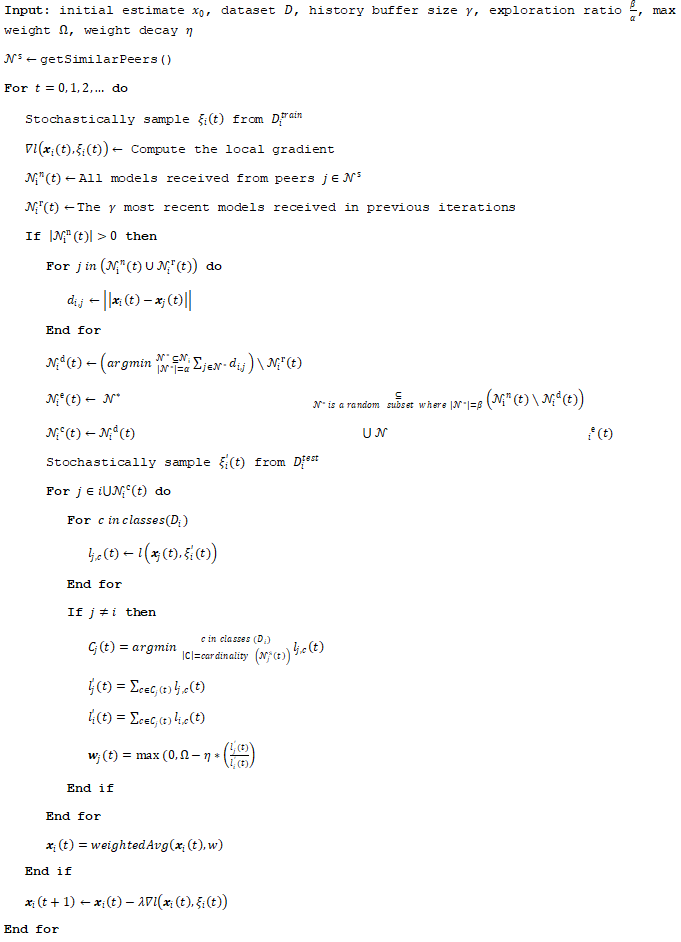
Pseudocode old version, you can skip this, perhaps slightly more readable than the formal version
Main:
similarPeers <- getSimilarPeers()
network = createNetwork()
trainDataSetIterator, testDataSetIterator = createIterators()

repeat:
    network.fit(trainDataSetIterator.nextBatch()
    if models received from other peers:
        averageParams = integrateParameters(network)
        network.setParameters(averageParams)
        recentOtherModels.add(newOtherModels)
        limit recentOtherModels to the 20 most recent models
    endif
end repeat
integrateParameters:
distances = euclideanDistance(ownModel, newOtherModels, recentOtherModels)
exploitationModels = first X models with the smallest distance
Exclude non-new models from exploitationModels
explorationModels = from (distances \ exploitationModels \ recentOtherModels), randomly select Y models
combinedModels = exploitationModels ∪ explorationModels
calculate for the peer's own model per class the loss on a random data sample
calculate for all combinedModels the loss on the same random data sample
calculate weight for every combined model
set new model to weighted average of combined models
calculateWeights
for every peer:
    C = cardinality of PSI with peer
    bestClasses = the C classes with the lowest loss for the other peer
    smallestOtherLoss = sum of the losses of the other peer for bestClasses
    smallestOwnLoss = sum of the losses of self for bestClasses
    weight = max(0, 8 - 4 * (smallestOtherLoss / smallestOwnLoss)
getSimilarPeers:

jverbraeken
on 12 Nov 2020
Related issues
 grandpaul
·
10Comments
grandpaul
·
10Comments
 NoNameForMee
·
6Comments
NoNameForMee
·
6Comments
 slrslr
·
7Comments
slrslr
·
7Comments
 FFY00
·
5Comments
FFY00
·
5Comments
 ichorid
·
8Comments
ichorid
·
8Comments
Most helpful comment
Update October 7

Issue
Simultaneously receiving/sending packets sometimes crashes => packets not always received by the listener
Links
https://github.com/jverbraeken/trustchain-superapp
https://github.com/jverbraeken/kotlin-ipv8
https://1drv.ms/u/s!AvNMRY4ml2WPgZhA-uL0CvZys_FopA?e=1tEZyo