Three.js: Font: Add support for textDirection.

 sonichy
All 4 comments
Workaround:
var text = 't\nh\nr\ne\ne\n.\nj\ns';
I suppose we could consider this issue to be a feature request to add .textDirection.
 WestLangley
on 12 Dec 2019
WestLangley
on 12 Dec 2019
Remembers me at #11680
 Mugen87
on 12 Dec 2019
Mugen87
on 12 Dec 2019
I worked on this with results :
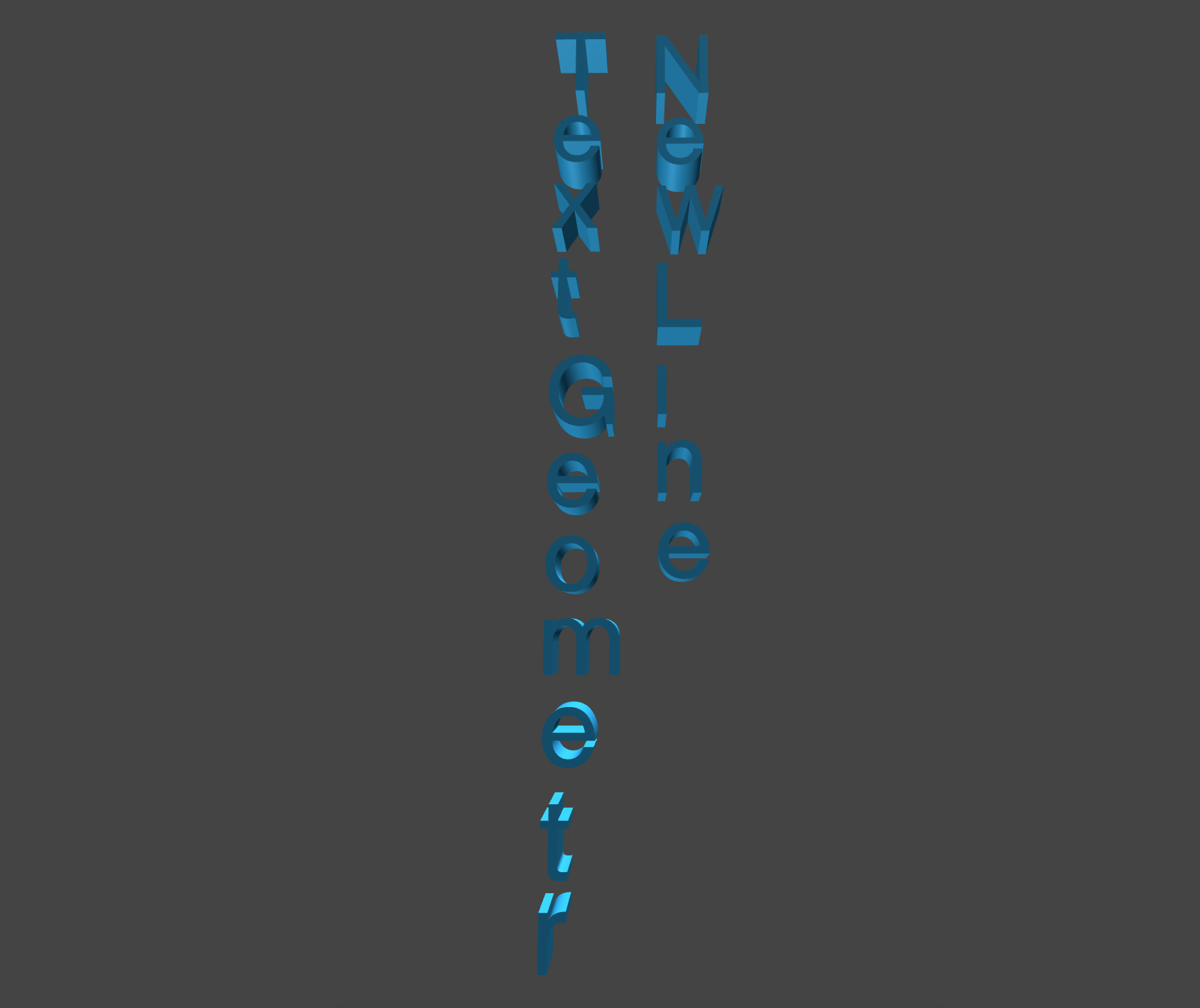
but also many problems like misplaced accents and dots :

or huge white spaces between letters even if latin character aren't design to be displayed vertically.
I don't really know if I'm taking the problem in the right direction. My idea was to create the character geometries separately for each shape then use then using those geometry's bounding boxes to translate character's vertices.
`
if ( parameters.textDirection === undefined || parameters.textDirection.equals( new Vector2( 1, 0 ) ) ) {
ExtrudeBufferGeometry.call( this, shapes, parameters );
} else {
BufferGeometry.call ( this );
    var verticesArray = [],
        uvArray = [];

    var xOffset = 0,
        yOffset = 0,
        prevXOffset = 0,
        lineXOffset = 0,
        lineYOffset = 0;

    var textDirectionNormal = parameters.textDirection.clone().normalize();
        textDirectionNormal.set ( -textDirectionNormal.y, textDirectionNormal.x ).normalize();

    var lineHeight = ( font.data.boundingBox.yMax - font.data.boundingBox.yMin + font.data.underlineThickness ) * (parameters.size / font.data.resolution);

    shapes.forEach(shape => {
        var geo = new ExtrudeBufferGeometry( shape, parameters );
        geo.computeBoundingBox();

        xOffset = lineXOffset + geo.boundingBox.min.x;
        if( prevXOffset > xOffset ){
            //new line
            lineXOffset -= lineHeight * textDirectionNormal.x;
            lineYOffset -= lineHeight * textDirectionNormal.y;

            xOffset = lineXOffset + geo.boundingBox.min.x;
            yOffset = lineYOffset;
        } else {
            yOffset += geo.boundingBox.max.y - geo.boundingBox.min.y;
        }

        var scaledDirection = parameters.textDirection.clone().multiply( new Vector2( xOffset, yOffset ) );

        var vertices = geo.getAttribute( 'position' ).array;
        for (var i = 0; i < vertices.length; i += 3){
            vertices[i] += scaledDirection.x - xOffset;
            vertices[i + 1] += scaledDirection.y - yOffset;
        }

        verticesArray.push( ...vertices );
        uvArray.push( ...geo.getAttribute( 'uv' ).array );
        prevXOffset = xOffset;
    });

    this.setAttribute( 'position', new Float32BufferAttribute( verticesArray, 3 ) );
    this.setAttribute( 'uv', new Float32BufferAttribute( uvArray, 2 ) );

    this.computeVertexNormals();
}
`
I wonder if it would be better to use the textDirection parameters directly in the Font class ?
 ValentinUsedREKTItsSuperEffective
on 20 Jan 2020
ValentinUsedREKTItsSuperEffective
on 20 Jan 2020
I wonder if it would be better to use the textDirection parameters directly in the Font class ?
Yes, I think so. For rtl support, I have read that you need a compatible font anyway because of problematic letter spacings. In other words, you can't just generate the text along arbitrary directions because it will look like in your screenshot.
Mugen87
on 20 Jan 2020
Related issues
 makc
·
3Comments
makc
·
3Comments
 jens-duttke
·
3Comments
jens-duttke
·
3Comments
 jlaquinte
·
3Comments
jlaquinte
·
3Comments
 filharvey
·
3Comments
filharvey
·
3Comments
 danieljack
·
3Comments
danieljack
·
3Comments
Most helpful comment
Workaround:
I suppose we could consider this issue to be a feature request to add
.textDirection.