Three.js: initMaterial called each time render is called on a material used on two scenes
Description of the problem
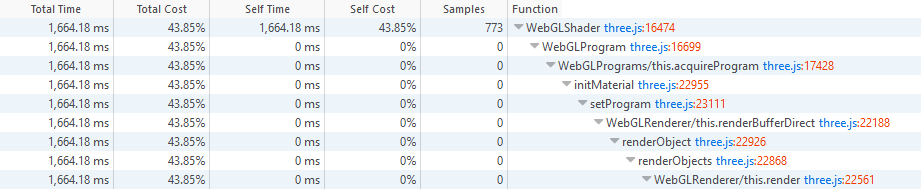
I noticed that there was a significant slowdown in the app I'm developing. I narrowed it down to being caused by initMaterial being called each frame under certain very specific conditions
. The minimum requirements to reproduce the bug (afaik) are:
- Create two meshes which share the same MeshLambertMaterial.
- Create two scenes and add the meshes to them.
- Create a single DirectionalLight in one of the scenes, not both.
- Create an OrthographicCamera overlooking the objects (not a perspective camera).
- Call render twice, once for each scene.
If you don't notice the slowdown, use the performance tab in Firefox to measure the performance and you should see WebGLShader at the top of the call tree.
Three.js version
- [x] Dev
Browser
- [x] Firefox
OS
- [x] Windows
 DennisBengs
All 6 comments
DennisBengs
on 14 Jul 2018
Hmm... If a material is shared between two scenes, initMaterial() is called with each use because:
materialProperties.lightsHash !== lights.state.hash
The hash is defined as:
state.hash = state.id + ',' + directionalLength + ... etc...
Even if the numbers and types of lights are the same in both scenes, state.id is different.
So, sharing a material between scenes will not be performant.
The work-around is to clone the material.
var mesh1 = new THREE.Mesh( geometry, material );
var mesh2 = new THREE.Mesh( geometry, material.clone() );
I guess I would call this a limitation.
And a duplicate of #14121.
 WestLangley
on 15 Jul 2018
WestLangley
on 15 Jul 2018
The issue may be a duplicate, but the content is not.
There is useful information in this thread that is not in #14121, namely that there is a work around available.
And the implication is we should document this limitation and work-around somewhere if we are not going to consider this a bug and fix it.
I do not think we should close _any_ issue before it has been addressed.
WestLangley
on 15 Jul 2018
In general we avoid multiple issues about the same topic. Since #14121 is the leading issue, you should transfer the workaround to this discussion.
 Mugen87
on 15 Jul 2018
Mugen87
on 15 Jul 2018
OK. Perhaps we can close duplicates like so:
_Closing as a duplicate. Please continue the discussion in #14121._
WestLangley
on 15 Jul 2018
Sounds good!
Mugen87
on 16 Jul 2018
Related issues
 jens-duttke
·
3Comments
jens-duttke
·
3Comments
 alexprut
·
3Comments
alexprut
·
3Comments
 boyravikumar
·
3Comments
boyravikumar
·
3Comments
 fuzihaofzh
·
3Comments
fuzihaofzh
·
3Comments
 ghost
·
3Comments
ghost
·
3Comments
Most helpful comment
OK. Perhaps we can close duplicates like so:
_Closing as a duplicate. Please continue the discussion in #14121._