Tasmota: POLL: Disable USE_ADC_VCC for permanent Analog user input
The ESP8266 provides an Analog input to be used as either Analog input OR as a voltage monitor. Switching between the two is only possible at compile time.
Currently the ESP8266 Analog input is enabled only in the sonoff-sensor firmware version. All other versions use it for voltage monitoring.
As recent devices start using the Analog input for either overtemperature detection (Shelly 2.5) or as Button (Supernight smart plug) I think it's a good time to decide to default enable the Analog input for the task it was designed for and make the voltage monitoring optional using the define.
I'm in favor of the switch as I never saw real use for the voltage monitoring.
Pls comment.
NB. This change has been implemented in development branch release 6.5.0.10
 arendst
All 18 comments
Agree
 ascillato
on 18 Apr 2019
ascillato
on 18 Apr 2019
"Pls comment if you think otherwise." - I do not think otherwise, but thought I'd comment anyway :wink:
 meingraham
on 18 Apr 2019
meingraham
on 18 Apr 2019
Change to analog input.
The measured voltage is useless. Never helped to find a power issue (and values depends on core)...
 Jason2866
on 18 Apr 2019
Jason2866
on 18 Apr 2019
Agree, I found that VCC monitoring is unreliable because its value is different between core version or between NodeMCU / Sonoff devices module, it made me confuse more than helpful.
 wongnam
on 18 Apr 2019
wongnam
on 18 Apr 2019
Agree... change to allow the use of A0. If there's some odd chance where someone needs it the other way it is way too easy for them to compile their own.
 digiblur
on 18 Apr 2019
digiblur
on 18 Apr 2019
Voltage monitoring is more of a novelty anyway and definitely not useful to average users. Only fear is that users will be confused if the A0 reading appears on the gui by default
 blakadder
on 18 Apr 2019
blakadder
on 18 Apr 2019
Will A0 still only be available if compiled with sensors option (e.g., sonoff-sensors.bin) or available like any input, even in base version (e.g., sonoff.bin)?
meingraham
on 18 Apr 2019
my 2c:
- Internal voltage is important mostly for battery operation only. This is not feasible with tasmota (no deep sleep, permanent wifi ->too power hungry): A0 for external sensors makes more sense as default.
- A0 is not used often. Readings should not be displayed per default, only when activated.
- A configurable mapping function like
display=a*A0^2+b*A0+cand a configurable unit string would be
nice.
 joba-1
on 19 Apr 2019
joba-1
on 19 Apr 2019
I plan to implement the ADC0 as any other GPIO so in the GUI a dropdown box with possible functionality. Doing it that way will allow for not seeing the Analog input if no functionality is selected.
arendst
on 19 Apr 2019
In branch development-adc0 you'll find the implementation of enabling ADC0 for users. It is compatible with the current templates where FLAG = 1 enables the ADC0 as analog input and FLAG = 2 enables the analog input as temperature sensor.
As I have very little coding time the next weeks I released it as another branch to free the current development branch from possible bugs implemented by the default ADC0 option.
Give it a try an I might be able to fix things the next day.
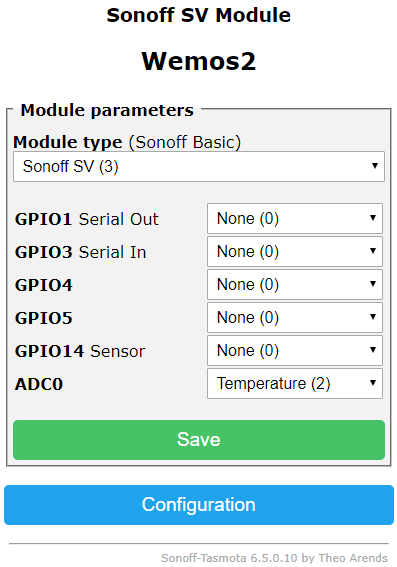
NB.1: The Light option hasn't been implemented yet.
NB.2: The Button is implemented using an analog value of 128 to discriminate between a low or high.
arendst
on 19 Apr 2019
The new implementation looks much nicer.
 Frogmore42
on 20 Apr 2019
Frogmore42
on 20 Apr 2019
I agree. I'm off for a few weeks giving you time to play with. Once I'm back I will integrate.
arendst
on 20 Apr 2019
Thx for all your input.
Implementing now.
arendst
on 13 May 2019
@arendst, I've completed my tests right now.
I think is a good implementation!
What I didn't see, for now, is a calibration tool: depending of the sensor type how we can do fine tuning?
Temperature for example, or even lux (if light analog was meant for that).
For me should be enabled just for sensors .bin.
 effelle
on 13 May 2019
effelle
on 13 May 2019
Implemented in dev release 6.5.0.10
arendst
on 13 May 2019
Note: this VCC monitor option could BE helpful for battery powered devices, like Tuya.
 ptrooms
on 4 Dec 2019
ptrooms
on 4 Dec 2019
If you need it, you can compile it by yourself (with the steps explained in the wiki). The only required change is in my_user_config.h file to uncomment the line #define USE_VCC_ADC.
As now the ADC is used by several devices like shelly for internal temperature protection, it will remain this option as default. If your device don't use the A0 pin, you can do as explained for using VCC. Take into account that internal VCC was not precise, was core dependant and it is measured internally inside the ESP8266 Chip. So, in the case of battery powered devices, it is better to attach the A0 pin to the battery directly (with the correspondent adaptation electronics) rather than measuring the internal VCC of the ESP chip.
ascillato
on 4 Dec 2019
@ascillato Good suggestion, thanks. Will do/research that on my todo list. The idea behind voltage measuring is to get a message that the battery is draining.
I Was not aware that the internal voltage measurement was (that) inaccurate.
ptrooms
on 4 Dec 2019
Related issues
 kckepz
·
3Comments
kckepz
·
3Comments
 ximonline
·
3Comments
ximonline
·
3Comments
 Joeyhza
·
3Comments
Joeyhza
·
3Comments
 TylerDurden23
·
3Comments
TylerDurden23
·
3Comments
 jensuffhaus
·
3Comments
jensuffhaus
·
3Comments
Most helpful comment
Implemented in dev release 6.5.0.10