Tasmota: 2.3.0 vs 2.4.0 vs 2.4.1 (what is it?)
After months of sweat and tears I finally got my Sonoff-Tasmota working with openHAB MQTT. I decided to write myself a HOW-TO file, so I could duplicate my setup in the future. When I got back to this wiki https://github.com/arendst/Sonoff-Tasmota/wiki/Arduino-IDE I got all confused again and could not remember what these numbers mean, 2.30, 2.40, and 2.4.1.
Are they Sonoff hardware model numbers? __________
Are they ESP8266 hardware model numbers? ___________
Are they software version numbers? ____________
What are the functions of each and advantages? _____________
How would I describe a HOW-TO step using them? _______________
In the wiki I see that I needed to do setup the Arduino IDE according to these numbers. I may have just tried something and stumbled into a working configuration. I also recall seeing files with these numbers when I did a download, but not sure what I did with them.
 sparkgap
All 21 comments
https://github.com/arendst/Sonoff-Tasmota/wiki/Troubleshooting#wifi-issues-fw--512x-expressif-versions
 Frogmore42
on 4 Jun 2018
Frogmore42
on 4 Jun 2018
Thanks for the quick response.
Ok then it's software for the ESP8266 board and good explanations of issues with various versions.
The instructions are to un-comment 2.3.0 using PlatformIO, but I'm using Arduion IDE.
I recall running into this before, and got confused Arduino IDE. I suppose I used whatever the default is for Ardiono IDE. I'll go back and study the wiki for Arduino IDE to force it to 2.3.0?
sparkgap
on 4 Jun 2018
In the following.........
Replace in Arduino IDE folder portable\packages\esp8266\hardware\esp8266\2.3.0 file boards.txt with the Tasmota Source code file arduino\version 2.3.0\boards.txt.
I can not find the IDE folder path ...../portable/.....
sparkgap
on 4 Jun 2018
Now I recall the confusion
1) If not available copy from the Tasmota release Source code folder arduino\version 2.3.0\tools\sdk\ld file eagle.flash.1m0.ld to Arduino IDE folder portable\packages\esp8266\hardware\esp8266\2.3.0\tools\sdk\ld.
2) Replace in Arduino IDE folder portable\packages\esp8266\hardware\esp8266\2.3.0 file boards.txt with the Tasmota Source code file arduino\version 2.3.0\boards.txt.
First bullet point does not make sense. If WHAT is not available?
Second bullet point seems poorly written
I was looking for these file in Program Files (x86) not there, but.......
I found.... user/appdata/local/Arduino15/packages/esp8266/hardware/esp286/2.4.1 with a boards.txt file (232KB),
But..... There was no .../portable/.... folder in the path nor was there a 2.3.0 folder.
I assume the..../portable/... in the path was a typo.
Furthermore I assume 2.3.0 in the path was also was a typo.
Now.... I could replace the board.text (232KB) in the 2.4.1 folder with the boards.txt (81KB) from the 2.3.0 downloaded source folder . Is this correct?
Now back to the first bullet point, should that be done in addition to the second bullet point?
sparkgap
on 4 Jun 2018
I would suggest PlatformIO. It has a bit of a learning curve, but I find using it with VSCode to be a far superior experience than using the Arduino environment for anything that is not trivial. Switching between 2.3.0, 2.4.0, and 2.4.1 is literally a one line change (single character if you like).
Why people think Arduino is a good development environment, I don't believe I will ever understand. Arduino is great if you have never done any programming and you desire does not go much beyond blinking an led (the proverbial hello world of embedded programming). Once you want to do something more complicated, the Arduino model makes it harder.
Frogmore42
on 4 Jun 2018
I've spend a week on Atom and Platform IO and it is still over my head. The same goes for VB editor, weeks more of learning. I use notepad ++ and Arduino very intuitive IMHO and have used both for years. I realize you prefer with VB and IO, but If someone could please clear up the Arduino IDE wiki (which is supported) , I'd have things working in a few minutes.
It appears that there are one or two files that need replacing. The first question is to clarify which or if both need replacing. I found both files in the source code for the 2.3.0 library, I just need to know which files to replace in the Arduino installation. Seems like an easy question for someone familiar with Arduino IDE. That would save me weeks of work learning IO and VB and possibly avoiding creating more problems. P.S. Using Arduino 1.8.5
sparkgap
on 4 Jun 2018
I think you are making my point. Arduino is great for beginner projects, because it hides all the complexity from you. Compiling Tasmota is not really for beginners, because there are issues with the underlying libraries/platform upon which Tasmota depends. Getting these correct is easy in PlatformIO. Doing it in Arduino is beyond the general capability of beginners.
Over the last year or two Arduino made it easier for people to extend the system, with the boards manager. But, that is a complex subject that most people don't understand. I don't typically use Arduino, because its editor is very poor.
I agree that PlatformIO can be intimidating. It can do a lot and can seem complex, but you don't need to understand much of it to get it to build your firmware
Frogmore42
on 4 Jun 2018
Update and my perspective:
I went back AGAIN and tired to work with Atom/PlatformIO, gave it an honest evening's work, but still messy in that the interface screen is too busy..... overkill IMHO...... brain overload..... Still could not get it to work.
I went back to my familiar Arduino IDE, my thinking is that it must work for many as it is still listed as a supported IDE. I once again meticulously followed the wiki instructions, still no luck following steps verbatim. So I got to thinking...... it must be written for a previous version of the Arduino IDE, because the instructions themselves had obvious conflicting steps. Anyway I stumbled into the fix. I found a scroll bar at the bottom of the package installer that gives selection options 2.3.1, 2.4.0, and 2.4.1. I simply clicked 2.3.1 and ignored the mumbo-jumbo file moving instructions in the wiki https://github.com/arendst/Sonoff-Tasmota/wiki/Arduino-IDE#copy-files. I now I have a perfect repeatable configuration.... I flashed 6 more sonoffs today.
As to which is more complicated (Arduino vs platormIO)..... With Arduino IDE it is a simple one click operation (at the bottom of the board installation screen) whereas with platformIO it is a matter of editing a line in the platformio.ini file. Therefore it's a wash as to which is the easiest, and my conclusion is that it is best to stay with whatever IDE a person is familiar with and has invested learning."
My problem was caused by the fact that the wiki instructions were not updated to match the latest board manager screen. The bullet points that instruct to manually move certain files needs to be deleted and replaced with.... "Select (click) the desired expressif version at the bottom of the Board Manager installation screen". Now this brings me to the point where the wiki needs to be cleaned up accordingly, to help others. How does one propose changes and who implements them? I struggle with understanding of the GitHub change process.
sparkgap
on 5 Jun 2018
Pls do not update the wiki with your findings as for core 2.3.0 you would still need to do the changes as documented in the wiki. Core 2.3.0 did never have the correct linker file needed for Tasmota.
 arendst
on 5 Jun 2018
arendst
on 5 Jun 2018
I had no intention to update. I thought you (as author with a password) were the only one who could make changes. This is spooky, if anyone like me could make changes. Besides..... I really don't understand how GitHub works.
As for my configuration, I have six sonoffs working perfectly well with Tasmota/MQTT/openHAB rules.
I get this on serial monitor
00:00:00 Project sonoff-0 Sonoff (Topic sonoff-4, Fallback DVES_07E8F4, GroupTopic sonoffs) Version 5.14.0-2_3_0
every time I boot up so I assumed it took 2.3.0
Also get Core/SDK Version | 2_3_0/1.5.3(aec24ac9)
in the web console
I could not make the changes as documented.... for instance it says:
Replace in Arduino IDE folder portable\packages\esp8266\hardware\esp8266\2.3.0 file boards.txt
But there is no such directory path with file 2.3.0 but there is however a 2.4.1 directory in the path. Purely following the instructions, one can not get there. That's why I suggested the update. Furthermore when I discovered the 2.3.0 selection in the broad manager installation, it looked like a "plug-n-Play". Furthermore I have no idea how any of these libraries work. I only chose 2.3.0 because I read somewhere that 2.3.0 was more stable with wifi. In my previous installation before using Tasmota I wrote my own code that would respond to a HTTP on/off POST but it got locked-up in one of the wifi libraries randomly about once a week. My whole reason for going to Tasmota MQTT was the hope that it would be more stable.
For some strange reason there was no recommended 1M (No SPIFFS) flash memory size pick in the drop-down menu. I used 1M (64K SPIFFS).
Both NodeRED and openHAB home pages are quite deceiving in their ease-of-use. Both should have a disclaimer - Caution it will take a year of sweat and tears to do anything practical. With openHAB I was getting in over my head, so tried NodeRED for a few months, but gave up and went back to openHAB. now, I don't want to be forced to learn an new IDE and editor so I hope ArduinoIDE will serve my simple applications well.
sparkgap
on 6 Jun 2018
Just a heads-up: I do not want to sound rude but the whole thing about changing boards.txt is providing the correct 1M(No SPIFFS) environment you will need to perform your first OTA or web firmware upload. With your current 1M(64K SPIFFS) it will fail and you will start thinking again why doesn't it work.
Any way. If it works for you keep it that way...
arendst
on 6 Jun 2018
The whole point of GitHub is to share knowledge. So, yes anybody who has an account can change the wiki, but it does keep track of who does what and when.
As far as Arduino goes, it is great. It simplifies things. That is great if what you need is simple. However, if what you need doesn't fit in the simple model, you have to figure out how to do what you need and it might be even harder.
The use of 2.3.0 is a good example. In Arduino, there is no built-in support for the 1M memory model. Back when 2.3.0 was new, not many projects needed that much memory (and it would be really hard to manage with the Arduino development environment). There is a way to make it work, since Arduino is really just a thin layer over C++. C++ has never been known to be easy, but most would agree it is pretty powerful. Arduino hides much of the (usually necessary) software engineering knowledge, which makes it easier to do many basic things.
If you are not developing software, you don't need to know it. If all you want to do is run Tasmota, you don't even need Arduino. Just install one of the pre-built binaries. Theo has done an excellent job of making it so you don't have to pre-configure anything. You can just flash a device and then configure it.
Frogmore42
on 6 Jun 2018
Just my 2 cents.... I am not a programmer (salesman for PBX and IT things)
I used Arduino for "hello world" on a LC Display. And i liked it to do cute little projects
in a easy way for non programmer.
Always interested in Home Automation someday i found Tasmota. This was exactly what i need to
build a HA system which suits my needs...
After a hard learning curve to get basics running in OpenHab, the next big step was get a Itead device
running with it.
After reading the wiki, for me was clear Platformio is the easiest way to get Tasmota compiled.
Sounds strange but if you compare what you have to do with Arduino vs. Platformio to setup
Platformio is the winner! Followed exactly the wiki -> Installing was smooth and no question was left open
After 1 h, i had my first self compiled Tasmota. Flashing went smooth too (i was lucky here because
i had/have a Ch340 adapter which is perfect for that)
After i understand what Theo had written (in wiki) to get a working switch in OpenHab.
-This took some time (i dont know nothing about mqtt at this time)-
And did it exactly as he described, i got a working switch via OpenHab.
I felt great at this moment like a child when getting the long awaited and wanted birthday gift...
So maybe i was simply a lucky guy to get Platforrmio running (fast).
Now i use Visual Studio Code. The reason for change. I can play with OpenHab and with Tasmota
in the same environment 😃 Installing went smooth too. I just followed the wiki again.
My conclusion dont give up to early, and do read the wiki. I can speak only for me i didnt understand
always what is written there at the first time. So i read it again...
 Jason2866
on 6 Jun 2018
Jason2866
on 6 Jun 2018
Thanks to all for the help and encouragement. This is so embarrassing I don't ever know what SPIFFS is. I always thought it partitioned EEPROM memory chip space into program storage area (static) and variable storage ares (dynamic), but then "no SPIFFS" would make no sense. I always used whatever the instructions said to use, and it worked, never having to worry about what SPIFFS is. So tonight I Google up on SPIFFS. To be continued tomorrow.......
sparkgap
on 7 Jun 2018
@sparkgap
IMHO Arduino is enough if you don't need to code, just edit user_config.h in notepad++ and compile.
It's default behavior that is to open at once all source files of the project folder make it very long to load.
Even if I switched to PlatformIO I can also compile Tasmota under Arduino and I even upgraded it's ESP2866 platform to the latest 2.4.1. So I can tell you that with a standard install (not portable) and under Win 8.1, Arduino IDE 1.85 put it's data in %localappdata%\Arduino15\packages\esp8266\hardware\esp8266\
To change the Arduino core, open the board manager, like this :
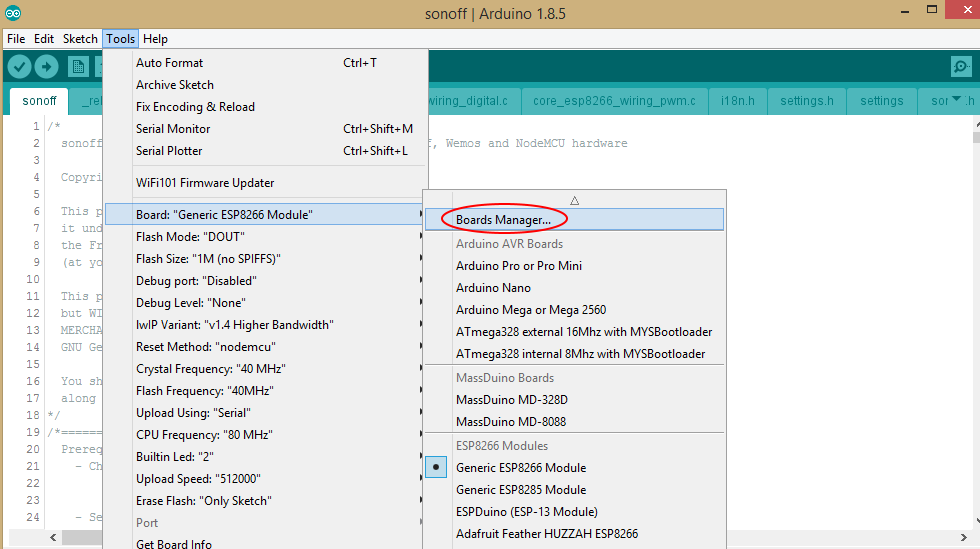
And find the ESP8266 package, you can change it's version by a click on "More info" :
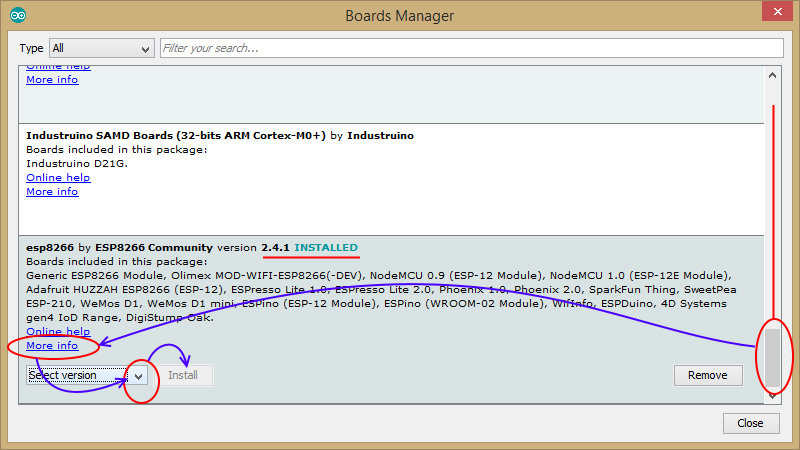
 localhost61
on 15 Jun 2018
localhost61
on 15 Jun 2018
Hi,
If your issue is solved, please close it. Thanks! :+1:
 ascillato
on 21 Jun 2018
ascillato
on 21 Jun 2018
I'm not really ready to close this yet. To recap..... my objective; Initially I was using HTML POSTS to control my sonoffs and was completely happy without Tasmota, however my c++ code would lock-up randomly every few weeks. Cycling the power would reset everything. The lock-up appeared to happen when the wifi signal became marginal and one of the wifi libraries would loose a hand-shake due to poor error recovery (or something) in one of the wifi libraries.
So.... I decided to try tasmota-sonoff. hoping it would be more robust and have some sort of watch-dog-timer to reset if there was a lock-up. When installing tasmota, I chose to fall back to 2.3.0 because of some comments about wifi stability. Unfortunately with the Arduino 2.3.0 board manager the flash size can only be set (via Tools menu pick) to 1M(64k-SPIFFS) whereas I am told that 1M(no-SPIFFS) is required if I want to do OTA upgrade. NO, I do not want to switch to and learn platformIO as some have suggested, (I tried two times and got lost in the busy GUI). Before permanently installing too many of these sonoffs, I was wondering if I should go back to the latest 2.4.1.
In other words.... is there really a wifi stability (lock-up) issuie with Ardiono Board Manager 2.4.1 ??????????????????
sparkgap
on 21 Jun 2018
2.4.1 have problems
2.3.0 is more stable
ascillato
on 22 Jun 2018
ascillato, Thanks
That's my thinking based on your and others report. So I will stick with Arduion 2.3.0 and worry about the OTA upgrade later. So far 2.3.0 is serving me well on several sonoffs. My old HTML code would have locked up by now....going on 3 weeks and no problems w/ 2.3.0.
I'll leave this issue open for a while in case someone wants to comment on why Arduino 2.3.0 does not allow selection of 1M (no-SPIFFS) as well as how 1M(64K-SPIFFS) will affect me when doing OTA upgrades. Furthermore, I really don't understand the SPIFFS thing other that 64K is set aside for something.
sparkgap
on 22 Jun 2018
Hi,
If the issue is solved, it is better to be closed so as to track better the open issues to provide the required help. Too many issues open issues result on issues left behind.
Anyone can comment on this one issue no matter if it is closed or open. If we see that it is necessary we can reopen it or make a new issue. So, for better issue tracking, please close it. Reopen if necessary. Thanks @sparkgap
ascillato
on 22 Jun 2018
Closing this issue and opening another with more appropriate subject line.
See.... "Can't set Arduino Flash Size to 1M(No-SPIFFS) with 2.3.0"
sparkgap
on 22 Jun 2018
Related issues
 garret
·
3Comments
garret
·
3Comments
 j4k3
·
3Comments
j4k3
·
3Comments
 esp32x
·
3Comments
esp32x
·
3Comments
 abzman
·
3Comments
abzman
·
3Comments
 TylerDurden23
·
3Comments
TylerDurden23
·
3Comments
Most helpful comment
The whole point of GitHub is to share knowledge. So, yes anybody who has an account can change the wiki, but it does keep track of who does what and when.
As far as Arduino goes, it is great. It simplifies things. That is great if what you need is simple. However, if what you need doesn't fit in the simple model, you have to figure out how to do what you need and it might be even harder.
The use of 2.3.0 is a good example. In Arduino, there is no built-in support for the 1M memory model. Back when 2.3.0 was new, not many projects needed that much memory (and it would be really hard to manage with the Arduino development environment). There is a way to make it work, since Arduino is really just a thin layer over C++. C++ has never been known to be easy, but most would agree it is pretty powerful. Arduino hides much of the (usually necessary) software engineering knowledge, which makes it easier to do many basic things.
If you are not developing software, you don't need to know it. If all you want to do is run Tasmota, you don't even need Arduino. Just install one of the pre-built binaries. Theo has done an excellent job of making it so you don't have to pre-configure anything. You can just flash a device and then configure it.