Swagger-ui: Recursive rendering needs work
Hello,
- swagger-ui version 3.0.17
- a swagger file reproducing the issue : https://gist.githubusercontent.com/julienkosinski/287a3b77e25a6ca3e6f7a0293bea4e3d/raw/fd94d4f1457ccbaa538f27996dba5d077d9c6f36/gistfile1.txt
I have the following model definitions spec:
    "definitions": {
        "models.Equipment": {
            "title": "Equipment",
            "type": "object",
            "properties": {
                "Features": {
                    "type": "array",
                    "items": {
                        "$ref": "#/definitions/models.Feature"
                    }
                },
                "Id": {
                    "type": "integer",
                    "format": "int64"
                },
                "IdType": {
                    "type": "string"
                },
                "Name": {
                    "type": "string"
                },
                "Price": {
                    "type": "integer",
                    "format": "int32"
                }
            }
        },
        "models.Feature": {
            "title": "Feature",
            "type": "object",
            "properties": {
                "Equipments": {
                    "type": "array",
                    "items": {
                        "$ref": "#/definitions/models.Equipment"
                    }
                },
                "Id": {
                    "type": "integer",
                    "format": "int64"
                },
                "IdFeature": {
                    "$ref": "#/definitions/models.Feature"
                },
                "Name": {
                    "type": "string"
                }
            }
        }
    }
In the Feature model, the Equipments property is defined as an array of Equipment models, but Swagger UI 3.x renders it as an empty array []. Everywhere Feature model is used, like as examples for POST method in Feature I have this kind of display.

We think it may be a bug caused by circular references. Thanks to Helen.
Thank you very much!
 julienkosinski
All 34 comments
@shockey @webron I mention you just to make sure this has been noticed, don't be offended :).
julienkosinski
on 15 Jul 2017
@julienkosinski thanks, I'll get this triaged on Monday 😄
 shockey
on 15 Jul 2017
shockey
on 15 Jul 2017
I'm seeing two things here:
Feature -> Equipmentsis being passed a $ref to render... this shouldn't be happening.- The nested model is showing a very strange generated name:

This isn't quite right - we'll look into it 😄
shockey
on 18 Jul 2017
In case it helps to find the issue => This indeed seems to be "Circular references" ... it also seems to appear without array wrapping.
"definitions": {
"Classification": {
"title": "Classification",
"properties": {
"ID": {
"type": "integer",
"default": 126132
},
"rank": {
"type": "string"
},
"scientificname": {
"type": "string"
},
"child": {
"$ref": "#/definitions/Classification"
}
},
"xml": {
"name": "Classification",
"wrapped": false
}
}
}
Results in:

In the 2.x versions this was handled as follows:

Further the Model example values (JSON and XML) don't handle these nested definitions. The property is just removed from the list. But this could be another issue.

 kverfaille
on 25 Jul 2017
kverfaille
on 25 Jul 2017
Just ran into this as well using the OpenAPI 3 spec:
{
  "openapi": "3.0.0",
  "info": {
    "title": "Circular reference example",
    "version": "0.1"
  },
  "paths": {},
  "components": {
    "schemas": {
      "SelfReferencingSchema": {
        "type": "object",
        "properties": {
          "children": {
            "type": "array",
            "items": {
              "$ref": "#/components/schemas/SelfReferencingSchema"
            }
          }
        }
      }
    }
  }
}
Yields the following:

I'm not familiar with the history or previous implementations of this or what's possible/hard, but personally I think it'd be nice to show the title for a circular reference but not expand it by default. E.g.:

 tobymurray
on 3 Oct 2017
tobymurray
on 3 Oct 2017
Here's a screenshot of another example I was testing (screenshot was made using v3.3.1). The structure of the schema object for the “containingFolder” attribute for “Folder” is similar to the one for “resourceFork” for “File”; I’m guessing the reason that it’s not shown that “containingFolder” is another “Folder” is due to the circularity.

Here’s the OpenAPI object:
{
  "openapi": "3.0.0",
  "info": {
    "title": "Test",
    "version": "0.1"
  },
  "components": {
    "schemas": {
      "Fork": {
        "type": "object",
        "properties": {
          "data": {
            "type": "string",
            "format": "base64"
          }
        }
      },
      "File": {
        "type": "object",
        "properties": {
          "name": {
            "type": "string"
          },
          "dataFork": {
            "$ref": "#/components/schemas/Fork"
          },
          "resourceFork": {
            "anyOf": [
              {
                "type": "null"
              },
              {
                "$ref": "#/components/schemas/Fork"
              }
            ]
          },
          "containingFolder": {
            "$ref": "#/components/schemas/Folder"
          }
        }
      },
      "Folder": {
        "type": "object",
        "properties": {
          "name": {
            "type": "string"
          },
          "containingFolder": {
            "anyOf": [
              {
                "type": "null"
              },
              {
                "$ref": "#/components/schemas/Folder"
              }
            ]
          },
          "containedItems": {
            "type": "array",
            "items": {
              "anyOf": [
                {
                  "$ref": "#/components/schemas/File"
                },
                {
                  "$ref": "#/components/schemas/Folder"
                }
              ]
            }
          }
        }
      }
    }
  }
}
 Rinzwind
on 4 Oct 2017
Rinzwind
on 4 Oct 2017
@Rinzwind
          "resourceFork": {
            "anyOf": [
              {
                "type": "null"
              },
              {
                "$ref": "#/components/schemas/Fork"
              }
            ]
"type": "null" is not valid in OpenAPI, because there's no null type - that's one of the differences from JSON Schema. OpenAPI uses the nullable attribute instead.
I'm not sure if there's a way to combine $ref with nullable. You'll probably need to add nullable: true directly to the referenced schemas (Fork and Folder).
 hkosova
on 4 Oct 2017
hkosova
on 4 Oct 2017
"type": "null" is not valid in OpenAPI, because there's no null type - that's one of the differences from JSON Schema. OpenAPI uses the nullable attribute instead.
@hkosova, I had missed that, thanks for pointing it out!
I'm not sure if there's a way to combine
$refwithnullable. You'll probably need to addnullable: truedirectly to the referenced schemas (Fork and Folder).
I’m not sure that adding nullable directly to the referenced schemas is going to match with what I was trying to express: for the references to Fork from File, only the value for “resourceFork” can be null, the value for “dataFork” can not be null. I guess I could still express this as follows, which as far as I can tell is at least in accordance with the OpenAPI specification? But using an “anyOf” with just one contained schema seems clumsy, is there a better way to handle this?
...
"File": {
  "type": "object",
  "properties": {
    "name": {
      "type": "string"
    },
    "dataFork": {
      "$ref": "#/components/schemas/Fork"
    },
    "resourceFork": {
      "nullable": true,
      "anyOf": [
        {
          "$ref": "#/components/schemas/Fork"
        }
      ]
    },
    ...
@Rinzwind can't think of a different way to express it.
 webron
on 5 Oct 2017
webron
on 5 Oct 2017
@Rinzwind can't think of a different way to express it.
Thanks for the feedback. I’ve posted an issue for it at the OpenAPI Specification repository.
Rinzwind
on 5 Oct 2017
Could you also use "allOf" . ? If so, would there be a difference between using the `anyOf`` method?
...
"File": {
  "type": "object",
  "properties": {
    "name": {
      "type": "string"
    },
    "dataFork": {
      "$ref": "#/components/schemas/Fork"
    },
    "resourceFork": {
      "allOf": [
        {
          "$ref": "#/components/schemas/Fork"
        },
        {
          "nullable": true
        }
      ]
    },
    ...
 jonschoning
on 25 Oct 2017
jonschoning
on 25 Oct 2017
allOf would actually be better than anyOf in this case.
webron
on 25 Oct 2017
@webron: I am not sure whether the example given by @jonschoning has the intended semantics.
The section on “allOf” in the JSON Schema Validation proposal says: “An instance validates successfully against this keyword if it validates successfully against all schemas defined by this keyword's value.”
As far as I understand, null validates successfully against the schema { "nullable": true }. But null does not validate successfully against the schema { "$ref": "#/components/schemas/Fork"}. Therefore, I take it null also does not validate successfully against this schema:
{
  "allOf": [
    {
      "$ref": "#/components/schemas/Fork"
    },
    {
      "nullable": true
    } ] }
In other words, in @jonschoning's example, null would not be a valid value for “resourceFork”. Or did I misunderstand how schemas work in OpenAPI?
Rinzwind
on 26 Oct 2017
@rinzwind at the same time that allOf is interpreted the ref is dereferenced, so the net effect results in the nullable being a part of the refs definition. You can check this understanding by considering how allOf works with appending properties to a ref with allOf
jonschoning
on 26 Oct 2017
Actually, @Rinzwind's point is correct, and that won't work. However, using anyOf also means that any type can be used because of nullable only schema.
webron
on 26 Oct 2017
@webron I have a hard time finding a working example of how nullable works as it's not present in https://github.com/OAI/OpenAPI-Specification/tree/master/examples/v3.0
https://github.com/OAI/OpenAPI-Specification/search?utf8=%E2%9C%93&q=nullable&type=
also it is not clear in https://github.com/OAI/OpenAPI-Specification/blob/master/versions/3.0.0.md#fixed-fields-20
jonschoning
on 26 Oct 2017
If you find that an example is missing, feel free to open an issue on that repo. Not really sure what's not clear about it though.
webron
on 26 Oct 2017
@jonschoning As far as I understand, the following is meant by “Allows sending a null value for the defined schema. Default value is false.”: “When true, allows sending any value; when not present or false, allows sending any value except null.”
Rewording the definition according to the terminology employed in JSON Schema Validation (using in particular the wording for “uniqueItems” as inspiration):
nullable
The value of this keyword MUST be a boolean.
If this keyword has boolean value
true, any instance validates successfully. If this keyword has boolean valuefalse, any instance validates successfully unless it isnull.If not present, this keyword MUST be considered present with boolean value
false.
I hope that helps. Keep in mind though that this is not a direct quote from the specification, but just my understanding of it.
Edit: I'm not quite sure whether my rewording in JSON Schema Validation terms is correct. It seems it would not imply that null validates successfully against {"type":"integer", "nullable": "true" } as intended. I'm not sure how to fix this. I'm inclined towards extending “linearity” with an additional exception that states that if the instance is null, and the keyword “nullable” is present with value true, then the instance validates successfully regardless of other keywords. But I’m not sure at this point whether that is correct.
Rinzwind
on 26 Oct 2017
Ok, I understand how, thank you.
It seems one cannot simply specify a ref should be nullable then with anyOf or allOf without also changing what validates per Ron's comment
jonschoning
on 27 Oct 2017
It seems one cannot simply specify a ref should be nullable then with anyOf or allOf without also changing what validates per Ron's comment
Indeed, as far as I understand, a schema like {"anyOf":[...,{"nullable":"true"}]} would allow null, but also any other value. The schema {"nullable":"true"} in OpenAPI is not equivalent to the schema {"type":"null"} in (pure) JSON Schema. I find the latter easier to understand, I'm not sure why OpenAPI introduced the former. I think I intuitively grasp its meaning, but as mentioned above, I'm having some trouble giving an exact definition for it. I agree with your earlier comment that the OpenAPI specification isn't very clear about the definition of “nullable”.
Rinzwind
on 29 Oct 2017
It looks like the original issue has been resolved, but there's still work to do on recursive rendering. The ticket has been renamed to reflect that.
webron
on 5 Jul 2018
It looks like the original issue has been resolved, but there's still work to do on recursive rendering. The ticket has been renamed to reflect that.
Hi, can I just check in to see if anyone has been working on this? I see the recursive rendering still not working in swagger
 Handled1
on 3 Sep 2019
Handled1
on 3 Sep 2019
+1. I have the following object:
account:
  type: object
  allOf:
    - $ref: '../openapi.yaml#/components/schemas/baseEntity'
    - properties:
        childAccounts:
          type: array
            items:
              $ref: '#/components/schemas/
This causes an error in Swagger-UI:

index.js:2247 TypeError: Cannot read property '1' of undefined
    at l (core.js:244)
    at Object.p [as applyPatch] (core.js:277)
    at Object.applyPatch (index.js:940)
    at e.value (index.js:2258)
    at index.js:2242
    at Array.forEach (<anonymous>)
    at e.value (index.js:2214)
    at index.js:2279
    at async Promise.all (:5001/index 0)
(anonymous) @ index.js:2247
value @ index.js:2214
(anonymous) @ index.js:2279
Promise.then (async)
value @ index.js:2276
(anonymous) @ index.js:2232
value @ index.js:2214
a @ index.js:2412
(anonymous) @ index.js:2390
value @ index.js:2380
(anonymous) @ index.js:2406
value @ index.js:2380
(anonymous) @ index.js:2406
value @ index.js:2380
(anonymous) @ index.js:2406
value @ index.js:2380
(anonymous) @ index.js:2406
value @ index.js:2380
(anonymous) @ index.js:2406
value @ index.js:2380
(anonymous) @ index.js:2406
value @ index.js:2380
v @ index.js:2419
Rt @ index.js:2707
(anonymous) @ index.js:2802
c @ runtime.js:45
(anonymous) @ runtime.js:271
e.<computed> @ runtime.js:97
o @ asyncToGenerator.js:5
s @ asyncToGenerator.js:27
(anonymous) @ asyncToGenerator.js:34
t @ _export.js:36
(anonymous) @ asyncToGenerator.js:23
Ft @ index.js:2813
In.resolveSubtree @ index.js:2777
resolveSubtree @ index.js:22
(anonymous) @ actions.js:178
c @ runtime.js:45
(anonymous) @ runtime.js:271
e.<computed> @ runtime.js:97
o @ asyncToGenerator.js:5
s @ asyncToGenerator.js:27
Promise.then (async)
o @ asyncToGenerator.js:15
s @ asyncToGenerator.js:27
(anonymous) @ asyncToGenerator.js:34
t @ _export.js:36
(anonymous) @ asyncToGenerator.js:23
(anonymous) @ actions.js:176
(anonymous) @ actions.js:176
c @ runtime.js:45
(anonymous) @ runtime.js:271
e.<computed> @ runtime.js:97
o @ asyncToGenerator.js:5
s @ asyncToGenerator.js:27
(anonymous) @ asyncToGenerator.js:34
t @ _export.js:36
(anonymous) @ asyncToGenerator.js:23
b @ debounce.js:95
x @ debounce.js:144
w @ debounce.js:132
setTimeout (async)
w @ debounce.js:135
setTimeout (async)
(anonymous) @ debounce.js:103
E @ debounce.js:172
(anonymous) @ actions.js:243
(anonymous) @ utils.js:134
(anonymous) @ bindActionCreators.js:3
(anonymous) @ OperationContainer.jsx:155
value @ OperationContainer.jsx:89
e.notifyAll @ CallbackQueue.js:74
close @ ReactReconcileTransaction.js:78
closeAll @ Transaction.js:207
perform @ Transaction.js:154
perform @ Transaction.js:141
perform @ ReactUpdates.js:87
w @ ReactUpdates.js:170
closeAll @ Transaction.js:207
perform @ Transaction.js:154
batchedUpdates @ ReactDefaultBatchingStrategy.js:60
e @ ReactUpdates.js:198
a @ ReactUpdateQueue.js:22
enqueueSetState @ ReactUpdateQueue.js:216
s.setState @ ReactBaseClasses.js:62
i.handleChange @ connect.js:302
f @ createStore.js:172
(anonymous) @ utils.js:137
(anonymous) @ bindActionCreators.js:3
(anonymous) @ wrap-actions.js:9
r @ system.js:174
(anonymous) @ system.js:461
(anonymous) @ index.js:22
r @ system.js:174
(anonymous) @ system.js:461
(anonymous) @ actions.js:77
(anonymous) @ utils.js:134
(anonymous) @ bindActionCreators.js:3
(anonymous) @ wrap-actions.js:5
r @ system.js:174
(anonymous) @ system.js:461
(anonymous) @ index.js:11
r @ system.js:174
(anonymous) @ system.js:461
p @ download-url.js:37
Promise.then (async)
(anonymous) @ download-url.js:26
(anonymous) @ utils.js:134
(anonymous) @ bindActionCreators.js:3
h @ index.js:153
Vn @ index.js:180
window.onload @ (index):42
load (async)
(anonymous) @ (index):39
Show 52 more frames
system.js:464 TypeError: Cannot read property 'every' of undefined
    at actions.js:191
    at reducers.js:93
    at immutable.js:3084
    at ft.__iterate (immutable.js:2206)
    at o.__iterateUncached (immutable.js:3083)
    at ce (immutable.js:604)
    at o.K.__iterate (immutable.js:320)
    at o.forEach (immutable.js:4381)
    at immutable.js:2069
    at ft.Ue.withMutations (immutable.js:1353)
As soon as I comment out that property, no errors in the UI.
 lorthirk
on 10 Sep 2019
lorthirk
on 10 Sep 2019
+1. I use this definition:
"Comment": {
        "type": "object",
        "properties": {
          "id": {
            "type": "string"
          },
          "post": {
            "type": "string"
          },
          "body": {
            "type": "string"
          },
          "parent": {
            "type": "string"
          },
          "author": {
            "$ref": "#/components/schemas/Author"
          },
          "createdAt": {
            "type": "string",
            "example": "2019-08-16T01:04:02.504Z"
          },
          "children": {
            "type": "array",
            "items": {
              "$ref": "#/components/schemas/Comment"
            }
          },
          "rating": {
            "type": "number"
          },
          "rated": {
            "$ref": "#/components/schemas/UserRate"
          }
        }
      },
children is null in response body.
 Darkzarich
on 2 Oct 2019
Darkzarich
on 2 Oct 2019
Encounter the same problem of recursive data structure...swagger-ui just don't rendering it properly.
Is there any plan to fix this?
 LaysDragon
on 22 Oct 2019
LaysDragon
on 22 Oct 2019
+1
 mabzzz
on 5 Dec 2019
mabzzz
on 5 Dec 2019
+1
 zkabic
on 29 Jan 2020
zkabic
on 29 Jan 2020
Is there any update on this?
 ChinmayanP
on 26 Feb 2020
ChinmayanP
on 26 Feb 2020
+1 Seems to be related, but with different errors in UI (Swashbuckle.AspNetCore.SwaggerUI 5.0.0):

{
  "swagger": "2.0",
  "info": {
    "description": "Version 1",
    "version": "v1"
  },
  "paths": {
    "/Recursive": {
      "get": {
        "tags": [
          "Recursive"
        ],
        "produces": [
          "text/plain",
          "application/json",
          "text/json"
        ],
        "responses": {
          "200": {
            "description": "Success",
            "schema": {
              "$ref": "#/definitions/RecursiveType"
            }
          }
        }
      }
    }
  },
  "definitions": {
    "RecursiveType": {
      "type": "object",
      "properties": {
        "item": {
          "allOf": [
            {
              "$ref": "#/definitions/RecursiveType"
            }
          ],
          "readOnly": true
        }
      }
    }
  }
}
 manmoth
on 28 Feb 2020
manmoth
on 28 Feb 2020
Hello,
I just encountered this issue as well. I have a list of Item instances. Each Item instance in that list has a property that's also a list of Item instances; a recursive data structure. Swagger does not like this.
Is there something that can be done for now, besides excluding the property that is?
 Cybrosys
on 17 Mar 2020
Cybrosys
on 17 Mar 2020
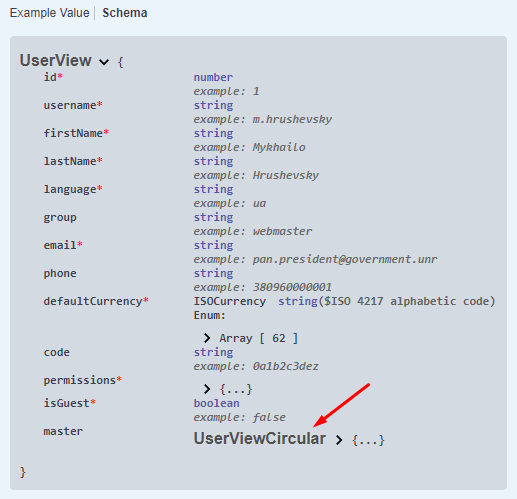
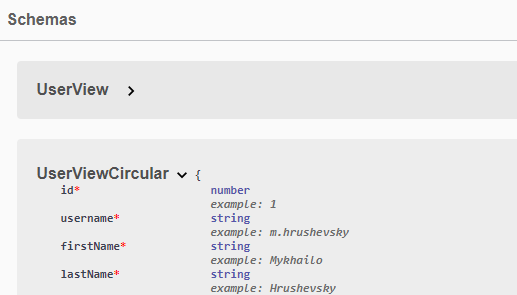
Not the most elegant solution, but it is possible to show the user what type this property is.
  schemas:
    UserView:
      type: object
      properties:
        id:
        # ....
        # ....
        # ....
        master:
          $ref: '#/components/schemas/UserViewCircular'
      required:
        # ....
    UserViewCircular:
      $ref: '#/components/schemas/UserView'
 aaaee2
on 21 Mar 2020
aaaee2
on 21 Mar 2020
There are also render errors in swagger hub swagger-editor.
I know that I've a recursive reference in my (quite complex) schema and it took me a long time to recognize that the UI error seems to come from there (see screenshot):

If I click randomly on some schema components in the left navigation bar, on nearly every click the editor increases the error count just saying the same error again and again: "error, line 0, undefined is not an object (evaluating 'm[b]')".
Hope there will be soon a fix for that available.
Thanks in advance,
Chris
 inet-cologne
on 31 Mar 2020
inet-cologne
on 31 Mar 2020
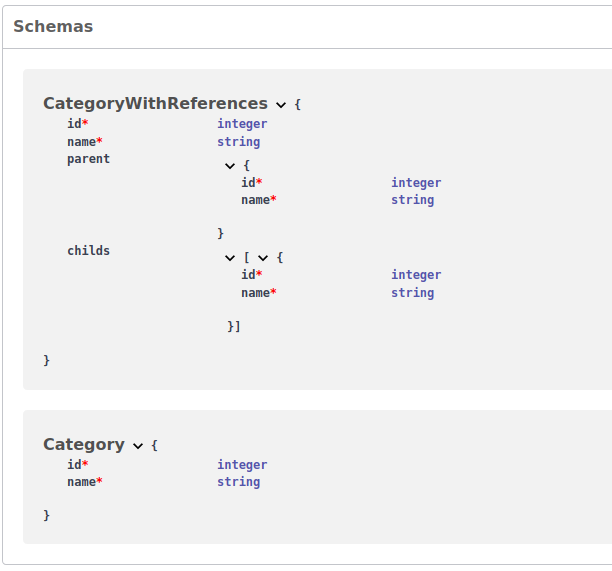
I decided my problem with circular dependencies like this
components:
  schemas:
    CategoryWithReferences:
      allOf:
        - $ref: '#/components/schemas/Category'
        - type: object
          properties:
            parent:
              allOf:
                - $ref: '#/components/schemas/Category'
            childs:
              type: array
              items:
                allOf:
                  - $ref: '#/components/schemas/Category'

    Category:
      type: object
      required:
        - id
        - name
      properties:
        id:
          type: integer
        name:
          type: string
 serieznyi
on 9 Apr 2020
serieznyi
on 9 Apr 2020
There's a very weird behavior with the call to SwaggerUIBundle. If the _url_ param is a absolute path, e.g. "/api/swagger.json", the JSON is loaded once (observed in devtools network monitor) and circular references appear empty. If the _url_ param is a relative path, e.g. "./swagger.json", the JSON is loaded twice and circular references are filled in!
 cem
on 21 Jul 2020
cem
on 21 Jul 2020
Related issues
 liuya05
·
3Comments
liuya05
·
3Comments
 prabhat1790
·
3Comments
prabhat1790
·
3Comments
 hnthu
·
3Comments
hnthu
·
3Comments
 ankon
·
4Comments
ankon
·
4Comments
 MartinMuzatko
·
4Comments
MartinMuzatko
·
4Comments
Most helpful comment
Just ran into this as well using the OpenAPI 3 spec:
Yields the following:

I'm not familiar with the history or previous implementations of this or what's possible/hard, but personally I think it'd be nice to show the title for a circular reference but not expand it by default. E.g.:
