Swagger-ui: examples for status code other than 200 do not display
Examples for 200 status codes show just fine.
Any custom examples added to specific error response codes in the YAML spec do not show, default examples are shown instead.
 alexmnyc
All 40 comments
Can you share a sample spec for us to test?
 webron
on 18 Feb 2016
webron
on 18 Feb 2016
responses:
        200:
          description: returns success response
          schema:
            $ref: '#/definitions/SomeSuccessResponse'
          examples:
            application/json: |-
              {
                "header": {
                  "request": "/v1/someid"
                },
                "body": {
                  "dai_method": "some"
                }
              }
        401:
          description: No Token Provided
          schema:
            $ref: '#/definitions/ErrorResponse'
          examples:
            application/json: |-
              {
                "header": {
                  "request": "/v1/someid"
                  "errors": [
                    "No Token Provided"
                  ],
                  "status": "ERROR"
                }
              }
Same problem here.
I uploaded an example that you can test: https://gist.githubusercontent.com/jmmercadom/18f5b8380b741c22689f/raw/f828c3bc76191c077e1ade7df0393e8701fdb891/swagger_response_examples.json.
Using the online demo http://petstore.swagger.io you can notice that the example provided for the 400 and 500 HTTP code are not showed but the one for the 200 HTTP code it is showed.
But if you use Swagger editor http://editor.swagger.io you and upload the same example you can see that the example for the three HTTP codes (200, 400 and 500) are showed.
I think that the first one uses SwaggerUI and the second is using other ways (AngularJS) to visualize the specification. This make me think that probably is an issue with SwaggerUI.
I hope that with this information is more clear what is the problem.
 jmmercadom
on 24 Feb 2016
jmmercadom
on 24 Feb 2016
+1
 ghost
on 25 Feb 2016
ghost
on 25 Feb 2016
+1
 firefoxNX
on 9 Mar 2016
firefoxNX
on 9 Mar 2016
+1, is there anything you can do about this? It's a blocker for us. Seems related to #618
 andrzejwp
on 23 Mar 2016
andrzejwp
on 23 Mar 2016
+1
 Georgevik
on 22 May 2016
Georgevik
on 22 May 2016
+1
 mikefeldmangh
on 24 Jun 2016
mikefeldmangh
on 24 Jun 2016
+1
 kneket
on 5 Jul 2016
kneket
on 5 Jul 2016
+1
 killmag10
on 7 Jul 2016
killmag10
on 7 Jul 2016
+1
 hallconama
on 15 Jul 2016
hallconama
on 15 Jul 2016
+1. I'll see if I can sort a PR
 dupski
on 20 Jul 2016
dupski
on 20 Jul 2016
+1
 Blagomir
on 24 Aug 2016
Blagomir
on 24 Aug 2016
+1
 JodyLognoul
on 7 Sep 2016
JodyLognoul
on 7 Sep 2016
+1
 jfach
on 22 Sep 2016
jfach
on 22 Sep 2016
+1
 IvanVas
on 19 Oct 2016
IvanVas
on 19 Oct 2016
+1
 bkapellusch
on 19 Oct 2016
bkapellusch
on 19 Oct 2016
+1
 IsmetKh
on 24 Oct 2016
IsmetKh
on 24 Oct 2016
+1
 aleixverges
on 30 Nov 2016
aleixverges
on 30 Nov 2016
+1
 anestik
on 30 Nov 2016
anestik
on 30 Nov 2016
+1
 cbandav
on 5 Dec 2016
cbandav
on 5 Dec 2016
+1
 Jwagner347
on 6 Dec 2016
Jwagner347
on 6 Dec 2016
@webron is it possible to get this addressed?
jfach
on 8 Dec 2016
@Jfach - we're very focused right now on a major update, and unfortunately don't have the capacity to address this right now. If someone can whip up a PR to support it, I'll do my best to push it to be reviewed and merged.
webron
on 8 Dec 2016
+1
 mmaio
on 19 Dec 2016
mmaio
on 19 Dec 2016
+1
 Saucistophe
on 28 Dec 2016
Saucistophe
on 28 Dec 2016
+1
 Fadelis
on 13 Jan 2017
Fadelis
on 13 Jan 2017
@webron no worries. Thank you!
jfach
on 20 Jan 2017
Hi guys,
Being looking at the issue but I haven't manage to figure it out just yet. Let me write my findings so far, will keep trying this week:
Looking at the OperationView.js file there is the following code:
if (typeof this.model.responses !== 'undefined') {
      this.model.responseMessages = [];
      ref2 = this.model.responses;
      for (code in ref2) {
        value = ref2[code];
        schema = null;
        schemaObj = this.model.responses[code].schema;
        if (schemaObj && schemaObj.$ref) {
          schema = schemaObj.$ref;
          if (schema.indexOf('#/definitions/') !== -1) {
            schema = schema.replace(/^.*#\/definitions\//, '');
          }
        }
        isJSON = value.examples;

        this.model.responseMessages.push({
          code: code,
          message: value.description,
          responseModel: schema,
          headers: value.headers,
          schema: schemaObj,
        });
      }
    }
As yo ucan see there is no reference at all to the sample code provided to the response. The funny part is that a few lines later there is specific code only for an attribute of the model called successResponse in which it does actually take it into account:
if (this.model.successResponse) {
      successResponse = this.model.successResponse;
      for (key in successResponse) {
        value = successResponse[key];
        this.model.successCode = key;
        if (typeof value === 'object' && typeof value.createJSONSample === 'function') {
          this.model.successDescription = value.description;
          this.model.headers = this.parseResponseHeaders(value.headers);
          signatureModel = {
            sampleJSON: isJSON ? JSON.stringify(SwaggerUi.partials.signature.createJSONSample(value), void 0, 2) : false,
            isParam: false,
            sampleXML: isXML ? SwaggerUi.partials.signature.createXMLSample(value.name, value.definition, value.models) : false,
            signature: SwaggerUi.partials.signature.getModelSignature(value.name, value.definition, value.models, value.modelPropertyMacro)
          };
        } else {
          signatureModel = {
            signature: SwaggerUi.partials.signature.getPrimitiveSignature(value)
          };
        }
      }
    }
I thought 🤔 , hey maybe if I pass the sampleJSON property to the responseMessages object might work. The problem comes then that for some weird reason the successsResponse has a ton of attributes that the other responses do not have and one that it is necessary seems to be the 'definition' one.
(There is no value on doing this, just wanted to give it a shot) And to make it even more complicated, you can try to create a path with a get response which will respond with the 200 error message and the example data that you want.
get:
  tags:
  - Error
  summary: Just an error
  description: "Just an error"
  operationId: errorGet
  responses:
    200:
      description: "Bad request"
      schema:
        $ref: '#/definitions/Error'
      examples:
        application/json:
          {
            "code": "40014",
            "key": "email_already_exists",
            "message": "Email already exists",
          }
THEN that exact same data will populate the example in the UI for the other endpoints which in their error response are using the Error definition, taking into account that for some really weird reason, will not take into account the example response you put in the 400 error response but will ALWAYS take the one you define in the 200 error response endpoint (which should not be there in the first place anyway).
Well lot of words but I help that maybe someone can point towards the direction where to fix it or even chip in and solve it together ;)
 javier-tarazaga
on 25 Jan 2017
javier-tarazaga
on 25 Jan 2017
+1
 ekoome
on 6 Feb 2017
ekoome
on 6 Feb 2017
+1
 brummetj
on 14 Feb 2017
brummetj
on 14 Feb 2017
+1
 strpipe
on 14 Feb 2017
strpipe
on 14 Feb 2017
+1
 jruehlin
on 18 Feb 2017
jruehlin
on 18 Feb 2017
It might not be the exact problem, but I've traced the issue back to swagger-client.js
in https://github.com/swagger-api/swagger-js
in types/operation.js:
if (responses['200']) {
    response = responses['200'];
    defaultResponseCode = '200';
  } else if (responses['201']) {
    response = responses['201'];
    defaultResponseCode = '201';
  } else if (responses['202']) {
    response = responses['202'];
    defaultResponseCode = '202';
  } else if (responses['203']) {
    response = responses['203'];
    defaultResponseCode = '203';
  } else if (responses['204']) {
    response = responses['204'];
    defaultResponseCode = '204';
  } else if (responses['205']) {
    response = responses['205'];
    defaultResponseCode = '205';
  } else if (responses['206']) {
    response = responses['206'];
    defaultResponseCode = '206';
  } else if (responses['default']) {
    response = responses['default'];
    defaultResponseCode = 'default';
  }
  //[...] (code non essential for the logic)
  if (response && response.schema) {
    var resolvedModel = this.resolveModel(response.schema, definitions);
    var successResponse;

    delete responses[defaultResponseCode]; // <-- Commenting out that line adds back the 2XX responses
    [...]
 }
It looks like it's finding the 1st success code, putting it on the side to be displayed in the main panel, and removing it from the list of responses.
To be honest it probably should be in both places as it's part of the responses. Especially since you can have more than 1 success code depending on what the api is doing. Like 201 and 207 isn't so uncommon.
Tests are failing when I remove it, because it's adding 200 as a default for a test case.
This might help someone fix it properly...
 MiiRaGe
on 24 Feb 2017
MiiRaGe
on 24 Feb 2017
Should no longer be an issue with 3.X. Please reopen otherwise.
webron
on 24 Mar 2017
Hello. i am using swagger ui 3.0.10 and still have this issue. Can someone double-check it?
 igorko
on 22 May 2017
igorko
on 22 May 2017
@igorko please file a new ticket.
webron
on 24 May 2017
+1
still same issue??
 RahmanM
on 22 Jul 2018
RahmanM
on 22 Jul 2018
WOW. NO EXAMPLES OTHER THAN 200 SHOW UP? We have like 500 APIs with numerous examples for many status codes. This is such an epic failure, that we're going to have to drop swagger altogether if this isn't fixed. WOW. It's like... "swagger shows examples" (then in the fine print "but 99/100 won't display, because of a bug from 2016 that still hasn't been addressed). WOW. This has been getting +1's for one month shy of 3 years now. Come on.
 triynko
on 22 Jan 2019
triynko
on 22 Jan 2019
@triynko this issue is closed, and the functionality is working.
Here's @alexmnyc's original definition in the latest version of Swagger UI:
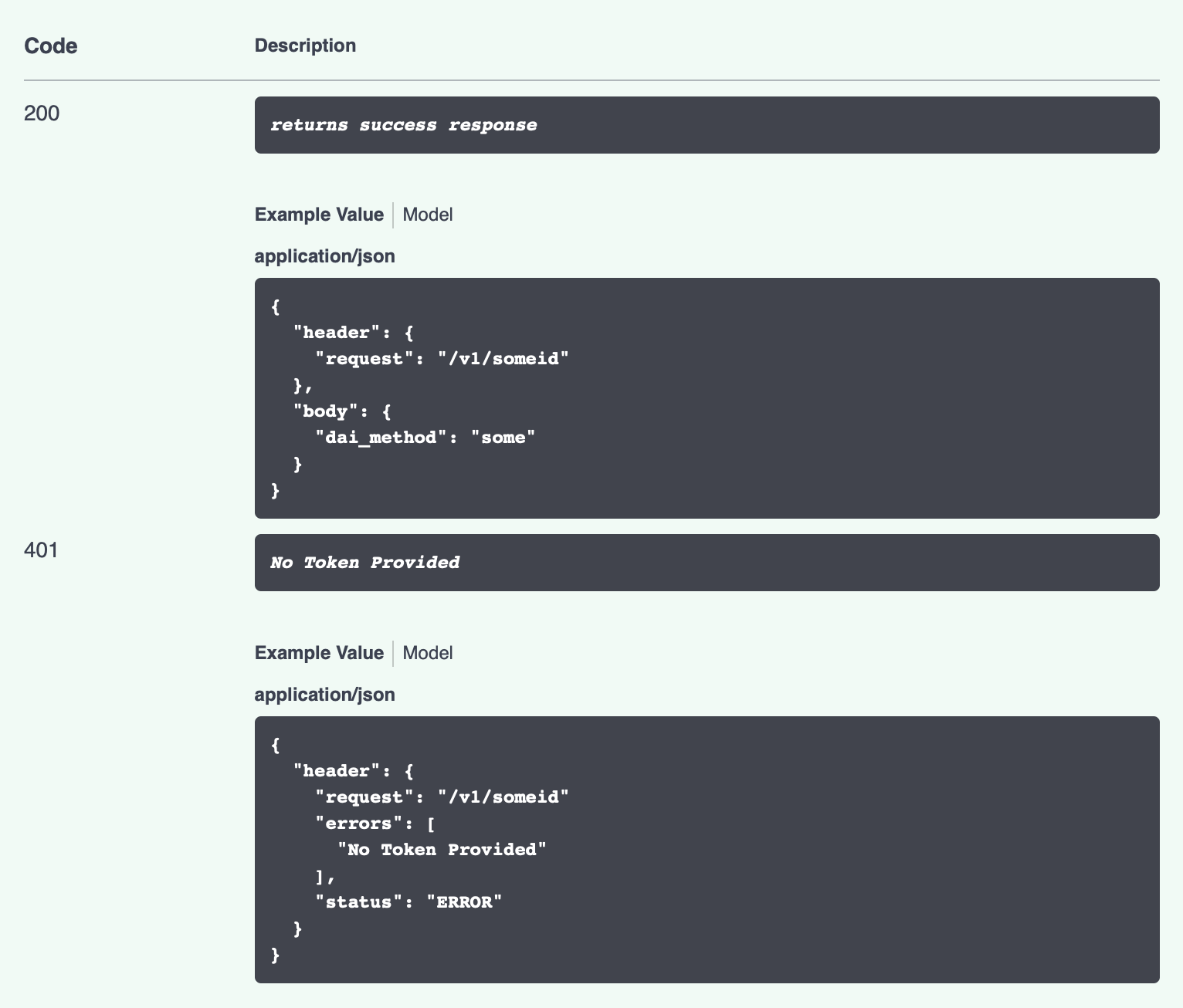
 shockey
on 24 Jan 2019
shockey
on 24 Jan 2019
Related issues
 ilnurshax
·
3Comments
ilnurshax
·
3Comments
 MartinMuzatko
·
4Comments
MartinMuzatko
·
4Comments
 andrecarlucci
·
3Comments
andrecarlucci
·
3Comments
 zilongl
·
3Comments
zilongl
·
3Comments
 insideshell
·
3Comments
insideshell
·
3Comments
Most helpful comment
Hello. i am using swagger ui 3.0.10 and still have this issue. Can someone double-check it?