Substrate: Metadata call Multisig.asMulti fifth argument
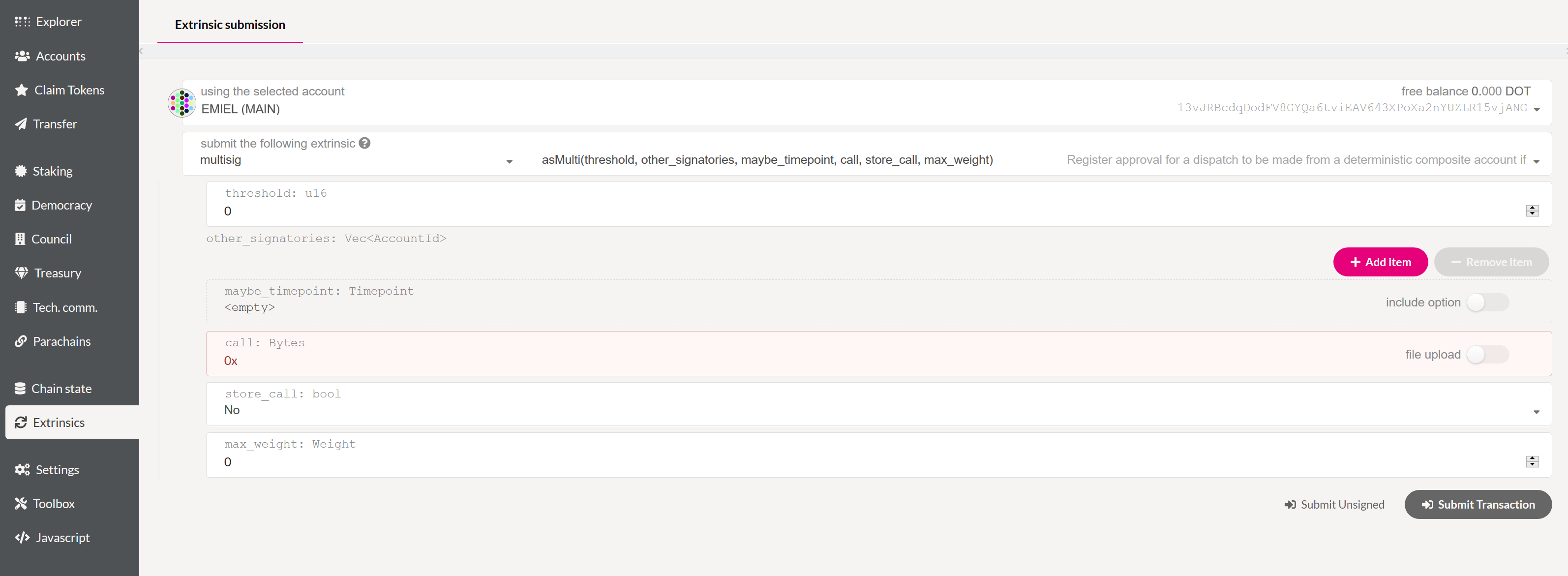
The metadata definition for the fifth argument of the call: multisig.asMulti should get the following type definition: Box<Call>.
The Metadata currently defines the fifth argument as a Vec<u8> (Bytes).
This prevents external systems such as Polkascan (https://polkascan.io/polkadot-cc1/transaction/0x603b68bb8b6bbd2b845d1096f2a043ddda4aa5ddc804041812f48282d1e939a9) and Polkadot JS Apps (https://polkadot.js.org/apps/#/explorer/query/357567) to properly interpret the data.
Example:
The following screen will allow the composition of a call if this gets corrected.
 emielvanderhoek
All 6 comments
@gavofyork could you get this addressed?
emielvanderhoek
on 3 Jul 2020
This is also the source of current problems in our kusama-utils and kusama-api libraries. Unfortunately the library wont be able to complete trades for users until this is resolved due to the failing of the as_multi encoding
 CodeForcer
on 3 Jul 2020
CodeForcer
on 3 Jul 2020
I recommend this to be part of a checklist for runtime upgrades. Nested calls should always be defined as Call or Box< Call>.
emielvanderhoek
on 3 Jul 2020
This does not prohibit sending txs at all. So not sure why the libs are broken - it does work, it is just helpful having it as a Call type.
 jacogr
on 3 Jul 2020
jacogr
on 3 Jul 2020
The use of an opaque data type was intentional. Encoding and decoding a call can itself be a potentially exponentially heavy operation. Determining and charging for its weight is impractical. Passing only opaque data keeps everything simple, easier to weigh and harder to attack.
 gavofyork
on 3 Jul 2020
gavofyork
on 3 Jul 2020
Yeah it breaks some assumption we have for decoding ‘internal’ (nested) calls we have in our harvester. I’d still prefer a new type such as ‘OpaqueCall’ to be able to deal with this in a more elegant way. That type definition could map to a Vec< u8> in turn of course.
That would solve your problem and mine.
emielvanderhoek
on 3 Jul 2020
Related issues
 tomaka
·
5Comments
tomaka
·
5Comments
 gregdhill
·
5Comments
gregdhill
·
5Comments
 Kalanamith
·
6Comments
gavofyork
·
4Comments
Kalanamith
·
6Comments
gavofyork
·
4Comments
 jiangfuyao
·
3Comments
jiangfuyao
·
3Comments
Most helpful comment
This is also the source of current problems in our
kusama-utilsandkusama-apilibraries. Unfortunately the library wont be able to complete trades for users until this is resolved due to the failing of the as_multi encoding