This time I will try to act smarter and ask before write code 😂
Sometimes I need to create a DOM elements, that Stimulus controller should controller after.
For example in this interface, when I create a new item, I need a way to add it to DOM.
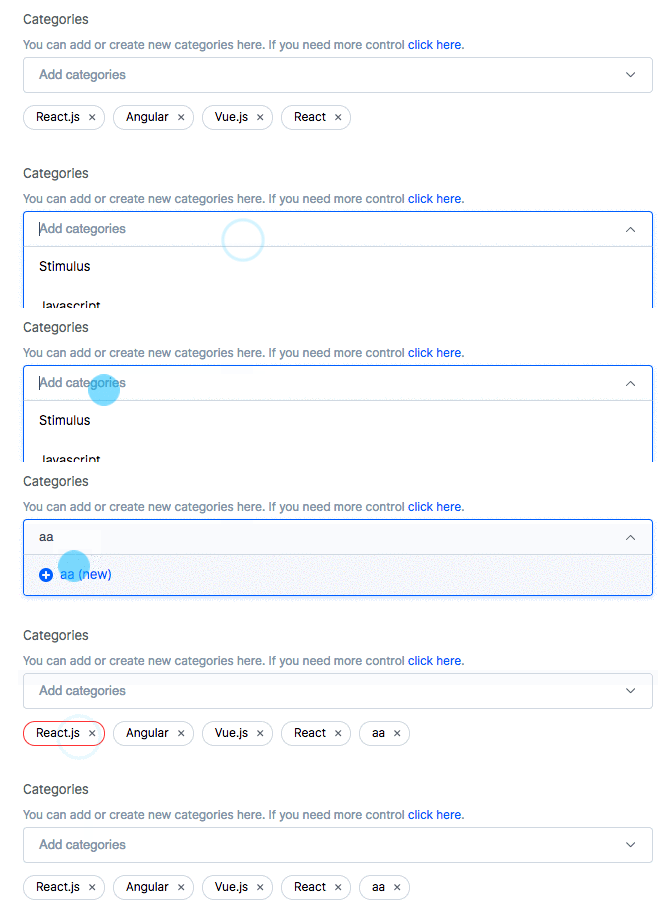
Right now I need to write this
    // create tag element
    const item = document.createElement('div')
    item.setAttribute('data-title', 'aa')
    item.setAttribute('data-id', 123)
    item.setAttribute('data-target', 'categories.selected_item')
    item.setAttribute('data-action', 'click->categories#removeItem')
    item.setAttribute('class', 'categories--selected-item')
    item.innerHTML = 'aa'

    this.targets.find('selected_items').appendChild(item)
Can we present some sort of function to simply create new dom elements inside. Like:
// element can be a 'div' by default
const target = this.targets.create('selected_item', {
  element: 'div',
  data: {},
  htmlOptions: { class: 'categories--selected-item' },
  innerHTML: ''
})
this.targets.find('selected_items').appendChild(target)
Probably we can just create a simple standard way to adding mix-ins to controllers.
This case we can keep things like that outside of Stimulus
 savroff
All 13 comments
What about using template tag? https://developer.mozilla.org/en-US/docs/Web/HTML/Element/template
 mdesantis
on 6 Jan 2018
mdesantis
on 6 Jan 2018
@mdesantis thank you! 🎉
savroff
on 6 Jan 2018
You can access a controller's own identifier with this.identifier. So you can avoid hard coding and repeating it by doing:
item.setAttribute('data-target', `${this.identifier}.selected_item`)
item.setAttribute('data-action', `click->${this.identifier}#removeItem`)
Instead of:
 item.setAttribute('data-target', 'categories.selected_item')
 item.setAttribute('data-action', 'click->categories#removeItem')
 javan
on 6 Jan 2018
javan
on 6 Jan 2018
@javan what I actually did.
I created own Conrollerclass with wrapping original Stimulus one and added functions there.
Can we think of a simple way to do a mix-in? Like for example in Vue
savroff
on 6 Jan 2018
@mdesantis one problem with templates, seems like they not supported in IE 💩
But a lot of our users still use last version of IE
savroff
on 6 Jan 2018
Yes, but there are many working polyfills in the wild :-)
mdesantis
on 6 Jan 2018
Anyway, I feel the needing of managing potentially existing HTML components, in a library like this one. Something that solves the requirement "How to display a new incoming message on my instant messaging app?"
mdesantis
on 6 Jan 2018
Agree, this can be placed in examples and in the handbook. Seems like I closed this issue too early :)
@mdesantis idea with templates is really nice, this case you can keep HTML related things in Rails view, but we need to include polyfill in a framework (could increase library size a little).
Or we can create new elements and insert them like I showed, plus wrap it in nicer helper. But I see a downside here, that new element markup fully created in the .js file.
Or introduce data-template.
@javan what you think about all these?
savroff
on 6 Jan 2018
Another alternative would be to provide facilities for cloning existing elements, so you can change any attribute you want before appending to the DOM. That way you don't have to deal with template strings (or rendering engine?!) which I'm not in favor of adding an unnecessary layer of complexity. I was thinking of data-bind-* attributes which allows you to expose an interface to your JS instead.
<ul class="tasks">
  <li data-controller="task_item" data-bind-text="task_item.name">Todo item</li>
</ul>
Or you could define this interface in your controller to avoid duplicated code if you're not using <template>:
interface: {
  name: '@text' // xpath-like expressions
}
Then somewhere in your JS you would do something like this:
this.clone().feed({ name: "New todo item" }).appendTo(this.element.parentNode)
Just my 2 cents.
+1 for <template> and pollyfills.
 rainerborene
on 7 Jan 2018
rainerborene
on 7 Jan 2018
Remember:
Stimulus is a JavaScript framework with modest ambitions. It doesn't seek to take over your entire front-end—in fact, it's not concerned with rendering HTML at all.
We don't plan to add our own way to do rendering, and there are a number of great options for you to chose from. I'd start small with document.createElement() or element.cloneNode(), and then reach for a templating library if needed. I'm a fan of hyperHTML and good ol' EJS.
javan
on 8 Jan 2018
@savroff on top of using template, you can also combine the template functionality with lodash's template and create this:
The only downside is, at least for me, that you have to use .erb.
TL;DR
You can create a simple HTML template enclosed by a script tag which gets ignored when viewing the page because of type='text/template'
<div id='responseBody' class='row align-top'></div>

<script type='text/template' id='responseBodyTemplate'>

  <div class='cell-sm-12 -margin-top_2'>

    {{ _.forEach(identities, (identity) => { }}

      <h3 class='-line-reset'>{{= identity.name }}</h3>
      <p class='-line-reset -margin-top_4'>
        About:
        <span class='-weight-regular'>{{= identity.about }}</span>
      </p>

    {{ }) }}

  </div>  <!-- cell-sm-12 -->

</script>
// Find the Template
const container = document.getElementById('responseBodyTemplate');

// Tell lodash to grab the contents of the Template
const template  = _.template(container.innerHTML);

// Magic happens
// 'parse' the template and pass the required variables
document.getElementById('responseBody').innerHTML = template({
  identities: [{ name: 'Foo', about: 'Bar' }]
});
 pacMakaveli
on 11 Jan 2018
pacMakaveli
on 11 Jan 2018
@pacMakaveli thanks!
I personally like keep markup outside from js files. 😍 We similar approach to this one and keep HTML in erb sounds really reasanoble in my case.
savroff
on 11 Jan 2018
Just for posterity I have found two libraries that does exactly what I was looking for: bind.js and simulacra. One of the authors published an article explaining how it works: Tiny two way data binding. It would be very simple to integrate with a stimulus controller and template tags.
rainerborene
on 7 Dec 2020
Related issues
 jenkijo
·
3Comments
jenkijo
·
3Comments
 gerdriesselmann
·
3Comments
gerdriesselmann
·
3Comments
 paulozoom
·
4Comments
paulozoom
·
4Comments
 jaredcwhite
·
3Comments
jaredcwhite
·
3Comments
 ngan
·
3Comments
ngan
·
3Comments
Most helpful comment
You can access a controller's own identifier with
this.identifier. So you can avoid hard coding and repeating it by doing:Instead of: