Sqlite_orm: More complex query example
Hey, sorry to keep posting here.. Is there an example somewhere of how you'd do a complex query such as:
SELECT b.*
FROM tagmap bt, bookmark b, tag t
WHERE bt.tag_id = t.tag_id
AND (t.name IN ('bookmark', 'webservice', 'semweb'))
AND b.id = bt.bookmark_id
GROUP BY b.id
HAVING COUNT( b.id )=3
I'm attempting to implement a toxi structure similar to the one posted here:
http://howto.philippkeller.com/2005/04/24/Tags-Database-schemas/
 jakemumu
All 33 comments
currently what I'm doing is two steps.
auto taggings = db->get_all<TAGMAP>(where(c(&TAGMAP::tag_uuid) == tag_id));

std::vector<ITEM> items;

for (auto tagging : taggings) {
    auto item = db->get_all<ITEM>(where(c(& ITEM::id) == tagging.item_id)).front();
}
but it's a hit on the DB for each item : /
jakemumu
on 25 Apr 2020
Assume you have struct Tagmap, struct Bookmark and struct Tag.
auto rows = storage.select(asterisk<Bookmark>(),
    where(is_equal(&Tagmap::tagId, &Tag::tagId)
        and in(&Tag::name, {"bookmark", "webservice", "semweb"})
        and is_equal(&Bookmark::id, &Tagmap::bookmarkId)),
    group_by(&Bookmark::id),
    having(is_equal(count(&Bookmark::id), 3))
);
Tell me if you need your table alises - I shall add it here too.
 fnc12
on 25 Apr 2020
fnc12
on 25 Apr 2020
here is the query with my table aliases using you ref:
        auto rows = db->getDatabase()->select(asterisk<MKUSampleMeta>(),
                                              where(is_equal(&MKUTagging::tag_uuid, &MKUTagMeta::uuid)
                                                    and in(&MKUTagMeta::name, { inTags[0].toStdString() })
                                                    and is_equal(&MKUSampleMeta::uuid, &MKUTagging::taggable_uuid)),
                                              group_by(&MKUSampleMeta::row_id),
                                              having(is_equal(count(&MKUSampleMeta::row_id), 1)));
so it's Tagmap -> MKUTagging, Bookmark -> MKUSampleMeta, Tag -> MKUTagMeta
I threw a print in to the lib where the query is generated:
SELECT * FROM 'SAMPLE_META'  WHERE ( 'TAGGINGS'."TAG_UUID" = 'TAG_META'."UUID" AND 'TAG_META'."NAME" IN (  ? ) AND 'SAMPLE_META'."UUID" = 'TAGGINGS'."TAGGABLE_UUID") GROUP BY 'SAMPLE_META'."ID"
libc++abi.dylib: terminating with uncaught exception of type std::__1::system_error: no such column: TAGGINGS.TAG_UUID: SQL logic error
The error is strange because that column most definitely exists in the db..
jakemumu
on 25 Apr 2020
@jakemumu please use dev branch cause master doesn't parse WHERE clause during filling FROM block. This is a new feature. It will be merged into master with next release
fnc12
on 25 Apr 2020
Nice, I just gave it a shot from dev and that query returned results.
The only thing is it's returning tuples instead of the full object, is there a way to have it return the ORM mapped object similar to the get_all
Anyways the features one dev are super useful, it's great to be able to prepare the statement and the be able to print / inspect it to make sure it's looking correct
jakemumu
on 26 Apr 2020
It is very good that new functions are useful for you.
About returning objects instead of tuples. select statements returns tuples not objects. If you need objects use get_all. But selection from several tables with get_all isn't supported right now. I need to think about adding it. I have some ideas. Anyway right now you can make std::transform and create objects from tuples with std::move. It is not the best solution but it will work for now.
fnc12
on 26 Apr 2020
Hey @fnc12,
Do you have any example on how you'd do that std::transform & move you mentioned?
I think it would be great to add relational mapping to the select statements, as tuples are pretty generic and difficult to interact with, and it would only make the ORM better : )
I assume there is a place in the library where you are doing conversions from tuples to the structs, maybe you could point me?
jakemumu
on 10 May 2020
Currently I'm doing it like this, but is it guaranteed the indexes on the tuple will always match the order they were defined in to the table?
    for (auto row : rows) {
        MKUSampleMeta sample;
        sample.row_id = get<0>(row);
        sample.uuid = get<1>(row);
        sample.pack_uuid = get<2>(row);
        sample.name = get<3>(row);
        sample.path = get<4>(row);

        mNoiseSamples.push_back(sample);
    }
std::transform is an algorithm from <algorithm> header which helps you in transforming data from one type to another. It is map function analog from js-like languages. If you need to transform a container of std::tuple to a container with structs you have to do it like this:
std::vector<std::tuple<...>> rows = storage.select(...);
std::vector<MKUSampleMeta> objects;
objects.reserve(rows.size());
std::transform(rows.begin(), rows.end(), std::back_inserter(objects), [](auto &tuple){
    MKUSampleMeta sampleMeta;
    sample.row_id = std::move(get<0>(row));
    sample.uuid = std::move(get<1>(row));
    sample.pack_uuid = std::move(get<2>(row));
    sample.name = std::move(get<3>(row));
    sample.path = std::move(get<4>(row));
    return sampleMeta;
});
@jakemumu what kind of API do you prefer in a perfect world? Just tell me and I shall try to implement it
fnc12
on 10 May 2020
I think the ideal would be that the select could have the option to take either the current column specification, such as, &MKUSampleMeta::ID, &MKUSampleMeta::Name which would return tuple, or select_all MKUSampleMeta (statement) which would function similar to the get_all
But as I've said this is all a very new approach to me so I'm not positive what's sure what's possible.
Another suggestion would be allow for a binding on the parameters on the preparedStatements, so that one could prepare the statement, but then change the arguments later as the parameters for queries change. It's also a bit tricky to deduce exactly what statement you've created from the prepared statements as when you print, it should the arguments as variable "?" but no ability to print what the arguments are currently? is that correct?
In general the framework is awesome and very close to an ORM you'd see in the web world such as Active Record from the Ruby on Rails platform.
The basic are seemingly all covered for me aside these couple details
jakemumu
on 10 May 2020
Is there any idea when you'll merge the dev features into master? I'd be a bit nervous to ship a product from the dev branch
You know what would be awesome, to create an actual API reference and add doxygen comments to the library. I think that would make it really helpful. Currently I have to look at the wiki & examples to discover what's possible. I would be happy to help with this. Maybe I could open a PR with a start?
jakemumu
on 10 May 2020
this binding is also failing:
auto selectStatement = db->getDatabase()->prepare(select(asterisk<MKUSampleMeta>(),
                                                         where(like(&MKUSampleMeta::name, "%"+mCurrentSearchString.toStdString()+"%")
                                                               and is_equal(&MKUTagging::tag_uuid, &MKUTagMeta::uuid)
                                                               and in(&MKUTagMeta::name, { tags_string })
                                                               and is_equal(&MKUSampleMeta::uuid, &MKUTagging::taggable_uuid)),
                                                         group_by(&MKUSampleMeta::row_id),
                                                         having(is_equal(count(&MKUSampleMeta::row_id), tag_count))));


std::cout << selectStatement.sql() << std::endl;
std::cout << get<0>(selectStatement) << std::endl;
std::cout << get<1>(selectStatement) << std::endl;
std::cout << get<2>(selectStatement) << std::endl;
There are 3 variables passed into this prepare statement, however the resulting sql statement is failing to get<1>(statement) & get<2>(statement) after creation.
This is from dev
jakemumu
on 10 May 2020
1) I guess expanding get_all with selecting from more than one table will give you exaclty what you want. To do it I need to refactor get_all implementation without changing API. I shall make it soon. It is a great idea thank you.
2) How do you want statements to be improved? You will help if you write desired behavior and current behavior.
3) I'd like to do update of master ASAP but there are still bug exists in prepared statements. And I also want to refactor serialization before. I almost finished it.
4) Looks like a bug. I shall try to fix it today or tomorrow. Thanks
5) Why lib reference is more comfortable to use instead of example? I always thought the opposite.
fnc12
on 10 May 2020
That would be awesome! thank you. I'd love to learn how this mapping works in the library
I believe I was incorrect actually, it seems you're making it so you can bind the parameters. It would just be nice to print the full statement with what the parameters are binded to for sanity checks. It seems the variables disappear or have no way for inspection, I couldn't figure it out.
Yeah I see that, take your time, more important to have stable master
Thank you
What IDE do you use? Here is an example from my wrapper I've been writing around your library specific to my application, basically to remove inline try & catches etc..
Here I build the function and use a doxygen comment which explains it's functionality with details:
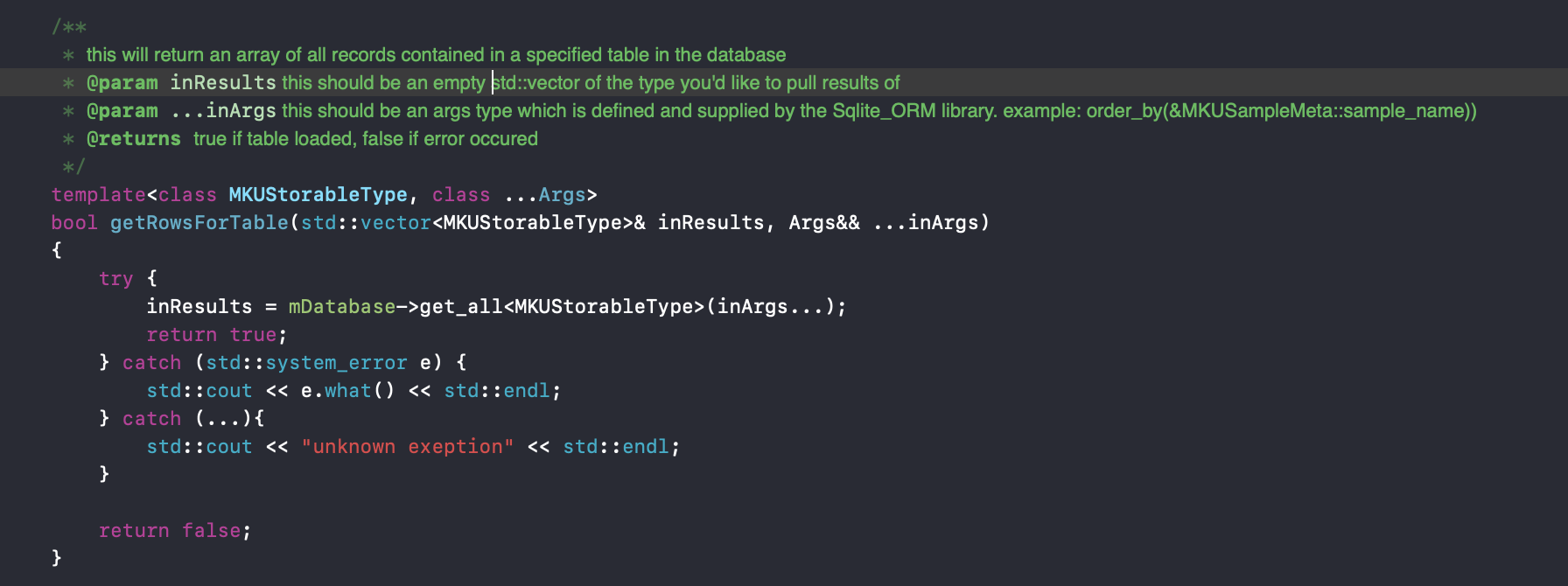
inside of Xcode on Mac, this then allows me to option click the function name to obtain the information from the function definition:
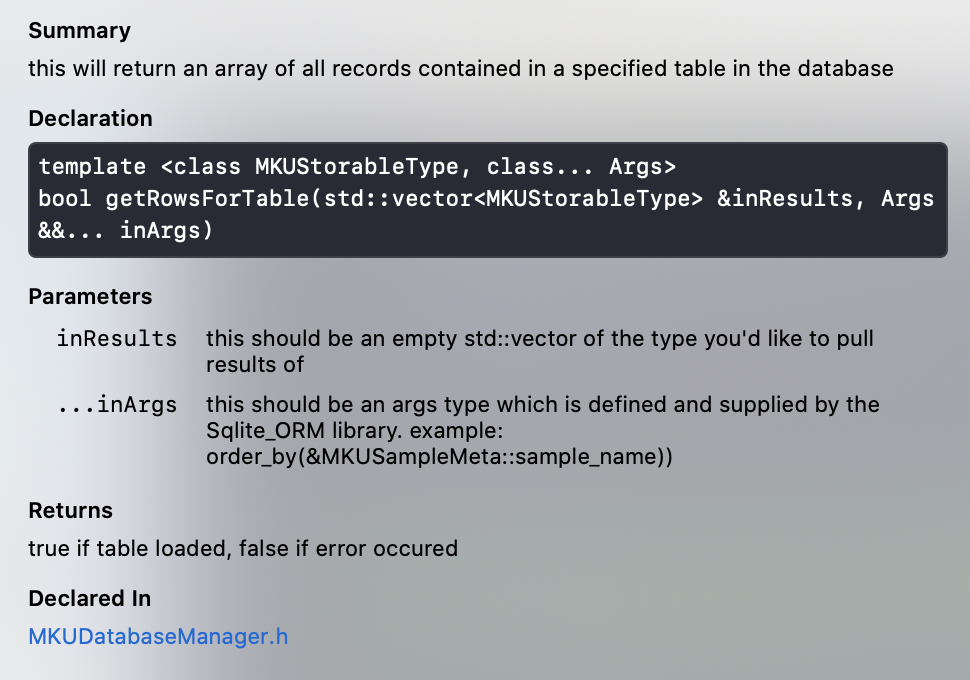
There's a couple benefits to this, first, it allows people to option click functions to learn about what they're doing and how to use them inside of the code.
The other benefit of a documentation, would be to explore the things which aren't in the examples.
The other note on having an API doc, would be because the library is a single header (which is totally awesome btw and should not change), it's difficult to look through the header to determine which functions are meant to be used by myself as the user, and which functions are meant to be used internally by the library.
One idea would be to have two files instead of one, which I don't think would be a deal breaker. One could be an interface file which would show all the functions which are meant to be used as a user of the library, and the other would hold all of the internal functions.
The other would be to only use doxygen comments on functions which are meant to be used as part of this interface, this would at least make it clear like: "hey, you can use this function" or, "hey, this function is internal and not for your use"
I think that you could then get doxygen to spit out documentation on only the functions which are labelled accordingly and build an API reference.
I agree examples are much better than references and shouldn't be dismissed, as they're much more helpful than a reference, but for example from my example Args&& ...Args, is very hard to figure out what type it corresponds to, how to find what options are available, etc.
I'd need to look more at the API, but I imagine if there is a function like get_all
Apologies if this is all laid out and I've just not figured out my way around the examples and documentation.
jakemumu
on 12 May 2020
@jakemumu I've created an issue for the first issue from this thread https://github.com/fnc12/sqlite_orm/issues/511
fnc12
on 13 May 2020
@jakemumu About printing statement with real values instead of question marks: statement.sql() function returns what sqlite3_sql returns. To achieve what you want I can create a different function like myStorage.dump(myStatement); which will return std::string. I cannot make at as a dedicate prepared statement's function cause one need a storage to serialize it cause storage has information about column names. Is it ok for you?
fnc12
on 13 May 2020
this binding is also failing:
auto selectStatement = db->getDatabase()->prepare(select(asterisk<MKUSampleMeta>(),
                                                         where(like(&MKUSampleMeta::name, "%"+mCurrentSearchString.toStdString()+"%")
                                                               and is_equal(&MKUTagging::tag_uuid, &MKUTagMeta::uuid)
                                                               and in(&MKUTagMeta::name, { tags_string })
                                                               and is_equal(&MKUSampleMeta::uuid, &MKUTagging::taggable_uuid)),
                                                         group_by(&MKUSampleMeta::row_id),
                                                         having(is_equal(count(&MKUSampleMeta::row_id), tag_count))));


std::cout << selectStatement.sql() << std::endl;
std::cout << get<0>(selectStatement) << std::endl;
std::cout << get<1>(selectStatement) << std::endl;
std::cout << get<2>(selectStatement) << std::endl;
There are 3 variables passed into this prepare statement, however the resulting sql statement is failing to get<1>(statement) & get<2>(statement) after creation.
This is from dev
fnc12
on 13 May 2020
5. What IDE do you use? Here is an example from my wrapper I've been writing around your library specific to my application, basically to remove inline try & catches etc..
I use Xcode too. And also I love these comments with Option+Click feature. I tried to write this type of comments in the beginning but then I stopped cause I thought that Xcode isn't as popular as VS for example. But now I've changed my mind - I shall add doxygen comments. Thank you
fnc12
on 13 May 2020
it's difficult to look through the header to determine which functions are meant to be used by myself as the user, and which functions are meant to be used internally by the library.
Everything declared inside internal namespace is not for public usage (but actually you can use it).
One idea would be to have two files instead of one, which I don't think would be a deal breaker. One could be an interface file which would show all the functions which are meant to be used as a user of the library, and the other would hold all of the internal functions.
This idea is great. I shall move to this but slowly cause it takes time to refactor the whole library.
Thank you for you help and feedback. It is very important.
fnc12
on 13 May 2020
Thanks @fnc12 , happy to share my feedback! loving the library as always and really happy to get to provide feedback to it.
jakemumu
on 13 May 2020
@jakemumu About printing statement with real values instead of question marks:
statement.sql()function returns what sqlite3_sql returns. To achieve what you want I can create a different function likemyStorage.dump(myStatement);which will returnstd::string. I cannot make at as a dedicate prepared statement's function cause one need a storage to serialize it cause storage has information about column names. Is it ok for you?
fnc12
on 16 May 2020
That sounds great!
jakemumu
on 18 May 2020
Assume you have
struct Tagmap,struct Bookmarkandstruct Tag.auto rows = storage.select(asterisk<Bookmark>(), where(is_equal(&Tagmap::tagId, &Tag::tagId) and in(&Tag::name, {"bookmark", "webservice", "semweb"}) and is_equal(&Bookmark::id, &Tagmap::bookmarkId)), group_by(&Bookmark::id), having(is_equal(count(&Bookmark::id), 3)) );Tell me if you need your table alises - I shall add it here too.
I was doing something similar. Could you please tell me how to do this with table aliases.
 shrijitsingh99
on 15 Jul 2020
shrijitsingh99
on 15 Jul 2020
@shrijitsingh99 can you please show me raw SQL
fnc12
on 16 Jul 2020
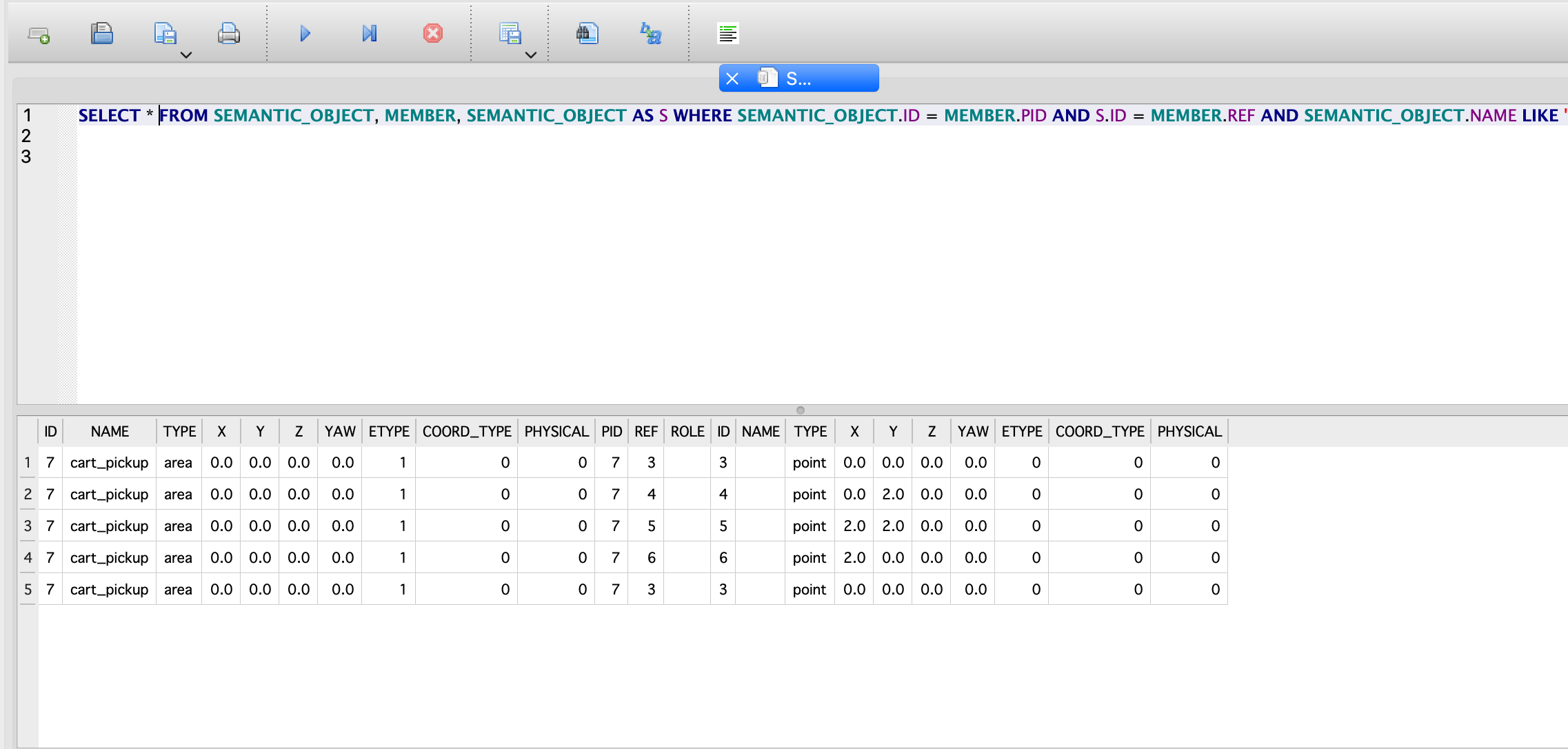
I have the following 2 tables:
SEMANTIC_OBJECT & MEMBERS
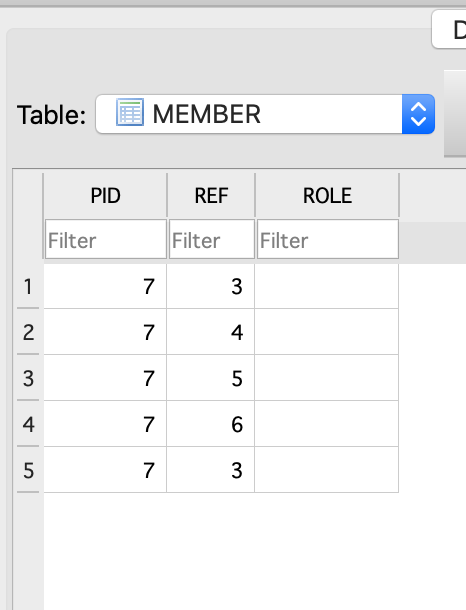
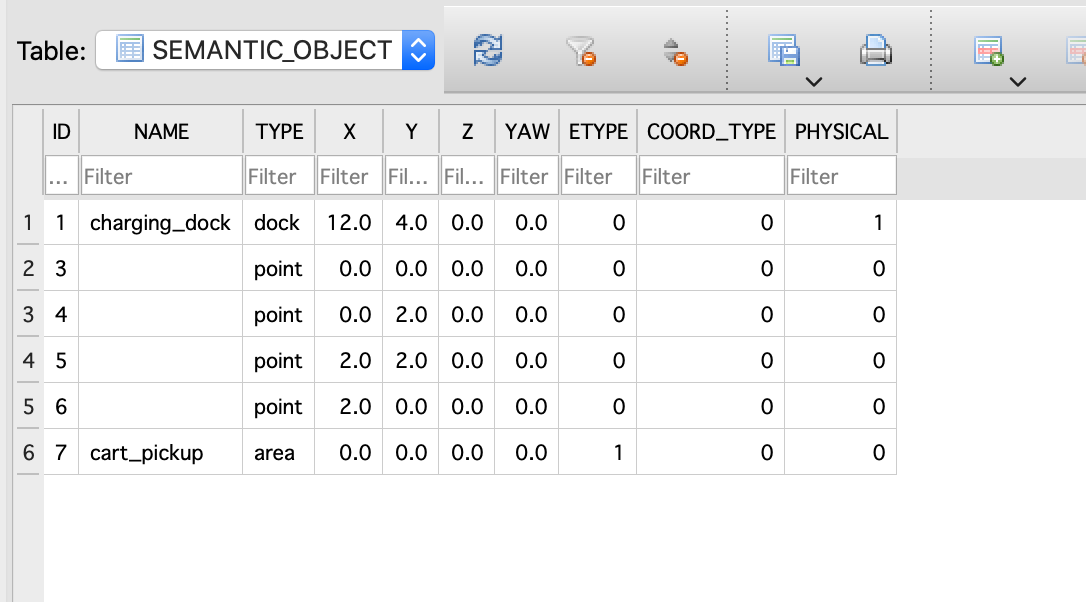
I am trying to execute the following query to get the results shown below:
SELECT *
FROM SEMANTIC_OBJECT, MEMBER, SEMANTIC_OBJECT AS S
WHERE SEMANTIC_OBJECT.ID = MEMBER.PID AND S.ID = MEMBER.REF AND SEMANTIC_OBJECT.NAME LIKE 'cart_pickup'
ORDER BY SEMANTIC_OBJECT.ID ;
shrijitsingh99
on 16 Jul 2020
@shrijitsingh99 so you need double rows in result? I mean your result table has all SEMANTIC_OBJECT's column twice. Is it correct? If yes then what type you want to obtain from the storage in a perfect situation?
fnc12
on 16 Jul 2020
@shrijitsingh99 are you there?
fnc12
on 19 Jul 2020
@shrijitsingh99 are you there?
fnc12
on 22 Jul 2020
@shrijitsingh99 are you there?
fnc12
on 30 Sep 2020
@shrijitsingh99 BTW try to use https://sqliteman.dev as a GUI SQLite client. This is a tool developed by me
fnc12
on 30 Sep 2020
very nice app @fnc12 -- would be cool to be able to see the available tables! : )
jakemumu
on 8 Oct 2020
@jakemumu this feature is in development right now!
fnc12
on 8 Oct 2020
Related issues
 MovRIP
·
4Comments
MovRIP
·
4Comments
 HyperionChen
·
5Comments
HyperionChen
·
5Comments
 daitouguan
·
9Comments
daitouguan
·
9Comments
 yuanlida
·
7Comments
yuanlida
·
7Comments
 steven-pearson
·
4Comments
steven-pearson
·
4Comments