Spring-cloud-sleuth: Regression in Webflux test when explicitely providing tracing headers
Describe the bug
Re-opening spring-projects/spring-cloud-sleuth#1507 because it looks like there is a regression linked to this bug.
Reminder of the encountered issue:
Once using Sleuth and injecting Tracing headers in a WebTestClient I was able to retrieve them in Reactor's context later on like this :
// Test
webTestClient.get()
    .uri("/api/tracing")
    .header("X-B3-TraceId", "463ac35c9f6413ad48485a3953bb6124")
    .header("X-B3-SpanId", "a2fb4a1d1a96d312")

// Controller
@GetMapping
    fun spanId(): Mono<String> {
        return Mono.subscriberContext()
                .filter { it.hasKey(Span::class.java) }
                .map { it[Span::class.java].context() }
                .map { it.spanIdString() }
    }
When comparing spanId and parentId present in the org.springframework.cloud.sleuth.TraceContext object, it appears that values are different than the spanId and parentId set in the headers.
Spring libraries versions used to reproduce this issue:
- spring Boot 2.4.2.RELEASE
- spring Framework 5.3.3.RELEASE
- spring-test 5.3.3.RELEASE
- spring-cloud-sleuth; 3.0.1
Sample
Sample available here
The branch 2021 contains latest changes to reproduce the issue with latest libraries (project forked from the initial reproducer)
The issue can be reproduced by executing the test com.spring.reproducer.spring.test.sleuth.reproducer.TracingResourceTest
 jackcat13
All 25 comments
Is this bug report only about tests and WebTestClient? When specifying a trace and span ID in the request header for Spring Cloud Gateway (based on WebFlux / Reactor) the values are ignored and new traces are generated by the application -- like in the test case linked above.
- Spring Boot 2.4.2
- Spring Cloud 2020.0.1
- Spring Cloud Sleuth 3.0.1
- Spring Cloud Gateway 3.0.1
 janekbettinger
on 15 Feb 2021
janekbettinger
on 15 Feb 2021
What are the headers that are being passed?
 marcingrzejszczak
on 15 Feb 2021
marcingrzejszczak
on 15 Feb 2021
I've tried the B3 headers as well as the newer ones (_localhost:9095_ is a Spring Cloud Gateway instance):
curl -sv http://localhost:9095/sample-route -H "X-B3-TraceId: explicit_X-B3-TraceId" -H "X-B3-SpanId: explicit_X-B3-SpanId" -H "traceId: explicit_traceId" -H "spanId: explicit_spanId"
The logs (or MDC) does not show the "explicit" values but new traces like _fa2ed5b4165d32e9_.
Furthermore, also the downstream service that is called by the gateway receives the trace IDs generated by the gateway instead of the manually passed ones:
2021-02-15 10:37:02.214 DEBUG [my-downstream-service,,] 4256 --- [io-8089-exec-10] o.a.coyote.http11.Http11InputBuffer : Received [GET /foo HTTP/1.1
User-Agent: curl/7.68.0
traceId: explicit_traceId
spanId: explicit_spanId
X-Forwarded-Port: 9095
X-Forwarded-Host: 172.28.96.1:9095
X-B3-TraceId: fa2ed5b4165d32e9
X-B3-SpanId: e96af85cf01d6eda
X-B3-ParentSpanId: fa2ed5b4165d32e9
X-B3-Sampled: 0
...
]
Note that the traceId and spanId we see in the request headers of the downstream service is probably just a "pass-through" by the gateway. I'd expect that the X-B3-TraceId value equals explicit_traceId as well.
janekbettinger
on 15 Feb 2021
X-B3-TraceId and X-B3-SpanId must be valid longs. If they are not then AFAIR we're generating new ones
marcingrzejszczak
on 15 Feb 2021
Gosh... indeed... yeah... it's working as expected with proper values... seems like I've fooled myself during testing ;-)
Thanks for the fast response, @marcingrzejszczak and sorry for hijacking this bug report!
janekbettinger
on 15 Feb 2021
No problem, glad that things are working fine :)
marcingrzejszczak
on 15 Feb 2021
Hello,
For information, I face the issue in the reproducer using both the parentId and spanId (Reproduced with X-B3 field as well as the new spanId and parentId fields). When setting these fields explicitely in the header, I get different ones in the response body
jackcat13
on 15 Feb 2021
Actually there are no new spanId and parentId - those are only set in MDC in a new format. For B3 headers you can either set the X-B3... or the b3 field that has both span, trace and optionally parent ids.
For information, I face the issue in the reproducer using both the parentId and spanId (Reproduced with X-B3 field as well as the new spanId and parentId fields). When setting these fields explicitely in the header, I get different ones in the response body
you're saying that you send (the ids are just a sample)
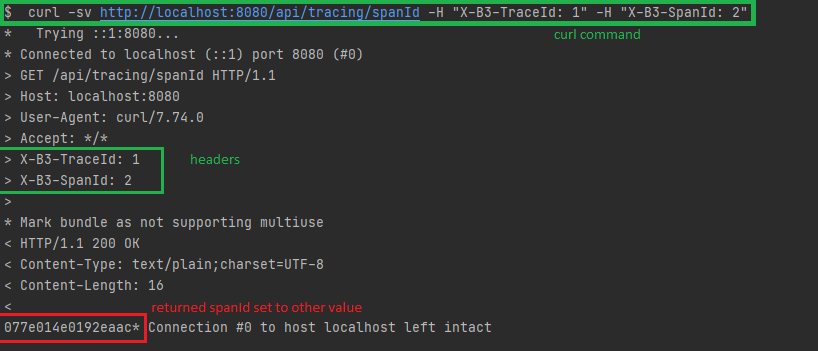
$ curl -sv http://localhost:9095/sample-route -H "X-B3-TraceId: 1" -H "X-B3-SpanId: 2
and in the gateway those headers are ignored and traceid and spanid are set to other values?
marcingrzejszczak
on 15 Feb 2021
Yes, as you can see in the following image, I'm doing the curl command and the value set in the header is ignored:
jackcat13
on 15 Feb 2021
I don't think 1 and 2 are valid values. Can you set propert values there? E.g.
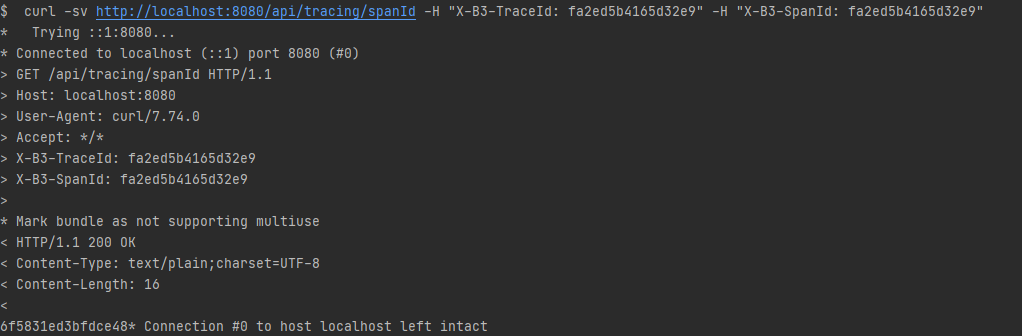
$ curl -sv http://localhost:9095/sample-route -H "X-B3-TraceId: fa2ed5b4165d32e9" -H "X-B3-SpanId: fa2ed5b4165d32e9"
Interestingly it does not work with ID values smaller than 10. For me it is also not working with X-B3-TraceId: 1 (GW generates new values), but it does with e.g. X-B3-TraceId: 10.
Update: hehe, simultaneous post :)
janekbettinger
on 15 Feb 2021
I also have another value set :
jackcat13
on 15 Feb 2021
I have no idea what is the thing that you're returning. Are values in the logs wrong? Is the trace data propagated properly? What do the Sleuth logs say?
marcingrzejszczak
on 15 Feb 2021
Let me try to summarize what I'm doing when I execute my test. The first step is a call using the webTestClient where I set the headers:

At this step, the spandId set in the header is "a2fb4a1d1a96d312"
Then, when I execute this test in debug mode, I'm able to visualize the content of the TraceContext instance (import org.springframework.cloud.sleuth.TraceContext)
I can visualize the following content :

My understanding is that the value of the spanId is never propagated to the TraceContext.
If you need some sleuth log, I have to setup logging in the reproducer. I can do it in the meantime.
jackcat13
on 15 Feb 2021
Wait a second - the trace context looks ok, the spanid is the child of the a2f... span. I don't understand what the problem is? We automatically created a child span.
marcingrzejszczak
on 15 Feb 2021
Well, I'm calling only one service from my test and my understanding is that the spandId and parentId would be equal to the ones I'm setting in the header.
Am I misunderstanding how the traceContext should be instanciated?
jackcat13
on 15 Feb 2021
It depends on what you're calling. What does happen properly is that on the client side the request headers were set properly and the trace context was successfully propagated. I have no idea what your controller does and how it looks like.
marcingrzejszczak
on 15 Feb 2021
The controller does nothing more than what I shared in the reproducer : Controller link here
the steps are:
- Call from the JUnit test
- SpanId returned by the Controller
- The test checks if the spanId returned by the controller is equal to the spanId set in the header
jackcat13
on 15 Feb 2021
Most likely that's a component somewhere in the reactor instrumentation that is creating a child span. I don't see a bug here nor a regression. The context is properly propagated.
marcingrzejszczak
on 15 Feb 2021
What confuses me is that it was the same issue in the following ticket: pring-projects/spring-cloud-sleuth#1507
In older versions of spring boot, the test in the reproducer actually passed (that's why I consider it a regression because the test passed until we move to Spring boot 2.4). The reproducer is a simple extract of an automated test of our project so we have detected that the behaviour around the propagation of the spanId/parentId seems different
jackcat13
on 15 Feb 2021
Ok I'll triple check this when I have time. Thanks for the reproducer.
marcingrzejszczak
on 15 Feb 2021
I'm sorry but I can't import the project to my IDE. Can you rewrite the sample to Java and Maven?
marcingrzejszczak
on 16 Mar 2021
Hello @marcingrzejszczak, I'm going to take a look to convert it today in java/maven on a separate brach
jackcat13
on 18 Mar 2021
@marcingrzejszczak You can find the converted reproducer at the following location : here
The test class to execute is TracingResourceTest.java
jackcat13
on 18 Mar 2021
I know what the problem is. Brave has the notion of Propagation and Propagation.Factory. When I introduced the composite of propagation types I have not overriden the Propagation.Factory methods. That means that what you see that happens is that supportJoin is equal to false. The trace headers are properly parsed but since support join is disabled it creates a new child span.
As a workaround what you can do is create your own bean like this
@Bean
    BaggagePropagation.FactoryBuilder myBaggagePropagationFactoryBuilder() {
        return BaggagePropagation.newFactoryBuilder(B3Propagation.newFactoryBuilder().injectFormat(B3Propagation.Format.SINGLE_NO_PARENT).build());
    }
and then you'll override the faulty composite one that I'll try to fix asap.
marcingrzejszczak
on 18 Mar 2021
Related issues
 oburgosm
·
4Comments
oburgosm
·
4Comments
 ezraroi
·
7Comments
ezraroi
·
7Comments
 andcuevas
·
5Comments
andcuevas
·
5Comments
 barrycommins
·
6Comments
oburgosm
·
4Comments
barrycommins
·
6Comments
oburgosm
·
4Comments
Most helpful comment
I know what the problem is. Brave has the notion of
PropagationandPropagation.Factory. When I introduced the composite of propagation types I have not overriden thePropagation.Factorymethods. That means that what you see that happens is thatsupportJoinis equal tofalse. The trace headers are properly parsed but since support join is disabled it creates a new child span.As a workaround what you can do is create your own bean like this
and then you'll override the faulty composite one that I'll try to fix asap.