Spark-nlp: bert_large_cased_en_2.4.0_2.4_1580580251298 Embedding doesn't work
bert_large_cased_en_2.4.0_2.4_1580580251298 doesn't work
Description
There are four pre-trained variants of BERT: bert_base_uncased , bert_base_cased, bert_large_uncased, bert_large_cased, when I tested the above models, only bert_base_cased model works for me.
Following is the code snippets
  val documentAssembler = new DocumentAssembler()
    .setInputCol("text")
    .setOutputCol("document")

  val sentenceDetector = new SentenceDetector().
    setInputCols(Array("document")).
    setOutputCol("sentence")

  val tokenizer = new Tokenizer()
    .setInputCols(Array("sentence"))
    .setOutputCol("token")

  val normalizer = new Normalizer()
    .setInputCols("token")
    .setOutputCol("normal")

  val bertEmbeddings = BertEmbeddings.load(path_bert_base_cased)
    .setInputCols(Array("sentence", "token"))
    .setOutputCol("bertEmbd")
    .setCaseSensitive(true)

  val nerBertModel = NerDLModel.load(modelPath)
    .setInputCols(Array("sentence", "token", "bertEmbd"))
    .setOutputCol("nerBert")

  val nerConverter = new NerConverter()
    .setInputCols(Array("document", "token", "nerBert"))
    .setOutputCol("ner_converter")

  val finisher = new Finisher()
    .setInputCols("nerBert", "ner_converter")
    .setIncludeMetadata(true)
    .setOutputAsArray(false)
    .setCleanAnnotations(false)
    .setAnnotationSplitSymbol("@")
    .setValueSplitSymbol("#")

  val stages = (Array(
    documentAssembler,
    sentenceDetector,
    tokenizer,
    bertEmbeddings,
    nerBertModel,
    nerConverter,
    finisher))

  val pipeline = new Pipeline().setStages(stages)

  val result = pipeline.fit(Seq.empty[String].toDS.toDF("text")).transform(testData)

  result.printSchema()
Expected Behavior
All the four pre-trained variants of BERT should work
Current Behavior
If use any model other than bert_base_cased, get the following exception:
Exception in thread "main" java.lang.IllegalArgumentException: requirement failed: Found input column with storage metadata. But such ref does not match to the ref this annotator requires. Make sure you are loading the annotator with ref: bert_base_cased
at scala.Predef$.require(Predef.scala:224)
at com.johnsnowlabs.storage.HasStorageRef$class.validateStorageRef(HasStorageRef.scala:27)
at com.johnsnowlabs.nlp.annotators.ner.dl.NerDLModel.validateStorageRef(NerDLModel.scala:19)
at com.johnsnowlabs.nlp.annotators.ner.dl.NerDLModel.beforeAnnotate(NerDLModel.scala:95)
at com.johnsnowlabs.nlp.AnnotatorModel._transform(AnnotatorModel.scala:49)
at com.johnsnowlabs.nlp.AnnotatorModel.transform(AnnotatorModel.scala:79)
at org.apache.spark.ml.PipelineModel$$anonfun$transform$1.apply(Pipeline.scala:305)
at org.apache.spark.ml.PipelineModel$$anonfun$transform$1.apply(Pipeline.scala:305)
at scala.collection.IndexedSeqOptimized$class.foldl(IndexedSeqOptimized.scala:57)
at scala.collection.IndexedSeqOptimized$class.foldLeft(IndexedSeqOptimized.scala:66)
at scala.collection.mutable.ArrayOps$ofRef.foldLeft(ArrayOps.scala:186)
at org.apache.spark.ml.PipelineModel.transform(Pipeline.scala:305)
Possible Solution
Context
Test NER performance by using different BERT models
Your Environment
- Spark NLP version: 2.4.4
- Apache NLP version: 2.4.4
- Java version (java -version): 1.8.0_162
- Setup and installation (Pypi, Conda, Maven, etc.): Maven
- Operating System and version: CentOS 7.7
 simon-oz
All 5 comments
This is not a bug, our NerDLModel pretrained model ner_dl_bert was trained by using bert_base_cased, therefore it can be only used by bert_base_cased, not any others. To use other BERT models, you need to train your own:
Blog: https://towardsdatascience.com/named-entity-recognition-ner-with-bert-in-spark-nlp-874df20d1d77
 maziyarpanahi
on 21 Apr 2020
maziyarpanahi
on 21 Apr 2020
Thanks maziyarpanahi to make it clear. Very much appreciate.
Will follow the link above to train a new model based on bert_large_cased embedding
simon-oz
on 22 Apr 2020
Hi maziyarpanahi,
Thanks for your suggestion and I followed the links above implemented my own bert_ner model.
However, when I use the trained model to do predictions, I found that the NER is not of BIO format, it always starts with I-....
I found it seems the output in the following link has the similar issue, for example, in the last part of the linked page, the output of an entity does not start with B-PER, but as following:
Peter NNP NNP I-PER
Parker NNP NNP I-PER
I also tested to transform training data by using
bert.transform(trainingData)
seems there is no different.
Am I wrong somewhere?
Thanks in advance
Following is the code I used to train the BERT ner model.
val bert = BertEmbeddings.load(bertEmbdPath)
  .setInputCols("sentence", "token")
  .setOutputCol("bert")
  .setCaseSensitive(false)
  .setPoolingLayer(0)

val dataTrans = bert.transform(testData)
dataTrans.write.mode(SaveMode.Overwrite).parquet(testDataPath)

val trainTrans = bert.transform(trainingData)

val nerTagger = new NerDLApproach()
  .setInputCols(Array("sentence", "token", "bert"))
  .setLabelColumn("label")
  .setOutputCol("ner")
  .setMaxEpochs(3)
  .setBatchSize(8)
  .setRandomSeed(0)
  .setVerbose(1)
  .setEnableOutputLogs(false)
  .setIncludeConfidence(true)
  .setEvaluationLogExtended(false)
  .setValidationSplit(0.2.toFloat)
  .setTestDataset(testDataPath)

val ner_pipeline = new Pipeline()
  .setStages(Array(bert, nerTagger))

val bertNer = ner_pipeline.fit(trainTrans)

bertNer.write.overwrite().save(modelSavePath)
You can train NerDLModel with any tagging style. It will learn no matter what and will predict. The quality of the tagging it's up to the tagging style based on research etc. However, NerConverter to extract entities only support IOB and IOB2.
Now that is being said, what you are seeing is IOB:
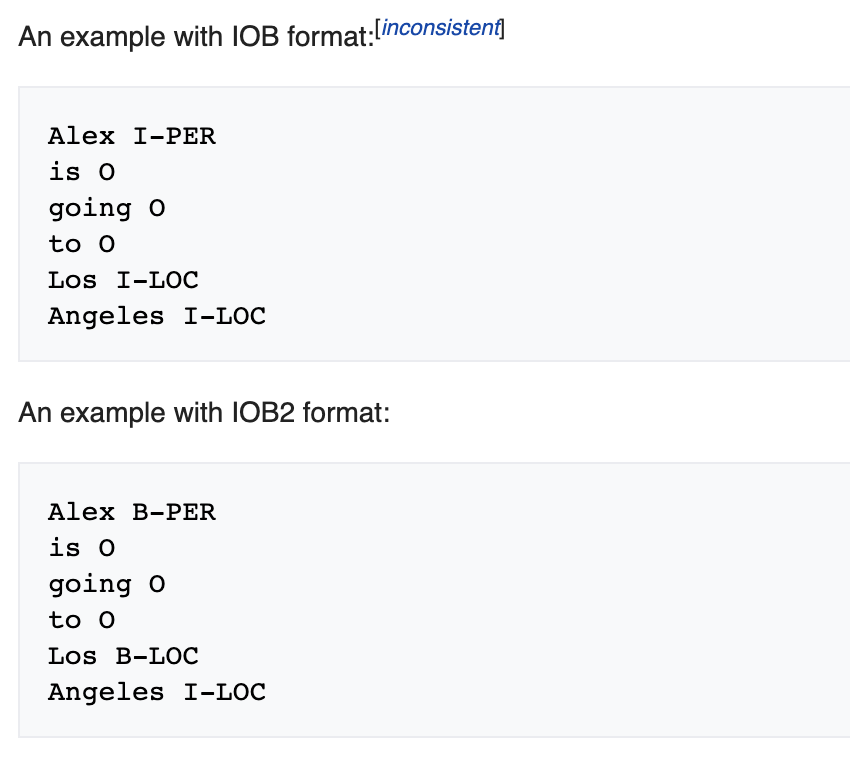
The CoNLL 2003 dataset is using that, it's not something that NerDL is doing to it, the data appears to be in that format, and that is how it learns. You can find the IOB2 style of CoNLL2003 and use that or BIOES format and convert it into IOB2 then use that or just use BIOES and not use NerConverter since it only accepts IOB/IOB2.
It's not an issue, what goes in, exactly comes out if the prediction is correct (there is a margin for error so one or two in a sentence might be false positive)
maziyarpanahi
on 22 Apr 2020
you are a legend maziyarpanahi !
Thanks tons !
simon-oz
on 23 Apr 2020
Related issues
 ashok12
·
6Comments
maziyarpanahi
·
7Comments
ashok12
·
6Comments
maziyarpanahi
·
7Comments
 tombriles
·
4Comments
tombriles
·
4Comments
 SankethBK
·
3Comments
SankethBK
·
3Comments
 santoshbs
·
5Comments
santoshbs
·
5Comments