Solvespace: Add "intersection" boolean operation for combining solids
Add this types for logic how solid model combine.
- "intersect" - make visible only those region where solid models intersect
- "XOR" (exclusive or) - make visible only those regions of solid models that not intersect (inverted to "intersect")
 Symbian9
All 52 comments
I don't see real cases where we need XOR. @Symbian9, any samples?
 Evil-Spirit
on 24 Aug 2016
Evil-Spirit
on 24 Aug 2016
XOR usefull for design parts of complex shape, for example in engine and watch constructions.
Symbian9
on 24 Aug 2016
If this is the feature I am thinking where the solid result is where the 2 solds intersected. This is particularly useful in many circumstances.
The image link below shows one possible use for such an operation.
http://help.autodesk.com/cloudhelp/2016/ENU/AutoCAD-Core/images/GUID-1C31FCED-9999-4012-B6F9-518D00711466.gif
 mmiscool
on 24 Aug 2016
mmiscool
on 24 Aug 2016
There is no question that an intersect ("AND") operation is useful. I don't see any point in "XOR" though.
 whitequark
on 24 Aug 2016
whitequark
on 24 Aug 2016
@whitequark,
I think this is a lot of unpredictable work. I actually have tried do the same thing for NotSolveSpace, but some problems force me to decide stop doing this.
If @jwesthues can help, we can try again.
Evil-Spirit
on 19 Nov 2016
@Evil-Spirit OK.
whitequark
on 19 Nov 2016
FYI: I've implemented the "intersection" operation in my own fork now. I needed this function for my 3D printing, where I frequently wish to extract part of a whole object in order to make a test print of that part only.
I circumvented most of the "unpredictable work" mentioned by @Evil-Spirit by rewriting the intersection operation A * B as the result of two difference operations A - (A - B). This incurs some overhead of course, but with the benefit of less unpredictability :)
Implementation was relatively straightforward this way and mainly consisted of modifications to srf/boolean.cpp for the non-mesh solids:
void SShell::MakeFromIntersectionOf(SShell *a, SShell *b) {
   SShell c = {};
   c.MakeFromBoolean(a, b, SSurface::CombineAs::DIFFERENCE);
   MakeFromBoolean(a, &c, SSurface::CombineAs::DIFFERENCE);
   c.Clear();
}
and to mesh.cpp for the meshes:
void SMesh::MakeFromIntersectionOf(SMesh *a, SMesh *b) {
   SMesh c = {};
   c.MakeFromDifferenceOf(a, b);
   MakeFromDifferenceOf(a, &c);
   c.Clear();
}
as well as the necessary changes to the UI to present the option to the user.


 ghoss
on 17 May 2018
ghoss
on 17 May 2018
Wow, this is really neat! I'll look into integrating it.
whitequark
on 17 May 2018
Cool. FYI, the work to do intersect without the double-Boolean should be very small, just the additional case in KeepRegion(), eight lines of code. Neither shell gets its normals flipped, and keep only the pieces from A that lie inside B (and vice versa).
 jwesthues
on 18 May 2018
jwesthues
on 18 May 2018
@jwesthues Hello! Can you give a links to lines of code where we should do this? I have understood what are you meaning, but any additional information can help.
Evil-Spirit
on 18 May 2018
Six lines plus one of whitespace, I guess. It should literally just be another case inside that switch statement.
Note that even though the intersection is a commutative operation (like union), the surfaces from shell A are treated differently from the surfaces from shell B, with the test on opA. This is to handle the case where a surface from A is coincident with B--we need to keep one of those surfaces but not the other. It's arbitrary which.
jwesthues
on 18 May 2018
Thanks. I actually tried to make the change in KeepRegion() before going the other way, but couldn't muster enough brain cells for the job. Will have another go at this. Also, I wasn't sure if anything needed to be done to KeepEdge() too.
ghoss
on 18 May 2018
I think no? But I often found it easier to just enumerate cases until I got the right answer than to think.
jwesthues
on 18 May 2018
I think no? But I often found it easier to just enumerate cases until I got the right answer than to think.
Nope, can't figure it out. I enumerated all cases and they all just give either nothing or clearly wrong result. What sort of condition should it even be? This code is like black magic to me.
Also, I tried optimizing mesh intersections with...
void SMesh::MakeFromIntersectionOf(SMesh *a, SMesh *b) {
    SBsp3 *bspa = SBsp3::FromMesh(a);
    SBsp3 *bspb = SBsp3::FromMesh(b);

    flipNormal = true;
    keepCoplanar = true;
    AddAgainstBsp(b, bspa);
    AddAgainstBsp(a, bspb);
}
but the resulting solid has all normals flipped (that's ok, we can flip them back) and this gives wrong result for coincident surfaces (which I never figured out how to fix). Any ideas?
whitequark
on 12 Jul 2018
The current code is pretty confusing. A surface from shell A might be:
- inside shell B
- outside shell B
- on shell B, with normals in the same direction
- on shell B, with normals in the opposite direction
The pieces (should) have been split so that each piece is strictly one of those four. It might be clearest to replace all of KeepRegion() with a lookup table, something like:
static const bool Keep[][] = {
   // inside    coinc_same    coinc_opp    outside
   { false,     false,        false,       true }, // union opA
   { false,     true,         false,       true }, //       opB
   // ...
};
You could do something similar for the BSPs for the mesh operations.
jwesthues
on 13 Jul 2018
Can we get this in? @whitequark If someone put just those changes into a branch off current master will you accept a PR?
 phkahler
on 11 Sep 2019
phkahler
on 11 Sep 2019
@phkahler Which changes exactly? I was never able to make it work properly, and I don't think merging the workaround with two difference operations is a good idea.
whitequark
on 11 Sep 2019
@whitequark The commits in @ghoss fork seem to have a little extra stuff - something about mirror groups. It seems a shame that someone is maintaining a useful and requested feature for so long. I don't think the implementation is bad, just not optimal. It's also hard to work out the "right" solution as outlined above when you need to integrate all the text window stuff anyway just to try things properly. I think this would be a net-positive for SolveSpace the way it is - but cleaned up with no extra fragments.
phkahler
on 11 Sep 2019
It's also hard to work out the "right" solution as outlined above when you need to integrate all the text window stuff anyway just to try things properly.
I've already worked out all the text window stuff--you can apply this patch to play with it. But given how slow and fragile all the solid operations already are, I'd probably rather not have intersection at all than have intersection that is unnecessarily twice as slow, and with twice as many opportunities for the NURBS operation to break.
whitequark
on 11 Sep 2019
So I made in "intersect" branch and put this in. Since I couldn't figure out the text window (sorry, couldn't apply the patch). I switched the call for difference to intersect in the first patch so I could test. It works using the dual difference method. Then I changed the code hoping to use KeepRegion with a single boolean. No luck. One thing of note: Making the code in INTERSECT identical to that in DIFFERENCE does not produce a difference operation. So now we know there are more changes needed to implement this in one operation.
I'm a blind as everyone else on this. It's not clear how all the pieces fit together. Like what does "opA" do? it selects one of two boolean expressions to return. Why? What does it indicate?
Anyway, I have what I just described branched off todays master if anyone wants to explore booleans again.
EDIT: Maybe I'm wrong. In order to get the shell flipped for difference, the CombineAs:: needs to be set to difference so it won't work properly if it's set to INTERSECT....
phkahler
on 11 Sep 2019
@phkahler I'll rebase the text window changes on top of master in a moment.
whitequark
on 11 Sep 2019
@phkahler See the branch wip-intersection.
whitequark
on 11 Sep 2019
As a side note, if you're ever blocked by anything related to the text window, feel free to ping me and I'll just fix it, that's one of the easier parts of SolveSpace to work on for me.
whitequark
on 11 Sep 2019
So this is in my "intersect" branch and working - freshly integrated from master. Try this out, it's really cool.
I still haven't figured out how to do it in a single boolean operation but the code is there and easy to switch. That currently works so long as none of the new edges are needed (those resulting from the intersection itself). So partly.
phkahler
on 11 Sep 2019
Correct, difference requires shell B to be turned inside out, and intersection (like union) doesn't.
See my comment above re opA, which for shellA [OPERATOR] shellB indicates whether the piece came from operand A (true) or B (false). We obviously need to know that for non-commutative operations like difference, but we need it for commutative operations too as outlined above.
jwesthues
on 12 Sep 2019
The remaining problem is that any new edges are being discarded:
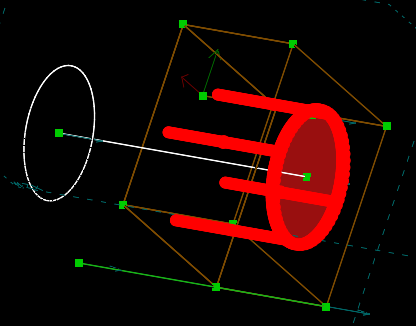
It's working fine if either shell is completely inside the other one.
I believe all new edges should be preserved if they are inside the trim region of either surface. That should be true for all intersection types (union, diff, intersect).
I'm a bit confused about the code. There is KeepRegion() and KeepEdge(). I think the issue is that KeepEdge needs to be independent of KeepRegion when it's a new edge, and yet KeepEdge make two call to KeepRegion.
Edit: New edges should be kept if and only if they are inside the trim curves of both surfaces. And that's valid for all intersection types.
phkahler
on 12 Sep 2019
Same for me. Except that I think the logic should be different.
See https://github.com/ruevs/solvespace/commit/db29aecb46884f45c50bafbaab1cef0e0e715f4e in my https://github.com/ruevs/solvespace/commits/wip-intersection branch.
First of all there is something strange going on in the KeepEdge function.
https://github.com/ruevs/solvespace/blob/wip-intersection/src/srf/boolean.cpp#L236
outdir_orig == SShell::Class::OUTSIDE and KeepRegion checks for if(!inOrig) return false; therefore keepOut is always false! Therefore it seems the second call to KeepRegion could be removed entirely?!
Did something in the logic get changed during the years and this became "crufty"? @jwesthues can you please shed some light on this?
While trying to understand the code I also realized that KeepRegion (https://github.com/ruevs/solvespace/blob/wip-intersection/src/srf/boolean.cpp#L202) is more complicated than it needs to be. So I optimized the UNION and DIFFERENCE operations. They still work fine and the code is absolutely equivalent to the old one. But now it is much more understandable:
Keep in mind that opA (operand A) is the "second" extrusion (the cylinder in the above screenshot)
- UNION:
Keep all faces from each object that are outside of the other object . For B only also keep faces that are on it's surface and with the same normal - makes sense. - DIFFERENCE:
Keep all faces from B (the object being cut) that are outside of opA (operand A - the cutting object). Keep all faces from A that are inside of or on the surface of B - this forms the "cut" - also makes sense. - INTERSECTION
In my opinion the operation should be: Keep all faces from each object that are inside of the other object. For B only also keep faces that are on it's surface and with the same normal.
But is does not work. In fact visually it looks very much like the @phkahler screenshot above.
 ruevs
on 12 Sep 2019
ruevs
on 12 Sep 2019
I also created a pull request to master just for the simplification https://github.com/solvespace/solvespace/pull/484
ruevs
on 12 Sep 2019
I agree that the comment in KeepEdge seems wrong. When it says "both in or both out" I expect there to be an XOR in the condition, an AND which only allows one of 4 cases to be true.
phkahler
on 12 Sep 2019
I added a function "KeepIntersectionEdge" on my intersect branch. Since KeepEdge was called separately for existing edges and those that result from an intersection of surfaces, I figured this was a good idea. If the type is not INTERSECT, it passed through to the regular KeepEdge, so no other booleans are affected. For INTERSECT type I'm just returning true since that should be the case. This means we can fiddle with the conditions in KeepRegion to get things right.
The new function has been extremely useful in getting the edges around the hole to stay, but I still can't get it right. A box with a cylinder (double sided extrusion) is very useful for testing this:
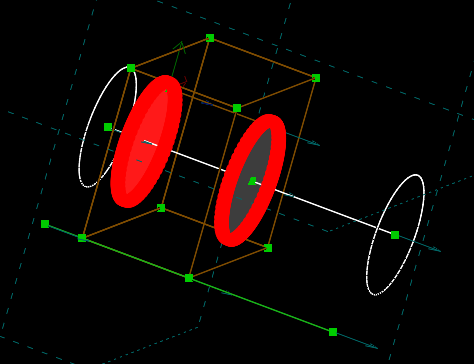
Just thought I'd check in. This is a real head scratcher. I would not be surprised if the existing known NURBS issues are lurking right here. I wish a bunch of us could sit in a conference room with computers and whiteboards for a day.
phkahler
on 12 Sep 2019
I'm testing in exactly the same way :-) Moving and stretching the cylinder to cover different cases. I also sometines constrain one of the sides to coincide with a box face to test the inSame case.
ruevs
on 12 Sep 2019
Interesting history from 10 years ago ;-)
Relevant to the current state of KeepRegion and KeepEdge
https://github.com/solvespace/solvespace/commit/c6b429b9ce1ff9f78010b84f4365fbda7c40b4e5
https://github.com/solvespace/solvespace/commit/ae35b3595cf646be78ba6636baa2ad01a5cf118d
https://github.com/solvespace/solvespace/blame/master/src/srf/boolean.cpp
ruevs
on 13 Sep 2019
I was wrong about the strangeness of the KeepEdge function. It is called with outdir_orig == OUTSIDE only for the original edges. For the edges resulting from the intersection outdir_orig is determined by this code https://github.com/solvespace/solvespace/blob/master/src/srf/boolean.cpp#L559
... I need to "parse" this more :-)
P.S. I amended my pull request to remove the comment.
ruevs
on 13 Sep 2019
Nostalgia... The more I reread this code, the more I doubt I ever had any deeper understanding than "there are many special cases, and I've modified this until it works with all the cases I've hit". In that spirit, in KeepEdge() let's define
int k = indir_shell*10 + outdir_shell + indir_orig/10 + outdir_orig/100;
So we uniquely identify each of the 4^4 possible cases with a four-digit decimal number. For intersection, keep (return true) 1112 and 2111, and discard (return false) 2212 and 2122. This doesn't handle the coincident cases, but you can enumerate those too.
The other problem is that edges from intersection seem to occur in the opposite direction from edges in the original surface--so AssemblePolygon() fails, because it requires them all to go in the same direction. I hacked around this by changing the third argument to false (in both boolean.cpp and surface.cpp), so that it assembles in any order; but I suspect that may have bad consequences elsewhere, and in any case the right thing is presumably to reverse the order (swap .a and .b) of some edges somewhere.
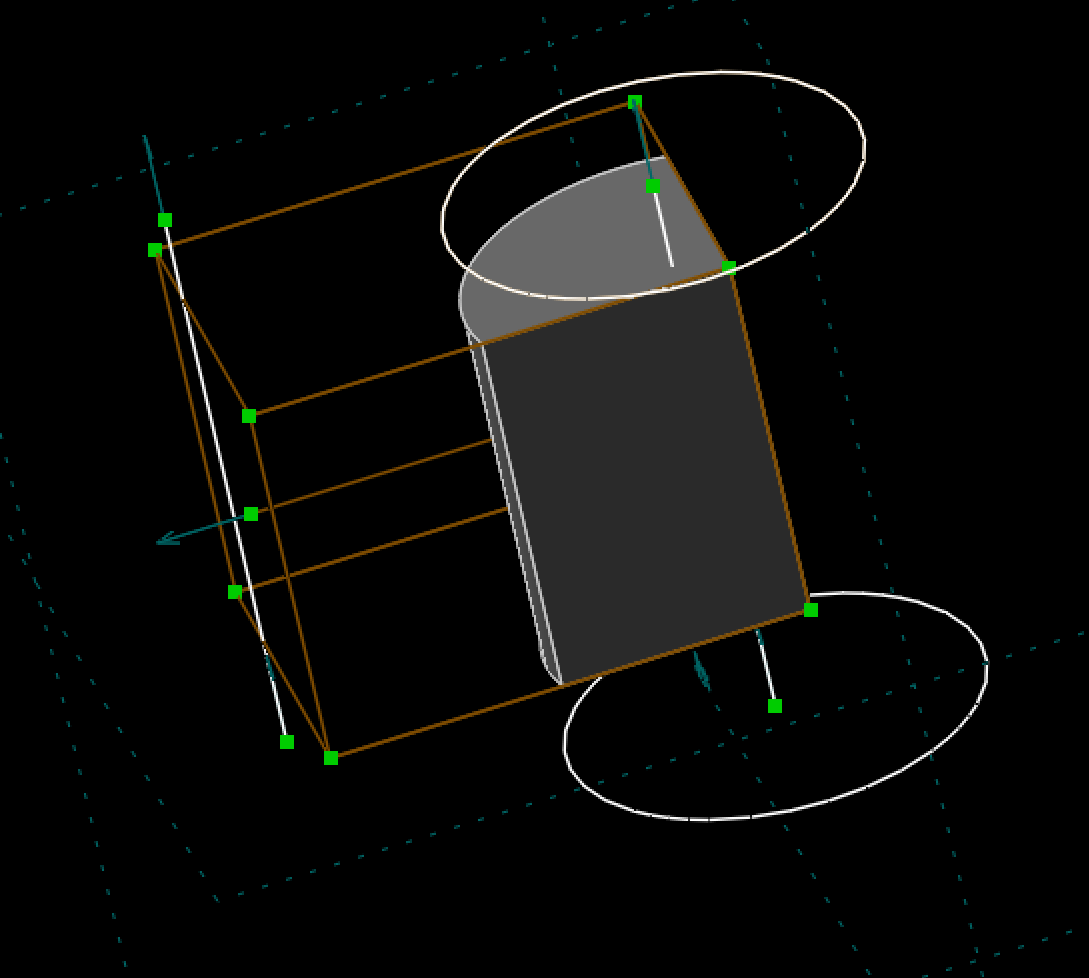
jwesthues
on 13 Sep 2019
The other problem is that edges from intersection seem to occur in the opposite direction from edges in the original surface--so AssemblePolygon() fails, because it requires them all to go in the same direction.
That would explain why unconditionally keeping them didn't work. It was also starting to look like the intersection-formed edges include others that don't really make sense that - maybe didn't get rejected earlier. I mean where did these arcs come from:
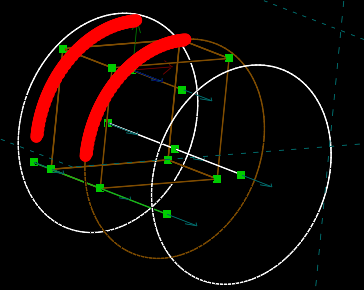
Only 2 small arc segments should be there clipping the corner of the box, but they extend a both directions to (presumably) the edge of the 90 patch. The strange thing is there are no flat surfaces out there - all flat surfaces on that box should use the full U,V range 0..1 right? In an earlier one I had 2 edges along the box faces where this same patch intersects (as I expected here but they're gone now) and they extended as straight line all the way to the ends of the cylinder. If was like a big hash # tag. Those lines shouldn't have been there either right? Or are flat surfaces considered infinite for intersections? in that case they're simply outside the trim curves but still surface-surface intersections.
@ruevs You got enough to make this work and offer a PR for this feature?
phkahler
on 13 Sep 2019
Almost. See my last commit - ugly hack following Jonathans suggestion above. It keeps all the proper edges but only "works" with "force NURBS surfaces to triangle mesh".
I presume this is because I did not commit passing true to AssemblePolygon because it has other bad consequences.
The logic that still sits in my KeepRegion also "almost" works - some edges are missing but "force NURBS..." makes it look OK.
By the way Jonathans logic can not be implemented with the current "two calls to KeepRegion in KeepEdge" no matter what one writes in KeepRegion. This explains why we could not figure it out thinking "in the box". I need to work on this and think about it some more. The semantics of indir_shell, outdir_shell, indir_orig, outdir_orig are still a bit fuzzy to me even though I have some semi-instinctive understating...
By the way I had had reverted the C=A-(A-B) version of MakeFromIntersectionOf in mash.cpp by mistake yesterday - it is critical for intersection to work and we still need to figure out the "proper" version for it.
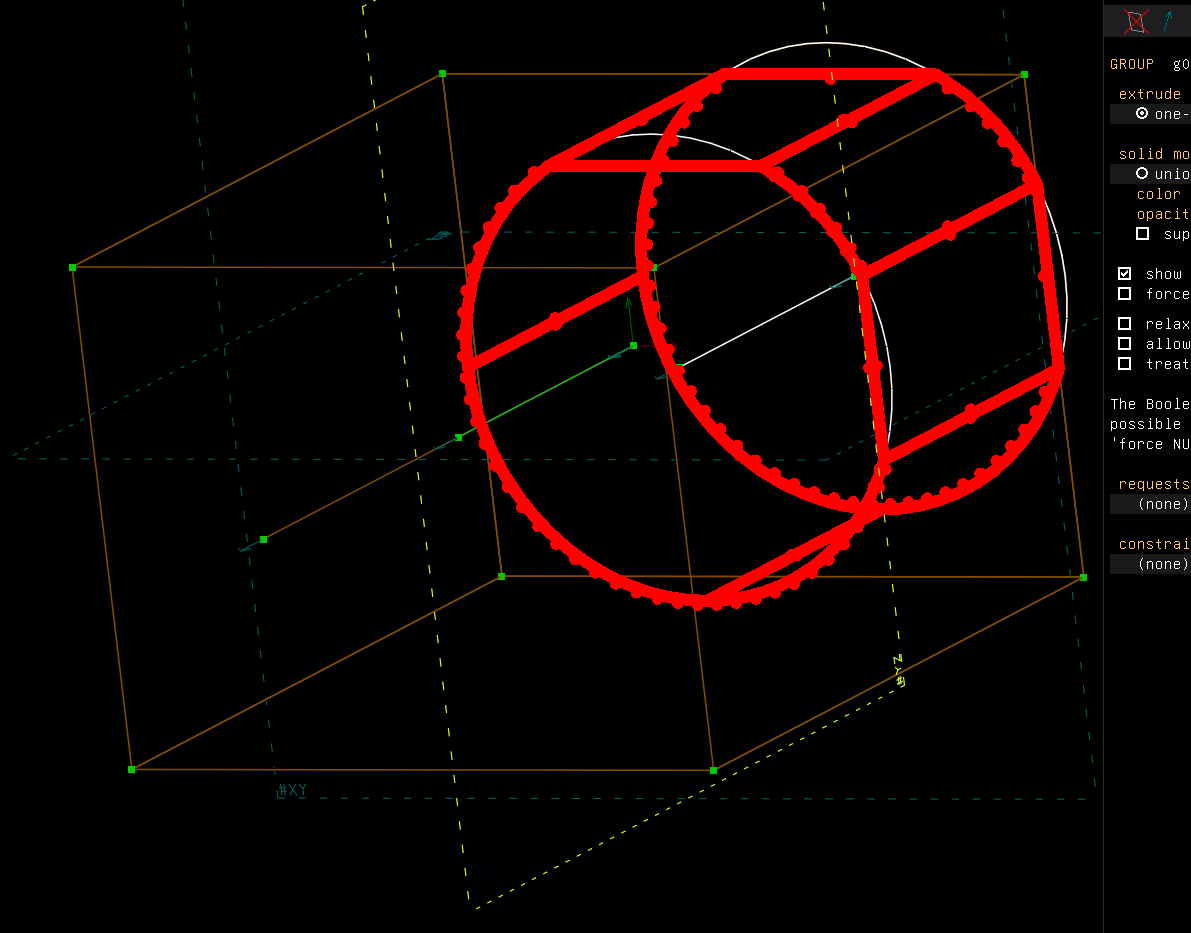
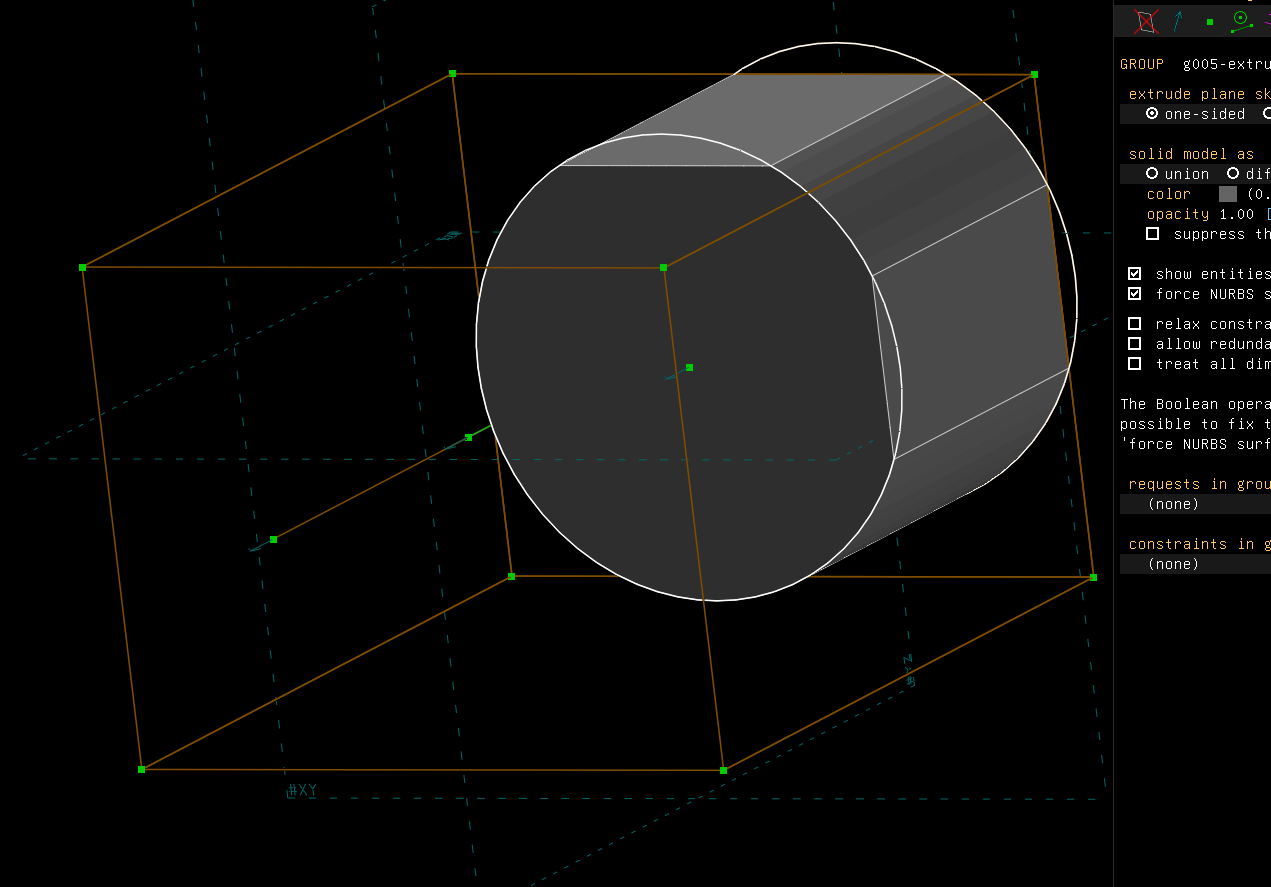
ruevs
on 13 Sep 2019
Cool, sounds good. I suspect you just want to always reverse the order of all the curves arising from surface-surface intersections when you do Boolean intersection (note the two confusing unrelated uses of "intersection"). That needs to be whiteboarded/tested though.
There's perhaps a decision to be made between (1) just enumerating all the special cases and handling each one, and (2) trying to be smart (remember the old "simulation of simplicity" paper, Edelsbrunner and Muecke?). I thought I was doing (2), but I was basically just doing (1) in complicated form. You could fully embrace (1), and move all operations (union and difference too) to more lookup-table-style code; or you could hunt for the elusive complete and comprehensible expression, taking care not to fool yourself as I did.
While you're in here, it would be great if someone debugged the Boolean failures. That's basically just an extended grind:
- debugging visually by plotting edges and such, find the extra/missing edge
- if that edge was never generated, then the problem is the surface-surface intersections
- if that edge was classified wrong ({
indir,outdir}_{shell,orig}), then the problem is the raycasting for that - if that edge was classified right but wrongly kept/discarded, then the problem is
KeepEdge()
The general model of the Booleans is to generate all the surface-surface intersection curves that could possibly be needed, and then choose which to keep and discard. So unneeded curves (as above) should always be just an efficiency issue, never a correctness one. I don't recall whether u and v are supposed to always lie in [0, 1], but I wouldn't rely upon it, especially e.g. after coplanar surfaces get merged.
jwesthues
on 14 Sep 2019
Well intersection now works better than difference (I am not joking) in my wip-intersection branch. Don't ask me how - I gave up, installed Visual Studio and debugged the hell out of it.
(I had forgotten how good Visual Studio was for debugging - had not used it for at least 12 years :-) )
Back to intersection.
It now handles all nasty cases that I could think of perfectly. See below. A few test files are attached.
I still need to think how to implement this cleanly (for all boolean operations). For now it's an ugly hack.
The "pass false to
AssemblePolygon" hack is still in there. I still have not figured out how to "flip" the edges properly.The edge classifier fails miserably for some edge on edge and edge on face cases. indir_shell etc. are not set at all. I still need to debug it. I does not seem to affect the current implementation of intersection tough.
The triangle mesh implementation in
SMesh::MakeFromIntersectionOfis stillC=A-(A-B). Completely different piece of code to understand and work on :-)I found some cases where difference fails with "couldn't find an ear! fail" - it's a message from
SContour::UvTriangulateInto. I need to debug this.
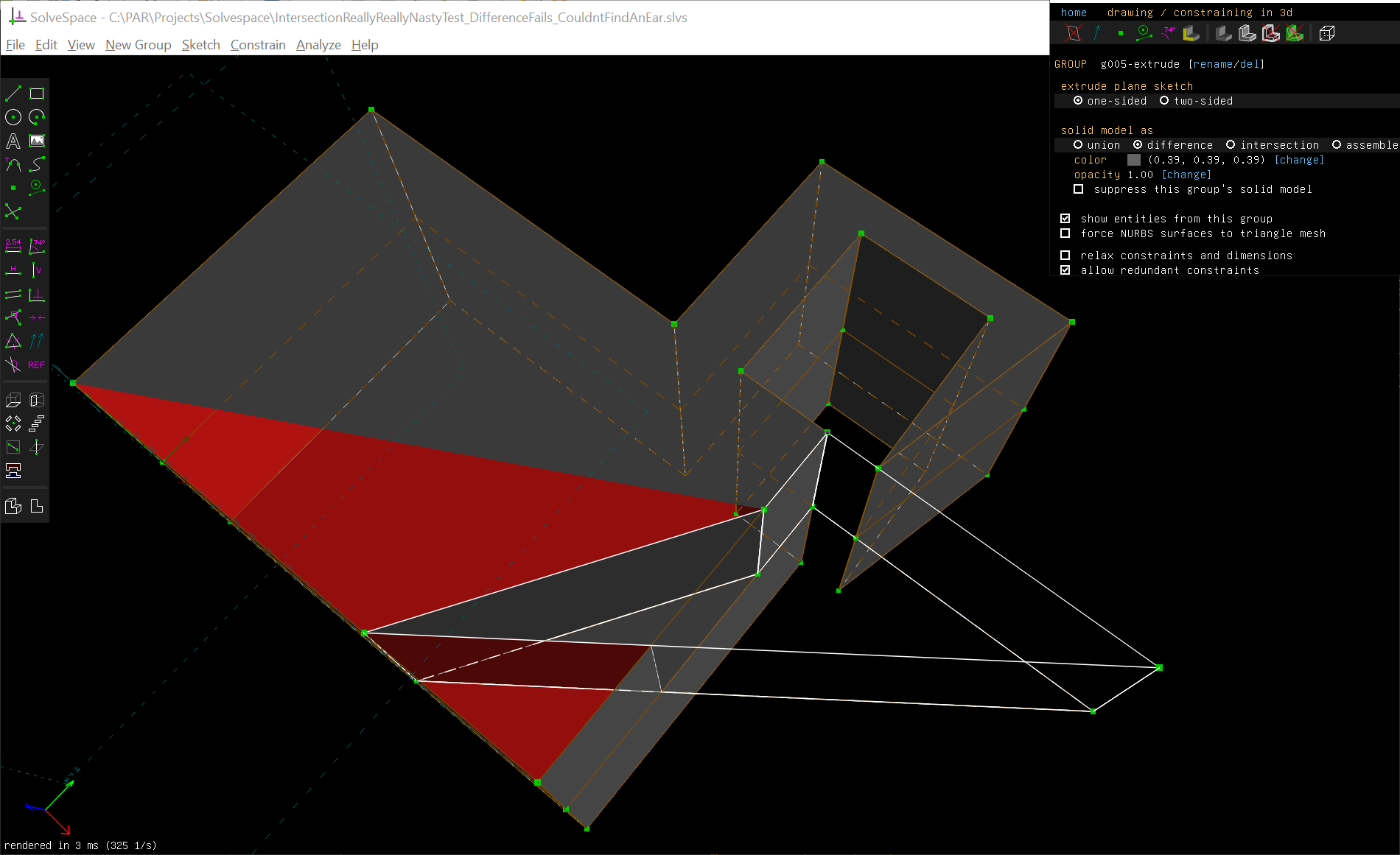
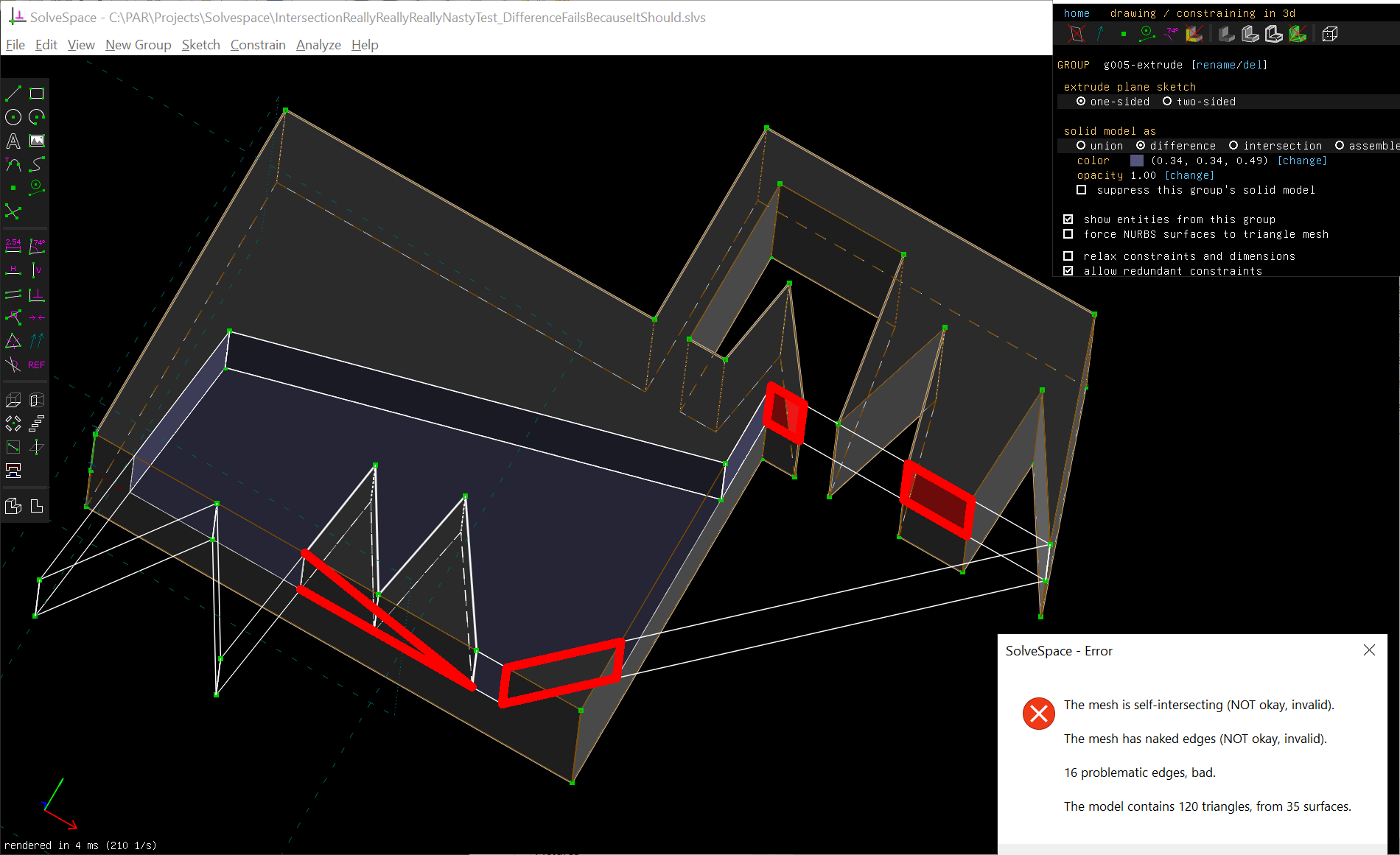
Difference fails - but this is normal:
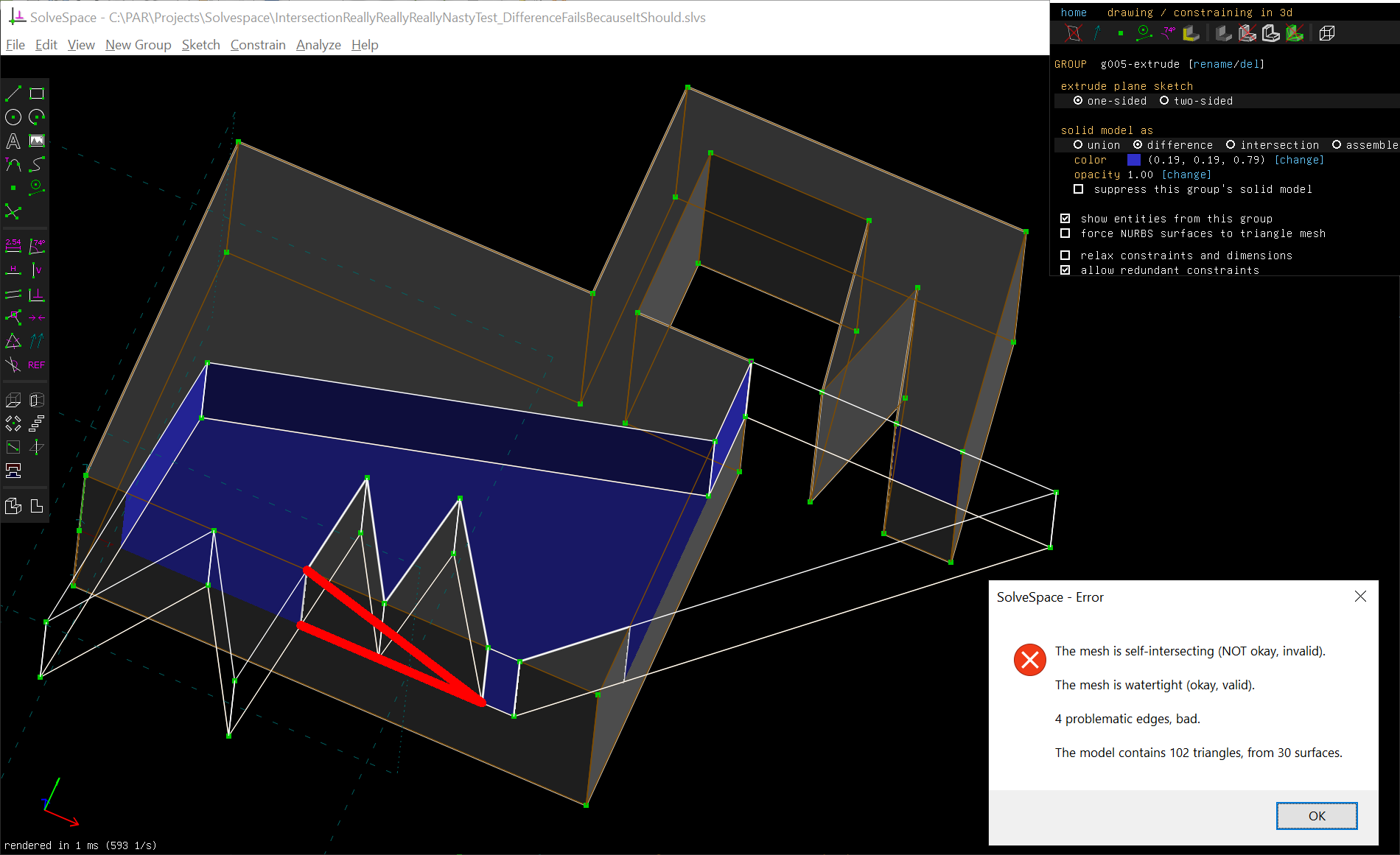
Difference fails where it should not:
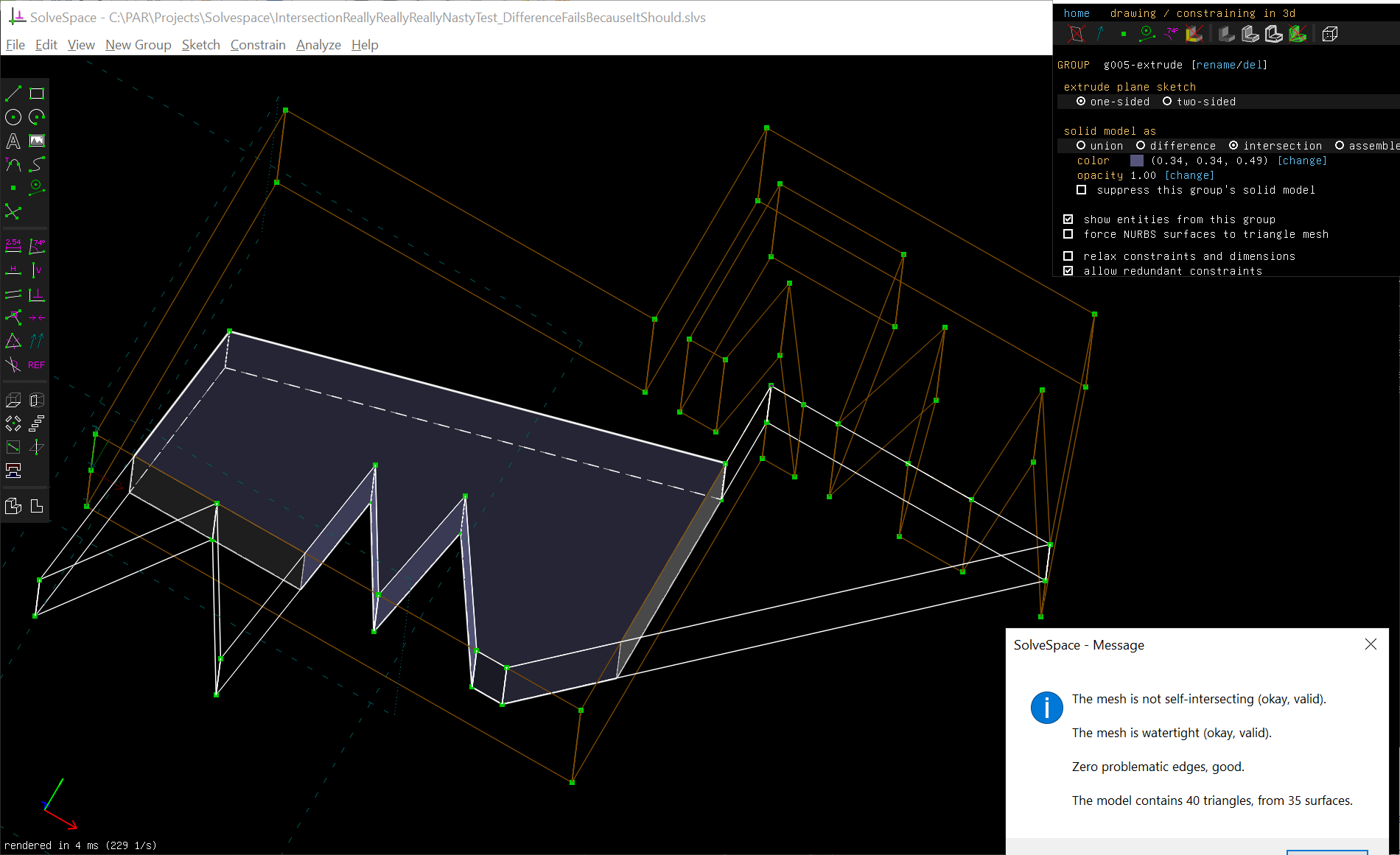
Intersection works perfectly:
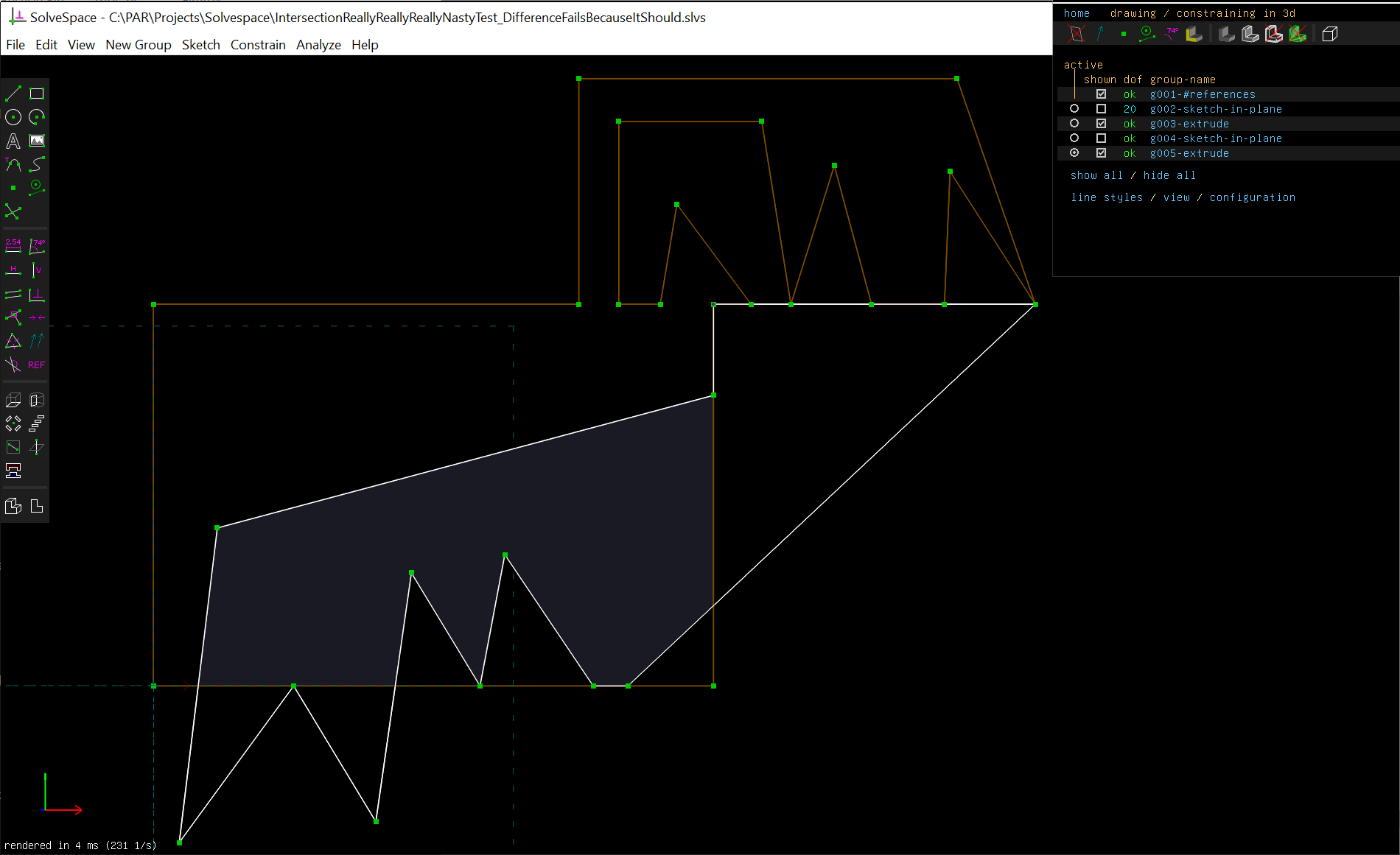
If it is not obvious why this object is a nasty test case here is a top view:
_Test files_
NURBSTests.zip
ruevs
on 15 Sep 2019
@jwesthues if you have some time please explain the semantics behind indir_shell, outdir_shell, indir_orig, outdir_orig. My intuitive understanding is much better now, but I still feel like I am doing a bit of a "cargo cult programming". Yes, I know that if I "just read" SShell::ClassifyEdge in raycast.cpp I should be able to figure it out, but I have not used the math in there for much longer than Visual Studio and it will take me a while :-) Eventually I will need to figure it out if I am to fix the classifier failures I mentioned above, but any hints you can give me would be _very_ useful.
ruevs
on 16 Sep 2019
I'd guess you're focusing on intersection for now. I can offer a couple reduced test cases for difference with simple models that have fairly specific changes between pass/fail.
In the mean time, I think PR #486 may have subtle effects. It improves the convergence of one of the iterations on curves. Also, don't even bother testing with helical extrusions without #473 it has a dramatic effect on helical boonean reliability.
I'll try to follow some of your changes on this one.
phkahler
on 16 Sep 2019
Here are some test models for booleans. "bug_one" has a difference that works fine until to drag it down slightly more and then 2 surfaces disappear. Issue 315 is interesting because if you change the bezier in g004 to a line segment it works fine. Changing it back to a bezier - even a straight one - causes it to fail again. Strange because there isn't any real difference when it's not curved. The first helix one I consider fixed by the above PR (which is purely numeric not boolean), while the second helical one seem to be the ultimate pathological case. Haven't tried any of these with intersection yet.
NURBS_issues.zip
phkahler
on 16 Sep 2019
Thanks a lot for the test models. It seems you are concentrating at a completely different set of NURBS failures - numerical ones. All your tests fail with something like:
didn't converge
have 0.000 4.751 -23.944
want 0.000 4.633 -24.419
didn't converge
have -nan(ind) -nan(ind) -nan(ind)
want -42.080 -41.514 -55.131
distance = -nan(ind)
And they fail independent of the operation.
I had seen your pull requests on github but had not tried them. I'll merge them and try them tomorrow.
I on the other hand I was concentrating on "singularities" in the geometry. I think for intersection I have handled them all (maybe :-) .
ruevs
on 16 Sep 2019
Well, both phkaler/nurbs and phkaler/vecmath merged cleanly. The helix intersection (all booleans) does work better, bug_one.slvs does as well. Of course it is still way too easy to break all your examples...
This is deep :-)
Now that I've merged your branches I will see if I can improve Helix_test2.slvs with intersection - by now I am very used to debug intersection curves choice problems.
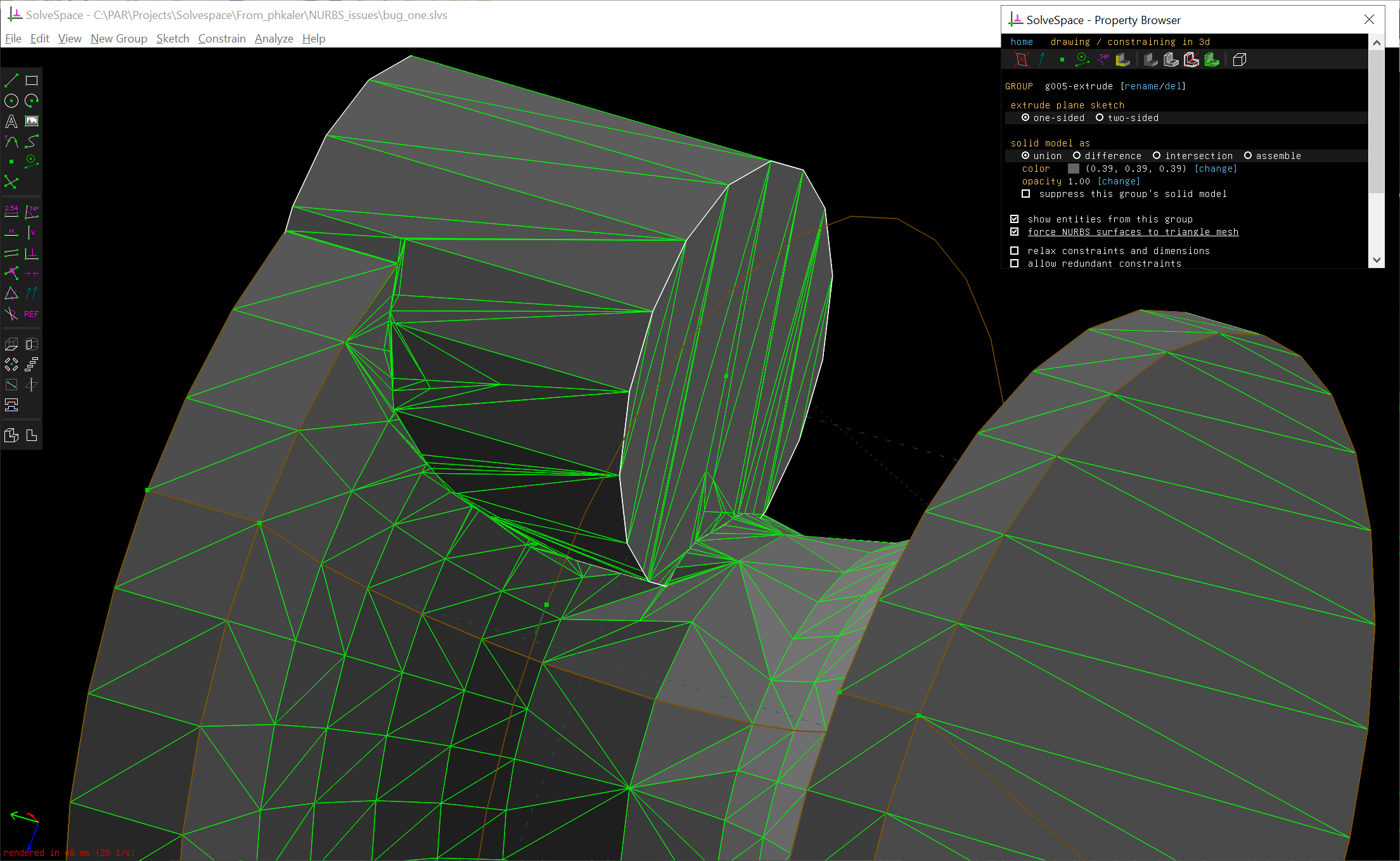
By the way it is always nice to see how much better the NURBS mesh is (when it works) compared to triangle...

ruevs
on 16 Sep 2019
@ruevs Did you extend the cylinder in bug1? It's fine the way I saved it, but when you cut away a little more it runs into problems:

If you fixed that it's IMHO a major improvement! Curves cause problems. Compound curves even more so.
phkahler
on 16 Sep 2019
I did not fix it :-(
Extended it, shortened it, moved it around, changed the diameter, made it larger and smaller than the "spool"... ;-)
And it is broken "most" of the time.
I looked dsuperficially for misidentified (by KeepEdge) edges and I think there are none (for intersection). I think it is all numerical.
Did the same with all four models.
ruevs
on 16 Sep 2019
I'm with Jonathan on the reversal of new curve segments. Intersection will always need them in the reverse direction for Union or Difference. Here's a drawing showing surface "A" with trimmed region "a" intersected by surface "B" with trim region "b". I have not shown the parts of A or B outside the trim regions because they aren't "real" in the sense that we don't ever care about them.

In the drawing I consider both surfaces to be facing us with b angled a bit to the left. The trim curves are supposed to be counter clockwise (CCW) for the outer curve if I recall correctly. So the arrows show the direction of the perimeter curves for a. It gets cut by surface b into two pieces. Which of those are kept depends on the boolean operation.
For Union, we'd keep the left half of a and throw away the right side because it's buried inside the other shell. For Difference we'd also keep the left side of a while the right side will be cut off because it's inside of b and needs be cut away. For Intersection, we throw away the left side and keep the right because it's inside of b.
The direction of the new edge in the middle depend which side of the surface is kept. When keeping the left side it needs to point up and for the right side down. So I agree with @jwesthues that its direction for Intersection should be opposite what it is for the other booleans. I have no idea how the direction is currently determined for new curves.
I would also argue that the existing curves should never have their direction changed. They will either be kept or discarded based on weather they are inside b or not.
While I have a diagram up, I think you can see that any curve resulting from the intersection of A and B is not relevant unless it's also inside of "a" and "b" because they're not "real" in the sense that we don't care about that part of the underlying surface. Those that are inside both a and b must be kept because they are the new edge which divides both surfaces into "keep" and "discard" regions.
I haven't thought too much about coincident surfaces, but I think all the curves on those should be pre-existing, but may be rediscovered by a surface-surface intersection algorithm.
I can imagine the data available to KeepEdge() contains all of this (or not) but it might be nice to condense it into higher level abstract flags that can have broader more understandable rules applied.
phkahler
on 16 Sep 2019
Cool re intersection--a triumph of the lookup table? You can presumably apply the same approach to difference/union, taking the existing behavior as a starting point and changing only cases that you've observed were broken.
The basis idea of the Booleans is that for each surface in each shell, we assemble a set of edges, including all the original trim curves plus any new edges arising from surface-surface intersections. This set should contain all of the edges that we'll ultimately need for the output trim curves, but may contain additional edges too. To determine which edges to keep, we want to know whether the region just inside (indir) or just outside (outdir) the edge lies within the shell. We want to know this both for the shell that the surface in question originally came from (orig) and for the other operand of the Boolean (shell -- agnst would be better).
So in raycast.cpp, we first test whether the edge lies exactly coincident with an edge of the shell, or whether it lies in a surface of the shell. In general, neither will be true, so we test by casting a ray from a point on that edge. In the general case, that ray intersects a surface of the shell somewhere inside a trim region, well away from any edges. The ray dot that surface's normal tells us whether we're inside or out. If we're unlucky, then we hit one of many possible special cases. The code doesn't try to handle these special cases. Rather, it tries to choose the ray's origin point (since that can be anywhere on the edge) and direction (since that's totally arbitrary) to avoid them.
Re the failure that turns into success by replacing a straight Bezier with a line--note that many types of surface-surface intersection are special-cased, so that we don't usually have to fall back to numerical (marching) intersection. (Though even without that, geometrically identical but parametrically different surfaces would perform differently when marching.)
If a problem is in that surface-surface intersection curve generation, then you can solve it either by improving the marching or by adding more special cases--for example, you can notice that the surfaces are particular types of conics for which a closed-form solution exists, and output that instead of a numerical approximation. Even when no exact solution exists, you can probably do an approximate special case that's more robust and faster than marching.
jwesthues
on 17 Sep 2019
I just realized that using A - (A - B) is also the same as doing A - !B where !B is the (infinite) solid defined as outside of shell B. In other words, turning B inside out and subtracting it from A is equivalent to A and B. There is actually a function for turning a shell inside out that basically reverses all the trim curves. Just thought that may offer a different way to see how to deal with edges, or dealing with whatever is in the triangle mesh code.
phkahler
on 22 Apr 2020
It is done.
The smart and beautiful method prevailed after all :-)
It was correct all along. All I had to do was realize that this was the case and only the reversal of the edges resulting from surface intersections was preventing it from working correctly. This took a while to figure out (as did figuring out where and how to reverse them).
Take a look here if you are curious and like gory details.
Next up: figure out how to do the triangle mesh intersection in SMesh::MakeFromIntersectionOf.
ruevs
on 8 May 2020
Excellent, very glad to see this dusted off. While you're in there, you could probably improve the union and difference too, surely many special cases handled wrong now....
jwesthues
on 8 May 2020
I am very glad as well. Too many months passed until I found time to concentrate on this,
My next targets are:
- The edge classifier failures
- "couldn't find an ear! fail" in SContour::UvTriangulateInto (https://github.com/solvespace/solvespace/pull/594#issuecomment-625587508)
These will help with all boolean operations.
And then the "did not converge" numerical stuff... there I will need to re-learn the math first, but I think @phkahler may beat me to it :-)
ruevs
on 8 May 2020
Just for cross-reference :-)
https://solvespace.com/forum.pl?action=viewthread&parent=1497&tt=1474341226
ruevs
on 4 Dec 2020
Related issues
 Timmmm
·
7Comments
Timmmm
·
7Comments
 fe60
·
6Comments
fe60
·
6Comments
 brothermechanic
·
9Comments
brothermechanic
·
9Comments
 prototype99
·
9Comments
prototype99
·
9Comments
 andres-erbsen
·
7Comments
andres-erbsen
·
7Comments
Most helpful comment
Nostalgia... The more I reread this code, the more I doubt I ever had any deeper understanding than "there are many special cases, and I've modified this until it works with all the cases I've hit". In that spirit, in
KeepEdge()let's defineSo we uniquely identify each of the 4^4 possible cases with a four-digit decimal number. For intersection, keep (return true) 1112 and 2111, and discard (return false) 2212 and 2122. This doesn't handle the coincident cases, but you can enumerate those too.
The other problem is that edges from intersection seem to occur in the opposite direction from edges in the original surface--so
AssemblePolygon()fails, because it requires them all to go in the same direction. I hacked around this by changing the third argument to false (in both boolean.cpp and surface.cpp), so that it assembles in any order; but I suspect that may have bad consequences elsewhere, and in any case the right thing is presumably to reverse the order (swap .a and .b) of some edges somewhere.