Solo: AuthenticatorData extensions not conforming to CTAP2 canonical CBOR encoding form
When sending a MakeCredential request with hmac-secret extension present and set to true, the Solo response extensions CBOR encoded bytes are A26B686D61632D736563726574F56B6372656450726F7465637401, which is {"hmac-secret": true, "credProtect": 1}. The keys in the map are presented out of order per the CTAP2 canonical CBOR encoding form rules (https://fidoalliance.org/specs/fido-v2.0-ps-20190130/fido-client-to-authenticator-protocol-v2.0-ps-20190130.html#message-encoding).
Currently this is preventing new Solo FIDO registrations against Microsoft's Azure AD and consumer services. @timcappalli has additional information.
 aseigler
All 6 comments
FIDOError[13:14:37] authenticator_data.cc:72 CBOR decoding of authenticator data extensions failed (Map keys must be strictly monotonically increasing based on byte length and then by byte-wise lexical order.) from A26B686D61632D736563726574F56B6372656450726F7465637401
 timcappalli
on 13 Jan 2021
timcappalli
on 13 Jan 2021
The registration process for Microsoft Account and AAD will fail with the following message:
We encountered an issue setting up your security key.
We couldn't verify your identity or you are using private mode. Please ensure you are not in a private browsing window and please try again.
timcappalli
on 23 Jan 2021
Thanks for reporting!
I've fixed this in the 4.1.0 release, and is covered under new tests introduced here https://github.com/solokeys/fido2-tests/pull/49.
Could you please check it and see if there's still an issue?
 conorpp
on 30 Jan 2021
conorpp
on 30 Jan 2021
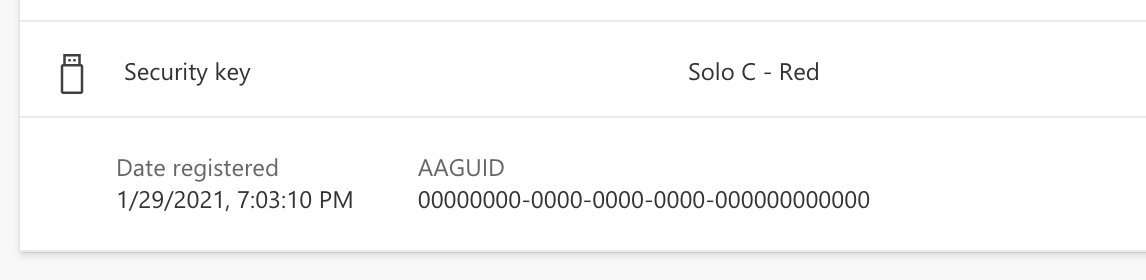
Working with AAD! Thanks for the quick fix @conorpp!
timcappalli
on 30 Jan 2021
I wonder why the AAGUID is all zeroes? That's odd.
aseigler
on 30 Jan 2021
Worked great on consumer and corporate registration endpoints!
aseigler
on 30 Jan 2021
Related issues
 nickray
·
9Comments
nickray
·
9Comments
 nicolazilio
·
7Comments
nicolazilio
·
7Comments
 craftyguy
·
10Comments
craftyguy
·
10Comments
 MaxHillebrand
·
4Comments
MaxHillebrand
·
4Comments
 ghost
·
7Comments
ghost
·
7Comments
Most helpful comment
Thanks for reporting!
I've fixed this in the 4.1.0 release, and is covered under new tests introduced here https://github.com/solokeys/fido2-tests/pull/49.
Could you please check it and see if there's still an issue?