Solidus: Remove admin ability to set a password, replace reset password email trigger.
In the spirit of better security. relates to https://github.com/solidusio/solidus/pull/421
 athal7
All 22 comments
@acreilly is working on this
 mamhoff
on 22 May 2017
mamhoff
on 22 May 2017
An admin would still have the ability to change the email associated with the account and then trigger the email reset - essentially giving them the ability to change the password. Should the ability to change a users email also be disabled? I can't think of too many use cases in which you'd need to change a users email. @acreilly
 seand7565
on 22 May 2017
seand7565
on 22 May 2017
The only time I could think that an admin would _need_ to be able to change the email address is if the user no longer has access to that email and would need their password changed. New account is the path there maybe?
 ericsaupe
on 22 May 2017
ericsaupe
on 22 May 2017
@ericsaupe Lets say the data associated with that account is important to the user though, I think keeping the ability to change the email would be helpful. It isn't a common scenario, so if we really want to take it out, I guess a developer can go into the console and change it. What do you think?
 acreilly
on 22 May 2017
acreilly
on 22 May 2017
Yeah, that's what I was thinking too. For our customer service reps I know they would be really angry if we simply told them to tell users to create a new account and lose all of their order history, saved cards, etc. Probably best to leave the ability to change emails in and let individual stores change that if they need to.
ericsaupe
on 22 May 2017
It doesn't appear that we use this view: https://github.com/solidusio/solidus_auth_devise/blob/master/lib/views/backend/spree/admin/user_passwords/edit.html.erb
Does having the reset_password_token increase security? Or do we just want to stick with adding the Send Reset Password Email button
acreilly
on 22 May 2017
It looks like it is required in the Devise method, https://github.com/plataformatec/devise/blob/master/app/controllers/devise/passwords_controller.rb#L32. I think it is simply for resetting the password through the controller but the issue here is to remove the change password form all together to simply send the reset email. So if it's not used it could probably be removed all together.
ericsaupe
on 22 May 2017
@ericsaupe I'm not sure if you are here today... but if you are would you mind helping me for a second? I am pretty easy to spot out in the room hah..
acreilly
on 22 May 2017
Of course! I'm next to that @skukx purple faced guy from that other PR. I'll come find you in a second.
ericsaupe
on 22 May 2017
Why don't you let customer support change the email address and then send out a password reset token?
mamhoff
on 22 May 2017
@mamhoff good idea. This task seems to be to add that ability to send the password reset using the admin.
ericsaupe
on 22 May 2017
Why don't you let customer support change the email address and then send out a password reset token?
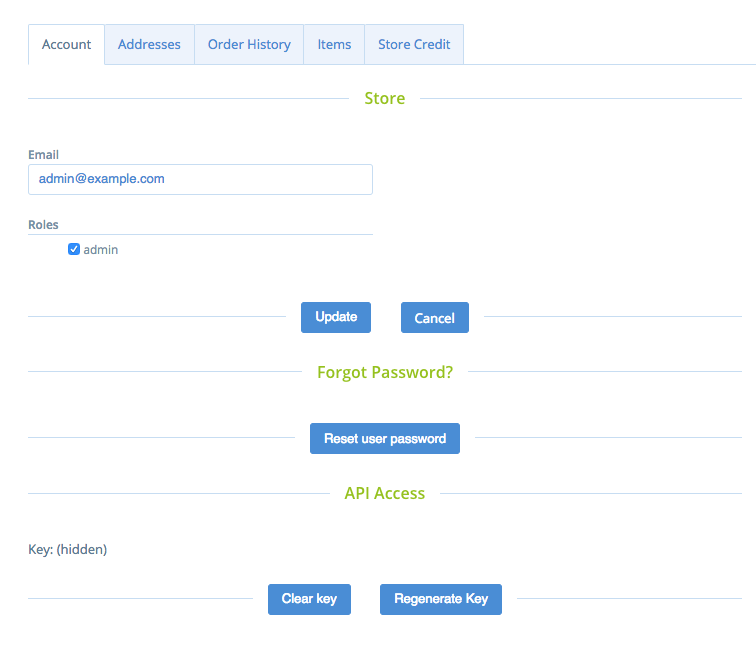
@mamhoff @ericsaupe This is exactly what #1942 does. Email address is already changeable and it adds a button to the users account page that allows admins to send a password reset token via email.
 tvdeyen
on 4 Oct 2017
tvdeyen
on 4 Oct 2017
I'm :-1: on this. I think it would be better if we had a superadmin role and an admin role. At some point, store owners will be a little upset they cannot make these changes.
 BenMorganIO
on 21 Sep 2018
BenMorganIO
on 21 Sep 2018
IMO an admin being able to set any users password creates unnecessary security issues. I get that some business owners may not like not having that ability - but there are some business owners that don't like not being able to see credit card numbers on orders - at some point you have to draw a line between platform security & business needs. In this case my opinion is that the security of the platform takes precedence.
seand7565
on 21 Sep 2018
Since there are arguments for both paths, is there a possibility this could be set up as a config option?
I tend to favor removing this ability by default.
 jacobherrington
on 21 Sep 2018
jacobherrington
on 21 Sep 2018
Security speaking, I don't think it is ever a good idea to allow anyone other than the user themselves set the password. I think this is a good step in the right direction
 skukx
on 21 Sep 2018
skukx
on 21 Sep 2018
@seand7565 I think credit card number vs. password is a whole different level of security; the former potentially leading to some business owners to court. There really is no security issue with giving a business owner access to changing passwords. They can do this with GSuite to manage employees, they can do it to their users on AWS, why not on _their own_ platform?
The decision to remove this from a business owner who already owns the data seems a bit redundant and frustrating.
The real security issue is the ability for the password to be poor or if the session is left open. Not much ado with poor passwords as that's up to the users naïvity. Simply ask for the current user's password and _then_ you've covered security threats and kept business owners not left cursing.
BenMorganIO
on 21 Sep 2018
@BenMorganIO There's a big difference between managing your employees passwords and managing your users passwords, and there is absolutely a security risk - I provided a link above that detailed a few of them (admin being able to log in and complete actions as a particular user, and setting the password usually leads to unsecured communication of the new updated password - e.g. "We've reset your password, it's now hunter2" via email in response to someone losing their password). Furthermore, the concept of password ownership as you've mentioned is a complicated subject, but I think it's safer to err on the side of the user owning the password rather than the owner - especially with everything going on in Europe right now with GDPR. Also, I imagine selling your users passwords would also lead to business owners in court, regardless of who owns them.
I admit that requiring the current password to set a new password is a big improvement over what is there currently, but I still prefer the solution proposed with the #1942 - it just seems less limiting to me. Perhaps, if the issue is employee management, we should allow the setting of passwords for admin user accounts only? (That is, super admin can set admin users passwords, but not regular users passwords)
seand7565
on 21 Sep 2018
I'm not educated on the requirements of GDPR (ignorant Canadian) but yes, I agree with the password ownership problem with an admin setting it.
Since an employee account, such as[email protected], is owned by Ecommerce Store, Inc. then this doesn't fall under GDPR and the password ownership is owned by the business entity.
I agree with this proposal :+1:. If a superadmin can change and takeover an employees account (or most likely an ex-employees account).
BenMorganIO
on 21 Sep 2018
It looks like this might've been solved with the above PR (https://github.com/solidusio/solidus_auth_devise/pull/146), can this issue now be closed?
 zabrador
on 23 Oct 2019
zabrador
on 23 Oct 2019
@zabrador this issue appears to only be half fixed. The PR you're referencing adds the ability to send a reset password email, but it does not remove the ability for an admin to set a password. I'm going to file a PR removing the password change form.
 JDutil
on 23 Oct 2019
JDutil
on 23 Oct 2019
The password fields should be still available, but protected by a permission.
All of these above mentioned arguments are correct, but it is not on us to make this decision. It is the store owners choice.
We as a framework provider should only give the tools, but not remove features we think are not compliant or problematic.
tvdeyen
on 24 Oct 2019
Related issues
 brchristian
·
5Comments
brchristian
·
5Comments
 aitbw
·
4Comments
aitbw
·
4Comments
 jhawthorn
·
4Comments
seand7565
·
3Comments
jhawthorn
·
4Comments
seand7565
·
3Comments
 spaghetticode
·
3Comments
spaghetticode
·
3Comments
Most helpful comment
IMO an admin being able to set any users password creates unnecessary security issues. I get that some business owners may not like not having that ability - but there are some business owners that don't like not being able to see credit card numbers on orders - at some point you have to draw a line between platform security & business needs. In this case my opinion is that the security of the platform takes precedence.