Sktime: Data set simulators/generators
As discussed in #320, it would be great to have functions that generate/simulate data sets, they are useful for testing and explaining the difference between estimators.
- We currently have a very simple data set generator here:
make_classification_problem - TSML has some here in Java: https://github.com/uea-machine-learning/tsml/tree/master/src/main/java/statistics/simulators
 mloning
All 9 comments
I am interested in this issue.
I would like to propose the following approach:
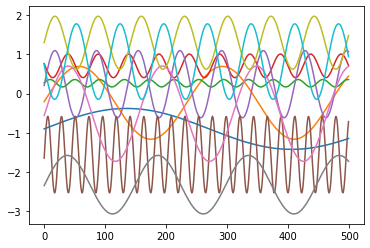
- Generate a bunch of randomised sine waves (10 here):
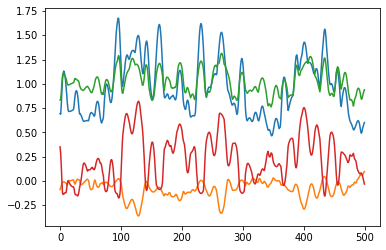
- Pass them through a sklearn MLPRegressor randomly fitted, to obtain a number of "observations":
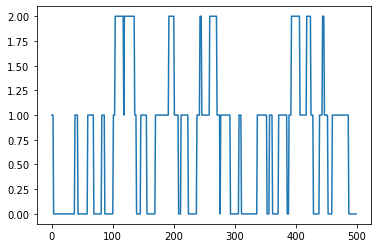
- Optionally, discretize some of the signals in 2. to obtains classes (here, the red signal is discretized in 3 bins via KBinsDiscretizer):
Step 2. should ensure that the data set is complex while keeping a realistic relationship between the signals.
We could also add some noise, under-sampling, etc. to step 2 to make it even more realistic.
What do you think?
Is it worth investigating that approach?
 Kerybas
on 1 Aug 2020
Kerybas
on 1 Aug 2020
@ABostrom @TonyBagnall any thoughts on this?
mloning
on 3 Aug 2020
There's an arxiv paper did ages ago here: https://arxiv.org/abs/1703.09480
An old SimulationExperiment class from tsml: https://github.com/uea-machine-learning/tsml/blob/master/src/main/java/experiments/SimulationExperiments.java
I think our angle for simulation was, what type of problem are you looking to simulate within TSC.
Can you design a simulated problem that an interval classifier should be best on, same for DTW, dictionary, shapelet etc.
 ABostrom
on 3 Aug 2020
ABostrom
on 3 Aug 2020
Hm, @TonyBagnall, @Kerybas, I thought it would be useful to get a quick way to generate synthetic test datasets for the different tasks, e.g., time series classification, regression, forecasting, that sktime supports?
Less about "methodological" side, but simply having it implemented for sktime test use?
 fkiraly
on 3 Aug 2020
fkiraly
on 3 Aug 2020
Simulators for discriminating between classifiers would be useful for the part of the user guide #361 where we want to guide algorithm choice and explain the inner workings of the different algorithms.
mloning
on 3 Aug 2020
so I wrote the data simulator to reinforce the design mechanism of hive-cote, i.e. that if you have no prior knowledge as to the correct feature space, a meta ensemble is the best approach. A simulator that just creates a task problem is much simpler, simply generate white noise. However, I would like to use more simulation experimentation, not least to satisfy the statisticians. I think we could definitely add this to the new road map we are developing, and make it a project, once we have prototyped the code structure
 TonyBagnall
on 4 Aug 2020
TonyBagnall
on 4 Aug 2020
Gluon-ts also have a lot of simulation functionality for forecasting/anomaly detection: https://gluon-ts.mxnet.io/examples/synthetic_data_generation_tutorial/tutorial.html
mloning
on 4 Aug 2020
I have existing code for simulating univariate ARMA, ARIMA time series based on a given polynomial. Would that be of interest here?
 sjmiller8182
on 13 Aug 2020
sjmiller8182
on 13 Aug 2020
@sjmiller8182 yes certainly, the discussion so far has focussed on time series classification, but having data generators for forecasting would be very helpful too! 👍
I'd appreciate a draft PR with a new file for generators in sktime/datasets/. Also feel free to open a separate issue to discuss this in more detail if you have more questions!
FYI statsmodels has an ARMAProcess generator too.
mloning
on 13 Aug 2020
Related issues
 shruthibalaji2307
·
6Comments
mloning
·
7Comments
shruthibalaji2307
·
6Comments
mloning
·
7Comments
 ngupta23
·
7Comments
ngupta23
·
7Comments
 big-o
·
6Comments
big-o
·
6Comments
 MJFlynn
·
5Comments
MJFlynn
·
5Comments
Most helpful comment
so I wrote the data simulator to reinforce the design mechanism of hive-cote, i.e. that if you have no prior knowledge as to the correct feature space, a meta ensemble is the best approach. A simulator that just creates a task problem is much simpler, simply generate white noise. However, I would like to use more simulation experimentation, not least to satisfy the statisticians. I think we could definitely add this to the new road map we are developing, and make it a project, once we have prototyped the code structure