Site-kit-wp: Enable settings view and settings edit component registration
Feature Description
We need to actually allow registration and usage of SettingsView and SettingsEdit components for modules.
_Do not alter or remove anything below. The following sections will be managed by moderators only._
Acceptance criteria
- The
registerModuleaction of thecore/modulesstore should be modified:
- The
settingsComponentargument should be removed. - Instead, optional
settingsViewComponentandsettingsEditComponentarguments should be introduced, which should be React components for the module's view and edit component respectively. There should not be any default (i.e.undefined).
- The
- The
DefaultModuleSettingscomponent should be removed. - Every module that currently uses the
googlesitekit.ModuleSettingsDetails-{$slug}filter should instead include a dispatch call toregisterModule, passing itsSettingsViewandSettingsEditcomponent as applicable (some modules have both, some modules have just the view, other modules may have neither). - A new functional hook-based component
SettingsRenderershould be introduced:
- It should receive
slug(string),isOpen(bool), andisEditing(bool) props. - It should basically mirror the implementation of today's
SettingsMaincomponent of every module. - It should assume
modules/${ slug }as the module's store name for now. - It should retrieve the module's
settingsViewComponentandsettingsEditComponentfromcore/modulesdatastore'sgetModuleselector.
- It should receive
- The
SettingsModulecomponent should be modified:
- It should be wrapped in the
withSelectHOC, to receive the registered module's data via the datastore. For now, it should only pass thehasSettingsprop to the inner component, based on whether there is amoduleData.settingsEditComponent(i.e.hasSettings = !! moduleData.settingsEditComponent). - The
googlesitekit.ModuleSettingsDetails-{$slug}filter should be removed, and instead it should render the above newSettingsRenderercomponent. - The component should not be further refactored, or as little as possible.
- It should be wrapped in the
- The now unused
ModuleSettingsDetailscomponent should be removed.
Implementation Brief
- Move
assets/js/modules/analytics/components/settings/SettingsMain.jstoassets/js/components/settings/SettingsRenderer.js
- Rename to
SettingsRenderer.js - Update it to accept a
slugprop and use a dynamicSTORE_NAMEdefined asmodules/${ slug }(see https://github.com/google/site-kit-wp/issues/1623#issuecomment-708328766)
_STORE_NAMEshould be changed tostoreNamenow as it is no longer a constant_ - Select
SettingsEditandSettingsViewfrom the module, falling back to a function that returnsnullso that they will safely render nothing if they don't exist in the store
- Rename to
- Update
SettingsModule(assets/js/components/settings/settings-module.js) to be wrapped withData.withSelectand pass through thehasSettingsprop
- Remove
googlesitekit.ModuleSettingsDetails-${ slug }filter - Replace
FilteredModuleSettingsDetailswithSettingsRendererpassing along the same props, as well asslug - Remove
hasSettingsprop passed fromSettingsModules
- Remove
- Update all
registerModulecalls for all core modules to provide theirSettingsViewandSettingsEditcomponents to thesettingsViewComponentandsettingsEditComponentrespectively (where applicable)
- Use
invariantto require that these values are functions (if provided) usingcomponent && ReactIs.isValidElementType( component )
Addreact-istodependencies(already required by multiple packages, and dependency ofprop-types)
- Use
- Remove the
settingsComponentkey frommoduleDefaultsinassets/js/googlesitekit/modules/datastore/modules.js - Remove all calls to
(add|remove|removeAll)Filters( 'googlesitekit.ModuleSettingsDetails-everywhere
- Module
index.jsmodules
- Module
- Remove
assets/js/googlesitekit/modules/components/DefaultModuleSettings.js - Remove
assets/js/components/settings/module-settings-details.js - Remove
assets/js/modules/*/components/settings/SettingsMain.jsand references
Test Coverage
Jest
- Add a
assets/js/components/settings/SettingsRenderer.test.jsusing a basic/dummy test module (not usinganalytics,tagmanager, etc)
- Test the behavior of the various props on the rendered output, as well as covering the settings rollback behavior
- Update
assets/js/googlesitekit/modules/datastore/modules.test.jsto cover the behavior of the changes toregisterModule - Remove
assets/js/modules/*/components/settings/SettingsMain.test.js
Storybook
- Update
createLegacySettingsWrapper
- Remove
googlesitekit.ModuleSettingsDetails-${ slug }filter - Remove the
hasSettingsprop toSettingsModuleas this is now provided by the HOC
- Remove
- Update
module-*-settings.stories.jstodispatch( core/modules ).registerModule(...)with the settings components provided on the fresh registry in theaddDecoratorfunction
- E.g. https://github.com/google/site-kit-wp/blob/099cac9a45e52cb90bc4473a68f37eb7f6f45666/stories/module-adsense-settings.stories.js#L96-L99
Visual Regression Changes
- N/A
QA Brief
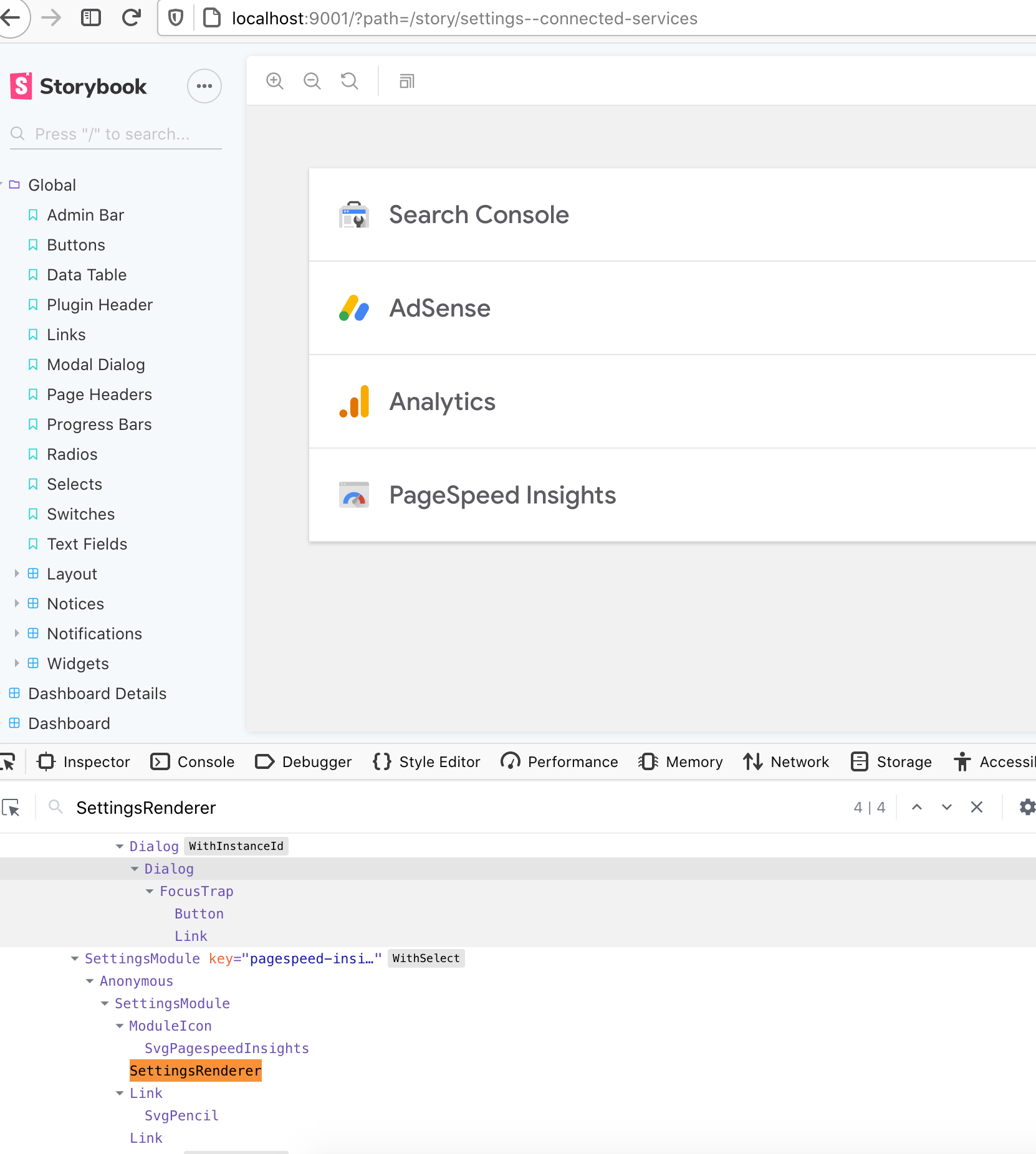
- Check module settings components in Storybook or WP with React devtools to see that all module settings components are rendered by a
SettingsRenderercomponent.
Changelog entry
- Allow registering a
settingsViewComponentandsettingsEditComponentwhen calling theregisterModuleaction on thecore/modulesstore.
 felixarntz
All 16 comments
@tofumatt Also for your review (follow-up to #1622), let's make sure we agree on the ACs (which largely are the IB here) and then go from there.
felixarntz
on 1 Jun 2020
One note: in the IB I changed setSettingsState and getSettingsState to setSettingsDisplayMode and getSettingsDisplayMode. The former was a bit too vague for me so I wanted to clarify the intention. If you're cool with that we can update the ACs too, but it's just the name I'm proposing changing, not the functionality 😄
Much of the ACs are copied as they're more/less IBs, and sound good to me 🙂
I've haven't modified the IB here but I wanted to make a note around the "locked" state we use for modules. Now that we store unsaved state in Redux, and can better load/unload editing screens, I think we should rethink the "locked" UX.
If anything, setting other modules _state_ to "locked" is fine, but instead of forcing a user to close their current module before switching, we should _confirm_ they want to exit editing without saving changes and then just let them.
Anyway, just a point to make really; doesn't affect the data store implementation.
 tofumatt
on 4 Jun 2020
tofumatt
on 4 Jun 2020
@tofumatt That change sounds good, I'll update this in the ACs too.
Regarding "locked" display mode, that's a fair point for consideration in the future. Although, I'm not sure I understand the technical concern here - when you're editing, you can't go to another module's settings, so you would never lock a settings panel where you were just editing.
IB ✅
felixarntz
on 4 Jun 2020
@felixarntz, @tofumatt, @aaemnnosttv this is ready for approach review. I have pushed everything to the feature/1623-implement-public-components-for-usage-in-module-settings-components which you can pull and check on your local. It is also available in the #1904 if you want to leave comments or request changes.
As an example, I have reworked Analytics module to work with the new settings components: https://github.com/google/site-kit-wp/blob/325ac41df980698533cf2bb46478d7ec3c63dfa9/assets/js/modules/analytics/components/settings/SettingsMain.js#L59-L68
Let me know what you think.
 eugene-manuilov
on 17 Aug 2020
eugene-manuilov
on 17 Aug 2020
I didn't do too thorough of a code review on the PR yet as I expect more changes based on feedback, but the approach above (and in the PR) seems good to me 😄
One note is I agree with @felixarntz's comment here: https://github.com/google/site-kit-wp/pull/1904/files#r471855142. DefaultModuleSettings seems like the wrong sort of name for this component—Felix's suggestion of SimpleModuleSettings makes sense to me, especially as it leaves open a future, more niche component that had "full control" over the settings component rendered.
But 👍 to this approach. Let me know if you need anything else from me before continuing, but I think I like the approach 🙂
tofumatt
on 19 Aug 2020
After another long conversation about this issue, I'll move this back to ACs. This issue has been too undefined overall - with all the alternative approaches suggested after the initial PR had already started, we've ended in some scope creep and still have no clear approach to go with. Let's regroup and decide on something next week and then pick this up with a new PR in Sprint 34.
cc @aaemnnosttv @tofumatt @eugene-manuilov
felixarntz
on 30 Sep 2020
- Instead of relying on a
hasSettingsprop,hasSettingsshould be set based on whether there is amoduleData.settingsEditComponent.- The component should not be further refactored, or as little as possible.
@felixarntz in the interest of minimizing the changes here, I would suggest we continue to pass hasSettings but pass it from withSelect based on the presence of the component.
Also, to avoid the temptation of refactoring other module-data related pieces like getModulesData use, I think we should pass the module components through as dedicated individual props, rather than passing through all of the selected moduleData from getModule().
I think the last remaining detail to clarify is around what happens to SettingsMain which is currently the component which is filtered in for all modules. This component is pretty much the same in all cases and is mostly used as a switch to control which of the two components to render, if anything. Apart from this though, the component has a useEffect hook which conditionally rolls back the settings which cannot be simply moved into one of the other two child components. To preserve this functionality, I think we can get away with keeping a common SettingsMain component to use as a wrapper in SettingsModule. Then we actually no longer need to use withSelect and SettingsMain can make these selections internally and pass anything else needed through as props. The problem then is where the store name will come from as this is needed to select things like haveSettingsChanged 🤔 Perhaps we need to add a storeName parameter to registerModule ?
 aaemnnosttv
on 13 Oct 2020
aaemnnosttv
on 13 Oct 2020
@aaemnnosttv
@felixarntz in the interest of minimizing the changes here, I would suggest we continue to pass
hasSettingsbut pass it fromwithSelectbased on the presence of the component.
I don't see really any additional complexity from getting rid of it as a prop. The component receives the edit component anyway, and hasSettings is only used in the render method, so it could become a single assignment like hasSettings = !! settingsEditComponent.
Also, to avoid the temptation of refactoring other module-data related pieces like
getModulesDatause, I think we should pass the module components through as dedicated individual props, rather than passing through all of the selectedmoduleDatafromgetModule().
Do you think this will make the task overly complex? I think getting the data from a module prop shouldn't be more work than changing some destructuring assignments to be based on props.module instead of props. All values that are on props.module should come from there, all other values (like provides) should remain a prop. I mostly want to be conscious of not changing _any_ logic or not migrating to use hooks in any way, but reassigning values from another location should be okay IMO.
I think the last remaining detail to clarify is around what happens to
SettingsMainwhich is currently the component which is filtered in for all modules. This component is pretty much the same in all cases and is mostly used as a switch to control which of the two components to render, if anything. Apart from this though, the component has auseEffecthook which conditionally rolls back the settings which cannot be simply moved into one of the other two child components. To preserve this functionality, I think we can get away with keeping a commonSettingsMaincomponent to use as a wrapper inSettingsModule. Then we actually no longer need to usewithSelectandSettingsMaincan make these selections internally and pass anything else needed through as props.
That's a good point. I think that we could add a component that solely takes care of the useEffect hook, this way we can keep the settingsViewComponent and settingEditComponent unaffected and put it right into SettingsModule where I think this makes most sense. The new component (e.g. SettingsRollbackTool or whatever) would be a temporary measure only used until we refactor SettingsModule to become a functional hooks component, at which point it would become part of it.
The problem then is where the store name will come from as this is needed to select things like
haveSettingsChanged🤔 Perhaps we need to add astoreNameparameter toregisterModule?
Let's not worry about this for now and just assume modules/${ slug } for the store name. It makes sense for this to be a registerModule argument, but I think for now we can rely on our convention.
felixarntz
on 13 Oct 2020
@aaemnnosttv I've updated ACs based on my above response, lmk your thoughts.
felixarntz
on 13 Oct 2020
I'm not sure about extracting the rollback effect into its own component to be rendered adjacent to the others. It would probably work, but I think we can make this a cleaner refactor by sticking a bit closer to how things are today.
We can simplify things even further with almost no changes needed to SettingsModule by more/less converting SettingsMain into a SettingsRenderer that would be responsible for selecting the registered components from the module and rendering them the same as today, including the rollback effect. The only difference is that it would accept the module slug in order for the same component to be used for all modules.
That would reduce reduce the changes to SettingsModule to only a handful of lines
diff --git a/assets/js/components/settings/settings-module.js b/assets/js/components/settings/settings-module.js
index 99e6d04bd..b2dad12a2 100644
--- a/assets/js/components/settings/settings-module.js
+++ b/assets/js/components/settings/settings-module.js
@@ -198,10 +198,6 @@ class SettingsModule extends Component {
        const subtitle = sprintf( __( 'By disconnecting the %s module from Site Kit, you will no longer have access to:', 'google-site-kit' ), name );

        const isSavingModule = isSaving === `${ slug }-module`;
-       // Disabled because this rule doesn't acknowledge our use of the variable
-       // as a component in JSX.
-       // eslint-disable-next-line @wordpress/no-unused-vars-before-return
-       const FilteredModuleSettingsDetails = withFilters( `googlesitekit.ModuleSettingsDetails-${ slug }` )( ModuleSettingsDetails );

        // Disable other modules during editing
        const modulesBeingEdited = filter( isEditing, ( module ) => module );
@@ -336,7 +332,7 @@ class SettingsModule extends Component {
                                                    mdc-layout-grid__cell
                                                    mdc-layout-grid__cell--span-12
                                                ">
-                                           <FilteredModuleSettingsDetails module={ moduleKey } isEditing={ isEditing[ moduleKey ] } isOpen={ isOpen } />
+                                           <SettingsRenderer slug={ slug } isEditing={ isEditing[ moduleKey ] } isOpen={ isOpen } />
                                        </div>
                                    </Fragment>
                                    }
@@ -501,4 +497,8 @@ SettingsModule.defaultProps = {
    setupComplete: false,
 };

-export default SettingsModule;
+export default withSelect( ( select, { slug } ) => {
+   return {
+       hasSettings: !! select( CORE_MODULES ).getModule( slug )?.settingsEditComponent,
+   };
+} )( SettingsModule );
Then SettingsRenderer would basically be a SettingsMain with the following changes
diff --git a/assets/js/modules/analytics/components/settings/SettingsMain.js b/assets/js/modules/analytics/components/settings/SettingsMain.js
index 895431fd5..7097f7e95 100644
--- a/assets/js/modules/analytics/components/settings/SettingsMain.js
+++ b/assets/js/modules/analytics/components/settings/SettingsMain.js
@@ -25,14 +25,14 @@ import { useEffect } from '@wordpress/element';
  * Internal dependencies
  */
 import Data from 'googlesitekit-data';
-import SettingsEdit from './SettingsEdit';
-import SettingsView from './SettingsView';
-import { STORE_NAME } from '../../datastore/constants';
 const { useSelect, useDispatch } = Data;

-export default function SettingsMain( { isOpen, isEditing } ) {
+export default function SettingsRenderer( { slug, isOpen, isEditing } ) {
+   const STORE_NAME = `modules/${ slug }`;
    const isDoingSubmitChanges = useSelect( ( select ) => select( STORE_NAME ).isDoingSubmitChanges() );
    const haveSettingsChanged = useSelect( ( select ) => select( STORE_NAME ).haveSettingsChanged() );
+   const SettingsEdit = useSelect( ( select ) => select( CORE_MODULES ).getModule( slug )?.settingsEditComponent || null );
+   const SettingsView = useSelect( ( select ) => select( CORE_MODULES ).getModule( slug )?.settingsViewComponent || null );
    // Rollback any temporary selections to saved values if settings have changed and no longer editing.
    const { rollbackSettings } = useDispatch( STORE_NAME );
    useEffect( () => {
It's also worth noting that ModuleSettingsDetails (placeholder component for () => null) is no longer needed and can be removed here.
What do you think? I think that covers everything and would be the simplest change to make.
aaemnnosttv
on 14 Oct 2020
@aaemnnosttv SGTM, I've updated the ACs.
felixarntz
on 14 Oct 2020
@felixarntz looks great, moving forward to IB 👍
aaemnnosttv
on 14 Oct 2020
@aaemnnosttv IB mostly LGTM, just one additional detail: We should probably remove hasSettings from being passed to SettingModule in SettingsModules, since that prop is now internally handled via the HOC.
felixarntz
on 15 Oct 2020
@felixarntz IB updated.
aaemnnosttv
on 15 Oct 2020
IB ✅
felixarntz
on 15 Oct 2020
QA ✅
Everything being rendered properly here:
tofumatt
on 30 Oct 2020
Related issues
 quindo
·
5Comments
aaemnnosttv
·
3Comments
tofumatt
·
5Comments
quindo
·
5Comments
aaemnnosttv
·
3Comments
tofumatt
·
5Comments
 theeducatedbarfly
·
4Comments
theeducatedbarfly
·
4Comments
 jsmshay
·
3Comments
jsmshay
·
3Comments
Most helpful comment
After another long conversation about this issue, I'll move this back to ACs. This issue has been too undefined overall - with all the alternative approaches suggested after the initial PR had already started, we've ended in some scope creep and still have no clear approach to go with. Let's regroup and decide on something next week and then pick this up with a new PR in Sprint 34.
cc @aaemnnosttv @tofumatt @eugene-manuilov