Simpletransformers: Explanation for prediction
I am using this library for sentiment analysis. I have trained the model and now I want to predict the testing dataset. When I am using model.predict(['sentence comes here']) of the prediction of an unknown new sentence I am getting an output as follows:
(array([0, 1, 0, 0, 1, 1, 1, 0, 0, 0, 1, 0, 0, 1, 1, 0, 1, 1, 0, 1, 0, 0,
0, 1, 0, 1, 0, 1, 1, 0, 0, 1, 1, 1, 1, 1, 0, 0, 1, 0, 0, 0, 1, 0,
0, 0, 0, 1, 0, 0, 0, 0, 1, 1, 0, 1, 1, 1, 1, 0, 0, 0, 0, 1, 0, 0,
1, 1, 1, 0, 0, 1, 0, 1, 1, 1, 0, 1, 1, 1, 0, 1, 1, 0, 0, 1, 1, 0,
0, 0, 0, 0, 1, 1, 1, 1, 1, 0, 1, 1, 1, 0, 0, 0, 1, 1, 1, 1, 1, 0,
1, 0, 0, 1, 0]), array([[ 0.05918646, -0.2312517 ],
[-0.15851352, -0.0500554 ],
[ 0.13287637, -0.25292102],
[ 0.13287637, -0.25292102],
[-0.11805943, -0.09430733],
[-0.19722672, 0.13679701],
[-0.27268714, 0.13469158],
[ 0.71184117, -0.83837014],
[ 0.04452557, -0.21931541],
[ 0.1598964 , -0.33018294],
[-0.21872135, 0.11754164],
[ 0.46354538, -0.52351034],
[ 0.00256112, -0.19036555],
[-0.27268714, 0.13469158],
[-0.27268714, 0.13469158],
[ 0.00256112, -0.19036555],
[-0.19722672, 0.13679701],
[-0.17320369, 0.00332226],
[ 0.1598964 , -0.33018294],
[-0.10593811, -0.06245855],
[ 0.04452557, -0.21931541],
[ 0.1598964 , -0.33018294],
[ 0.31071872, -0.46716788],
[-0.15851352, -0.0500554 ],
[ 0.05918646, -0.2312517 ],
[-0.42780194, 0.4040406 ],
[ 0.00256112, -0.19036555],
[-0.19722672, 0.13679701],
[-0.17320369, 0.00332226],
[ 0.1598964 , -0.33018294],
[ 0.74134415, -0.89872265],
[-0.37553215, 0.2911712 ],
[-0.19722672, 0.13679701],
[-0.27268714, 0.13469158],
[-0.21872135, 0.11754164],
[-0.62663805, 0.67718726],
[ 0.1598964 , -0.33018294],
[ 1.263364 , -1.7161529 ],
[-0.37553215, 0.2911712 ],
[ 0.74134415, -0.89872265],
[ 0.74134415, -0.89872265],
[ 0.71184117, -0.83837014],
[-0.11805943, -0.09430733],
[ 0.1598964 , -0.33018294],
[ 1.263364 , -1.7161529 ],
[ 0.00256112, -0.19036555],
[-0.04172399, -0.13767837],
[-0.37553215, 0.2911712 ],
[ 0.05918646, -0.2312517 ],
[ 0.1598964 , -0.33018294],
[ 1.263364 , -1.7161529 ],
[ 0.05918646, -0.2312517 ],
[-0.37553215, 0.2911712 ],
[-0.21872135, 0.11754164],
[ 0.46354538, -0.52351034],
[-0.10593811, -0.06245855],
[-0.24102493, 0.12610589],
[-0.19722672, 0.13679701],
[-0.11805943, -0.09430733],
[ 0.04452557, -0.21931541],
[ 0.1598964 , -0.33018294],
[ 1.263364 , -1.7161529 ],
[ 0.13287637, -0.25292102],
[-0.37553215, 0.2911712 ],
[ 0.49057966, -0.6595632 ],
[ 0.49057966, -0.6595632 ],
[-0.11805943, -0.09430733],
[-0.21872135, 0.11754164],
[-0.27268714, 0.13469158],
[ 0.1598964 , -0.33018294],
[ 1.263364 , -1.7161529 ],
[-0.21872135, 0.11754164],
[ 0.25952443, -0.29697695],
[-0.37553215, 0.2911712 ],
[-0.17320369, 0.00332226],
[-0.21872135, 0.11754164],
[ 0.25952443, -0.29697695],
[-0.37553215, 0.2911712 ],
[-0.17320369, 0.00332226],
[-0.21872135, 0.11754164],
[ 0.25952443, -0.29697695],
[-0.37553215, 0.2911712 ],
[-0.17320369, 0.00332226],
[ 0.1598964 , -0.33018294],
[ 0.46354538, -0.52351034],
[-0.27268714, 0.13469158],
[-0.27268714, 0.13469158],
[ 0.74134415, -0.89872265],
[ 0.49325183, -0.62816525],
[ 1.1978749 , -1.6458939 ],
[ 1.1978749 , -1.6458939 ],
[ 0.00256112, -0.19036555],
[-0.19722672, 0.13679701],
[-0.21872135, 0.11754164],
[-0.27268714, 0.13469158],
[-0.37553215, 0.2911712 ],
[-0.17320369, 0.00332226],
[ 0.13287637, -0.25292102],
[-0.62663805, 0.67718726],
[-0.37553215, 0.2911712 ],
[-0.10593811, -0.06245855],
[ 1.1978749 , -1.6458939 ],
[ 0.74134415, -0.89872265],
[ 1.1978749 , -1.6458939 ],
[-0.5022752 , 0.5205793 ],
[-0.5022752 , 0.5205793 ],
[-0.5210591 , 0.31223089],
[-0.25475317, 0.12043235],
[-0.38624087, 0.32818356],
[ 0.23968135, -0.35400856],
[-0.5210591 , 0.31223089],
[ 0.19725166, -0.36717686],
[ 0.16669363, -0.35203722],
[-0.24102493, 0.12610589],
[ 1.1978749 , -1.6458939 ]], dtype=float32))
Can you please help me understand this output as I have trained on 0 or 1 sentiment. I was expecting some integer as an output. Please can you help me understand this output?
Thank you
 samarthsarin
All 15 comments
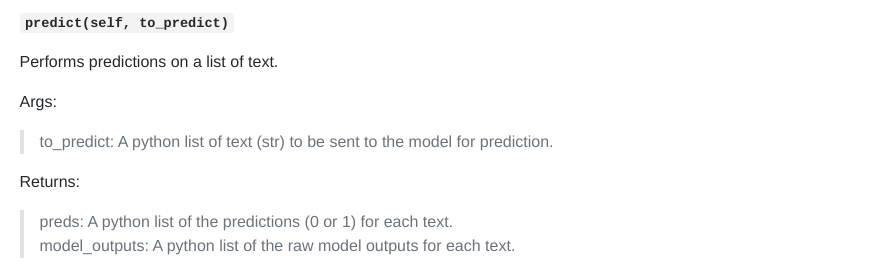
It's mentioned in the docs. The first array is the predicted labels. The second array is the raw outputs from the model. If you got this output for a single example, make sure that you are passing in a list and not a single string.
 ThilinaRajapakse
on 7 Oct 2019
ThilinaRajapakse
on 7 Oct 2019
Yes, I am passing it as list only
predictions = model.predict(["I'd like to puts some CD-ROMS on my iPad, is that possible?' — Yes, but wouldn't that block the screen?"])
predictions
(array([0, 1, 0, 0, 1, 1, 1, 0, 0, 0, 1, 0, 0, 1, 1, 0, 1, 1, 0, 1, 0, 0,
0, 1, 0, 1, 0, 1, 1, 0, 0, 1, 1, 1, 1, 1, 0, 0, 1, 0, 0, 0, 1, 0,
0, 0, 0, 1, 0, 0, 0, 0, 1, 1, 0, 1, 1, 1, 1, 0, 0, 0, 0, 1, 0, 0,
1, 1, 1, 0, 0, 1, 0, 1, 1, 1, 0, 1, 1, 1, 0, 1, 1, 0, 0, 1, 1, 0,
0, 0, 0, 0, 1, 1, 1, 1, 1, 0, 1, 1, 1, 0, 0, 0, 1, 1, 1, 1, 1, 0,
1, 0, 0, 1, 0]), array([[ 0.05918646, -0.2312517 ],
[-0.15851352, -0.0500554 ],
[ 0.13287637, -0.25292102],
[ 0.13287637, -0.25292102],
[-0.11805943, -0.09430733],
[-0.19722672, 0.13679701],
[-0.27268714, 0.13469158],
[ 0.71184117, -0.83837014],
[ 0.04452557, -0.21931541],
[ 0.1598964 , -0.33018294],
[-0.21872135, 0.11754164],
[ 0.46354538, -0.52351034],
[ 0.00256112, -0.19036555],
[-0.27268714, 0.13469158],
[-0.27268714, 0.13469158],
[ 0.00256112, -0.19036555],
[-0.19722672, 0.13679701],
[-0.17320369, 0.00332226],
[ 0.1598964 , -0.33018294],
[-0.10593811, -0.06245855],
[ 0.04452557, -0.21931541],
[ 0.1598964 , -0.33018294],
[ 0.31071872, -0.46716788],
[-0.15851352, -0.0500554 ],
[ 0.05918646, -0.2312517 ],
[-0.42780194, 0.4040406 ],
[ 0.00256112, -0.19036555],
[-0.19722672, 0.13679701],
[-0.17320369, 0.00332226],
[ 0.1598964 , -0.33018294],
[ 0.74134415, -0.89872265],
[-0.37553215, 0.2911712 ],
[-0.19722672, 0.13679701],
[-0.27268714, 0.13469158],
[-0.21872135, 0.11754164],
[-0.62663805, 0.67718726],
[ 0.1598964 , -0.33018294],
[ 1.263364 , -1.7161529 ],
[-0.37553215, 0.2911712 ],
[ 0.74134415, -0.89872265],
[ 0.74134415, -0.89872265],
[ 0.71184117, -0.83837014],
[-0.11805943, -0.09430733],
[ 0.1598964 , -0.33018294],
[ 1.263364 , -1.7161529 ],
[ 0.00256112, -0.19036555],
[-0.04172399, -0.13767837],
[-0.37553215, 0.2911712 ],
[ 0.05918646, -0.2312517 ],
[ 0.1598964 , -0.33018294],
[ 1.263364 , -1.7161529 ],
[ 0.05918646, -0.2312517 ],
[-0.37553215, 0.2911712 ],
[-0.21872135, 0.11754164],
[ 0.46354538, -0.52351034],
[-0.10593811, -0.06245855],
[-0.24102493, 0.12610589],
[-0.19722672, 0.13679701],
[-0.11805943, -0.09430733],
[ 0.04452557, -0.21931541],
[ 0.1598964 , -0.33018294],
[ 1.263364 , -1.7161529 ],
[ 0.13287637, -0.25292102],
[-0.37553215, 0.2911712 ],
[ 0.49057966, -0.6595632 ],
[ 0.49057966, -0.6595632 ],
[-0.11805943, -0.09430733],
[-0.21872135, 0.11754164],
[-0.27268714, 0.13469158],
[ 0.1598964 , -0.33018294],
[ 1.263364 , -1.7161529 ],
[-0.21872135, 0.11754164],
[ 0.25952443, -0.29697695],
[-0.37553215, 0.2911712 ],
[-0.17320369, 0.00332226],
[-0.21872135, 0.11754164],
[ 0.25952443, -0.29697695],
[-0.37553215, 0.2911712 ],
[-0.17320369, 0.00332226],
[-0.21872135, 0.11754164],
[ 0.25952443, -0.29697695],
[-0.37553215, 0.2911712 ],
[-0.17320369, 0.00332226],
[ 0.1598964 , -0.33018294],
[ 0.46354538, -0.52351034],
[-0.27268714, 0.13469158],
[-0.27268714, 0.13469158],
[ 0.74134415, -0.89872265],
[ 0.49325183, -0.62816525],
[ 1.1978749 , -1.6458939 ],
[ 1.1978749 , -1.6458939 ],
[ 0.00256112, -0.19036555],
[-0.19722672, 0.13679701],
[-0.21872135, 0.11754164],
[-0.27268714, 0.13469158],
[-0.37553215, 0.2911712 ],
[-0.17320369, 0.00332226],
[ 0.13287637, -0.25292102],
[-0.62663805, 0.67718726],
[-0.37553215, 0.2911712 ],
[-0.10593811, -0.06245855],
[ 1.1978749 , -1.6458939 ],
[ 0.74134415, -0.89872265],
[ 1.1978749 , -1.6458939 ],
[-0.5022752 , 0.5205793 ],
[-0.5022752 , 0.5205793 ],
[-0.5210591 , 0.31223089],
[-0.25475317, 0.12043235],
[-0.38624087, 0.32818356],
[ 0.23968135, -0.35400856],
[-0.5210591 , 0.31223089],
[ 0.19725166, -0.36717686],
[ 0.16669363, -0.35203722],
[-0.24102493, 0.12610589],
[ 1.1978749 , -1.6458939 ]], dtype=float32))
I am still finding it difficult to understand what is the sentiment of this sentence
samarthsarin
on 7 Oct 2019
Shouldn't it be returning only a single number that depicts the class name?
samarthsarin
on 7 Oct 2019
(array([1]), array([[-0.19189453, -0.1743164 ]], dtype=float32))
This is the output I get when I pass the same sentence you provided to the predict method.
ThilinaRajapakse
on 7 Oct 2019
Can I please get your email id or LinkedIn id so that I can share my code and if you code help me out in it please?
samarthsarin
on 7 Oct 2019
The predict function returns both the class labels and the logits from the model. The reason for this is in case you need to compute the probabilities for each class rather than just a class label.
predictions, raw_outputs = model.predict(["I'd like to puts some CD-ROMS on my iPad, is that possible?' — Yes, but wouldn't that block the screen?"]
This would put the class label in predictions, and the logits in the raw outputs. If you don't need the logits, you can do;
predictions, _ = model.predict(["I'd like to puts some CD-ROMS on my iPad, is that possible?' — Yes, but wouldn't that block the screen?"]
Note that predictions is still a list. So if you are doing it for a single value, you can get it with predictions[0].
ThilinaRajapakse
on 7 Oct 2019
It worked. Thanks
samarthsarin
on 7 Oct 2019
Is there way to convert the raw outputs to predictions between 0 and 1? like:
[3.04134, -2.42028] will become [0.9237, 0.0763]
 kinoute
on 19 Dec 2019
kinoute
on 19 Dec 2019
You can apply a softmax.
from scipy.special import softmax

probabilities = softmax(raw_outputs, axis=1)
46
ThilinaRajapakse
on 19 Dec 2019
@ThilinaRajapakse You're faster than Clint Eastwood.. Thank you again!
kinoute
on 19 Dec 2019
Haha, thanks! (I spend too much time on my computer)
ThilinaRajapakse
on 19 Dec 2019
is there any plan to allow question_answering_model to return preds with probs?
`def predict(self, to_predict, n_best_size=None):
"""
Performs predictions on a list of python dicts containing contexts and qas.
    Args:
        to_predict: A python list of python dicts containing contexts and questions to be sent to the model for prediction.
                    E.g: predict([
                        {
                            'context': "Some context as a demo",
                            'qas': [
                                {'id': '0', 'question': 'What is the context here?'},
                                {'id': '1', 'question': 'What is this for?'}
                            ]
                        }
                    ])
        n_best_size (Optional): Number of predictions to return. args['n_best_size'] will be used if not specified.

    Returns:
        preds: A python list containg the predicted answer, and id for each question in to_predict.`
is so, i would like to submit a MR. thanks.
 alexucb
on 15 May 2020
alexucb
on 15 May 2020
Yes, I think it's better to return those so that QA is consistent with the other tasks. We should probably return the probabilities both with the predict() and the eval_model() methods.
For eval_model(), we can simply return all_nbest_json which is created here.
For the predict() method, we can use the same functions to get all_nbest_json and return it.
What do you think? I'd be happy to take a look if you open a PR for this. This is something I've been procrastinating on, so it would be really helpful!
ThilinaRajapakse
on 15 May 2020
How do you apply softmax if raw_outputs array has nested array for each data point?
[array([[-0.00824738,  0.63574219],
       [ 0.10467529,  0.31518555],
       [-0.39599609,  0.98681641],
       [-0.08673096,  0.70507812],
       [-0.359375  ,  0.78320312]]),

     array([[0.01482391, 0.58496094],
       [0.04428101, 0.69140625],
       [0.42407227, 0.23718262]]),
 ........]
 SaffronWolf
on 18 Feb 2021
SaffronWolf
on 18 Feb 2021
Please open a new issue with more details.
ThilinaRajapakse
on 18 Feb 2021
Related issues
 Lalit-01
·
4Comments
Lalit-01
·
4Comments
 zbaida-achraf
·
7Comments
zbaida-achraf
·
7Comments
 caprone
·
7Comments
caprone
·
7Comments
 manueltonneau
·
4Comments
manueltonneau
·
4Comments
 krrishdholakia
·
7Comments
krrishdholakia
·
7Comments
Most helpful comment
You can apply a softmax.
46