Shards: Integration with a registry site
I've started working on a project which I think could benefit the Crystal community, a real registry for shards. Notice I didn't say repository, because that is both expensive and very hard to pull off, especially given my limited time, but I have been working on a shards registry which would allow people to:
- register a shard
- tie that shard to a github (and eventually gitlab) repository (which is where the shard will still be pulled from)
- keep track of versions, downloads, dependencies, etc
- search for shards
- possibly more features in the future
I have taken inspiration from rubygems.org and npmjs.com for the design and the functionality. To start with, my idea was that we could allow dependencies to be listed in shard.yml like this
dependencies:
  cadmium: ~> 0.1.0
  apatite:
    github: watzon/apatite
Basically if the value of the dependency is a String you'd fetch it from the registry (and by fetch I really mean you'd send an API request to the registry which would return the github info for that repo), otherwise you'd continue to handle requests for specific git repositories as normal.
I am definitely open to suggestions and can add up to 3 people to the repo if anyone wants to run it locally or help out. Here are some screenshots of the current design.
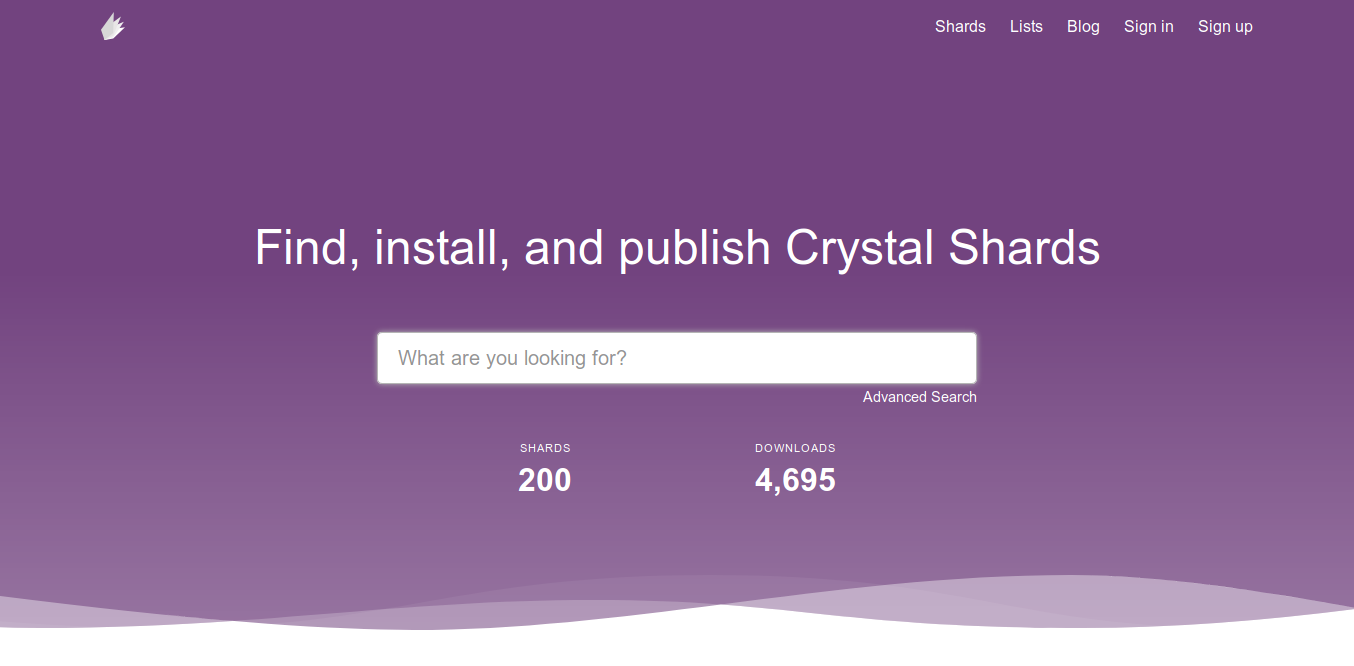
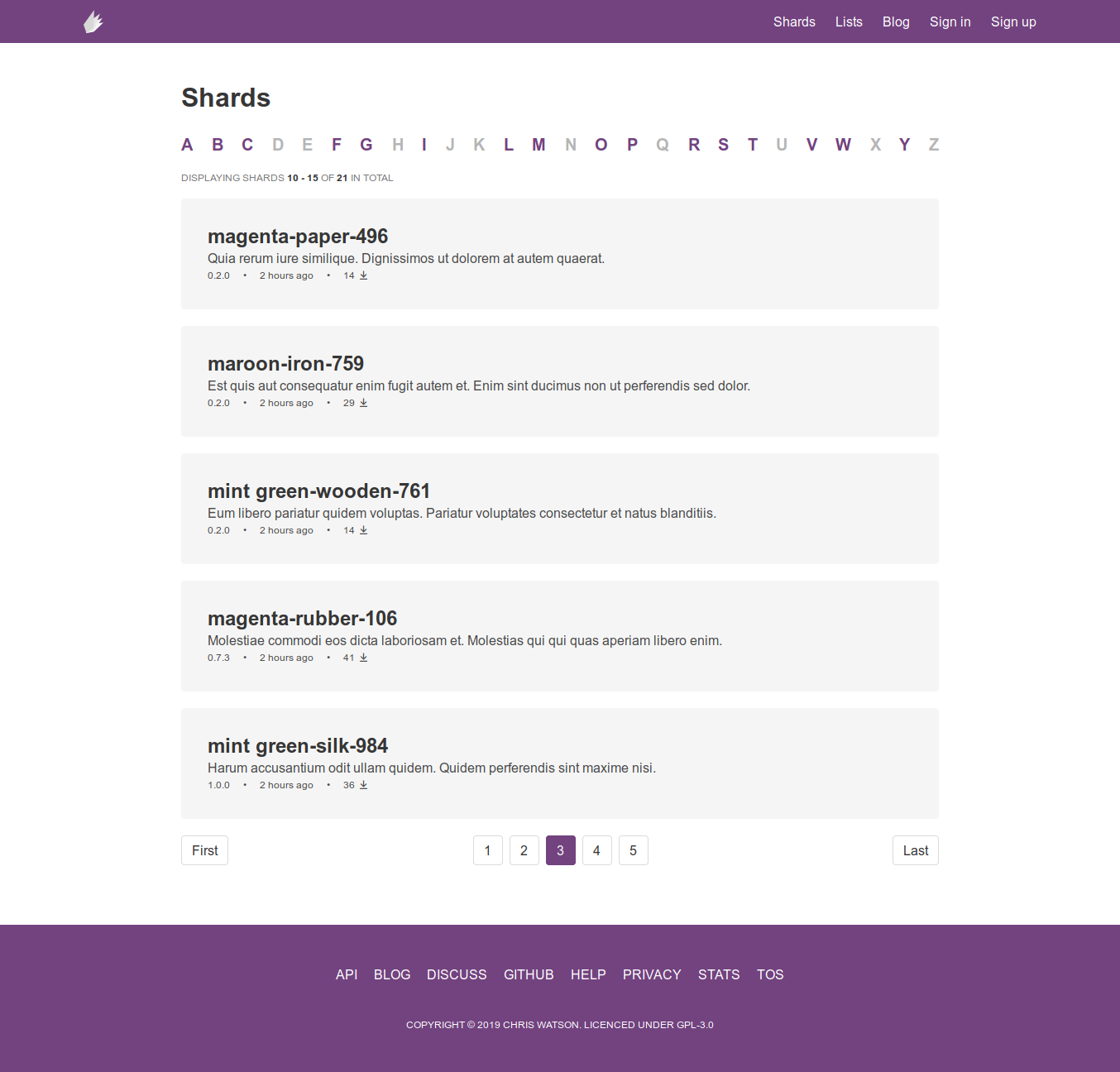
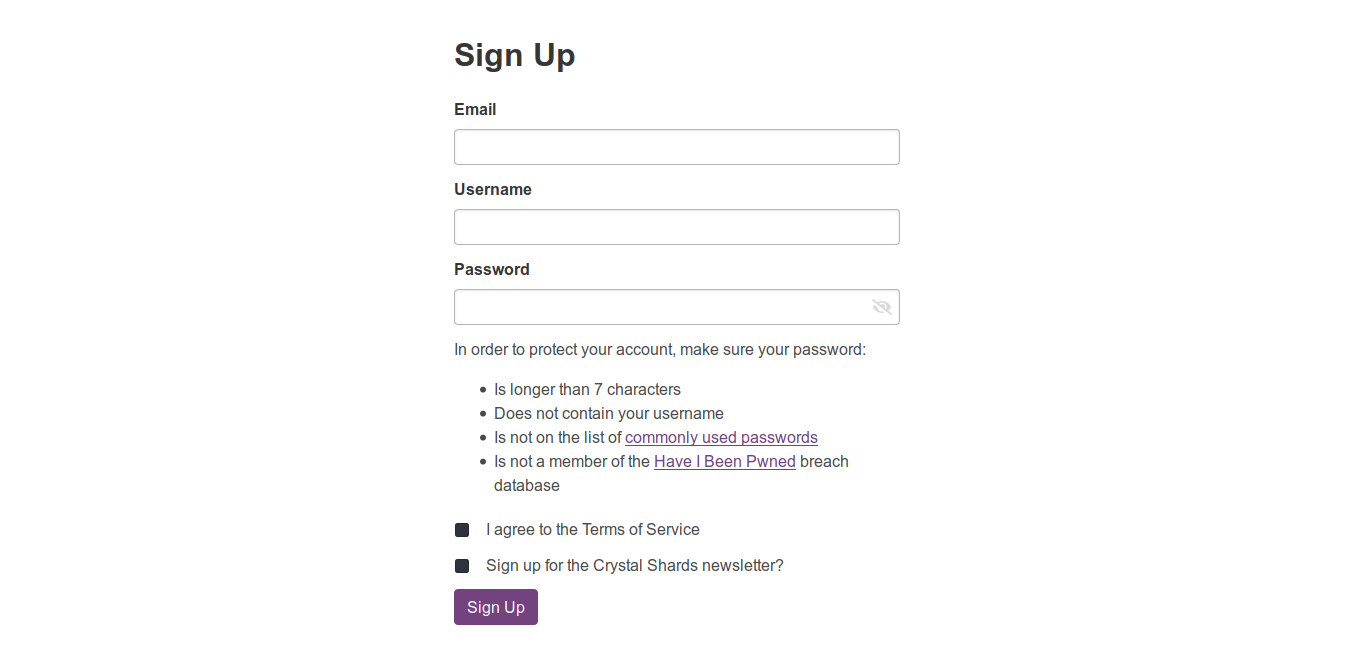

Hopefully I'm not pushing any boundaries or being too presumptuous here. I just love Crystal and want to give back to the community. Thanks!
 watzon
All 42 comments
Hi @watzon, there is also https://crystalshards.xyz/ (which is a fork of https://crystalshards.herokuapp.com/) listed in https://crystal-lang.org/community/ .
I don't think you are pushing any boundaries here.
If you are looking for feedback of the site directory maybe the forum is a better place to initiate that conversation.
Shards intent to be decentralized, so I fail to see what are you thinking an integration could look like.
I hope the site is written in Crystal 😎 .
 bcardiff
on 19 Jun 2019
bcardiff
on 19 Jun 2019
I know about crystslshards, but my goal with this is twofold. I want a centralized registry where we can keep track of shards with individual names, keep track of metrics such as downloads, etc and do it in such a way that it can be easily integrated directly into shards without requiring any real infrastructure changes.
The benefit of this is
- there would be one place to search for shards
- each registered shard is tied directly to a specific release, which means you have to have a realase to publish a shard
Also yes, it's definitely written in Crystal. Using Lucky.
watzon
on 19 Jun 2019
keep track of metrics such as downloads
from people who happen to not have boycotted the project.
What do I see:
- Benefits:
- Popularity contest helps to choose shards.
- Downsides:
- Centralization.
- Need manual steps when publishing.
 oprypin
on 19 Jun 2019
oprypin
on 19 Jun 2019
I just had a thought, perhaps such a system could work without any change to shard.yml files but just by adding telemetry to shards project, but keep using the URL as the unique identifier (which is what it literally is)
oprypin
on 19 Jun 2019
@oprypin I feel like there's a couple more upsides:
- all shards are actually shards, not just any project with a
shard.ymlor however crystalshards is doing it right now. - reduces confusion
- allows for additional metadata (such as platform-specificity)
- could provide other info about a shard by parsing the
shard.yml, such as dependencies
What do you mean by adding telemetry to the shards project?
watzon
on 19 Jun 2019
actually shards
What does that even mean?
allows for additional metadata
You can put any needed metadata into text / yaml files.
reduces confusion
How exactly?
adding telemetry to the shards project
= Whenever shards runs, upload the actions that it took to a statistics server.
This is specifically to keep track of download count, because I think it's the only problem of the ones listed here that can't be solved with the approach taken by https://crystalshards.xyz
oprypin
on 19 Jun 2019
And if you wanted to instead just make a "better crystalshards", that would be very nice.
I do think that almost all of the benefits listed here can be achieved without the downsides of a centralized server that everyone must agree to use.
oprypin
on 19 Jun 2019
What does that even mean?
With crystalshards' fuzzing approach not all the "shards" are actual shards. Other repos get listed just because they give the appearance of being a shard.
I'm not saying that a lot of this stuff can't be done with shards and a completely decentralized approach, but this isn't really an attempt to completely centralize shards either. I'm not advocating that we get rid of github/gitlab integration, but just that another provider be added. One that could provide valuable statistics about shards, and one that could allow for organizations to create private shards (which would use the github api to link to private repos).
Getting private organizations interested could equal sponsorships which would in turn mean more funding for the development of Crystal. But that's long term goals. Obviously Crystal has to hit v1 before most organizations will even consider touching it.
watzon
on 19 Jun 2019
Also tbh it doesn't really necessitate any changes to how shard.yml is structured. It would be pretty easy to have shards check to see if a listed github repo is a registered shard, if it is then fetch it through the registry, otherwise just go to github.
watzon
on 19 Jun 2019
With crystalshards' fuzzing approach not all the "shards" are actual shards. Other repos get listed just because they give the appearance of being a shard.
Well yeah, that may indeed be a problem with it. Just one small problem, though. Could instead just try to mitigate it.
Also tbh it doesn't really necessitate any changes to how
shard.ymlis structured
I suppose it doesn't, yeah. Just that this was presented as the main part of this project.
another provider be added. One that could provide valuable statistics about shards, and one that could allow for organizations to create private shards (which would use the github api to link to private repos).
This can be done without a new provider though
e.g. GitHub provides download statistics already
oprypin
on 19 Jun 2019
If we want a central repository without having to host something we could do what Julia does: https://github.com/JuliaRegistries/General
Basically, have a YAML or JSON file in one github repository with all the registry. The repo seems to also record dependencies of each package. Then shards could inspect this registry... somehow...
Just an idea.
 asterite
on 19 Jun 2019
asterite
on 19 Jun 2019
Rust does something similar: https://github.com/rust-lang/crates.io-index
In comparison to Julia, instead of a couple of files for a package, it has a single file with JSON serialized forms of their Cargo.toml (== shard.yml) for each release.
ex: https://github.com/rust-lang/crates.io-index/blob/master/se/re/serenity
 z64
on 19 Jun 2019
z64
on 19 Jun 2019
I really like this project where is it deployed?
I love the idea of decentralized repositories and feel like npm is a great example of the downsides of centralization.
Here is a good video from a former lead of the project: https://youtu.be/MO8hZlgK5zc
Here is the alternative to npm that was discuses in the video: https://github.com/entropic-dev/entropic
However I think this project would be a great place for searching, evaluated information of shards, and the thing I want most tagging and discoverability.
I would love to see features "more like this" and "plugins here".
I hope this develops further and if you could post a link I would love to check it out.
 wontruefree
on 19 Jun 2019
wontruefree
on 19 Jun 2019
@wontruefree currently it's in a private repo and not hosted yet as I've still got a lot of work to do. I'll take a look at those videos though and maybe that will influence my thinking a bit.
watzon
on 19 Jun 2019
The common ground from this discussion seems to be a centralized search like crystalshards with a package registry that's not reliant on github and shows additional statistics with build status.
Goals:
- Comprehensive single search website with all shards regardless of provider.
- Telemetry - Download statistics.
- Crystal compatibility status.
- Dependency mapping.
- Other features?
This can be accomplished by:
- Keeping shards as is with additional telemetry to track downloads and versions used.
- Providing a website with a registry for additional packages and showing additional data such as build status and crystal compatibility.
- Possibly periodically populating the database with existing crystal shards until ownership is taken or providing a combined local database + github search.
Did I miss anything?
 didactic-drunk
on 19 Jun 2019
didactic-drunk
on 19 Jun 2019
@didactic-drunk seems about right
watzon
on 19 Jun 2019
Private shards are already supported using git: [email protected]/some/private.git for example. No need to setup a private registry or anything: it just works.
I'm strongly against telemetry. It's always totally irrelevant to the actual app, and a privacy issue. I won't add any calls to report downloads to some external website, be it _the_ shards index. Not gonna happen.
I don't think we need a registry.
If decentralised, you must download the whole database locally, which means you must download it all (it can grow big) with the whole history (updating a shallow clone doesn't work well on github) then have to keep it updated...
For private shards, you suddenly need to setup a private registry (not nice) or Shards must now deal with different ways to build its dependency graph (increased complexity).
The benefit, thought, is that Shards could ask the registry for the dependency graph, but then the registry must build it, for everyone, all the time, which can consume lost of server resources, and... what if the registry fails?
That being said, your registry looks nice. Having a central place to search for shards, with published shards by their author (not scrapped), that would display the README, the available versions with their release date, the list of required dependencies, the dependent shards, all tightly coupled with GitHub (so it's updated when a tag is created) and others, would be very nice.
Add a tiny API to search for shards, and one to get infos on a shard, and I'll gladly integrate them as search and info commands.
 ysbaddaden
on 20 Jun 2019
ysbaddaden
on 20 Jun 2019
Note that a registry must only ever contain libraries released by their authors. Having a repository with a shard.yml for an experiment (just for fun) is totally different from publishing a library to be used by others.
ysbaddaden
on 20 Jun 2019
Note that a registry must only ever contain libraries released by their authors. Having a repository with a shard.yml for an experiment (just for fun) is totally different from publishing a library to be used by others.
I agree 100%. That's one of my issues with the crystalshards approach. Don't get me wrong, I love it and use it all the time, but it is full of "shards" that aren't really shards.
watzon
on 20 Jun 2019
But then you might never get the critical mass of repos in your registry
oprypin
on 20 Jun 2019
@oprypin you mean like NPM? Lol
watzon
on 20 Jun 2019
No, "critical mass" doesn't mean "too many", it means "enough" - enough not to languish from the get-go, because who needs a registry that doesn't have any packages that one would be looking for. That becomes a negative feedback loop.
oprypin
on 20 Jun 2019
Talking about this
a registry must only ever contain libraries released by their authors.
Nim language got a central registry early on and even they couldn't afford to be that strict. Instead they allowed anyone to register a package but have a reviewer to check if it makes sense
oprypin
on 20 Jun 2019
Well here's my idea to prevent that. Every shard that is registered must have a release associated with it, that is the only real requirement. That and names must be unique. I'll have a job that runs automatically every so often and scours Github for crystal repositories and then creates a shard record for each unique repo that:
- is not a fork of another repo
- has a
shard.ymlfile - has at least one release associated with it
Then people will have the ability to connect their github account and claim the shards as theirs if they want to. This way I can avoid indexing small projects, but still build up a large collection very quickly.
watzon
on 20 Jun 2019
I personally hope for a registry in which claiming shards would not be typically necessary.
But if there is such a feature, you'd need to support not just github.
An idea for that would be to require the user to add a special string to their repository. Maybe signed with a key by the registry itself or maybe a hash or maybe even just plaintext, because I don't know what's important to hide there
oprypin
on 20 Jun 2019
@oprypin that's not a bad idea. I do want to have it search Gitlab and BitBucket in the future as well, but only Github will be supported initially as that is the one I have an API wrapper for. The nice thing about this approach is that claiming would be optional.
watzon
on 20 Jun 2019
I'd like to add 2 optional pieces that are not requirements but my own personal pet peeves of missing functions.
shard search fooQueries the registry via an API and displays matching shards. (Like gem/other search).- Reverse dependencies list. I have my own code that gets every github crystal project and creates a dependency list that I use to check on the health of crystal projects before using them. Maybe that's useful for other people too.
didactic-drunk
on 20 Jun 2019
@didactic-drunk if you want to share your code for the reverse dependency list I'd love to see it. I do have something like that planned. I also want to implement badges for various things and maybe do some kind of ranking system like they do with https://pub.dev.
watzon
on 20 Jun 2019
With the current set of features "owning" a repository on github may not be necessary. Can the entire site function via data scraping and telemetry? Perhaps user signups are only needed for 3rd party providers. Even then you could probably have a submit URL for inclusion page that starts scraping the repository regardless of who owns it. Delisting or special commands could take place in a special branch with a single file.
@oprypin Authentication for github could use OAUTH. Special branches can contain tokens provided by the website for initial authentication. Authentication may not be necessary if the data is scraped automatically.
@watzon Are there features that require manual configuration not available from scraping?
@ysbaddaden A branch or other file could list the library versions with their compatibility information.
The website and shard search foo should probably list both library versions and general shards that are clearly marked for what they are. I've recently run in to problems with crystalshards not showing shards older than 1 year leading to duplicated effort. The main branch had no contributions for a year and was not shown on crystalshards but the forks were active and still not shown. That's the type of information I would like to see on a website along with a shards healthcheck? command so that someone can take over or easily upgrade their shards to a supported fork.
didactic-drunk
on 20 Jun 2019
@didactic-drunk technically no. There's nothing currently that would require manual configuration.
watzon
on 20 Jun 2019
@watzon The dependency list code is in ruby and was made as a quick and dirty way to get information not available elsewhere. Do you care? It can output JSON/YAML/etc.
didactic-drunk
on 20 Jun 2019
@watzon The dependency list code is in ruby and was made as a quick and dirty way to get information not available elsewhere. Do you care? It can output JSON/YAML/etc.
I just wanted to take a look and get inspiration. I haven't started the code for dependency matching yet so anything helps. Thanks :)
watzon
on 20 Jun 2019
Is http://shards.info a better starting point? It already has forward and reverse dependency tracking.
I've seen crystalshards.xyz but not shards.info before. Am I the only one that didn't know about it until now?
didactic-drunk
on 20 Jun 2019
@didactic-drunk I'd never heard of it either. But I do have 2 trending repos on the front page, so yay me!
watzon
on 20 Jun 2019
@watzon @oprypin Please, don't publish shards for authors that never asked to!
Having a shard.yml and releases doesn't mean it's a library: it could be an app (e.g. shards, prax)!
Of all the repositories I have, I'd only publish a few (e.g. minitest, earl, scrypt, pool): the ones I want to maintain and be used. Others are mere weekend side projects; I don't want to have those listed in an official registry!
Let's have a central place to publish and search for shards. Let it be populated patiently with real libraries that people do care for in the long run, and let's avoid the junk that nobody uses, not even their own authors (including me).
ysbaddaden
on 20 Jun 2019
If you think it's useful to have a registry of an arbitrary subset of libraries (I expect <10% for a very long time), I can't stop you.
oprypin
on 20 Jun 2019
http://shards.info is awesome! It needs to be advertised more (or at all!)
It's exactly what I would want from such a tool and a living proof that centralization is not required to achieve these goals.
oprypin
on 20 Jun 2019
@watzon have you thought about posting this on forum.crystal-lang.org ? I feel like most of the crystal community is watching the crystal-lang/shards repo but there might be some more people watching on the forum.
wontruefree
on 20 Jun 2019
@wontruefree really I only posted it here because I wanted to get the maintainers opinions and see if having this site and shards be integrated in some way would be something they'd be willing to do. I'm not aiming for much attention right now.
watzon
on 20 Jun 2019
@watzon feel free to contact me directly. I'd love a directory, and the few screenshots you posted above are very nice, and feel a lot like what I wanted.
I'm closing for the time being, since I believe your questions are answered :)
ysbaddaden
on 21 Jun 2019
Thanks @ysbaddaden. Once I have it a bit more feature complete and make the repo public I'll consult with you about how to go about integration with shards.
watzon
on 21 Jun 2019
There shouldn't be any integration with shards and a registry. That's centralization. Any registry should be a community project, just a list of "these are maintained shards and here's their repositories" with a nice UI.
Any other features can be obtained through the website without integration with shards.
 RX14
on 22 Jun 2019
RX14
on 22 Jun 2019
Related issues
 vladfaust
·
7Comments
vladfaust
·
7Comments
 mamantoha
·
7Comments
bcardiff
·
8Comments
ysbaddaden
·
7Comments
mamantoha
·
7Comments
bcardiff
·
8Comments
ysbaddaden
·
7Comments
 anatol
·
3Comments
anatol
·
3Comments
Most helpful comment
There shouldn't be any integration with shards and a registry. That's centralization. Any registry should be a community project, just a list of "these are maintained shards and here's their repositories" with a nice UI.
Any other features can be obtained through the website without integration with
shards.